2.2 kg, Dual Motors with 1 kW Total Power, 18,000-Meter Single-Battery Endurance: A First Hands-On with Chengtian Technology's GoGo H Pro hip assist exoskeleton
Have you ever had this experience: you're accompanying your parents on a stroll through the park, and before you've walked very far, your calves start to swell and ache; on a weekend Citywalk, before you're even halfway through the route, your knees start to protest; it's even more obvious on stairs—after just a few steps you have to stop and catch your breath, your legs feeling like they're filled with lead.

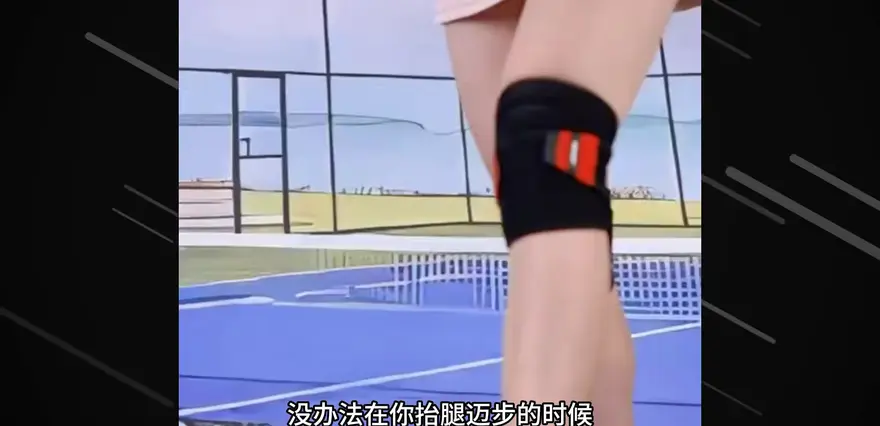
You may have tried wearing knee braces or strapping on a lumbar support belt, but in the end that's only a layer of passive support—no matter how tight you cinch it, it's still just passively absorbing the force, with no way to actively give you a push the moment you lift your leg and take a step.
As it happens, just ahead of the opening of the 2026 WRC World Robotics Conference, I got early access to the new release sent over by Chengtian Technology—the GoGo H Pro hip assist exoskeleton. Positioned around "joyful mobility, professional wellness," it's a smart assistive device purpose-built for daily commuting and light outdoor scenarios.
Can it really strip the fatigue out of walking and lift it off your legs? This hands-on review lays it all out in one go.

From "Passive Braces" to "Active Assist": The Missing "Lending Hand"
A quick bit of background first. When walking, the hip joint is one of the highest-work joints in the lower limb—which is exactly why most consumer-grade exoskeletons today take the form of hip assist: motors are placed on either side of the hips, transmitting force to the thighs through leg struts, and actively delivering a boost the moment you lift your leg or push off the ground.
This is fundamentally different from the logic behind knee or back braces. Braces are "passive support"—they can only bear the brunt when force is already applied, unable to actively do work before a movement begins; an exoskeleton is "active assist"—it has motors, sensors, and algorithms, and it moves in sync with your gait. In the words of the video: traditional braces are rigidly passive and only know how to hold the line, while this one genuinely lends a hand the moment you lift your leg and take a stride.

The GoGo H Pro follows exactly this route: dual-motor drive, algorithm-based scene recognition, lumbar-and-hip load bearing, positioned for "daily commuting + light outdoor" use. Now, onto the main event.
First Impressions: 2.2 kg, the Weight of Four Bottles of Water
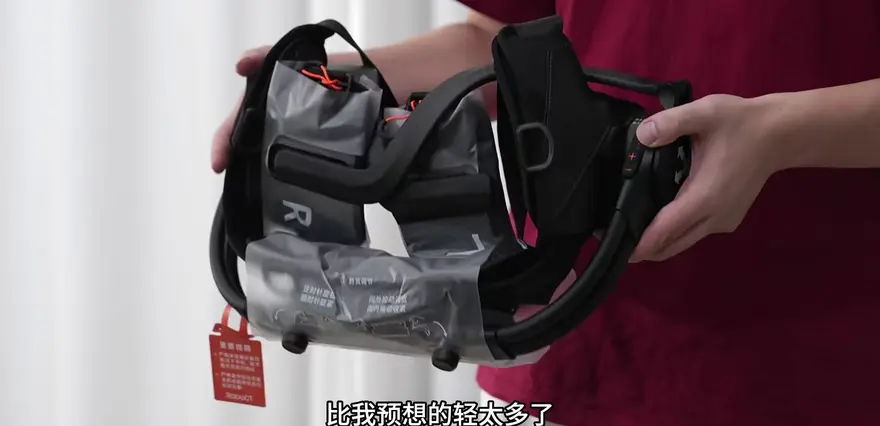
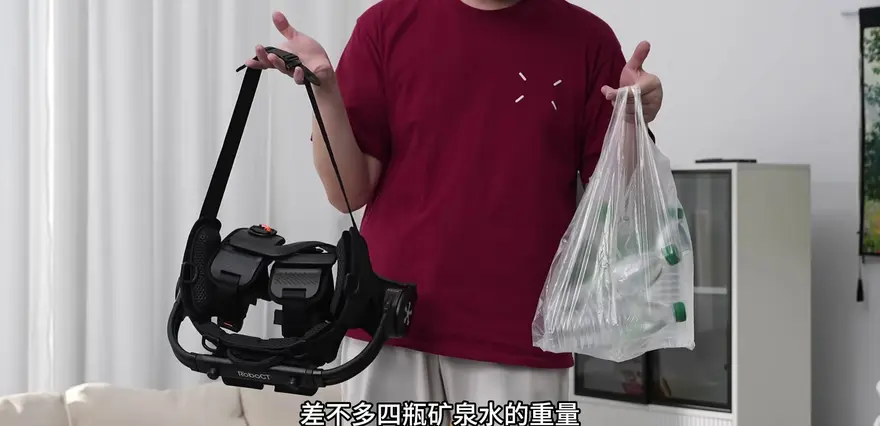
The very first impression in hand: far lighter than expected. Lifting it with one hand to gauge the heft, there's none of that dense, leaden pull you'd normally brace for.
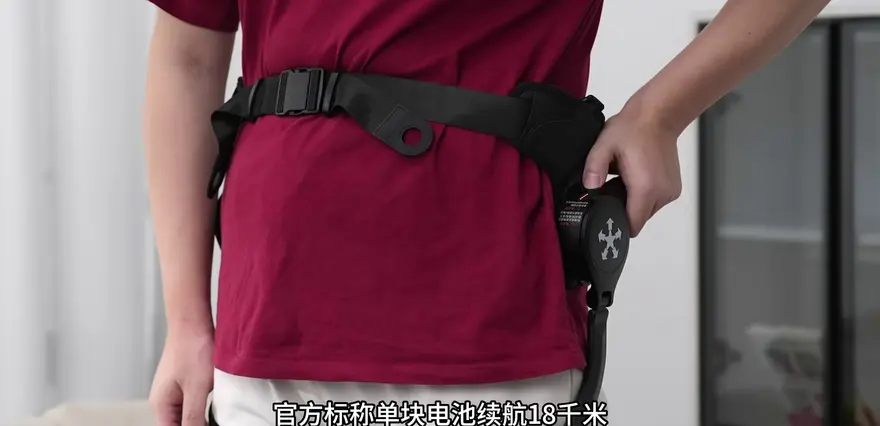
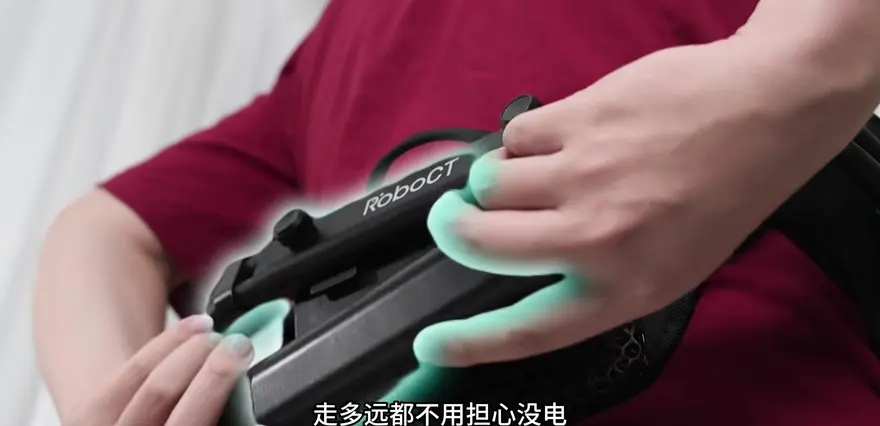
Official spec puts the whole unit at 2.2 kg, roughly the weight of four bottles of mineral water; the body uses aluminum alloy, with carbon fiber at the joints (as mentioned in the video).

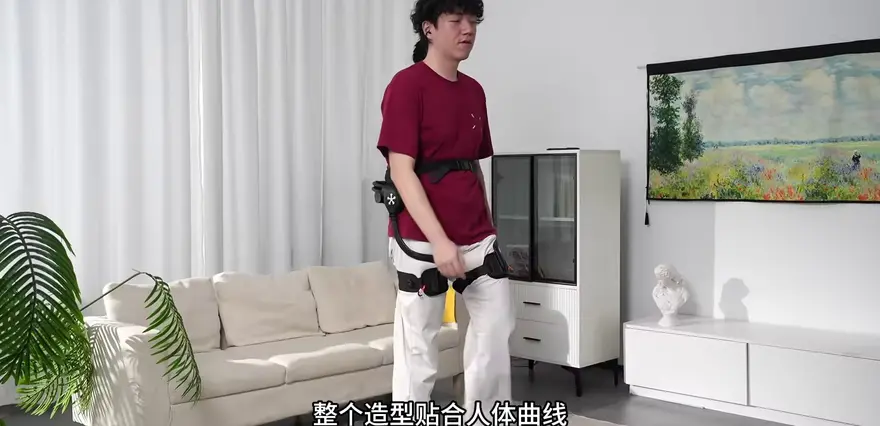
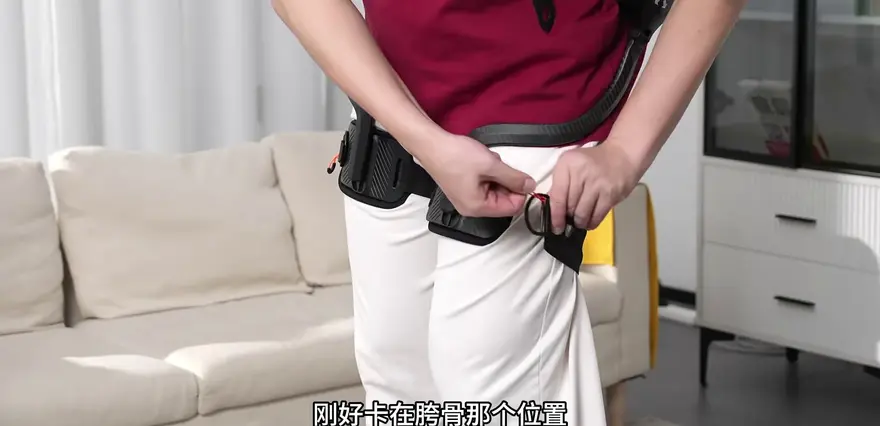
In terms of design, the GoGo H Pro pairs an S-shaped ergonomic leg frame with a bionic lumbar support, contouring naturally to the human body. The build quality feels solid to the touch, with no cheap-plastic vibe. Resting it against the waist, it locks right at the hip bone without any uncomfortable pressure; once worn, even extended use doesn't produce that dragging, weighted-down sensation.


One extra note here: for a consumer-grade exoskeleton, "light" is never just a number on the scale. The same 2.2 kg distributed entirely across the shoulders would feel completely different; the waist and hip, by contrast, happen to be the load-bearing zone humans are most accustomed to when wearing a backpack. Anchoring both the weight and the assist at the hip is the prerequisite for this category to achieve a "barely-there" wearing experience. At least on the static-wearing test, the GoGo H Pro's fit passes the bar.
Onboarding Threshold: Wear Detection + Boot Memory, Giving "Parameter Tuning" Back to the Machine
I originally thought putting on an exoskeleton would be a complicated affair — tuning a pile of parameters, fiddling back and forth for ages. In practice, it was far more effortless than expected: no complex manual adjustment steps at all.
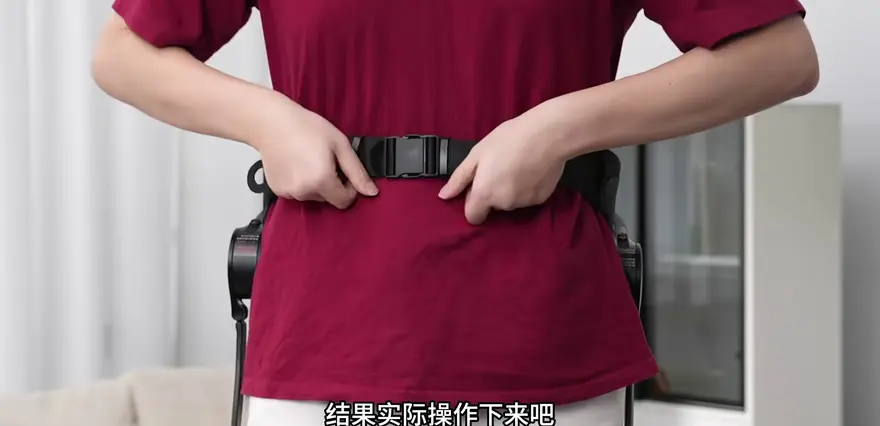
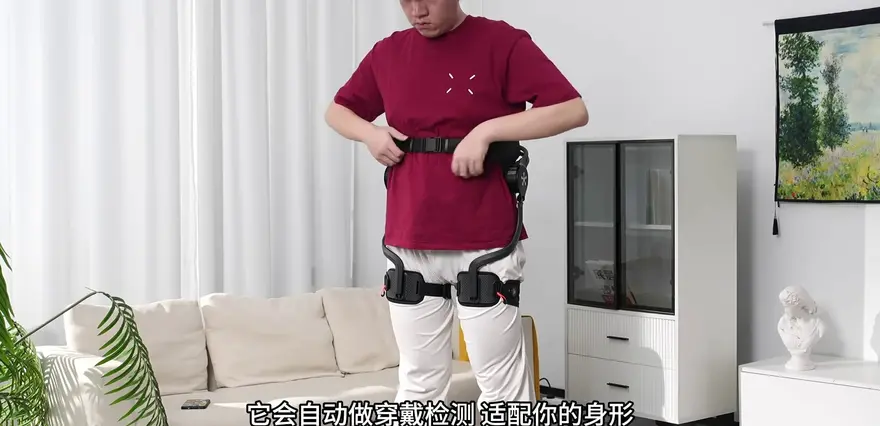
Once you put it on and power it on, it automatically performs wear detection and adapts to your body shape; there's also a boot memory function — the state you dialed in last time is ready to go on the next power-up, so you don't have to tweak parameters one by one yourself (mentioned in the video).
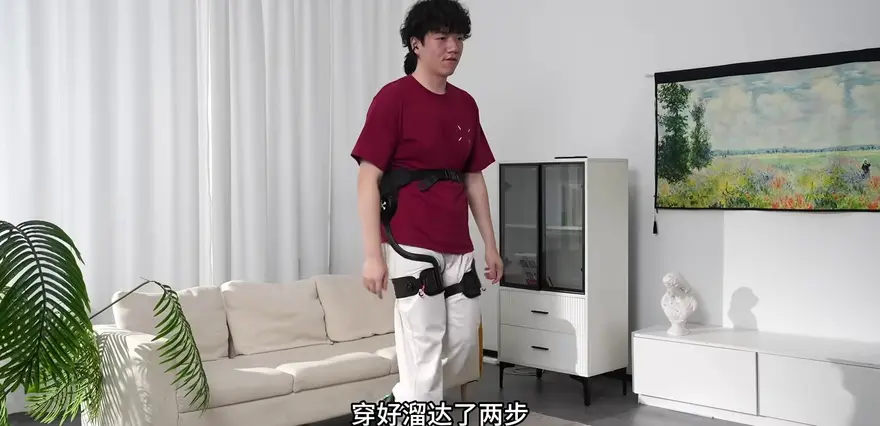
After suiting up and strolling a few steps, it genuinely kept pace with my feet. This may sound like a small thing, but it's actually the hidden threshold of any consumer-grade product: geeks are willing to spend an afternoon tuning a device, but ordinary users and older relatives won't. Handing parameters over to sensors and algorithms is the step an exoskeleton must take to move from "geek toy" to "mass-market product."
Flat Walking: Gait Algorithm "Speeds Up When You Do," No Dragging Sensation
Flat ground is the most common daily scenario, and it's where the algorithm's competence shows up first.
The GoGo H Pro features a professional motion algorithm that automatically recognizes scenarios like flat walking, turning, climbing slopes, and descending stairs—no manual mode switching required. The assist follows naturally: it speeds up when you do, slows down when you do, and turns smoothly, with none of that awkward "being dragged along" feeling.
"It speeds up when you do, slows down when you do." (mentioned in the video)

After a few laps, you can clearly feel the burden on your legs lighten—every step feels like a little assistant gently lifting you from behind.
Worth noting: this "seamless follow" is a plus for younger users, but nearly a necessity for seniors—they can't and shouldn't have to manually switch modes. Behind scene recognition is typically a combination of motion sensors like IMU and gait algorithms (the video didn't detail the specific sensor configuration), and whether recognition is accurate and transitions are smooth directly determines whether this exoskeleton "helps" or "gets in the way." From these few flat-ground laps, it handled all common scenarios with ease.
Climbing Slopes and Descending Stairs: The "Lending a Hand" Philosophy of the Dual-Motor 1kW Setup
Walking on flat ground alone isn't convincing enough, so I deliberately sought out ramps and stairs to put its real capability to the test.
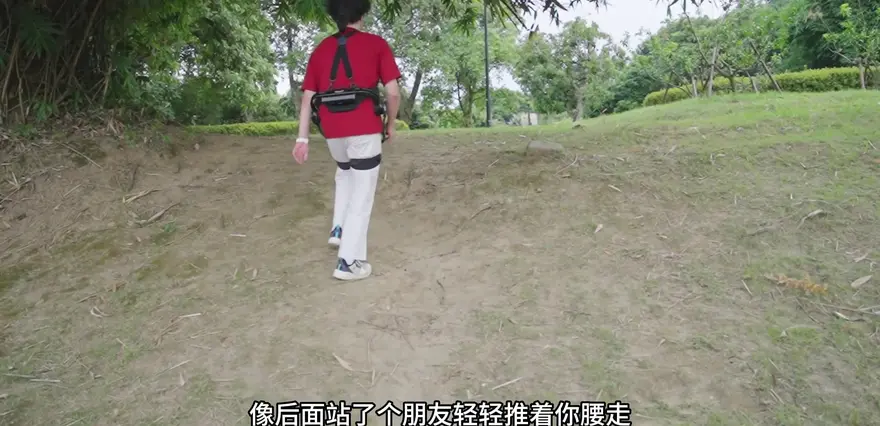
First, uphill. Normally when walking this kind of slope, my calves tighten up halfway up and I have to push hard to make it. The GoGo H Pro uses a dual-motor design:
Total power 1 kilowatt, officially tuned specifically for daily commuting and light outdoor scenarios (mentioned in the video).
I expected the assistive force to be aggressive, but once I put it on, the power felt just right: the moment I lifted my leg, there was an upward pull, like a friend standing behind you, gently pushing your lower back as you walk — it's not a yanking sensation at all, just the right amount of "lending a hand." After completing the full slope, my calves barely felt sore. The assistive feel is genuinely solid.
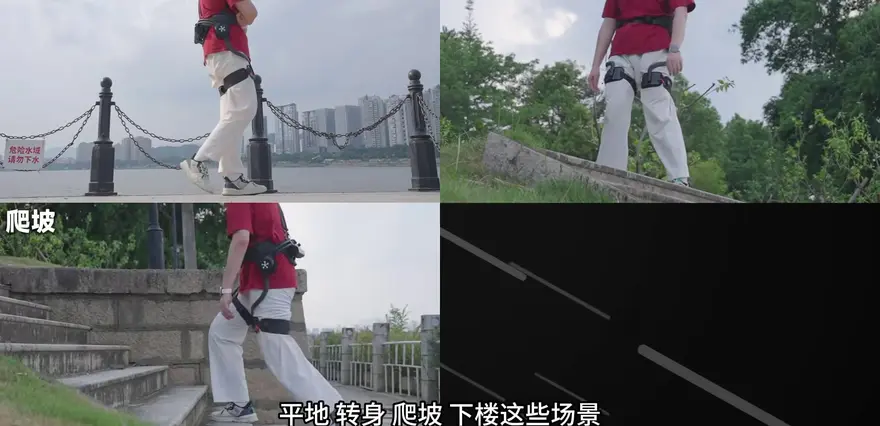
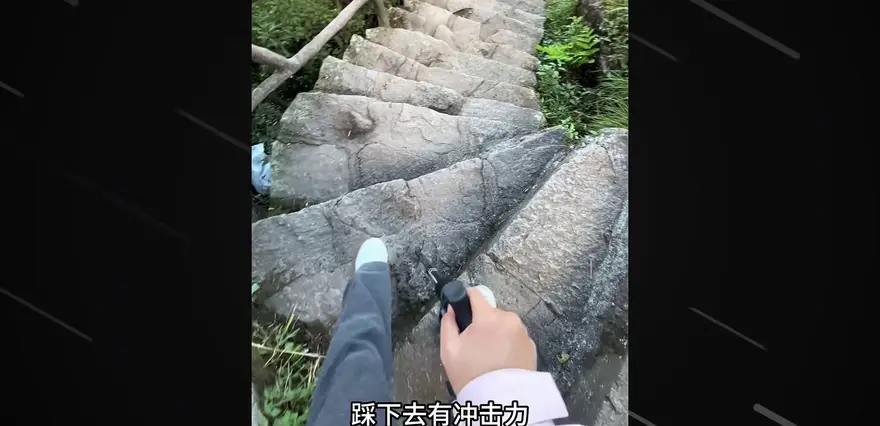
Next, descending stairs. The result was notably better than expected. Normally when going downstairs, my knees always feel tight, each step lands with impact, and they ache after a while. It handles automatic controlled descent with cushioning: the moment your foot lands, it absorbs the force instead of slamming hard onto the step, almost like stepping on a soft pad — far kinder to the knees.
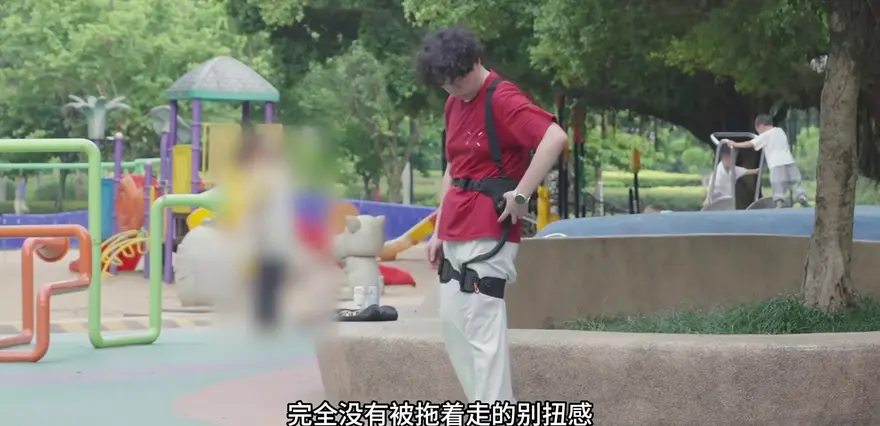
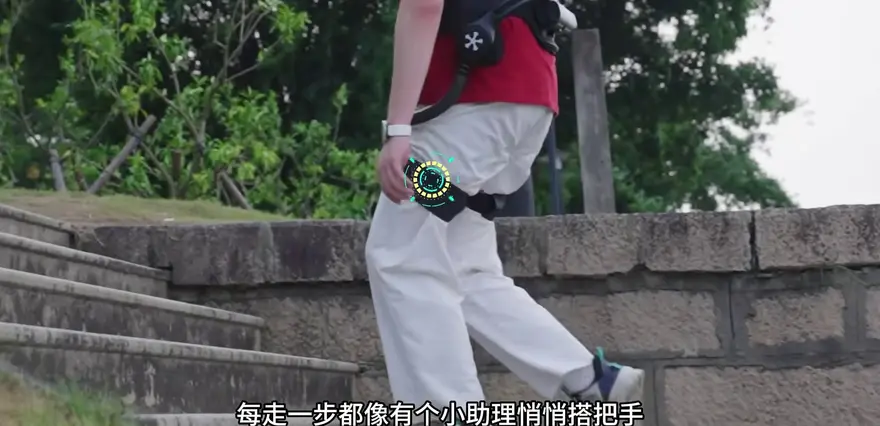
A few observations here. A total power of 1 kilowatt sounds intimidating, but what impressed me most in this hands-on experience was precisely the phrase "the power feels just right" — the key to the assistive feel lies in being "present but unobtrusive." Beyond peak specs, the tuning of the assistive curve is what truly separates the best from the rest. Additionally, the controlled-descent cushioning when descending stairs essentially "dissipates" the impact rather than bracing against it; for older adults whose knees have already begun to deteriorate, this may be more valuable than the uphill assist.
One caveat to keep in mind: the video did not clarify whether the 1 kilowatt refers to peak or sustained power, nor did it provide joint torque data. Where the ceiling of the assistive upper limit actually lies remains to be seen in more extreme testing.
Battery Life & Protection: 18,000m per Battery, Hot-Swap, IP54
Assist is its core, but for daily use, battery life and protection have to be reliable.
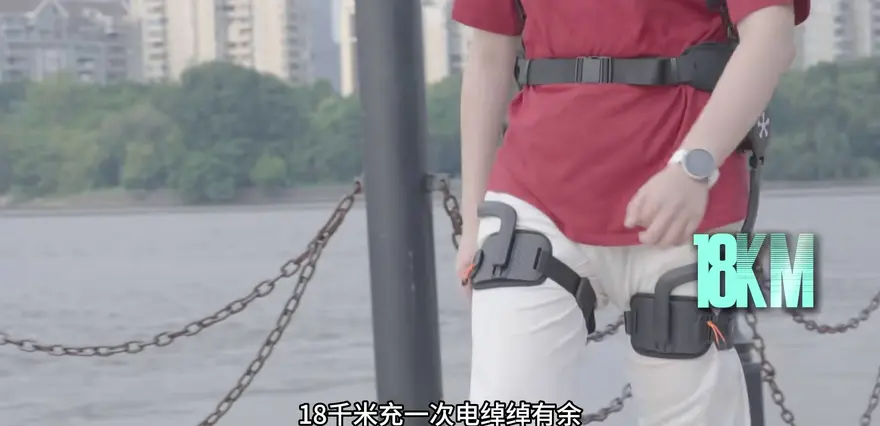
Official spec: 18,000m runtime per battery; supports seamless hot-swap—just pop it out and snap in a new one; IP54 rating (all figures mentioned in the video).
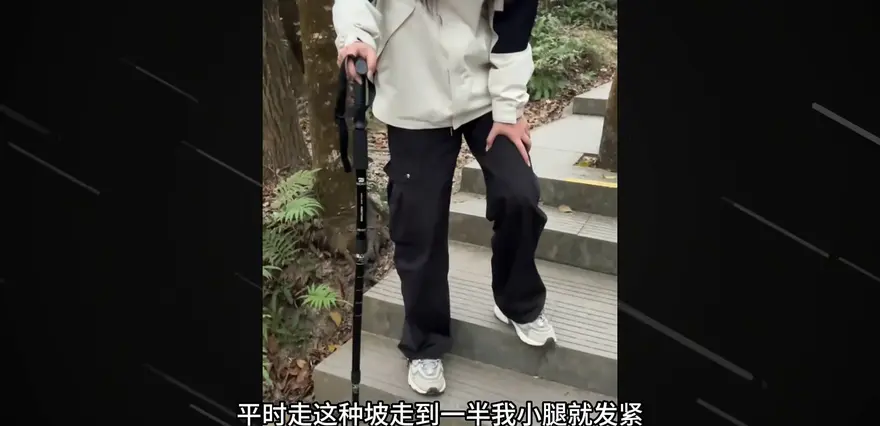
Let's do the math: a day out shopping, or a round-trip walk with elders through the park—one charge of 18,000m is more than enough. For long-distance trekking, just bring a spare battery—the seamless hot-swap means you never worry about running out of power, however far you go.

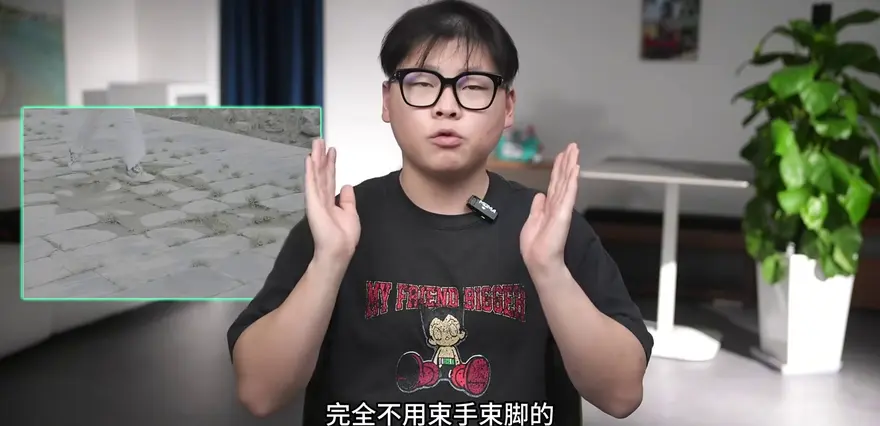
On protection, IP54 means freshly watered sidewalks, a bit of mud and dust—just use it as-is, no need to tiptoe around.

Two takeaways: first, the hot-swap approach is smarter than just piling on battery capacity—an exoskeleton has a strict weight budget, and swappable batteries turn "range anxiety" into a simple "should I bring a second battery?" choice. Second, IP54 is a typical everyday protection level—splashes, light rain, and floating dust are no problem; heavy downpours and wading through water, forget it. One caveat: 18,000m is the official spec; actual endurance depends on body weight, assist intensity, and terrain, and will need to be verified through long-term use.
Who It's For: A Full Day for the Young, Stairs for the Older Generation
The biggest takeaway after testing: this is genuinely an exoskeleton that fits the whole family.
For younger users — the ones who love Citywalks, wandering around, short hikes, and end up with sore legs after walking a while: wear it out for a full day of strolling, and your legs won't feel miserable when you get home — roughly the equivalent of two extra hours of walking per day.
For older family members — parents who are getting on in years, struggle with stairs, and start to wobble after just a few steps outside: it can genuinely help, the kind of "tech gift that actually gets used once you give it."

One more thought from me: "filial piety gift" may well be one of the most realistic landing spots for the consumer-grade exoskeleton. Massage devices address the feeling of soreness; an exoskeleton addresses the action of not being able to walk — the latter's sense of "usefulness" is far more direct. But boundaries should be drawn clearly: the GoGo H Pro is a consumer-grade assistive device, not a rehabilitation exoskeleton; the latter is typically a medical-grade product aimed at rehab training scenarios, and the two are not interchangeable. If family members have specific knee or hip conditions, consult a doctor first before deciding.
Opinion: From Rehabilitation Exoskeleton to Consumer-Grade, Chengtian Switched Tracks Entirely
Let's talk a bit of industry observation. Chengtian Tech has previously been more closely associated with rehabilitation exoskeletons (medical-grade), while the GoGo H Pro is clearly built on consumer-grade logic: medical-grade products pursue precision, safety, and controllability in institutional settings; consumer-grade products pursue light weight, imperceptibility, good looks, battery life, and price — it's almost like remaking the product from scratch.
Set against the wider industry, the consumer-grade exoskeleton track is heating up: brands like Kenqing, Aoshark, Hypershell, and Dnsys have taken their positions in succession, while major outdoor and appliance players such as Toread and Haier are also probing the space. Early products mostly cut in from hardcore outdoor scenarios like hiking and trekking assist, whereas the GoGo H Pro opts for "daily commuting + light outdoor + whole-family fit" — a higher-frequency, lower-barrier, and far harder-to-execute approach. The demands that high-frequency scenarios place on weight, comfort, and algorithmic robustness are actually far more stringent than what you'd need for climbing a mountain once a week.
The competition in consumer-grade exoskeletons is shifting from "whether there's assist" to "whether the assist feels like it isn't there."
Of course, there are also things left unclarified in this coverage — before placing an order, we recommend confirming with the official channels: the price has not been announced; the 1 kW power spec (peak/sustained) and joint torque data are not provided; long-term use issues such as noise performance, the stuffiness of wearing it in summer, the size-fitting range, and fall protection are also untouched. These are precisely the keys to whether a consumer-grade product can be used "daily," and we hope subsequent, more hardcore real-world testing will fill in the gaps.

Channels to Experience & Learn More: See You at WRC 2026
August 19–23, Beijing · 2026 World Robot Conference (WRC), Chengtian Tech booth — come and try out the product in person (as mentioned in the video).

For those who can't make it to the venue, you can learn more about the product via the pinned link in the comments section. If you're also fed up with "walking feeling exhausting," why not head to the site and strap on this "extra helping hand" for your legs and give it a try — when it comes to exoskeletons, your hips ultimately have the final say.

Top Community Comments
@LeiYaFist (2 likes): A more professional exoskeleton, safeguarding the whole family's healthy travel.
Interpretation: The creator supplemented the comments section with two redirect links (likely product detail / official related pages) and re-emphasized "safeguarding the whole family's healthy travel" — it's clear the author themselves anchors this product's core selling point to the "family" audience rather than the "geek" crowd, corroborating the video's conclusion that it "fits the whole family."
@LeiYaFist (1 like): @ChengtianTech @ChengtianAssistiveExoskeleton
Interpretation: The creator directly @-mentioned the brand's official accounts, on one hand pointing interested viewers toward further information, and on the other indicating this is clearly a sponsored collaboration with the brand — when watching, it's advisable to maintain a "sponsored content" critical lens and focus more on the real-world test details (weight feel, assistive feedback, descending-stairs cushioning) rather than the marketing pitch.
@ZhangTemmo (1 like): Kind of want to buy one to try — is there an official account?
Interpretation: A typical high-intent-user comment, revealing two signals: first, the "lightweight + assistive feel" experience description genuinely resonates with ordinary consumers, showing that demand for consumer-grade exoskeletons is real; second, awareness of official channels remains very low — users want to buy but can't find the entry point, which is both a channel shortcoming for the brand and a sign that this category is still in the early stage of market education.
One-Sentence Summary
Chengtian Tech's GoGo H Pro is a 2.2 kg-class hip assist exoskeleton that brings "active assist" into everyday life: the chassis is light enough, the algorithms are smart enough, and battery life and protection are daily-ready—it may not help you conquer snow-capped mountains, but it's enough to extend your Citywalk by two more hours and ease your parents' knee complaints on the stairs, making it the ideal "first exoskeleton" for the whole family.
About this article: part of Chinese-Made Exoskeleton Review Archive — an independent, regularly updated English archive of reviews of consumer exoskeletons made in China, edited from publicly available video transcripts. Not an official manufacturer page.
For inquiries and purchasing, contact lonlonago@foxmail.com. More in Reviews · All articles.