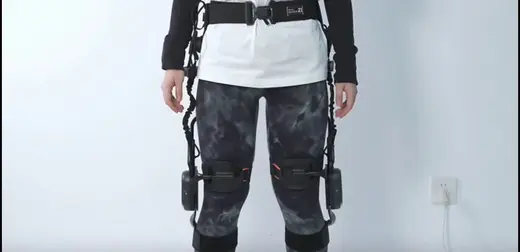
Dnsys Z1 Pro “Island Collaboration Edition” Hands-on Test: A Consumer-Grade Exoskeleton That Treats the Knee as Its “Second Engine”—Does It Really Deliver?
01 Product Positioning and First Look: A Futuristic Vibe, But It's the "Knee Joint"'s Main Stage



This is the "Dnsys Z1 Pro Kojima Collaboration Edition" knee exoskeleton. While it is a consumer-grade exoskeleton, it is fundamentally a wearable robotics device focused on knee assist. By leveraging joint torque and support strategies, it delivers significant assistance during scenarios such as sitting to standing, climbing and descending stairs, navigating ramps, and walking downhill.
- The exterior design truly lets you "stand in the present, experience the future": it features a compact structure, easy wearability, and a strong techwear aesthetic.
- The modes offer at least a "Sprint Mode" and other settings, demonstrating differentiated tuning of torque and assist output tailored to various gait and scenarios.
- Essentially, it functions more like a "knee joint booster." Unlike the full-leg assist approach of traditional lower-limb exoskeletons, this represents a lightweight, scenario-driven consumer-grade route.

02 From Sitting to Standing: This Product's Most Standout Core Selling Point




During the demo, the mode was switched to "Sprint Mode." With both knees relaxed and hanging down, the device instantly delivers noticeable assistive torque, helping the user "spring up" from the chair.
- In hands-on testing, this knee exoskeleton truly shines in the "rising" phase: it directly propels the user from seated to standing, with the effort saved feeling immediately intuitive.
- Based on structural analysis, it achieves short bursts of high-power boost through knee motion capture and rapid joint torque output — a positioning that aligns with assistive exoskeletons built around the freedom to stand up independently.
- For older users and anyone with mild to moderate knee discomfort, this feature delivers an almost instant improvement in experience.

03 Daily Walking: Subtle Assist, but "Reliable Knee Support"



To be honest, normal walking is not its main selling point. At this stage, the walking assist output for daily walking is only about 5%-6%, and the highest perceived assist approached 10% (as mentioned in the video).
- When walking on flat ground, the assist is not particularly aggressive, resembling more the stability of "gently supporting the knee"; the sense of support is more obvious at the moment of straightening the knee.
- The benefit of this strategy is its safety and lack of abrupt pulling; the drawback is that for healthy adults, the "effort-saving thrill" of walking on flat ground is not very strong.
- The product's true value lies in "critical moments": standing up, climbing stairs, slopes, and descending—rather than a slow stroll.

04 App and Data Visualization: You Must Understand It to Tune It Right


You can check the current output ratio and running status via the App (mentioned in the video) to intuitively understand the assist strength.
- The App's primary function is not just a flashy demonstration but making assist curves and mode selection transparent: users can see exactly when the equipment provides a stronger assist intervention.
- This helps different users quickly find their own "comfort zone": for example, elderly users prefer stability and smooth, consistent support, while younger users pursue a more powerful standing assist in "Sprint Mode."
- For future iterations, incorporating finer gait recognition (such as trigger thresholds for climbing up and down stairs, and suppression control when descending) could further elevate the experience.

05 Clear Ascent, Slower Descent: Channeling All Joint Torque into the "Rise" Phase




Kinetic amplification is distinctly noticeable when ascending stairs (as noted in the video): the device applies robust force to support the knee during the foot lifting phase, giving your walking assist a powerful push.
- The stair-climbing experience is highly intuitive; you can instantly feel the sensation of "someone firmly supporting the back of your knee and boosting you upward," resulting in a pronounced amplification of the assistive exoskeleton's powered output.
- Conversely, the descent assist engages less instantly and exhibits a noticeable latency. This factor is worth flagging for users sensitive to downward movements.
- For users experiencing knee vulnerability, it is advisable to perceive the descent mode as a "stabilizing support" rather than an "active forward propulsion": allow the device to ensure your self-balancing and stability, rather than anticipating the forceful drive it provides during an ascent.

06 Gentle Slope Test: The Steeper the Slope, the More Pronounced the Support



In the gentle slope test, the device actively supports the knee more as the incline increases; the enhanced support is clearly felt when climbing uphill (as mentioned in the video).
- This scenario closely mirrors real-world outdoor conditions: mountain trails, park ramps, ancient town cobblestone paths... The shear force on the knees is significantly higher than on flat ground.
- The Z1 Pro's strategy is to "support the knee," rather than directly pushing you upward. By synchronizing with the gait phase, it amplifies support exactly when you need it.
- For mixed-terrain activities like hiking and mountain climbing, it significantly reduces the risk of "knees suddenly buckling."

07 Preventing 'Soft Legs' on Descents: The Real Safety Value



When descending, the device first supports the knee, providing a 'lifting sensation' to help you descend more steadily (as mentioned in the video).
- Many people experience so-called 'leg weakness' or uncontrolled acceleration when descending, which is essentially due to excessive burden on the anterior quadriceps' eccentric control, causing the knee to 'fail to support' during repeated braking.
- The value of the Z1 Pro at this stage is not to 'help you run down' but to 'help you walk steadily'—which precisely addresses the need for fall protection.
- If there is a delay, short high-risk moments (e.g., when the toe just touches the ground or body weight shifts) particularly require algorithms and sensors to enhance response speed.

08 Overall Verdict & Buying Advice: Who Is It Ideal For?



This is a consumer-grade exoskeleton that feels more like a “knee booster”: it delivers immediate value when moving from sitting to standing, climbing stairs, walking up slopes or ramps, and preventing “soft legs” on the way down; on slow walks over flat ground, the output is relatively restrained (mentioned in the video).
- Best for:
- Helping elderly parents with standing up and going up/down stairs in everyday life;
- Users recovering from a knee injury or post-surgery who are not yet ready for a medical-grade rehabilitation exoskeleton;
- People who enjoy hiking, climbing, or light trail use but occasionally feel their legs go weak on descents.
- Things to note:
- Current assistance when going downstairs has latency;
- The “effort-saving” feeling on flat-ground walking is not exaggerated—align your expectations;
- It cannot replace a medical-grade rehabilitation exoskeleton, nor should it be treated as an all-purpose knee protector.
Top Community Comments
What elderly people need most is the moment of standing up—this product seems to hit that pain point exactly.
Interpretation: What users care about is not “walking faster,” but dependability in the split second of starting.
The walking assist on flat ground is average, but going upstairs and downstairs is a real game changer.
Interpretation: Scenario-specific value outweighs universal applicability—this is the core strategy for consumer-grade exoskeletons.
It feels like there’s lag when going downstairs; for people with bad knees, would that make it feel less secure?
Interpretation: Safety concerns concentrate in the “downward” phase; algorithm response and sensor latency are key.
I’d like to see a comparison with similar knee-assist/leg exoskeletons from Aoshell, TOREAD, Haier, and others.
Interpretation: Market perception is still fragmented; side-by-side comparisons can quickly establish a reference frame.
If it could add a safety harness for fall protection or an interconnected airbag, it would feel more reliable.
Interpretation: Users treat “walking assist” and “fall protection” as an integrated safety package.
What’s the weight and battery life/runtime? The video didn’t give the numbers—a bit opaque.
Interpretation: Consumer-grade users are sensitive to hard specs; parameter disclosure should be more transparent.
It feels more like a civilian version of a rehabilitation exoskeleton—the positioning is quite clear.
Interpretation: Users are already distinguishing medical-grade rehabilitation exoskeletons from consumer-grade ones, making purchasing expectations more rational.
One-Sentence Summary
The Dnsys Z1 Pro Kodama Collaboration Edition is a consumer-grade exoskeleton focused on knee-centric scenarios: it shines in activities like standing up, climbing stairs, and descending, while flat-ground walking offers more in the way of steady support. It is ideal for users seeking enhanced everyday safety and outdoor stability, but don't mistake it for a "cure-all knee".
About this article: part of Chinese-Made Exoskeleton Review Archive — an independent, regularly updated English archive of reviews of consumer exoskeletons made in China, edited from publicly available video transcripts. Not an official manufacturer page.
For inquiries and purchasing, contact lonlonago@foxmail.com. More in Reviews · All articles.