Climbing Three Mountains in Suzhou With an Exoskeleton: Yuanye Tech Powernee Knee Exoskeleton Field Test — About 40% Effort Reduction on Real Mountain Trails, and the Ticket Price Still RMB 1
Unbox and Gear Up: Maybe You Can Too—Wearing a consumer-grade exoskeleton into the Suzhou mountains
This season is the perfect time to explore the hills and waterscapes of Suzhou. Forget the guidebooks on how to tackle the popular hiking routes at Lingyan, Qionglong, and Wangshan Mountains—I just strapped on an exoskeleton and headed out.
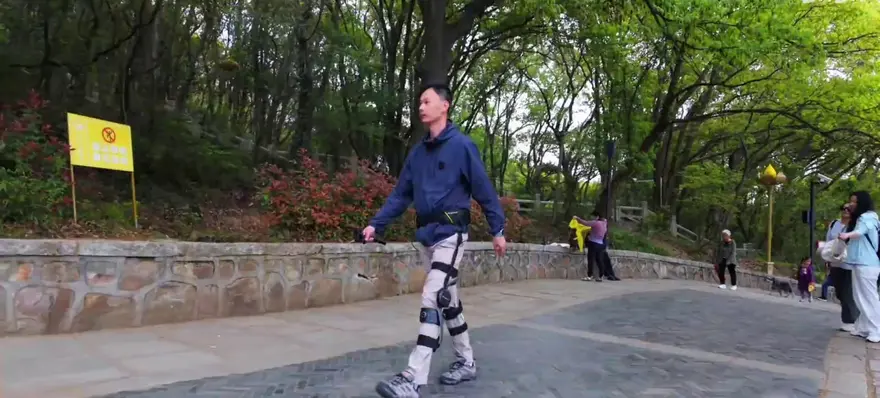
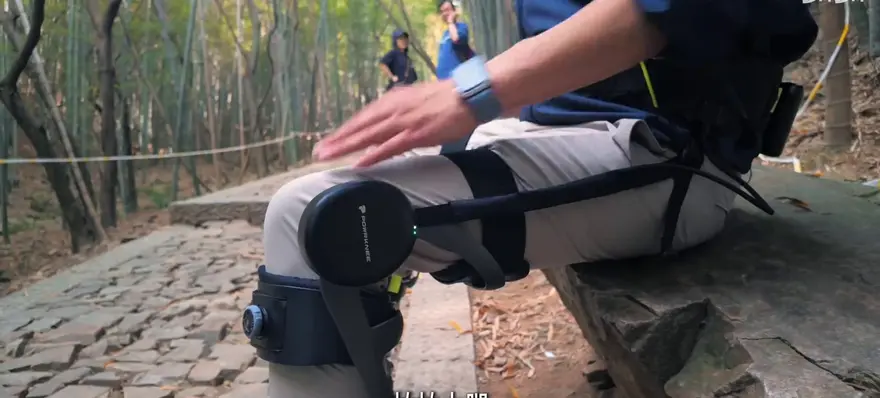
Today, I'm wearing the Powernee knee joint exoskeleton from Yuanye Tech (upon hearing it in the video, it phonetically sounds like "Powernee knee joint exoskeleton"). Its official positioning is an outdoor hiking gear designed to protect the knees. It isn't a medical rehabilitation exoskeleton. Rather, it's a more consumer-oriented assistive exoskeleton. The philosophy is straightforward—it doesn't walk for you, but gives your knees a boost exactly when needed—during leg lifts, downhill descents, and standing up from a seated position.
We've set our route to a Trifecta of Three Peaks in Suzhou: a warm up at Lingyan Mountain, followed by an intensity boost at Qionglong Mountain, and finishing off with a green-stroll at Wangshan. Before we depart, it's a quick check-in. The goal isn't flexing tech, but answering three key questions: How much effort does it save going uphill? Does it truly protect the knees on the descent? Will the battery capacity hold out for a full day?
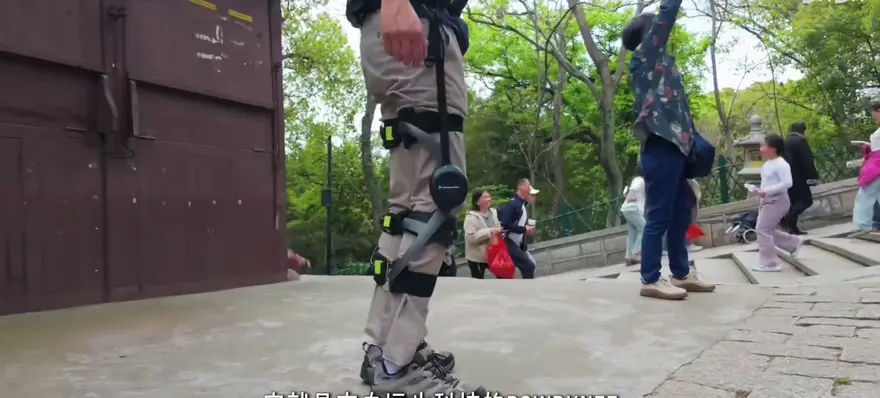
Lingyan Mountain Warm-Up: The Push You Feel When Lifting Your Leg
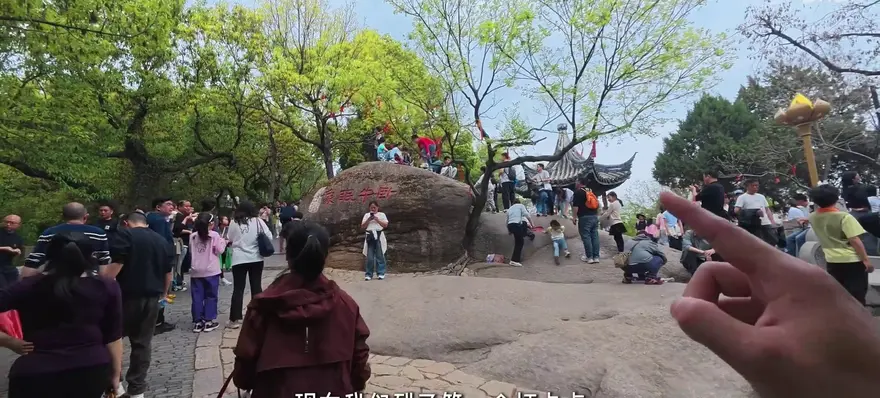
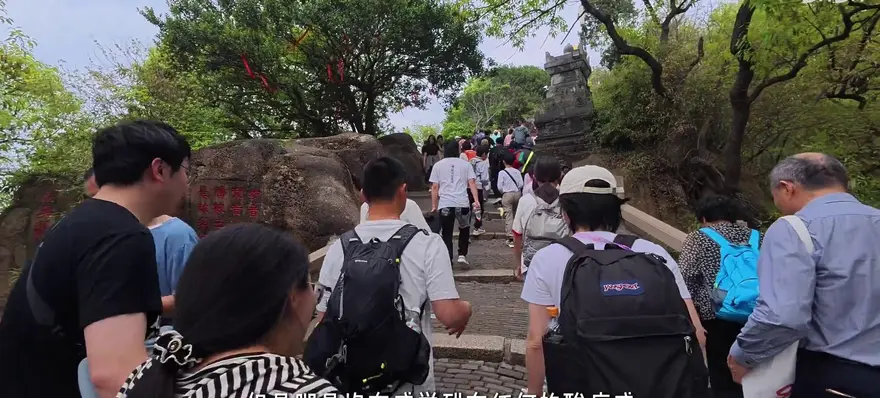
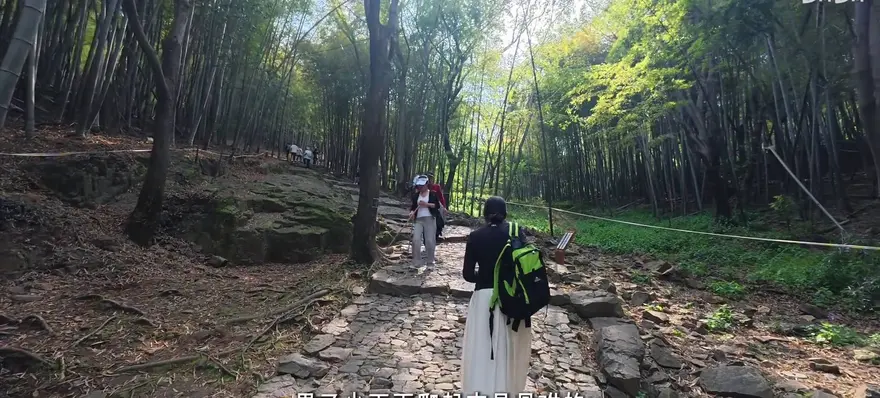
The upward trail on Lingyan Mountain is noticeably wider now, making the walk much more comfortable than before; the abundance of greenery also gives the "exoskeleton mountain climbing" experience less of a hardcore testing vibe and more of an outing feel.
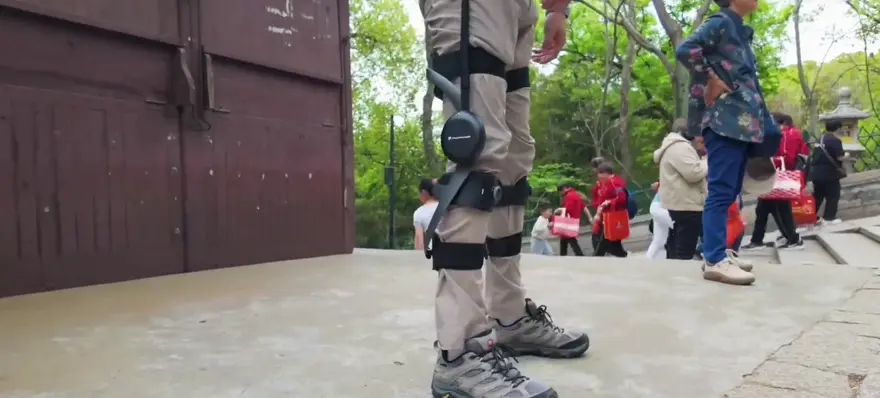
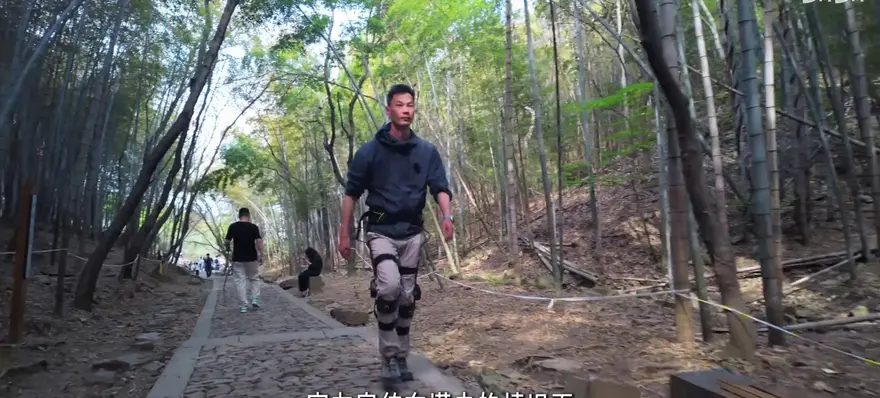
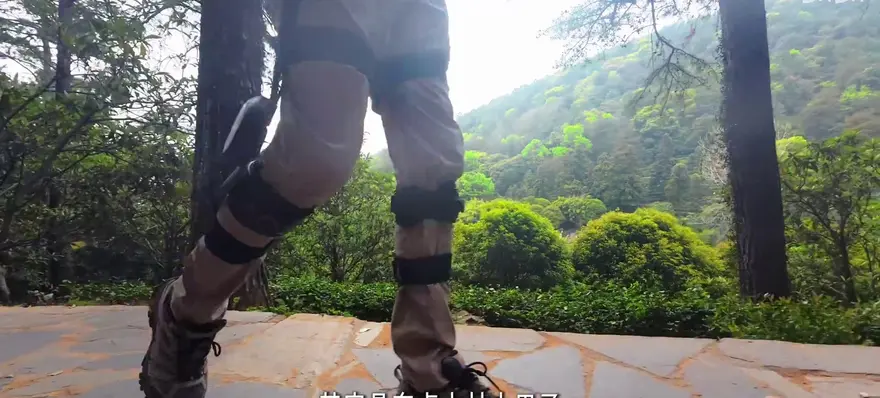
Right after starting up the slope, the assistive feel becomes very concrete: as you lift your leg to take a step and your body moves upward, the knee joint mechanism supplies an active push in the same direction as your movement.
"It gives you an active push when you lift your leg and your body is moving upward, just like someone is behind you pushing you forward." (Mentioned in the video, paraphrased from the original statement)
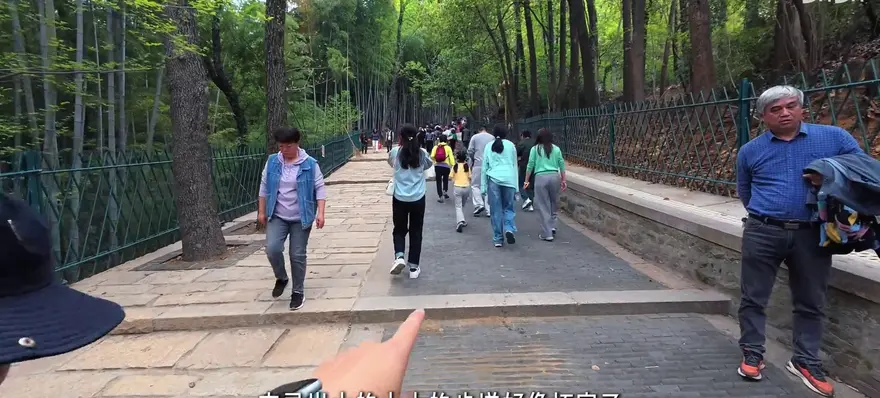
This is the opposite of the initial impression many people have of exoskeletons—feeling "pulled along by the machine." Here, the assistance is applied at the exact phase you need, rather than a continuous, forceful pull. The absence of noticeable soreness in the legs indicates that the device does not force you into "passive compensation." Of course, the trade-off is that you still need to actively lift your legs and maintain your own gait rhythm—it acts more like a pair of "legs that understand you" rather than taking over your pace.
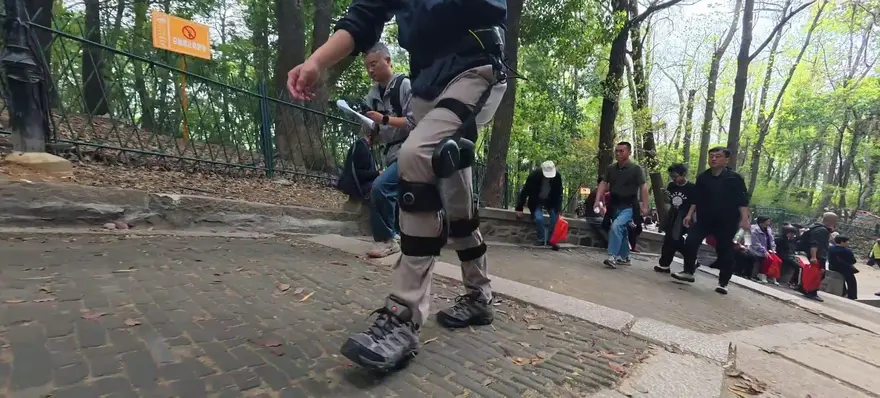
Ridge Views and Vegetarian Noodles: What It Feels Like to Save ~40% Effort
A direct route leads to the core observation deck of Lingyan Mountain, offering expansive views; there are also vegetarian noodles and meals at the summit. Lingyan Mountain isn’t particularly tall—a normal climb takes just over 20 minutes to reach the top. The well-maintained trails, not any geek gear, are what truly give hikers the edge.
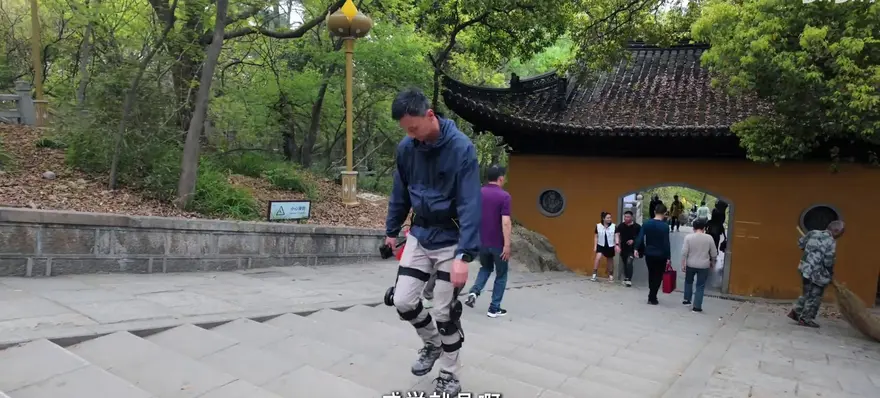
But what I cared about was effort distribution. My legs didn’t ache on the ascent, though my heart rate noticeably rose with the slope's steepness.
Video narration: Hiking consumes roughly 40% less physical effort (based on subjective estimates in the video, not lab data).
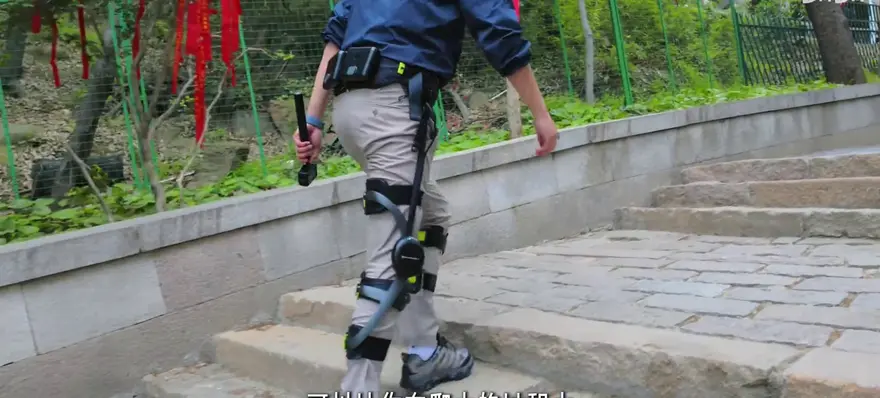
Note: The 40% figure is anecdotal. Actual effort reduction varies from person to person, influenced by weight, slope gradient, and step frequency. We prefer to view it as a general trend: once part of the work needed to lift the legs is “re-energized,” the subjective sense of exertion on the same slope drops by roughly the same magnitude—a result we’ve reproduced on mountain trails.
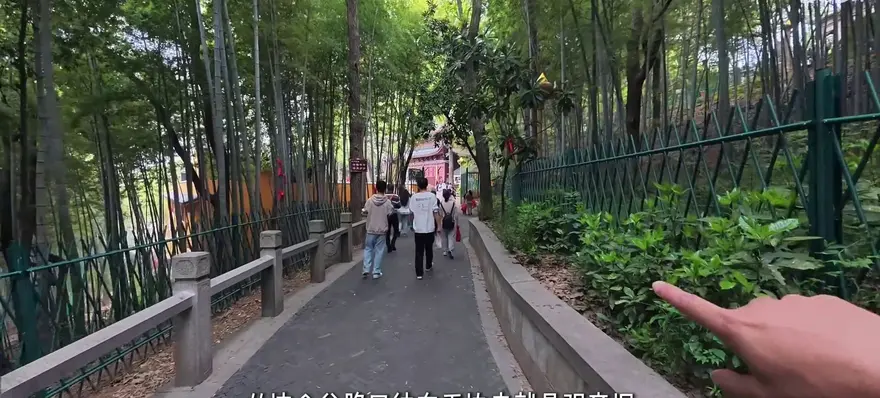
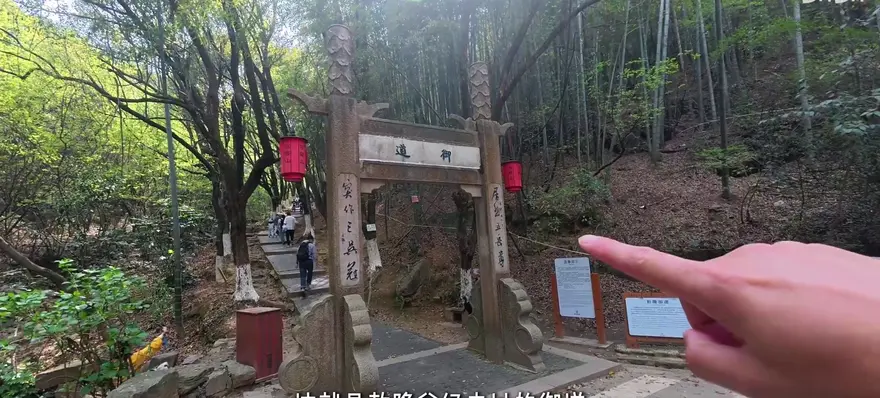
A small Easter egg comes with the admission ticket: Lingyan Mountain’s entrance fee has stayed at 1 yuan for years. A 1-yuan entry paired with a consumer-grade exoskeleton is quite the contrast.
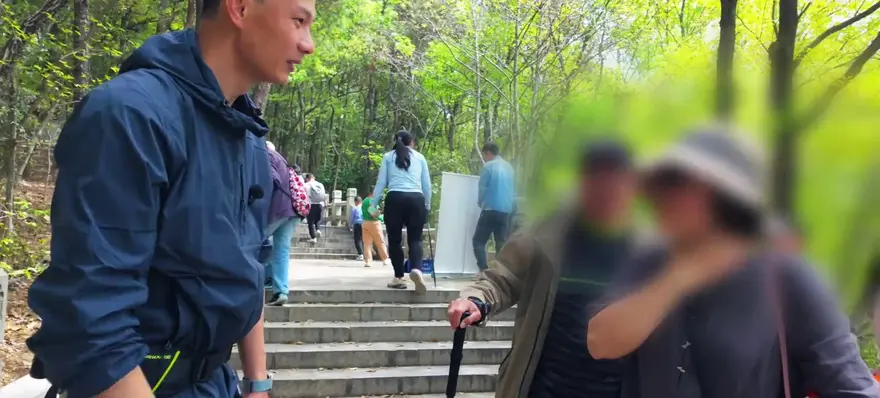
Flat Terrain and Squatting: Gait Following and Immediate Stopping
The biggest concern when buying an exoskeleton is—will it turn me into a robot? On flat terrain, the answer is clear: the following capabilities perform much better than expected.
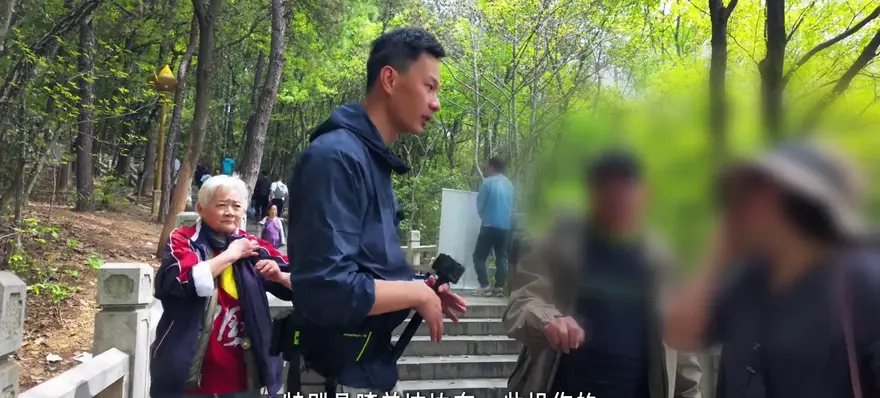
The first highlight is the natural gait. While walking, the device adjusts completely to your rhythm: if you speed up, it matches you; if you want to stop, it halts precisely at the current step frequency without pulling you back.
“The walking gait is very natural. You can stop at any time, and it feels completely comfortable.” (Mentioned in the video)
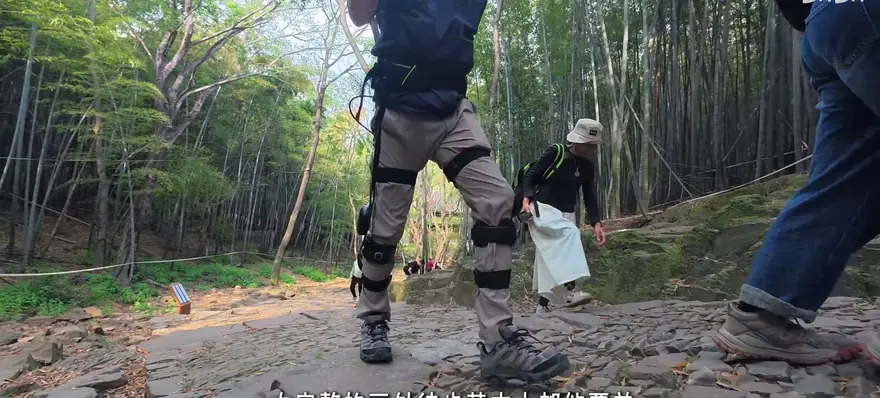
The second highlight is the squat-to-stand motion. The knee exoskeleton does not add extra weight or sway. Testers could squat down and stand up directly without significant leg effort, and the joint range of motion remained unobstructed by the exoskeleton mechanism.
These two aspects are actually the core technical challenges for consumer-grade exoskeletons. The former relies on high-gain joint torque control and real-time following phase switching; the latter implies that kinematic compromises have been made regarding the knee joint's rotation center and mechanism degrees of freedom. This product effectively addresses the user fear of feeling like a robot, making strategic trade-offs in the following algorithm: minimal drift, with the inner bending angle restricted to a comfortable range, virtually eliminating any sense of restraint.

```
Downhill: Relieving Knee Pressure, Like a Pair of Large Hands Supporting Your Knees
If you thought an exoskeleton only exerts force during uphill climbs, this section on downhill movement might make you rethink that. When wearing this device to walk down stairs, the experience is completely different:
"When going downhill, it greatly reduces the pressure on your knees when stepping down, as if a pair of hands is holding up your knees." (Mentioned in the video)
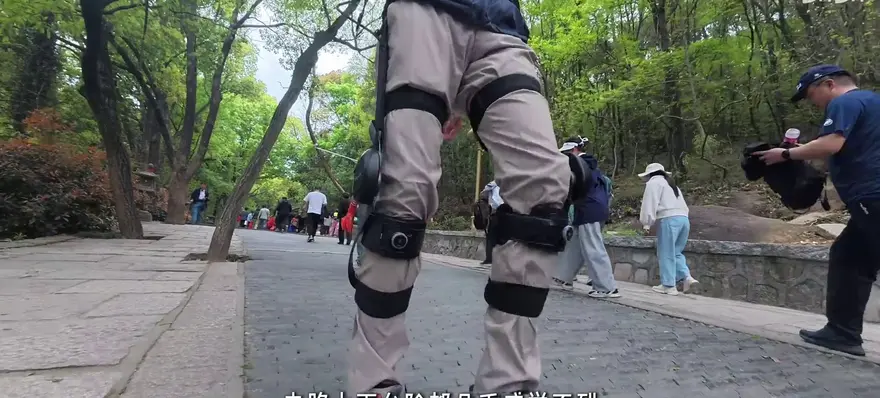
During descents, the shock absorbed by the knee joint is often severe. This knee exoskeleton utilizes passive hydraulic damping and partial active rebound during the knee flexion and extension phases of the descent, effectively providing targeted cushioning for the knee. Walking down becomes much more stable with a reduced physical burden—especially for individuals with pre-existing knee joint degeneration or meniscus wear. For these users, this specific value is even more worthwhile than the energy saved on uphill climbs.
Sitting to Standing: Slap Your Thigh to Stand Up — This Design Earns Full Marks
Anyone who hikes regularly knows this: when you're exhausted and sit down, the hardest part isn't sitting — it's the moment of standing back up. That moment of doubt, when your thighs and knees take the biggest load, is pure misery.
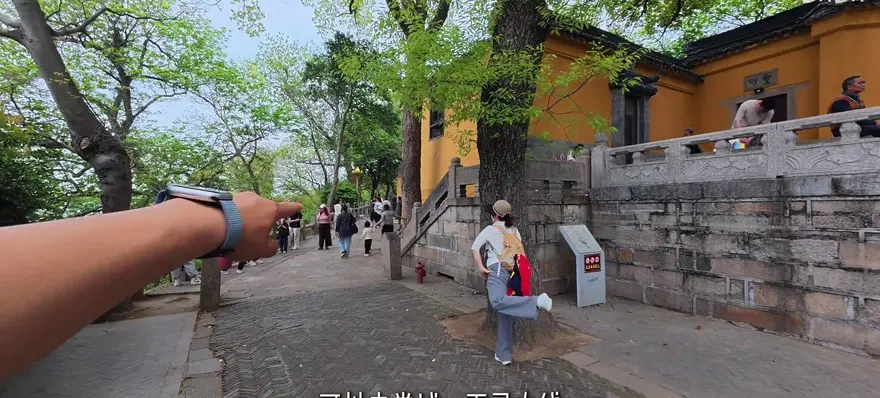
The most practical sit-to-stand design has arrived.
Video description: This assist system from Yunye Tech will help you stand up after you sit down — just pat your thigh.
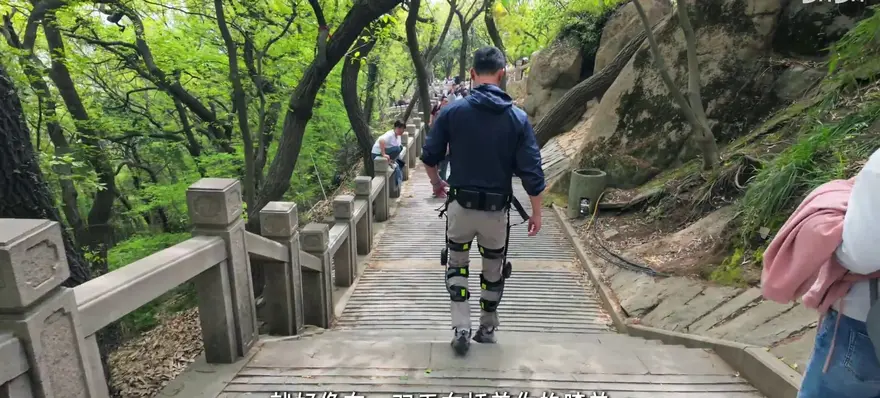
This interaction design is a major plus. There's no complicated control panel: give your thigh a pat, and the mechanism identifies it and delivers one sit-to-stand assist — intuitive and lowering the learning curve for seniors and first-time users. Outdoors, intuitive operation means safety.
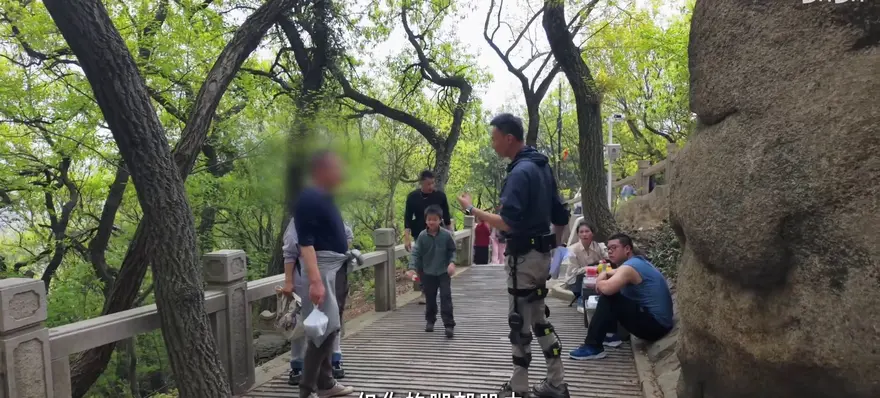
Extra Training on Qionglong Mountain: Walking Qianlong's Path with Only 5% Battery Drain in One Hour
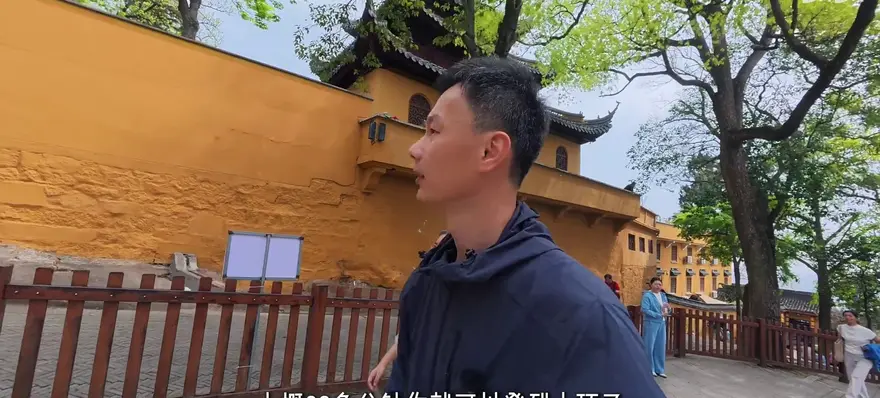
Leaving Lingyan Mountain, we headed for Mt. Qionglong. The initial path into the mountain was relatively flat. The audio guide joked about how the so-called ‘mastermind’ who planted bamboo shoots on the mountain must have been disappointed to find them all dug up before they were even cooked.
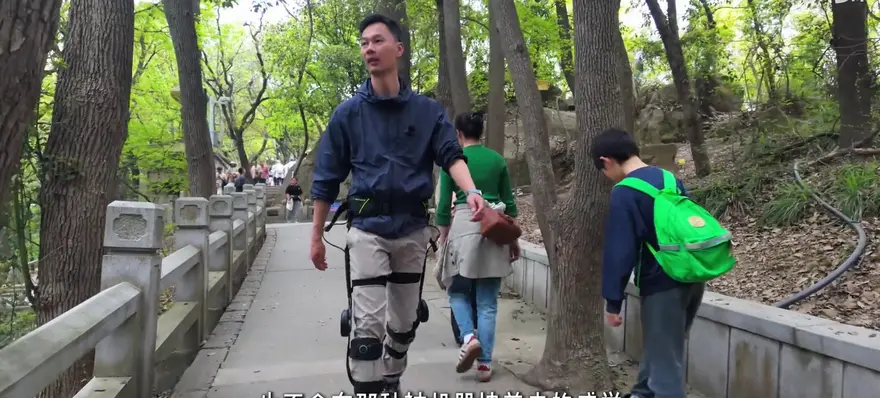
On the mountain trail, we also encountered the Imperial Path once walked by the Qianlong Emperor. This section provided a complex terrain of flat ground and gentle slopes, presenting a more realistic hiking challenge than a simple staircase.
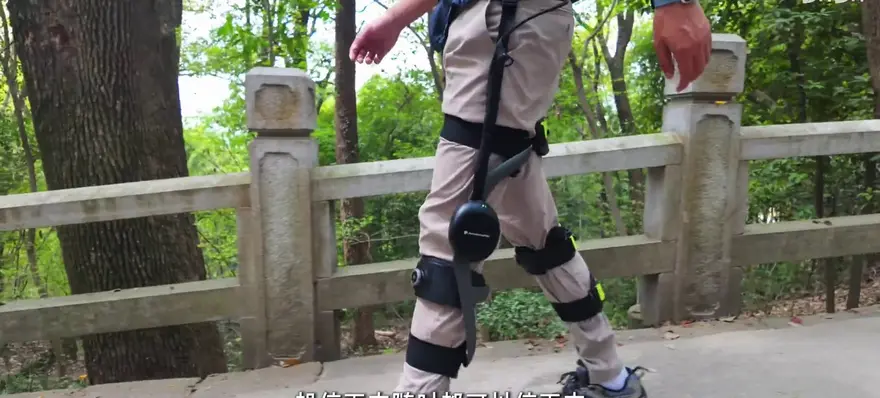
Here comes the key part: battery life. After approximately one hour of continuous use on Lingyan Mountain, the battery level had only dropped by 5%.
“After 1 hour of use, only 5% of the battery was consumed. The official specifications claim a 5-hour runtime on a full charge, with fast-charging support.” (Mentioned in the video)
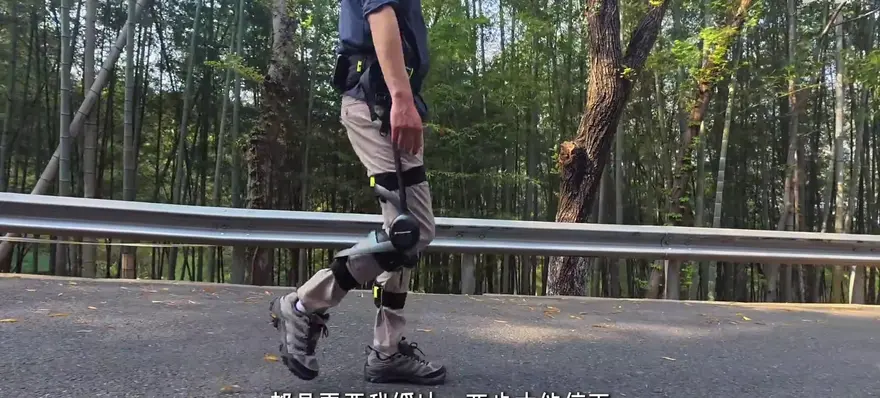
Let's do a quick calculation: the video test recorded a power consumption rate of about 5% per hour, which aligns closely with the officially rated 5-hour runtime. Based on this, a 20% charge would yield approximately 4 hours of runtime, and a full 100% charge could deliver a conservative estimate of 20 hours of continuous use. Actual battery life will be affected by factors such as walking pace, slope gradient, and the selected assist level. Additionally, energy consumption per step when descending may change due to regenerative braking from the motors.
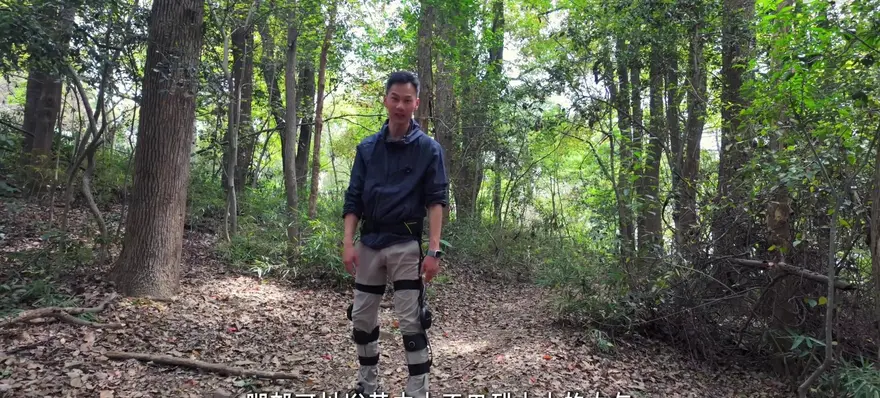
Video summary: Based on the actual experience, the device is fully capable of covering a complete outdoor hiking trip on a single charge.
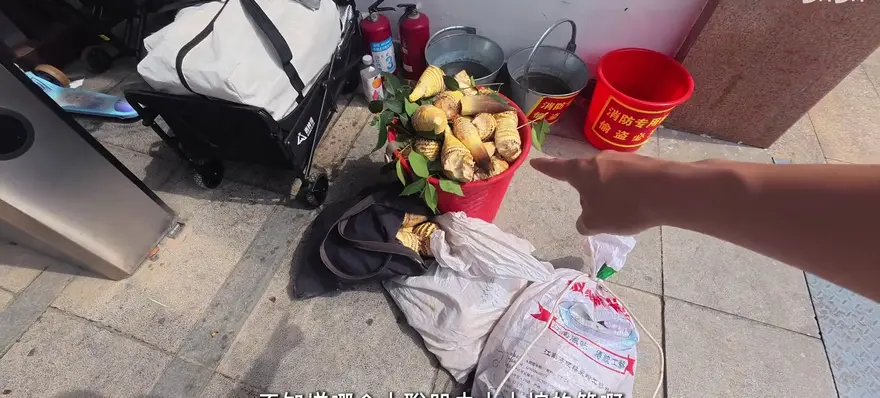
There is another metric used for in the hiking community: handling a daily count of 40,000 steps is no problem. (The video mentioned that “40,000 steps of continuous walking is no problem,” indicating that the device can easily match this kind of high-intensity, long-distance traversal.)
Wangshan Spring Outing: An "Add-on" for Family Knees, Also Works as a Massage Gun for Relaxation
Wangshan is a great destination for a spring outing with the family. Frankly, for those who spend a lot of time outdoors, wearing an exoskeleton to climb Wangshan might be "overkill"; however, for users with degenerative knee conditions or those caring for elderly family members, this device hits exactly the right pain points.
Local Wangshan specialty Songhua balls are made and sold fresh; the emerald green of Jiulong Pool also makes for great photos.
The most unexpected feature is its relaxation module: after climbing the mountain, you can use it to relax tight leg muscles.
"It can also be used to relax tight leg muscles, a feature that other exoskeletons do not have." (Mentioned in the video)
This feature directly elevates the product's positioning from a "mere assistive exoskeleton" to an "outdoor recovery device." True outdoor enthusiasts know that muscle recovery after finishing a race or reaching the summit is often harder than the climb itself. If it can truly alleviate next-day soreness, its usage frequency will not be limited to the hiking season.
Head-to-Head Exoskeleton Review: Which Brand Understands the Outdoors Best?
Zooming out for a broader perspective, the domestic consumer-grade / general outdoor exoskeleton landscape is not limited to a single device like Yunye Technology’s Powernee.

Take Hypershell and Dnsys, for example; they focus on athletic performance and more aggressive assist output, which are perfect for advanced extreme sports enthusiasts. Meanwhile, Chengtian and Kenqing are more mature in pressure support and load-bearing support. Aoshark places a heavier emphasis on exoskeleton applications in industrial lifting and heavy-duty occupational protection, measuring extremely high-intensity physical exoskeleton needs. "TOREAD" (Toread) focuses more on lightweight design. In contrast, Yunye Technology’s product directs its development efforts bijectively "welded" onto knee joint torque. Unlike solutions providing integrated power at the ankle and thigh, Yunye Technology opts to tackle knee weaknesses directly. Its advantages lie in an extreme lightweight design, a single full long-range battery life, and a lower entry barrier for the general public. Its positioning is remarkably clear: it is not built as "a second pair of human legs," but rather, it is designed as an "invisible supportive brace born specifically for hiking and protecting against knee pain."

Overall Review: A consumer-grade exoskeleton with a "de-teched" approach
Final verdict: Powernee has taken "contextualization" to the extreme. From lifting your legs, sitting and standing, downhill cushioning, to post-exertion relaxation, this feature matrix targets the highest-frequency and most force-intensive movement nodes in hiking scenarios. In stark contrast to other products that require a high learning curve, aggressive gait correction, or even an adaptation period, Powernee's philosophy is "seamless intervention." The weight of just over two kilograms becomes virtually unnoticeable once worn, offering precise gait tracking with zero latency. The feature that allows you to stand up simply by patting your thigh while seated is a brilliant insight into genuine outdoor fatigue.
If you are in the market for a medical rehabilitation exoskeleton, you should consult a rehab clinic, as that belongs to the realm of a rehabilitation exoskeleton. However, if you and your family love hiking in the mountains, occasionally suffer from knee discomfort, or experience knee joint wear and tear, but still want to wear a device to enjoy nature, Powernee is absolutely the exoskeleton I most highly recommend right now.
Top Community Comments
“Many scenic areas already have them, but 100+ RMB per rental still feels too expensive.” (@YikeDaLuobo)
— This comment hits the cost-equation pain point beyond individual purchase: if the daily rental is over 100 RMB and you only climb twice a year, renting is the smarter choice. For exoskeletons to break out of the geek niche, the industry needs to do the math: do you buy the device, or rent it on demand? High upfront costs can’t be ignored, and “try before you buy” should be the bare minimum right any dealer offers.
“As a Suzhou native, the hills here are all ‘baby hills.’” (@YESORNOXXX)
— This quip reveals something important: local users treat it as a stylized accessory and hiking tool, not a medical device. For marketing in local markets, instead of emphasizing “protect your knees,” it’s better to say “give those baby hills a buff.”
“I really wish I had one while hiking during May Day.” (@AdolfoOnly)
— For single-occasion demand during holidays, renting beats buying. May Day trips and weekend outings are high-frequency scenarios for exoskeleton rentals. If per-trip rental rolls out across tourist sites nationwide, it will be the perfect complement to retail.
“Never heard of this brand. What’s their background?” (A brand question in the comments)
— Brand awareness in the exoskeleton industry shouldn’t depend on reviewers alone. There are many white-label devices in China. A vertical player like Yuanye (Yuanye / Powernee) may be less known than AI-exoskeleton giants, but that’s an opportunity to stand out through product design and win beyond its niche.
“I showed a video to my parents. They said, ‘Don’t waste money on that yet.’” (A heartfelt comment from the community)
— The elders’ first reaction is telling: it looks like a medical brace from the wearer’s perspective. To shift that perception, brands should step out of the review lab and set up real experience corners at massage and therapy shops—use it once, then decide whether to buy.
“If rental at a scenic spot hits 50 RMB/day, I’d get a membership.” (A casual rent expectation from the comments)
— Manufacturers see fixed-asset costs, while users see a mental price account. If charging and depreciation management mature, pushing rent into the 50 RMB range could be a tipping point for penetration.
Yuanye Technology's Powernee exoskeleton is not hardcore sports equipment, nor is it a medical rehabilitation machine, but a knee-protection exoskeleton born for the trails: lifting to assist your legs, cushioning on downhills, aiding your movements when sitting down or standing up, and helping you relax after exercise—all designed to address the real pain points of hiking enthusiasts and people with knee degeneration. If your knees are still in good shape but you find yourself short of stamina for weekend hikes, start by renting one to try. This might be the least "impulse purchase" decision you can make for your knees.
About this article: part of Chinese-Made Exoskeleton Review Archive — an independent, regularly updated English archive of reviews of consumer exoskeletons made in China, edited from publicly available video transcripts. Not an official manufacturer page.
For inquiries and purchasing, contact lonlonago@foxmail.com. More in Reviews · All articles.