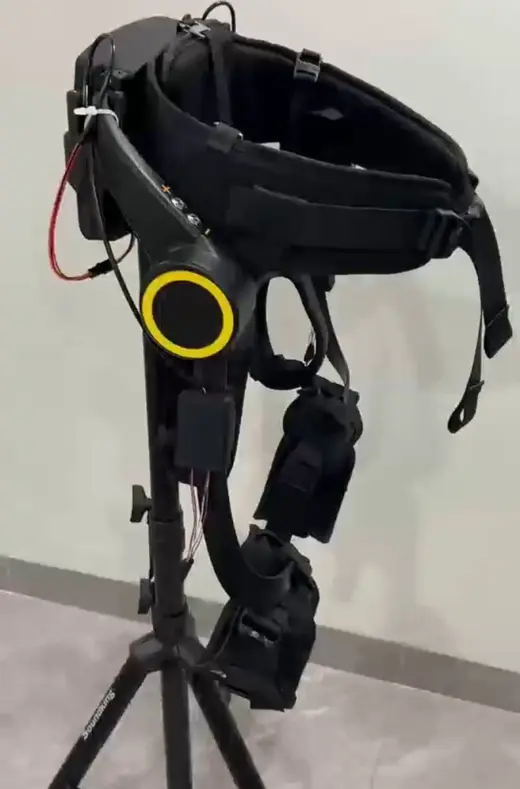
Field Test: Hypershell X Ultra — 8.5 Hours, 22,079 Steps, 56% Battery Remaining. Can a Consumer-Grade Exoskeleton Really "Walk Your Legs for You"?
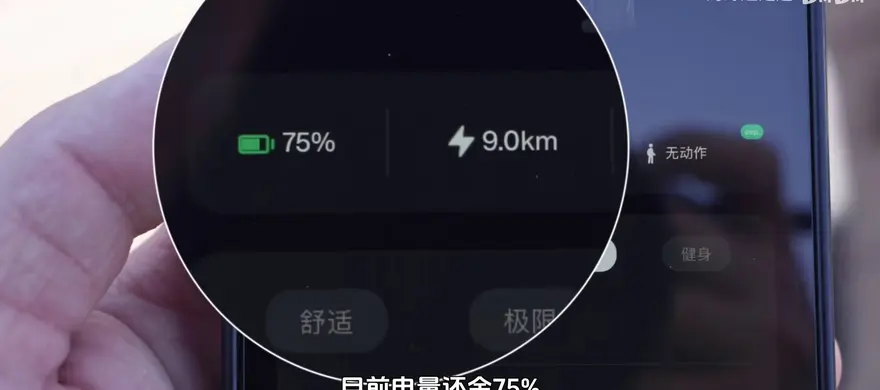
First climb of spring, and the creator geared up with a "steel partner"—the Hypershell X Ultra mechanical exoskeleton. From 10:15 AM powered on with a full charge, to 6:52 PM back at the parking lot—a full eight and a half hours, over twenty-two thousand steps, with 56% battery left. This isn't a product launch press release; it's a real, hardcore field test in the mountains.

Why Hypershell X Ultra
In the consumer-grade exoskeleton space over the past two years, Hypershell has been one of the few products to make outdoor hiking assist its main battlefield. Unlike brands such as Chengtian, Kenqing, Aoshark, and YuanYe, which lean more toward rehabilitation and medical scenarios, Hypershell targets sports like hiking and trekking — long-duration, low-to-medium-intensity, repetitive-gait activities — which aligns closely with the one-day ascent route on Songshan (Taishi Mountain) tested in this episode.
As the flagship of its high-end lineup, the X Ultra is built around a hip assist + lower-limb coordination solution, pairing carbon fiber structural components with brushless motors. Its overall positioning is to "reduce the load for amateur outdoor enthusiasts," rather than to replace professional hiking gear.

Mentioned in the video: The model tested here is the Hypershell X Ultra. It powered on fully charged, connected to the phone app in seconds, and the assist intensity is adjustable (set to 20% during testing).

2. Five Minutes to Onboarding: Teaching the Exoskeleton "Your Gait"
The biggest hurdle for wearable assistive devices isn't weight — it's human-machine adaptation. When first worn, the X Ultra requires you to input height and weight, then enters a roughly 5-minute learning and adaptation process that records your walking habits.

The creator describes the process in the video as quite smooth:
"It takes about five minutes overall. Now, every time I lift my leg or make any movement, it captures it in real time and provides an assistive force."
Behind this is a combination of IMU + pressure sensor: by capturing the flexion/extension angle of the hip joint and changes in plantar pressure, the exoskeleton determines the current gait phase (swing phase / stance phase), then decides when to output torque and how much. A 5-minute learning duration is fairly standard among consumer-grade products — compared to medical-grade rehabilitation exoskeletons that often require tens of minutes of calibration, it's already much more user-friendly.


Three. First Flat-Road Experience: Even 20% Assist Can "Carry You Along"
On test day, the assist intensity was dialed in at just 20%, which sits at the low end of the X Ultra's adjustable range. But the creator's hands-on feedback is worth noting—
"Even though it's only using twenty percent assist right now, you can feel that on flat ground it's carrying you along."

The phrase "carrying you along" is key. It shows that the X Ultra's assist isn't a passive top-up that waits for the user to exert force before kicking in. Instead, it relies on gait prediction to actively feed forward: when the sensor judges that you're about to lift your leg, the motor pre-emptively outputs an upward torque, making the user feel as though they're being "lifted." This feed-forward assist delivers its best experience in flat-road, steady-pace scenarios, and it stands as one of the core technical barriers for consumer-grade hip-assist exoskeletons.


IV. Climbing Test: The Real Feel of Leg-Lift Assist
Songshan greets you right out of the gate with continuous stairs — a genuine proving ground for any exoskeleton. The creator's description is refreshingly direct:
"This exoskeleton gives you this constant feeling of your legs being lifted upward... you can feel it carrying your legs along, up and down, climbing all the way up."

Along the way, a passerby asked on the spot, "Does this exoskeleton actually do anything?" The creator's answer was an unequivocal yes — the effect comes from the servo motor's active leg-lift assist during the hip-flexion phase, and the force level is adjustable. This captures the core value of an assistive exoskeleton — reducing fatigue buildup in the quadriceps and gastrocnemius, so that for the same energy expenditure you can climb higher and trek farther.


That said, the creator honestly called out the limits of the 20% power level:
"Of course, I've only set the power to twenty percent right now, so it's not super pronounced, but for me, it's enough.Enough" is an important signal — it means that for users with a baseline level of fitness, even a low assist level already delivers substantial load relief, while higher gears are reserved more for heavy-payload or long-endurance scenarios.

V. Hardcore Battery Data: 8.5 Hours, 22,079 Steps, 56% Remaining
This is the most hardcore set of numbers in this episode, and the key indicator for judging whether a consumer-grade exoskeleton can truly "go into the wild."

| Metric | Data |
|---|---|
| Test duration | Approx. 8.5 hours (10:15 → 18:52) |
| Steps | 22,079 steps |
| Starting battery | 100% |
| Ending battery | 56% |
| Assist intensity | 20% |
| Actual power consumed | Approx. 44% / 8.5h |

Mentioned in the video: After about eight and a half hours, when returning to the parking lot, the battery still had fifty-six percent remaining, with twenty-two thousand and seventy-nine steps taken — "this endurance really exceeded my expectations."
A quick calculation: at the 20% assist setting, the X Ultra's equivalent endurance can be extrapolated to the 15–19 hour range, enough to cover the vast majority of single-day hiking routes. For multi-day heavy-load trekking, this data also means that a single mid-trip recharge is all it takes to complete the journey.


A reminder worth noting: endurance is strongly correlated with assist intensity. Push the setting to 50% or higher, and the power consumption curve becomes noticeably steeper. The impressive figures from this 20% setting cannot be directly extrapolated to full-power scenarios.

VI. Pain Point 1: 2-3 Step Lag in Variable-Speed Scenarios
The "silky smoothness" of an exoskeleton comes with a caveat. The creator explicitly pointed out that the X Ultra performs best during steady-speed motion (continuous stair-climbing, stable walking), but once the rhythm is interrupted, the experience drops off a cliff:
"For example, when we're climbing a mountain, the person ahead of us often stops suddenly. In that moment, it takes about two to three steps to readjust the assist."

This is a common issue with gait-prediction algorithms. Feedforward assist relies on anticipating the "next moment's movement." Once the user suddenly stops, steps aside to yield, or changes direction, the gait phase captured by the sensor misaligns with the prediction model, and the controller has to re-enter its learning state before it can resume output. A 2-3 step lag is harmless on flat ground, but in complex mountain terrain (trail bottlenecks, broken steps, sightseeing stops) it gets triggered constantly—making it a shared engineering challenge for today's consumer-grade exoskeletons.


VII. Pain Point 2: The "Position Battle" Between Backpack and Battery Compartment
The second issue is at the industrial-design level. The X Ultra's battery compartment sits at the lower back, while the creator is carrying a 27L hiking pack—
"The entire pack is pressing down on top of this battery compartment... If it could be adjusted, that would of course be best; and if we all use this exoskeleton, we'd probably need to carry a smaller pack, say 20L or 16L, which would likely work better."
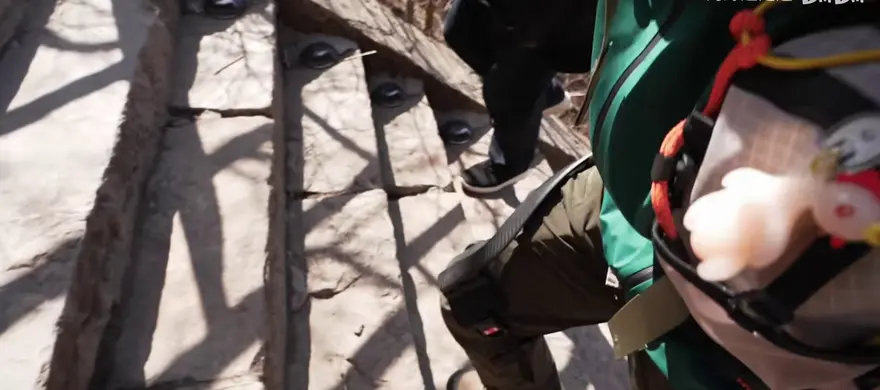
This may seem like a minor detail, but it actually exposes a bigger issue: the compatibility between consumer-grade exoskeletons and human load-bearing systems. Hikers carry their load mainly through their backpack, and the pack's hip belt happens to rest right on the lumbar–sacrum region, which spatially conflicts heavily with the battery + drive module of hip assist / lumbar assist exoskeletons. The result: you either sacrifice pack capacity, or you sacrifice exoskeleton fit.


By comparison, Hypershell's own lighter models and competitors like Dnsys are both trying to move the battery compartment to the outer thigh or front waist, but the trade-off is gait interference from the forward shift in center of gravity. The X Ultra opts for a "concentrated rear-waist layout" to keep the center of gravity stable, yet it's inherently incompatible with mid-to-large backpacks—this is a trade-off that users need to think through before buying.
8. Positioning Thoughts on Consumer-Grade Exoskeletons: Achievement Regardless of Size
At the end of the video, the UP host shares a rather moving remark:
"Achievement is not measured by size or quantity. Climbing a new mountain and being embraced by it, walking a few hundred meters further, going up two or three more steps—these are all achievements."
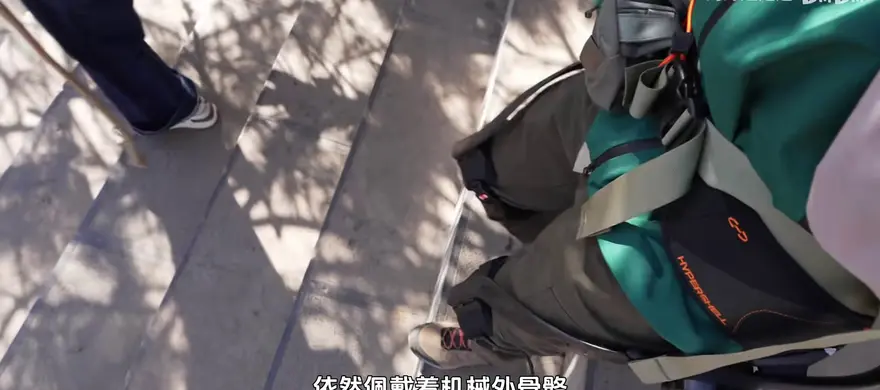
This remark actually captures the essential difference between consumer-grade exoskeletons and medical-grade/industrial-grade exoskeletons: the latter two pursue "functional recovery" or "productivity gains," while the former pursues experience enhancement—allowing ordinary people to walk a bit farther and climb a bit longer at the same level of fatigue, turning "places you couldn't reach" into "scenery you can reach."

In this sense, the value of Hypershell X Ultra lies not in whether it can turn you into Iron Man, but in that it compresses a solution—"gait prediction + hip feedforward assist + half-day endurance"—once confined to the lab, into a consumer-grade form factor that an ordinary person can carry up a mountain. The pain points (lag, backpack compatibility) also clearly exist, but all fall within an acceptable range of engineering iteration.



Top Community Comments
@BigEaterXiaoWang (48 likes): Scared me to death — turns out they were wearing a mechanical exoskeleton, I thought they were wearing a restraint shackle [Tibetan fox]
Interpretation: This highly-liked comment reflects the biggest perception challenge currently facing consumer-grade exoskeletons — the product form factor still carries a strong "sci-fi / medical" vibe, and the average passerby's first reaction is not "outdoor gear" but "orthotic device" or "restraint." For exoskeletons to truly enter the mass consumer market, shedding the medicalized and industrialized look is an unavoidable step.
@LifeLovingGiantAuntie (15 likes): When climbing mountains, the most fatiguing parts are the calf's gastrocnemius and the thigh's quadriceps — these two have to fire together to lift the body's height, so what an assistive exoskeleton solves is exactly the muscle fatigue problem, letting people climb higher mountains or walk farther distances under the same physical exertion
Interpretation: This is a comment from someone who genuinely understands exercise physiology, accurately pinpointing the mechanism of a hip assist exoskeleton — by sharing the workload of the hip flexor muscle group, it indirectly reduces the compensatory load on the quadriceps and gastrocnemius. It also answers the most common question: "do exoskeletons actually work?"
@AccountDeleted (15 likes): If the price is right, outfitting mountain porters with a pair could lighten their burden [doge]
Interpretation: Seemingly a joke, but it actually points out the potential ToB / professional scenarios for consumer-grade exoskeletons. People engaged in high-intensity repetitive load-bearing — mountain porters, couriers, movers — are in fact the ideal real-world use cases for hip assist / lumbar assist exoskeletons, but the current price and durability of consumer-grade products are not yet sufficient to support professional use.
@ (common feedback across the comments) Amazement over battery life
Interpretation: Both the live comments and the comment section expressed surprise beyond expectations at "8.5 hours with 56% remaining," indicating that the public's perception of consumer-grade exoskeleton battery life is still stuck at the "two-or-three-hour toy" stage. The real-world test data from this episode serves as an effective correction to industry perceptions.
@ (common feedback across the comments) The debate over "is it just an IQ tax"
Interpretation: Every exoskeleton video inevitably draws the "IQ tax" debate in its comments, which reflects that the category is still in its early stage — users have neither unified review standards nor a mature usage mindset. In the video, the creator honestly pointing out the latency and backpack pain points is exactly the most effective way to dispel the "IQ tax" doubts.
One-Sentence Summary
Hypershell X Ultra is a consumer-grade hip-assist exoskeleton that delivers perceptible assist even at the 20% level, with battery life sufficient to cover a full day of hiking or trekking; it suits medium-to-long-distance hiking and trekking users who maintain a regular gait, but if you're used to carrying a large pack or frequently stop-and-go on congested stretches, the current gait lag and battery compartment layout remain hard constraints you'll need to weigh.
About this article: part of Chinese-Made Exoskeleton Review Archive — an independent, regularly updated English archive of reviews of consumer exoskeletons made in China, edited from publicly available video transcripts. Not an official manufacturer page.
For inquiries and purchasing, contact lonlonago@foxmail.com. More in Reviews · All articles.