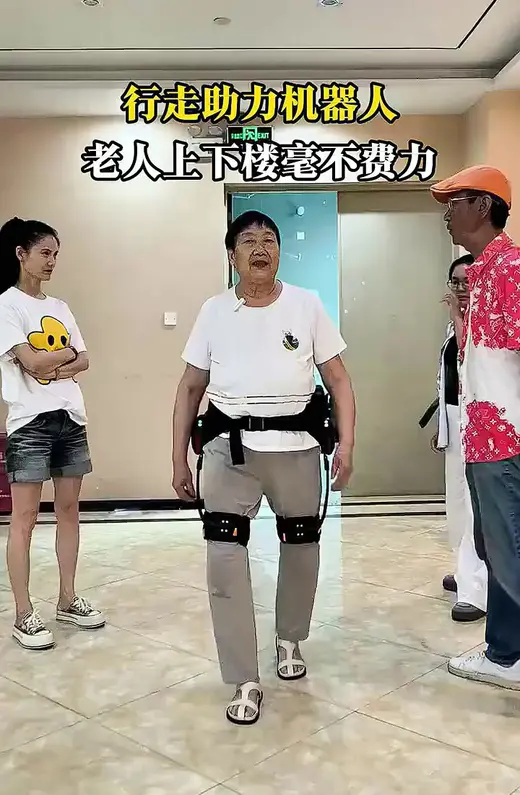
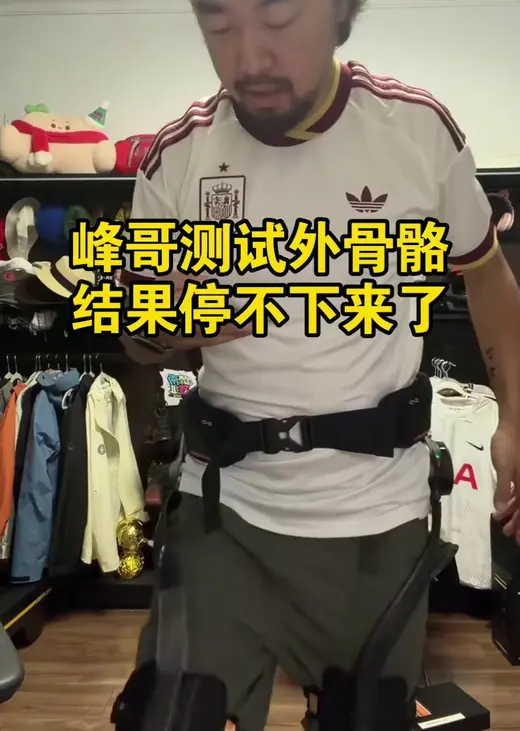
1.8kg of "Lower-Limb Black Tech": We Tested This Consumer-Grade Exoskeleton Capable of "Automatic Stair Climbing"
What is the experience of “wearing” 1.8 kilograms on your legs?
Today, we're embarking on a highly challenging outdoor test: putting a consumer-grade exoskeleton that weighs only 1.8 kilograms to the real-world test. In the past, “exoskeletons” were often associated with being heavy, bulky, and having a cold, clinical feel similar to medical devices. But today's product completely shatters that stereotype—it's incredibly light, to the point where you might wonder if it's even making a difference. In just a few minutes of immersive experience, the initial impression from this product was incredibly profound.



“[The brand] weighs only 1.8 kilograms, which absolutely shatters our baseline understanding of the lower-limb exoskeleton.” — Mentioned in the video
Heavy-duty industrial exoskeletons can easily weigh tens of pounds, whereas the lightweight design of this consumer-grade exoskeleton means it truly possesses the qualities for “daily wear,” rather than being something that just gathers dust in a corner.

Hardware Breakdown: The "Power Magic" Hidden in 1.8kg
What kind of hardware design can compress a complete assistive system into a mere 1.8kg weight? Although the video does not show an internal teardown, the actual wearing experience clearly indicates that this device employs a highly integrated lumbar / back assist hub design. This exoskeleton cleverly concentrates powerful servo motors, the battery life / runtime module, and the control motherboard in the waist area closest to the body's center of gravity. Meanwhile, the components wrapping the legs are kept extremely lightweight, drastically reducing the legs' free inertia.



Just imagine if you had a heavy mechanical frame strapped to your legs; not only would walking be exhausting, but you would also feel like a clumsy robot. It is precisely because of this extreme weight control that the product's joint torque performance is sufficiently responsive. For users looking for daily commuting or light exercise, the wearing process is incredibly user-friendly.

Core Algorithm: The Moment It Starts to “Actively Lift Your Legs”
Once you’ve put it on and press the power button, the most fascinating part begins. This exoskeleton’s sensitivity in gait recognition exceeded my expectations. When walking on flat ground, the instant my thigh lifts and drives my calf forward, the device sharply detects the movement, and the hip assist module at the base immediately releases an upward push, precisely helping me complete the leg lift.



“It feels like it’s helping to lift my legs, and it saves so much effort.”—mentioned in the video
How can I describe it? It’s like your legs suddenly became 10 kilograms lighter. When climbing uphill or stepping over obstacles, you no longer have to grind it out with your knees and thigh muscles. This isn’t just about saving effort—it’s a physical power-up that technology gives to the human body.

High-Energy Moment: Climbing Stairs in It Feels Like Being Divinely Assisted
If walking on flat ground is merely a test of its minor capabilities, climbing stairs is undoubtedly the killer application scenario for this exoskeleton. During the stair-climbing challenge, it demonstrated astonishing gait-following capability. With every step lifted, the assistive exoskeleton intervenes at precisely the right moment. It makes you feel as though you are not exerting your own strength to push upward, but are instead being "lifted" by a gentle yet firm force. Whether descending or ascending, this effortless sense of ease—free from the need to deliberately exert force—is something no prior mobility device has ever been able to provide.



"Is this what it feels like? It feels as though someone kicked you right from behind, pushing you forward, making it incredibly comfortable." —Mentioned in the video
If the algorithms are further advanced in the future, this might just become the standard gear at cyberpunk conventions. This mastery of the "timing of assistive intervention" is precisely the core competitive strength of this exoskeleton R&D team.

Extending the principle: How is a human gait "read" and "replicated"?
So here’s the question: How does this device that feels like a piece of cyberpunk tech know exactly when I’m about to lift my leg or when I need to plant my foot firmly on the ground? From a technical standpoint, it all depends on the precision sensors distributed across the legs and waist. These include an IMU and pressure sensors. This system has to calculate the body’s movement intentions within milliseconds and then trigger a motor to deliver the corresponding joint torque.



When your foot strikes the ground, the pressure sensor in the sole instantly registers the impact. When you’re about to take a step, the IMU processes the angular velocity of your thigh. This closed-loop control system is something traditional mechanical structures simply cannot match. In the future, integrating EMG sensors could further enhance motion perception accuracy.

Product Origins: Who Else Makes a 1.8kg Lightweight Exoskeleton Besides Hypershell?
Combining the product features of a "hacked exoskeleton,1.8kg ultra-lightweight," and "strong leg-lift and stair-climbing support," we're taking a comprehensive look at the consumer-grade exoskeleton market. Represented by the overseas sensation Hypershell, its Go series closely matches the weight and assist performance characteristics of the product in the video. Of course, domestic brands like Chengtian, Aoshark, and even Kenqing are also making their mark. However, the exceptional control achieved at just 1.8kg of weight still allows this product to stand out in the consumer-grade (rather than bulky rehabilitation exoskeleton) arena. Unlike unpowered passive exoskeletons, this type with active power is what can truly be called "Force."



This product perfectly nails the demand for lightweight solutions in non-medical scenarios. It strips away the precision of medical rehabilitation control systems, instead channeling all its costs and R&D efforts into the most essential scenarios for the user: "walking assist" and "climbing stairs." This is a very geeky trade-off.

Scenario Expansion: It's not a medical device, it's a lightweight accessory for outdoor and daily use
With an extreme weight of just 1.8kg and excellent assistive logic, this assistive exoskeleton boasts an application scope much broader than one might imagine. Whether it's for outdoor hiking / trekking assist, a spring outing on the weekend, riding shared bikes in the city, or even running, it handles all these tasks with ease. Built with lightweight materials like carbon fiber, this assistive exoskeleton boasts excellent self-balancing while supporting a considerable max payload / load capacity. It also comes equipped with built-in fall protection mechanisms. More than just a fun gadget, it actually solves the fundamental physical pain points of human flesh being fragile.



As for extended wear experiences, thanks to sound ergonomic design, users don't need to worry about sweating or discomfort. It's not just a geek's toy; it's the ultimate leg-liberation gadget that every working stiff dreams of.

Pros and Cons Overview and Buying Advice
Of course, as a cutting-edge consumer-grade product, it isn't flawless. After getting hands-on, we've pinpointed a clear set of strengths and weaknesses to help potential buyers decide. The standout advantages are extreme lightness and an excellent stair-climbing experience. However, one area to watch closely is battery life (runtime). Since this is a portable, wearable exoskeleton, the amount of power in your pocket decides how far you can go.


“Purchase URL: — mentioned in the video
Overall, this is a consumer-grade exoskeleton that delivers a futuristic feel and pushes the concept of “effort reduction” to the edge.
Top Community Comments
“@Reader (0 likes):
Interpretation: This purchase link (or is it some code?) reveals that some core viewers can’t hold back their impulse to buy. It’s a hint to the creator to show purchase channels and price on screen in the next review to satisfy everyone's desire to be an early adopter.
“@Reader (12 likes): My mom has arthritis and finds it painful to climb stairs every time. Can elderly people use this?”
Interpretation: This is a classic discussion about the target audiences for consumer-grade exoskeletons versus medical-grade rehabilitation exoskeletons. For seniors with mild to moderate joint degeneration, this type of lightweight device might provide daily walking assist, but remember, it cannot replace professional medical equipment.
“@Reader (45 likes): This is exactly my ideal, Cyberpunk 2077-style setup! When can a running-shoe version be released?”
Interpretation: This comment perfectly captures the "geek romance" behind tech products. Young players see it not just as a tool, but as a cutting-edge lifestyle statement and a trendy accessory.
“@Reader (8 likes): 1.8kg is indeed light, but how many hours of battery life does it have? If you're hiking or trekking, won't it become a burden when the battery dies?”
Interpretation: This hits on the core pain point for consumer-grade exoskeletons: endurance (in hours). Unless battery technology undergoes a qualitative leap, the "weight-assist-endurance" triangle will always be a difficult trade-off to break.
“@Reader (21 likes): Could this be made by DJI or a Xiaomi ecosystem company? If the price could be kept under two thousand, it would absolutely take off.”
Interpretation: The mass consumer market is extremely price-sensitive. When a tech product wants to break into the mainstream, the price-performance ratio sometimes carries more weight than pure technological awe.
“@Reader (6 likes): Will it feel tight or uncomfortable around the waist after wearing it for a long time? As an office worker who stands a lot, I'm tempted, but I'm worried my delicate waist won't be able to handle it.”
Interpretation: The ergonomic fit of wearable devices is crucial. No matter how good the algorithms and power delivery are, it all comes down to long-term wearing comfort. The fit and feel around the lumbar area is a tough indicator that challenges a designer's skill.
One-Sentence Summary
This is not just a 1.8 kg cyberpunk toy; it is a practical piece of magic that truly integrates into your life, transforming daily mobility from "physical exertion" to "technological transport." Recommended for all tech geeks curious about new tech, outdoor hiking enthusiasts, and office workers keen to save their knees and lower backs during daily commutes.