16 consumer-grade exoskeletons explained in one go: From 158-yuan passive support to 16,000-yuan hip-knee synergy
Recently, if you are looking to pick a "daily life and travel" gift for your parents, or want to save some energy for weekend hiking, you will most likely come across the term "exoskeleton". But a quick search reveals a remarkably consistent absurdity in this market: prices range from a cheap 158 yuan to an expensive 16,000 yuan, a nearly 100-fold price gap, and the product images all look quite similar. So we have put 16 models together, grouped by assist type, and compared them within the same group by budget. In this episode, we only help clarify three things: which ones offer true electric assistance, which are actually just "passive support", where the money is well spent, and what sizes and conditions you need to check before placing an order.

A Good Starter Guide: Passive vs. Active Exoskeletons Are Not the Same
When choosing your first exoskeleton, start by looking at three key areas. First, clarify the type: two of the models tested here are "passive models." Lacking internal motors, they rely on aluminum plates or springs to provide support. They are passive support structures, completely different from the motorized assistive exoskeletons featured later—do not mix them up in your comparisons.
The 158 RMB and 232.76 RMB tiers feature no motors and serve as passive support; they belong to a completely different category from the motorized "assistive exoskeletons" discussed later. (Mentioned in the video)
Second, look at the motor placement and quantity. Most of the motorized models tested here utilize a dual-motor setup for "hip assist" or "hip-knee coordination" to power the thigh muscles; another model is a "wheeled motorized shoe," which represents a entirely different type of power system. Third, pay attention to weight, battery life / runtime, and sizing: when used by the elderly, the overall weight directly impacts their willingness to wear it for extended periods; battery life / runtime corresponds to how long you plan to be out; and since most of these machines rely on height, waist, and leg circumference for sizing, measure yourself carefully before placing an order.

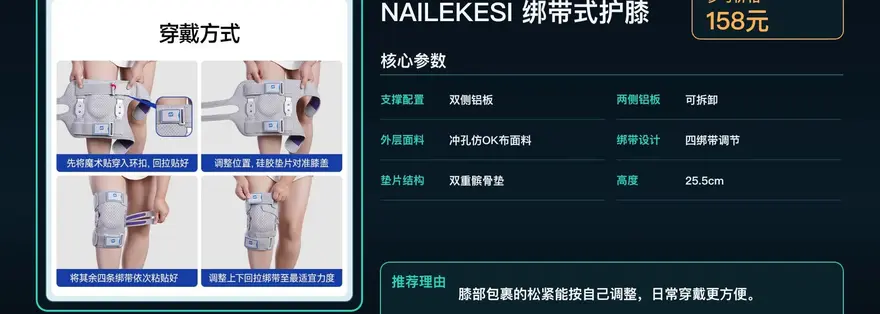
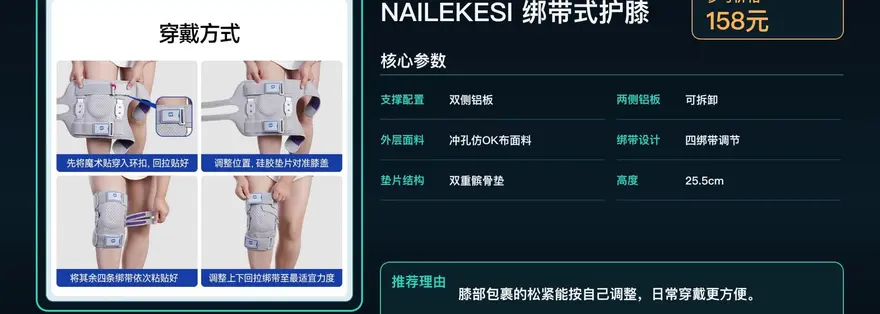
The cheapest knee brace: Nelix Yihu C at US$22, supported by aluminum plates
First up is the most affordable option, the Nelix Yihu C, priced at about US$22 (158 yuan). It follows the "knee brace" approach: there is an aluminum support strip on each side, which is adjustable and can also be removed. It comes with four straps, and the tightness can be adjusted separately. The fabric has a three-layer structure: a perforated breathable outer layer, an SBR middle layer, and a mesh inner layer that sits against the skin. The patella area features dual padding plus left and right side pads, working with the straps for everyday stabilization and support.
The Nelix Yihu C is priced at US$22 (158 yuan); two aluminum support strips that are removable and adjustable; four-point strapping; three-layer fabric: perforated outer layer + SBR middle layer + mesh inner layer. (Mentioned in the video)
Two key measurements before purchasing: use "the leg circumference 10 cm (about 4 in) above the center of the patella (kneecap)" and "the calf circumference 10 cm (about 4 in) below it." Measure with a soft tape against the skin without tightening; choose according to your actual leg measurements. One important point: it cannot replace medication, and any knee issues should still be addressed by a doctor first.
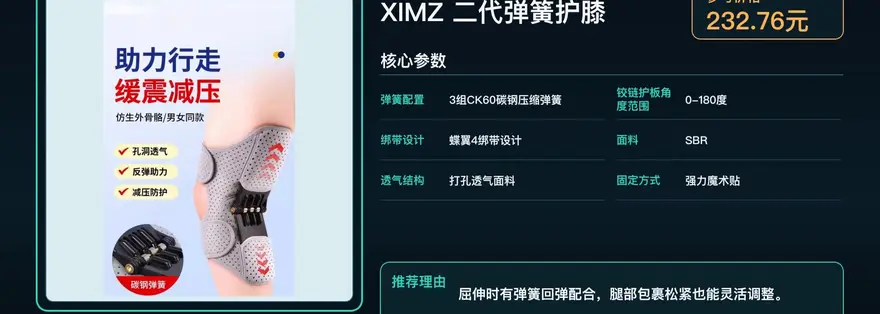


XIMZ Gen 2's Spring Route: Three carbon steel compression springs rebound with knee movement
The XIMZ Gen 2 provides walking assist and is priced at 232.76 RMB per pair, taking the mechanical spring route. It is equipped with three sets of CK60 carbon steel compression springs: when the leg bends, the springs are compressed, and when it straightens, they rebound, always moving in tandem with knee action, providing a "compression-rebound" force without requiring a motor or electricity. This represents a different approach from the subsequent electric models' "active motor drive." The shin guard's range of motion extends to 180 degrees, and the inner side of the main body features a curved fit for the back of the knee; it is secured by four straps; the SBR fabric is perforated for breathability.
XIMZ Gen 2: 232.76 RMB/pair; three sets of CK60 carbon steel compression springs; provides passive rebound during knee joint flexion and extension; battery-free. (Mentioned in the video)
Directionality is required for wearing: the longer end of the spring plate is the upper leg piece—make sure not to put it on backwards. It is also important to note that it does not provide "body support," making it suitable only for individuals who can stand steadily and walk independently.

Entry-Level Electric at the 3.8k Tier: Shenxingjia A1 — "Lightness" is the Keyword
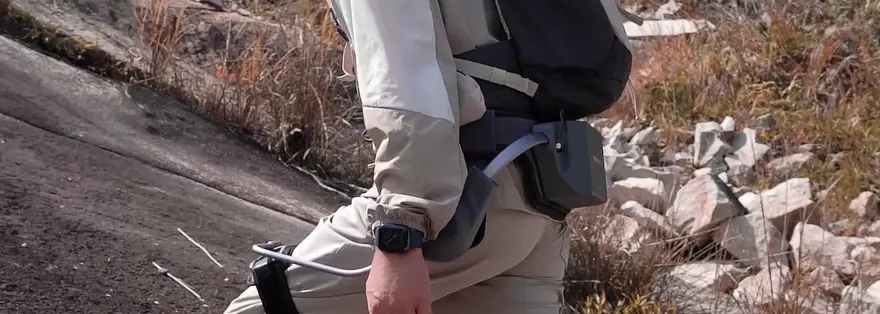
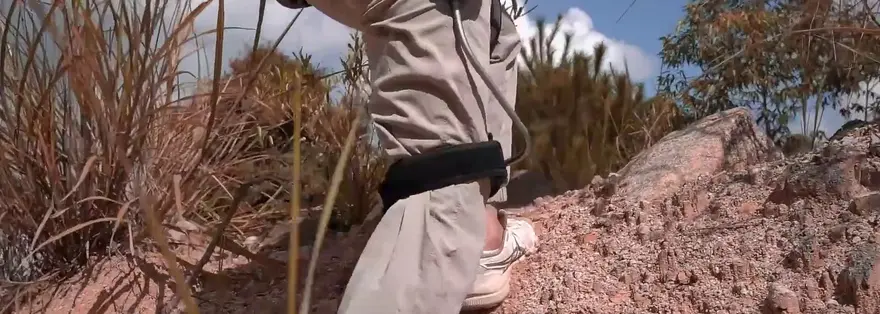
Starting with the Shenxingjia A1, we enter the realm of motorized "assistive exoskeletons." At a price of 3,878 RMB, it is the most affordable tier among the electric models reviewed here. With a total weight of 1.8 kg including the battery and straps, it is considered "a cut above" in lightness compared to other electric options in this batch. However, whether it actually feels heavy in use requires a personal fitting to confirm. It adopts an approach of "proactive assistance without strain," adjusting power output based on your status while walking. Walking, climbing stairs, ramps, hills, navigating gravel roads, and running are all within its recognition scope.
Shenxingjia A1: 3,878 RMB; total system (including battery + straps) approx. 1.8 kg; hip joint range of motion 0–90°, knee joint 0–120°; 3500 mAh battery, fully charged in 2 hours, Type-C universal interface. (Mentioned in video)
The securing system features full Velcro straps paired with 360° sliding buckles for easy adjustment. The waist belt is available in two sizes: "Standard SM" and "Extended L," selected based on actual waist measurements. For scenarios such as short walks or neighborhood commuting, it represents a reasonable budget-friendly starting point to "test the waters."




The "Standard Answer" in the 4k–6k Range: Texima's Dual Motors and "Short-Step Mode"
Priced at 5,702.65 RMB, the Texima exoskeleton offers dual-motor assist with a peak joint torque of 17 N·m per motor. Weighing about 2.5 kg for the main body (without the battery) and 3.15 kg fully loaded, it is foldable for easy storage. Its strength lies in recognition and modes: it can identify 6 different states—climbing stairs, descending stairs, cycling, walking, running, and hiking—and automatically switches to the corresponding assist method as soon as it detects one. Power delivery is controlled independently for the left and right legs. There is also a dedicated "short-step mode" designed for elderly users who cannot take large strides. It offers 8 gear settings overall.
Texima: 5,702.65 RMB; dual motors with a peak joint torque of 17 N·m per motor; 2.5 kg for the main body, about 3.15 kg total weight including the battery, foldable. (Mentioned in the video)
The "Lutra edition" comes with two batteries, providing a runtime of about 4–5 hours. An onboard screen makes adjusting parameters and switching modes more intuitive. At this price tier, your money buys more than just having motors; it buys finer gait recognition and a more stable assist curve.
Mid-Range Step-Up: Aosaki, Haier, Yuanye, and Toread Compete on "Sensors and Assist Levels"
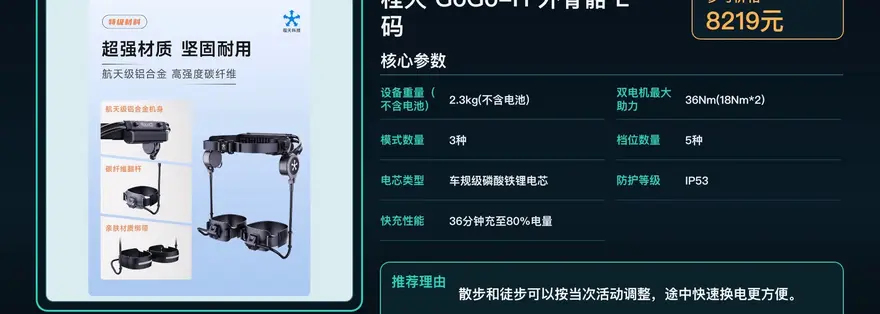
Mid-range pricing is spent on algorithms that "perceive gait then apply force" and on more robust structures. Aosaki's lower-limb assistive exoskeleton, priced at around 8,800 yuan, adopts a full-body coordination solution using a 7-axis IMU and foot pressure sensors. It supports 12 motion mode recognitions with 0–7 assist levels. The battery is 6,400 mAh with approximately 3-hour fast charging, and the battery life is rated at about 4–5 hours. The max payload is around 100 kg.
Aosaki: ~8,800 yuan; 7-axis IMU + foot pressure sensor; 12 motion modes; 0–7 assist levels; 6,400 mAh; ~4–5 h battery life; max payload ~100 kg. (Mentioned in the video)
Haier's consumer-grade lower-limb exoskeleton, priced at around 9,999 yuan, pursues a "lightweight + user-friendly" route. The total weight is in the 1.9 kg range, with a maximum single-leg assist force of about 10 N and a peak joint torque of about 20 N·m. It features a 10,000 mAh battery with a rated battery life of 4–6 hours (S mode) / 6–8 hours (E mode). The main structure is made of full carbon fiber, equipped with self-balancing detection and fall protection alerts, and supports "follow-along" tracking.
Haier: ~9,999 yuan; total weight ~1.9 kg; max single-leg assist force ~10 N; peak joint torque ~20 N·m; 10,000 mAh; battery life 4–6 h (S) / 6–8 h (E). (Mentioned in the video)
Yuanye's lower-limb assistive exoskeleton, priced at around 11,788 yuan, emphasizes noise reduction and motion tracking. It operates at around 48 dB, features built-in motion data recording, accommodates a waist circumference of 65–110 cm, and allows users to view gait data via a companion app.
Yuanye: ~11,788 yuan; operation at ~48 dB; provides gait/motion data recording; waist fit ~65–110 cm. (Mentioned in the video)
Toread's consumer-grade lower-limb exoskeleton, priced at around 4,999 yuan, targets "outdoor scenarios." It includes a built-in altimeter for automatic uphill recognition. With an 80 kg load, the runtime is about 5 hours on flat terrain and about 3 hours uphill. The total weight is less than 2.2 kg, with a hip joint torque of 10 N·m. It offers 1-hour fast charging to 80%, and the battery is removable.
Toread: ~4,999 yuan; built-in altimeter/slope recognition; with 80 kg load: ~5 h flat, ~3 h uphill; total weight <2.2 kg; hip joint torque 10 N·m. (Mentioned in the video)
At this tier, beyond simply "saving effort," there is a stronger emphasis on quantifiability: you can view your own gait data, and the device utilizes algorithms to adjust "when to apply force and how much force" more smoothly.





Flagship Segment: Heilou's Hip-Knee Integration and Hypershell's 30+ Sensors
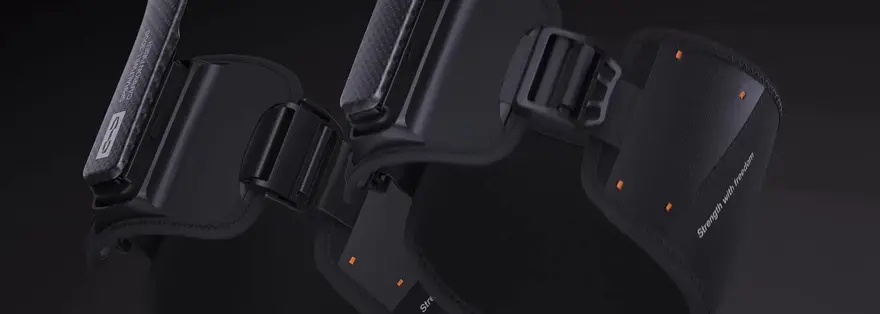
Moving up, it is about integrated joints and multi-sensor fusion. Heilou incorporates a hip-knee integrated active exoskeleton: four joints work synergistically to apply force, with both the hip and knee engaging to handle complex movements like climbing stairs. Constructed with 77% carbon fiber and 5% titanium alloy, it weighs approximately 3.2 kg including the wearing system but excluding the battery; charging takes less than 1.5 hours. Its sensing system, governed by 30+ sensor and an algorithm, dynamically adjusts on slopes, stairs, and gravel roads. It features a pocket-style replaceable battery that fits in a backpack and includes a voice assistant to help adjust the assistance.
Heilou: Hip-knee integrated four-joint synergy; chassis 77% carbon fiber + 5% titanium alloy; approximately 3.2 kg including wearing system; charging approx. 1.5 h; 30+ sensor; replaceable battery. (Mentioned in video)
Two points to note: First, the nominal 20 km battery life was measured on a lab treadmill at 4 km/h, a 1-degree slope, ECO mode, and 30% assist power. Real-world results will vary with environment, terrain, load capacity, and assist settings. Second, fit requires matching waist circumference, hip width, and thigh length; users must also be able to lift their legs independently and maintain their own self-balancing. Dnsys solutions in the same tier also fall into this group; for detailed parameters, please refer to the brand page.




Thinking Outside the Box: The "Wheeled Electric Shoes" Hypershell / Mole Walker is an Entirely Different Species
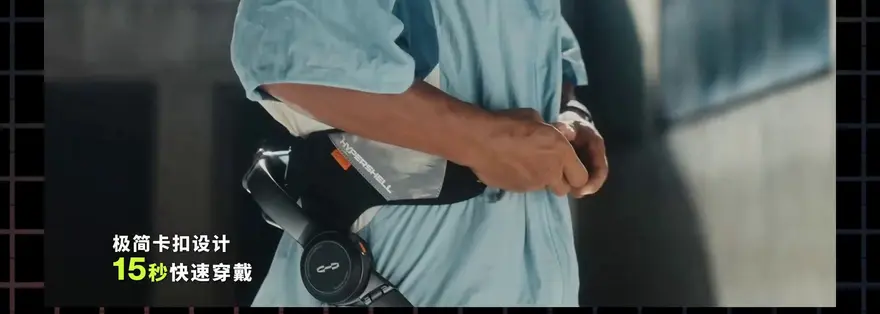
The final item is not part of the "hip and lower-limb assist" ecosystem: Hypershell's "Tanluzhe Wheeled Shoes (Mole Walker)", with a price of 8,999 RMB, is a pair of "wheeled electric shoes". It is powered by 8 wheels, features an approximate 400 W power output, reaches a top speed of 11.3 km/h, and can climb a 10 degrees slope; the nominal battery life is 10 km, and each shoe weighs about 2.41 kg. Its philosophy is completely different from an exoskeleton: instead of strapping to the joints to provide assistance, it directly adds wheels to the soles; an algorithmic system adjusts the power output to match your walking gait rhythm - you take normal steps, and it helps you accelerate; the wheels can turn approximately 30 degrees for a non-stiff walking experience; the straps feature magnetic buckles for easy on and off; it includes three preset modes for indoor, city, and sports; and the companion APP offers interactive tutorials.
Hypershell Tanluzhe Wheeled Shoes (Mole Walker): 8,999 RMB; 8-wheel drive; approx. 400 W; up to 11.3 km/h; climbs 10 degrees; nominal battery life of about 10 km; each shoe weighs approx. 2.41 kg. (Mentioned in the video)
There are a few "hard requirements" for choosing this product: shoe sizes must be between 39 and 46 (EU), and the recommended weight limit is within 100 kg (200 jin); wheel-driven propulsion requires some practice to master; beginners should follow the tutorials to get familiar with the controls before taking them outside. It is not a direct, interchangeable alternative to lumbar and lower-limb exoskeletons. Only consider this if you meet all the criteria and are willing to spend time familiarizing yourself with the operation.


Four Steps Before You Buy: Measure Size, Match Max Payload, Check Runtime, and Test Control
Before you place an order, always prioritize the "user's physical condition." Electric models require the user to be able to stand steadily and walk independently; they help you "reduce physical exertion" but do not replace medical therapy. For sizing, most models require sizing based on height, waist, leg girth, and shoe size—measure first, buy later. For max payload, different solutions support different max loads; especially when traversing gravel or steep slopes, remember that "assist" is not equivalent to "replacing the stability of your legs." When it comes to battery life / runtime, do not just look at the claimed figures: always ask under what "terrain, assist level, and load" the endurance (in hours) was tested. Finally, when choosing for yourself or your parents, prioritize environments where you can "try it on." For the same weight, the user experience varies greatly across different body types; for the same joint torque, the fit of different strap systems will directly alter the assist efficiency.
Three Routes on One Table: Passive, Active, and Wheeled
When 16 models are placed side by side, three distinct routes become clearest. The passive route: one fixed-support design and one spring-rebound design; with no motors inside, neither should be compared to motorized models for assist. The active route: among motorized models, the vast majority adopt a “dual-motor hip solution,” tracking your movement through gait recognition; the differences lie in weight, battery life / runtime, mode details, and how they are worn. Then there is Heilou, the only “hip-knee integrated” four-joint active solution; beyond that, Hypershell / Dnsys leverage multi-sensor setups and more advanced algorithms. The third route is wheeled: Hypershell’s TOREAD wheeled shoe places power under the foot, eschewing “anthropomorphic joints” in favor of “wheel drive + push-off compensation”; it is not a substitute for an exoskeleton, but rather another category of “personal mobility equipment.”
Within the same budget, prioritize products with transparent key specs (joint torque, battery, and battery life / runtime conditions) as well as clear sizing / max payload. (Mentioned in the video)
Current prices are for reference only; please refer to the actual price on the product page when placing an order. If you want more details on a specific model, let me know in the comments.
Top Community Comments
- > @Reader (Like 0): Mainly for short walks, with a budget of around 5,000, looking for something lightweight that includes the battery.
Short walks plus a ~5k budget point to “daily usability”: still lightweight with the battery, quick to put on, and battery life or runtime sufficient for 1–2 hour strolls—this aligns more closely with tier like Shenxingjia A1 / Texima.
- > @vacavaca (Like 0): Mainly for short walks, with a budget of around 5,000, looking for something lightweight that includes the battery.
The same budget repeated suggests “lightness” is a gating factor for frequent use; the video’s repeated emphasis on overall weight and on-body validation maps to this concern.
- > @284688 (Like 0): An elder takes shorter steps but can stand and walk steadily; looking for a small-step mode.
Being able to stand steadily is the safety baseline for powered models; a “small-step mode” tailors the assist curve to a shorter stride—this is the value point we highlight in the mid-tier category.
One-Sentence Summary
With 16 exoskeletons displayed on a table, the most important conclusion is simple: first distinguish between passive support and active assist, then allocate your budget to gait algorithms and joint setups better suited to your sports scenario; so, when selecting for elders, always prioritize "stay balanced, sense, and try it on."