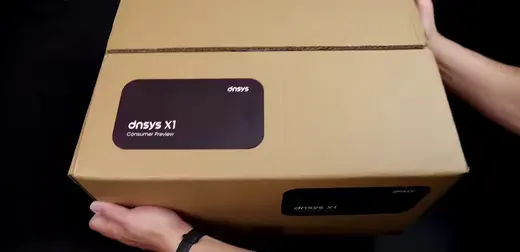
40% Assist, 30 kg Load Capacity, 17.5 km of Extra Battery Life: Hypershell X Wants to Take the Exoskeleton to the Summit
The call of the mountains never changes—what changes is our body. In its latest promo video, Hypershell offers its answer: a consumer-grade exoskeleton billed as the "world's first multi-scenario outdoor powered exosuit"—one that boosts leg strength by 40%, cuts physical exertion by up to 30%, handles a 30 kg load, and whose battery helps you walk an extra 17.5 km. The numbers look impressive, but for a device you strap on to climb mountains, what's truly worth discussing is this: what problems does it actually solve, and which ones has it deliberately chosen to sidestep?
1. From Rehab Wards to Hiking Trails: The Exoskeleton's "Consumer-Grade Moment"
Exoskeletons are nothing new. Over the past decade, they have mostly lived in two places. First, hospitals: rehabilitation exoskeletons from the likes of Chengtian and Kenqing are medical-grade devices that help stroke and spinal cord injury patients rebuild their gait — with price tags and entry barriers never meant for ordinary consumers. Second, factories and warehouses: Aosha Intelligence's back-assist exoskeletons help material handlers bend less and get injured less. The keywords they all shared: expensive, heavy, and confined to closed scenarios.
The turning point came outdoors. Hiking and trekking are among the few mass-market scenarios where users are genuinely willing to pay real money to save effort, and brands like Hypershell and Dnsys have used crowdfunding to push the price of assistive exoskeletons into consumer territory. That opening line from the video — "We are forever torn between the call of the wild and the pull of the summit" — is really the shared narrative of the entire category: an exoskeleton doesn't walk for you; it simply nudges your stamina ceiling a little further out.




2. Hypershell X: A "Multi-Scenario Outdoor Power Suit"
Let's start by correcting a machine-translation error in the promo video's subtitles: "the world's initial multi-scenario outdoor power suit" should properly read "the world's first multi-scenario outdoor power suit." That positioning statement packs in three key points.
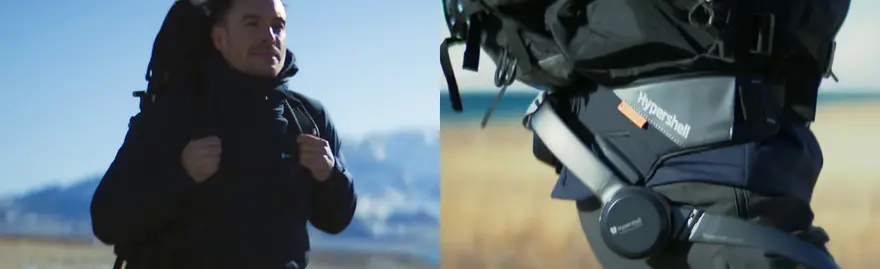
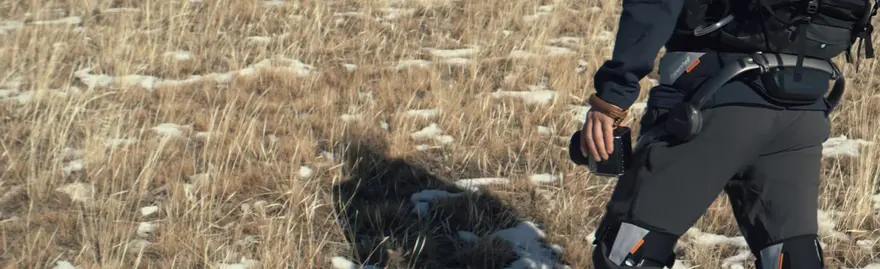
First, it's a lower-limb exoskeleton, not the full-body mech suit from the movies: structurally, it's simply a waist ring plus thigh straps, with the hip assist module at its core — a brushless motor mounted on each side of the hip joint, layering joint torque directly onto your hips through a transmission structure. Second, "multi-scenario" means hiking, trekking, stair climbing, and everyday brisk walking all share one set of hardware, rather than being specialized for a single activity. Third, making the hips the main battlefield for assistance is industry consensus: whether you're walking, climbing a slope, or heading upstairs, the primary workhorse is hip extension. Hip assist is the architecture that delivers "the most effort savings per watt," while keeping the overall weight gathered around your waist and hips — minimal interference with your gait.
If a lighter self-weight is what you're after, carbon fiber frames have long been the standard approach for the premium versions of this product category — in a consumer-grade exoskeleton, every hundred grams directly decides whether you're willing to take it out the door. The promo video claims it will "redefine every step." Whether that redefinition holds up — let's look at the specs first.



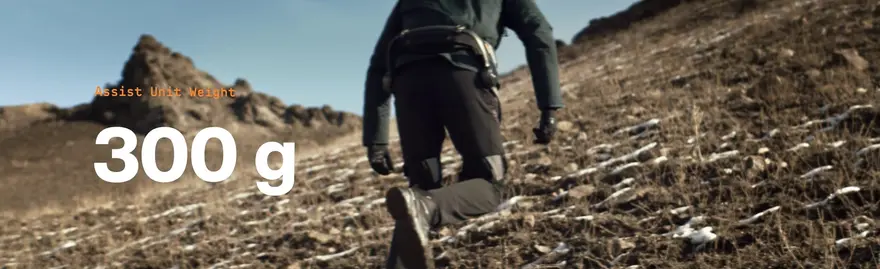
3. Four Numbers That Tell the Story: 40%, 30%, 17.5 km, 30 kg
The most information-dense part of the entire promo video comes down to four numbers—worth unpacking one by one:
Leg strength boosted by 40%. (mentioned in the video)
This is the peak-assist figure, and it maps to scenarios that demand a "burst"—climbing slopes, going up stairs. The joint torque the motor layers on at the instant of hip extension feels, in practice, like "someone giving you a boost up."
Physical exertion reduced by up to 30%. (mentioned in the video)
Pay attention to the words "up to": this is a best-case ceiling, and a leisurely walk on flat ground is unlikely to get anywhere near it. Still, it offers a tangible anchor—on the same long climb, at the mileage where others hit the wall, you may still have some reserve left.
Each battery adds an extra 17.5 km to your trip. (mentioned in the video)
Quoting endurance in kilometers instead of hours is a smart move for an outdoor exoskeleton: what hikers care about is "how much farther can it help me walk," not "how many more hours will it stay on." 17.5 km roughly covers the distance of a moderate-intensity day hike. With battery life measured in distance, longer treks will call for spare batteries.
It can carry a 30 kg load. (mentioned in the video)
A max payload of 30 kg means multi-day heavy loads (tent, sleeping bag, stove) or long hauls with camera gear all fall within its capability.
Equally worth noting is what the video leaves out: overall weight, exact joint torque figures, price, and charging time—none of them appear. For a device you wear on your body, these are precisely the specs you should be pressing on before you place an order.

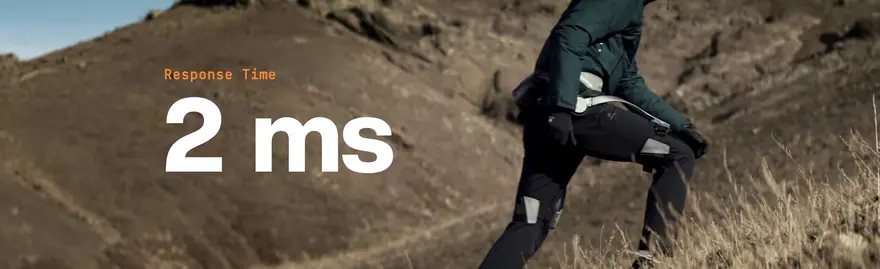

4. How It "Understands" You: Sensors, Gait Recognition, and Real-Time Assist
The core competitive edge of an assistive exoskeleton isn't the motor—it's the timing. Here's how the chain works: IMU and pressure sensors continuously capture your gait data, the algorithm decodes your motion phase in real time (which leg is in stance, which is in swing), and the brushless motor at the hip delivers joint torque at the exact moment you exert force. That subtitle line mangled by machine translation—"real-time analysis of your every movement"—refers to precisely this real-time gait recognition. Assist one beat early and it feels like dragging; one beat late and it's just idle spinning. Only when it lands right on your moment of exertion does it truly count as assist.
The promo video also reveals two distinct assist personalities: on flat ground, it's a "gentle, natural assist," while climbing slopes and stairs switches to a high-energy mode built for short bursts and rapid response. Another easily overlooked detail is quietness—the narration makes a point of stressing that the motors work "silently." Out in the mountains, noise ruins the experience long before the weight ever does.
And let's be clear about the boundaries: what it optimizes is force efficiency, not balance. Self-balancing and fall protection are not on its capability list—a point that will keep coming up later.




5. On-Mountain Scenarios: Trekking Assist, Heavy Loads, and Complex Terrain
Translate the specs into real-world scenarios, and the value of the Hypershell X comes down to three things.
Sustained climbs. The 40% power boost pays off most on long ascents—it pushes your "wall" further out, so you can hold your gait rhythm while others are busy rationing whatever energy they have left.
Heavy loads. A 30 kg max payload covers multi-day heavy-packing trips and long photography hauls, with lumbar assist and hip assist working together to take the strain off your back. On long routes, the promotional claim of "significantly reducing fatigue" translates into one practical thing: you can dare to plan a longer single-day itinerary.
Complex terrain. Scree slopes, steep steps, wet and slippery ground—real-time responsive assist helps you maintain gait rhythm and traction control. In the words of the promotional video, it "gives you the control you need."
The mountains are calling you, but your body has its limits. (Promotional video voiceover, adjusted per context)
That line is the reason this product exists: it doesn't change how fast you can walk—it changes how long a route you dare to map out.




6. Real User Data: From 500 Meters to 2 Kilometers
Beyond the spec sheet, the first batch of crowdfunding users have offered far more honest numbers.
"Before, she couldn't manage more than 500 meters on her own. Now, with this on, she can walk nearly two kilometers — and with someone supporting her, four or five." — First-batch crowdfunding user @Chixiangdeyang
A fourfold expansion in activity radius. No marketing copy can compete with evidence like this. For younger users, it's an experience upgrade; for elderly people with declining muscle strength, it's a lifestyle change — from "can't make it out of the neighborhood" to "can walk all the way to the park."
The same comment contains two more key details: stair climbing "also helps," but "going up and down stairs feels easier, yet it doesn't relieve the pain when weight presses down on the knees"; and "it feels a bit awkward the first time you use it — just walk more and it gets better." The former points to the limits of the product architecture (more on that in the next section); the latter shows that gait assist comes with a human-machine break-in period — the algorithm needs a few kilometers to learn your gait, and you need a few kilometers to trust its rhythm.
As for "the crowdfunding price is an absolute steal," it lays bare the pricing reality of this category: low crowdfunding prices in exchange for seed users and word of mouth. Whether the mass-production retail price can hold up is the real test of the business model.




7. Shortcomings Checklist: Knees, Fall Protection, and the Specs Left Out of the Promo Video
With the strengths covered, the shortcomings are just as clear—and they're all written in the user feedback.
No knee protection. This is the natural blind spot of a hip-assist architecture: the assist is applied at hip extension, so when going downhill or down stairs, the knee joints take the full impact—not a bit less. For users with degenerating knees, "saving effort" and "protecting the knees" are two different things—if you want knee protection, you'll have to wait for knee-assist modules or hip-knee coordinated solutions to mature. This is also the real technological divide between consumer-grade assistive exoskeletons and medical-grade rehabilitation exoskeletons.
No fall protection. It won't "catch you" the moment you slip. The user's remark—"with someone supporting me, I can walk four or five kilometers"—is an important footnote: elderly users still need a companion by their side. It amplifies mobility, but it doesn't replace care. Self-balancing, for now, exists only at the fringes of marketing language; it is not a real capability of this class of product.
An adjustment period and an information gap. First-time wearers need time to break in the assist rhythm; overall weight, joint torque, price, and charging time are all left unmentioned in the video—for consumer-grade exoskeletons, spec transparency still has a long way to go.


8. Who Buys It: The Ads Target Sporty Youth, but the Real Demand May Be Hiding at the Caregiving Bedside
The promo video is all young people running through the mountains from start to finish — but the comment with 221 likes cuts straight to the point: "It would sell better as a care device."
The math isn't hard to do: for fitness users, paying to "walk an extra 17.5 km" is a nice-to-have; for elderly people with sarcopenia, paying to go "from 500 meters to 2 kilometers" is a must-have. Crowdfunding backers buying units for elderly family members have already proven that the latter demand is real. But the care setting comes with its own set of barriers — medical device certification, fall protection, caregiver interaction — exactly the things consumer-grade products lack. So the more realistic middle path is "home walking assist": not into hospitals, but into homes.
Set against the competitive landscape: Chengtian and Kenqing hold the rehabilitation ground, Aosha does industrial material handling, Toread and Haier are probing from the edges of apparel and home appliances, while Yuanye, Dnsys, and Hypershell meet head-on in consumer-grade outdoor. The crowdfunding report card shows the demand is there; what comes next is a contest of motor efficiency, algorithm refinement, and price control.
"This isn't just technology — it's a mission." (voiceover at the end of the video)
Put in industry terms: the endgame of the exoskeleton isn't making athletes faster — it's helping ordinary people walk farther.




Top Community Comments
I was in the first batch of crowdfunding backers. I bought it for an elderly relative at home and tried it myself as well. Her feedback: walking now takes far less effort. She used to run out of steam after 500 meters on her own; with this on, she can walk nearly 2 kilometers, and 4 to 5 kilometers with someone supporting her.
— @ChiXiangDeYang (407 likes)
Take: The most valuable piece of "grassroots field-test data" in the entire video. An activity radius expanding from 500 meters to 2–4 kilometers shows that hip assist delivers an order-of-magnitude improvement for people with declining muscle strength—and confirms that "elderly care" may be a far stronger reason to pay than "outdoor sports."
It helps with stair climbing too, but it doesn't protect the knee joint. Her knees aren't in great shape either—going up and down stairs feels easier now, but it can't relieve the pain when the knee presses down under load.
— @ChiXiangDeYang (407 likes)
Take: This nails the technical boundary of the hip-assist architecture in one sentence—the assist is at the hip, but the load is still on the knees. Knee-joint protection will be the dividing line for the next generation of products, and the real technological chasm between consumer-grade and rehabilitation exoskeletons.
It feels a bit unfamiliar the first time you use it—just walk more and you'll get used to it. And the crowdfunding price is an absolute steal [doge][doge]
— @ChiXiangDeYang (407 likes)
Take: The first half points to a human–machine break-in period for gait assist—the algorithm's adaptive capability directly determines the out-of-the-box experience. The second half exposes the category's pricing playbook: low crowdfunding prices in exchange for seed users. Whether the mass-production retail price can hold is what really makes or breaks the business model.
I know about exoskeleton activation—but is there one with jet propulsion? One that recovers kinetic energy when falling from a height? Ideally it could also mount two C4 charges.
— @AXinPENN (329 likes)
Take: A textbook high-like meme comment, with Death Stranding vibes turned up to the max. But behind the joke sits a wishlist of user imagination: kinetic energy recovery, fall cushioning—beyond today's technology, yet pointing squarely at fall protection, a very real technical direction.
This ad still aims its use case at young, athletic users, but I think it would sell better as a care device.
— @HeLuoMeng (221 likes)
Take: A pivotal vote in the positioning debate. Sports scenarios tell an easier story and look great in marketing, but the stronger willingness to pay—and the more essential, must-have demand—may well lie in elderly care. The precondition: closing the two gaps of fall protection and regulatory compliance first.
One-Sentence Summary
The Hypershell X is currently the consumer-grade hip assist exoskeleton that comes closest to being something "ordinary people can actually afford and use": hikers and heavy-pack trekkers buy it to save energy and keep going longer, and it's even more worth considering if you have an elderly family member who struggles with walking — but remember its limits: no knee protection, no fall protection, and elderly users still need someone by their side.
About this article: part of Chinese-Made Exoskeleton Review Archive — an independent, regularly updated English archive of reviews of consumer exoskeletons made in China, edited from publicly available video transcripts. Not an official manufacturer page.
For inquiries and purchasing, contact lonlonago@foxmail.com. More in Exoskeleton · All articles.