Bringing an Exoskeleton to Climb Mount Fuji: Hypershell XPro Field Test — Where Is the Practical Limit of a consumer-grade exoskeleton?
I recently got my hands on an incredibly fascinating piece of gear — the Hypershell XPro G3 exoskeleton (in the video, the host frequently mispronounces the brand name Hypershell as “Hambershow,” “Azure,” or “Hipershow”; for this review, we’ll stick with the official designation Hypershell). Though I’d heard about it before, only during this trip to Japan to climb Mount Fuji did I actually have the chance to bring it along and put it through a high-intensity real-world test.
In the ever-segmenting field of wearable robotics, has the consumer-grade exoskeleton truly matured? With that question in mind, let’s dive straight into this hardcore Mount Fuji field test.
Unboxing and Storage: Hidden Pain Points Behind the Highlight of Portability
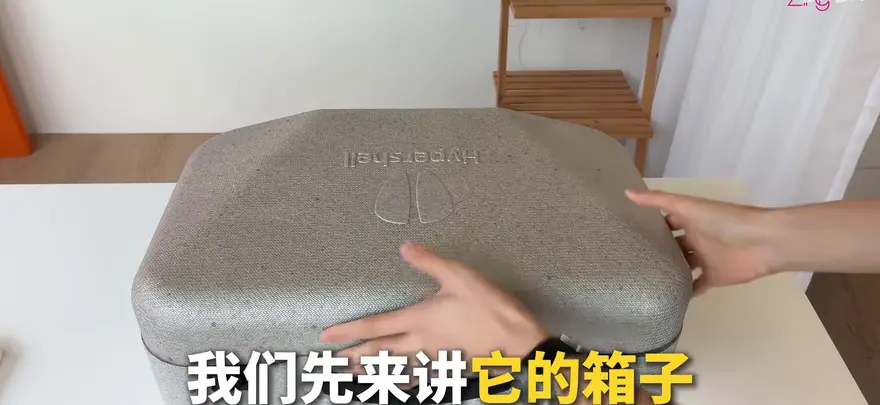
When it comes to a device designed to accompany us on our travels, portable packaging design is crucial. This time, the Hypershell XPro packs everything into a hard-shell case similar to a premium clutch bag. In addition to the main exoskeleton, it neatly stores the battery and charging cables. This all-in-one design makes carrying it from place to place extremely convenient, giving off a highly polished, premium vibe.
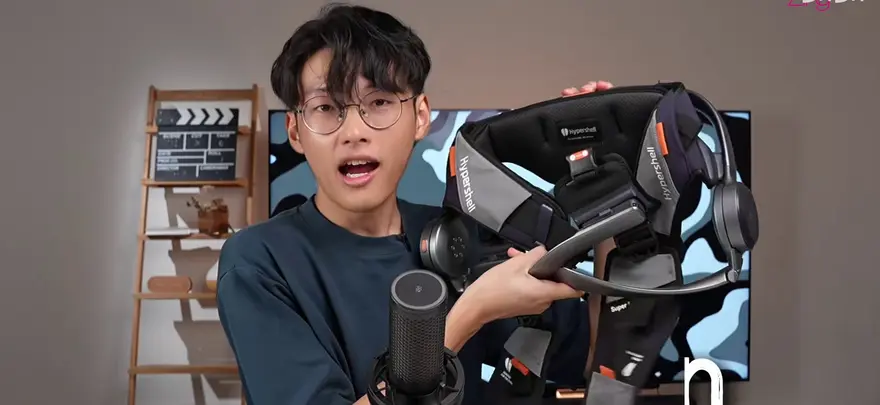
However, during the unboxing and packing process, I also noticed a few hits and misses in terms of the industrial design experience:
First is the storage logic that isn't intuitive enough. When you finish your first session and want to pack it away, you often have to stare at this array of mechanical structures for a while, wondering, "How exactly do I pack it away perfectly?" In an era where consumer-grade electronics increasingly prioritize "idiot-proof" interaction, this counter-intuitive packing experience is a drawback. If packing it away is this cumbersome on the very first try, believe me, you will simply not bother taking it out for a spin next time.
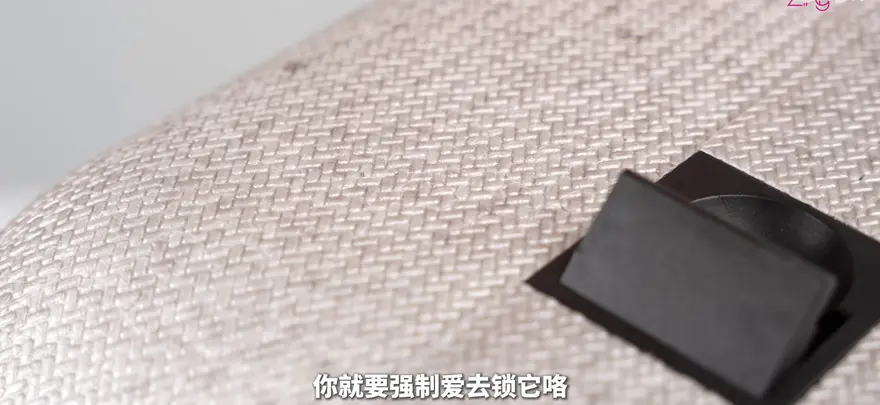
Second is the lack of mechanical confidence in the plastic latches. The critical locking hooks are made of plastic, and occasionally, if they don't snap into the perfect notch, the latches stick out slightly. This slight mechanical interference not only makes you worry about them snapping after long-term use, but also instills a subconscious sense of "insecurity."

Wearing Experience and Everyday Compatibility: The Heat Dissipation Curse and the Pocket Crisis
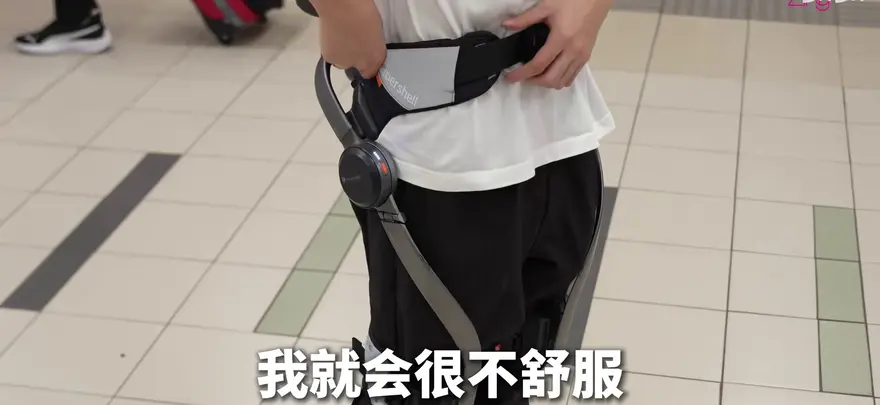
Putting on this exoskeleton is surprisingly friendly—the straps are sensibly designed for a “snap‑and‑secure” fit, and you can don it proficiently after just one or two attempts.
The outside of the knee is wrapped with a generous panel of foam padding. It feels akin to a thin pair of hiking knee pads, and this soft material not only provides a clear sense of support, but also prevents the outer thigh from feeling uncomfortably pressured under prolonged mechanical load.

That close fit between the sensors and your body, however, brings the “heat dissipation curse” familiar to every consumer-grade exoskeleton. Out on the trail or just walking, the contact zones where the hardware hugs your skin—especially at the upper thigh and lumbar areas—get unusually hot. In a Japanese summer, heat builds up almost instantly, “warming your lower back” in the most literal sense. Yet when you climb into higher, cooler altitudes (think the summit of Mount Fuji), that passive warmth turns into a physical boost; the experience is wonderfully peculiar.
In terms of daily compatibility, two pain points stand out the moment you head out wearing the device:
- Pocket stretch resistance: With certain pant styles, slipping your hand into a pocket while wearing the exoskeleton becomes incredibly difficult. For example, the pair of trousers I picked up from a film‑set wardrobe almost turn fishing my phone out, through the exoskeleton’s mechanical frame, into a genuine battle of fingers.
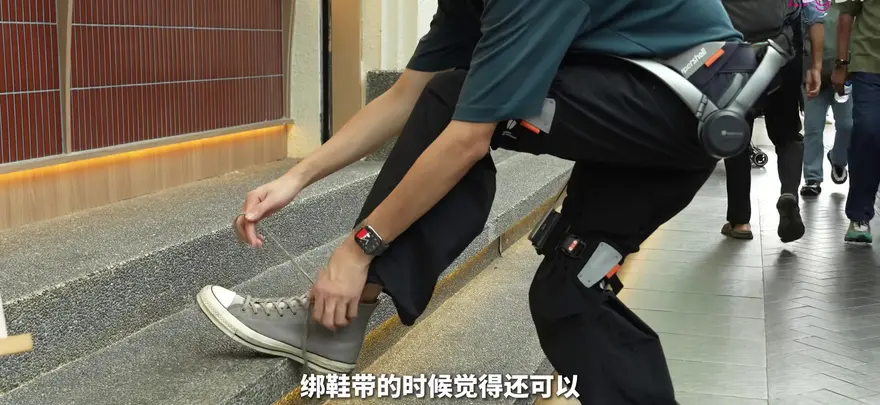
- Seating conflicts: The good news is that sitting down to tie your shoes causes no obvious obstruction. That said, you must avoid chairs that are too narrow—the wider joint structures of the exoskeleton can prevent you from squeezing in altogether.


Backpack Pressure and Force Interference: A Physical Tug-of-War with Your Rucksack
During this Mt. Fuji trip, I encountered the most frustrating physical compatibility issue: backpack pressure.
If you are used to carrying a rucksack with a rigid suspension system (like the HD Design backpack I was using), wearing a Hypershell exoskeleton for walking assist creates a direct problem. As you stride, the backpack's shoulder straps press directly against the exoskeleton's hard hip-assist shell, applying a persistent downward force. This is not only highly uncomfortable; it also skews the force distribution, creating a risk of the exoskeleton slipping downward.
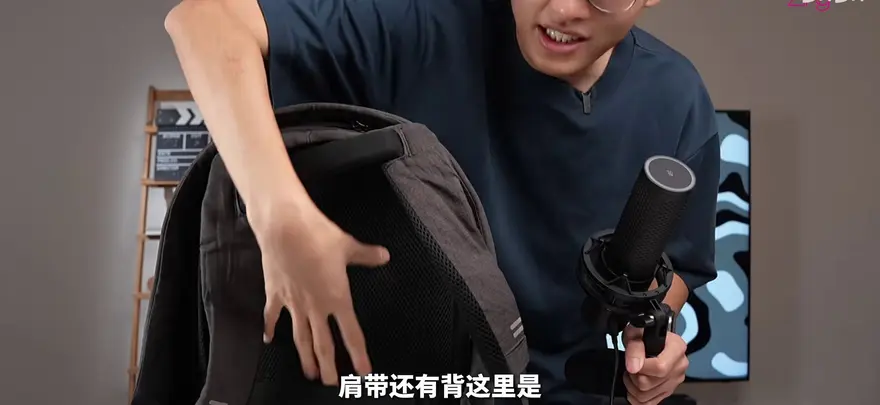
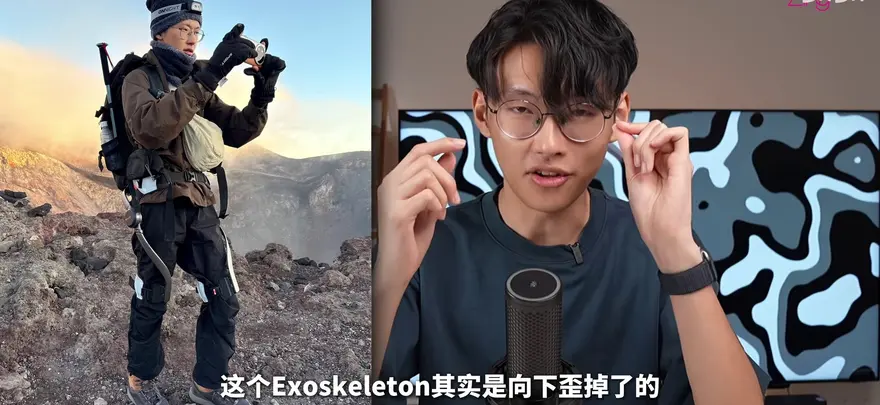
For the ascent of Mt. Fuji, I carried a professional 50L backpack loaded with roughly 10KG of gear. Due to the backpack's persistent pressure, you can see in the photos that the exoskeleton visibly tilts and shifts downward. The downward pulling sensation on the exoskeleton was only kept from becoming overly obvious because I was wearing a specialized outdoor inner layer underneath (the "Go Home" layer mentioned in the video).
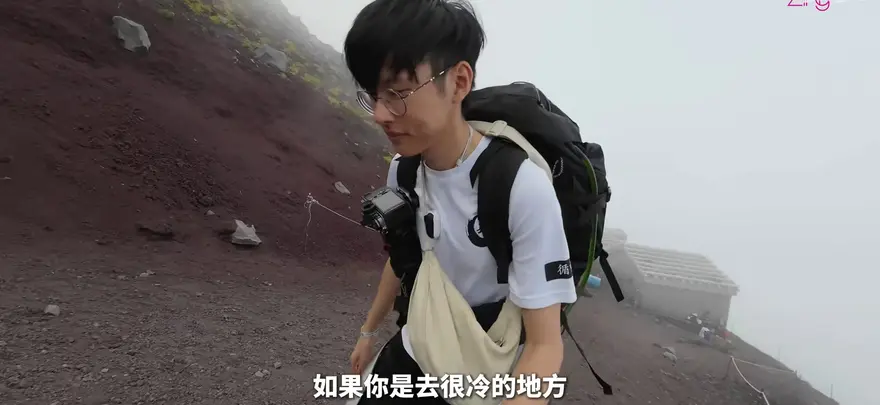
To address this issue, you can adopt two strategies:
- If you must wear a rucksack, opt for a model with a shorter back panel. This ensures the suspension straps don't sit right on top of the hip-assist housing.
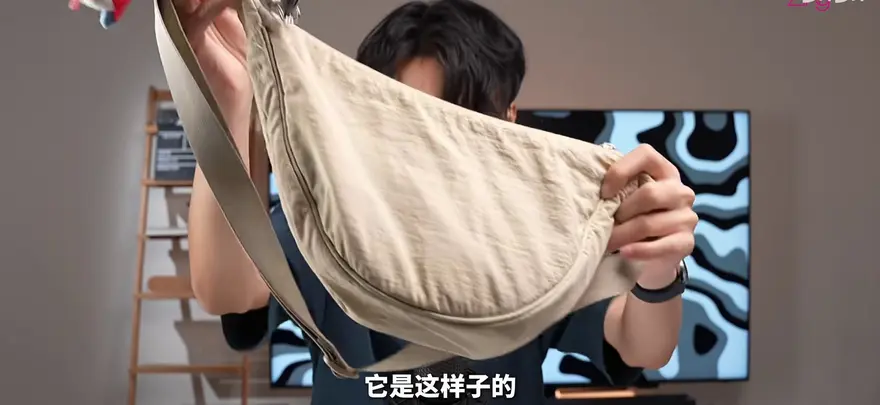
- The ideal solution is to skip the rucksack entirely and pick up a unisex sling bag (like from Uniqlo). Carrying your gear across the front of your chest allows easy access to your camera or phone, while flawlessly avoiding any mechanical interference with the exoskeleton.

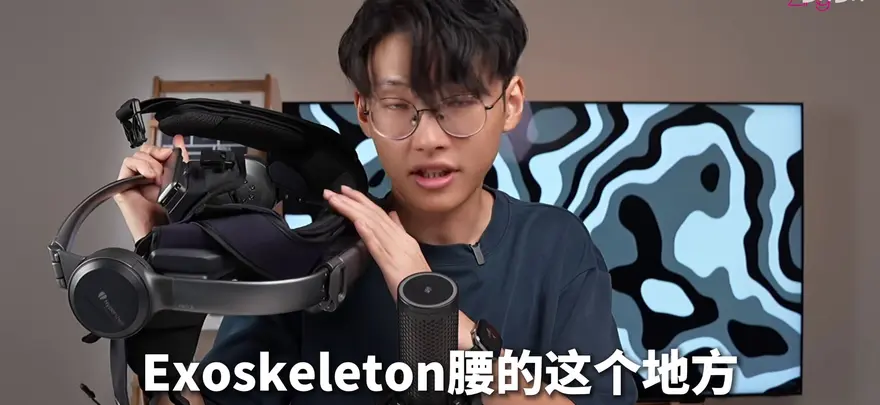
Core Complaint: Mode Experience and Altitude Endurance Challenge
As an excellent exoskeleton for walking assist, the power modes and battery life / runtime are its soul. But this time, in the rapidly rising altitude environment of Mount Fuji, Hypershell gave us the most profound lesson on runtime.
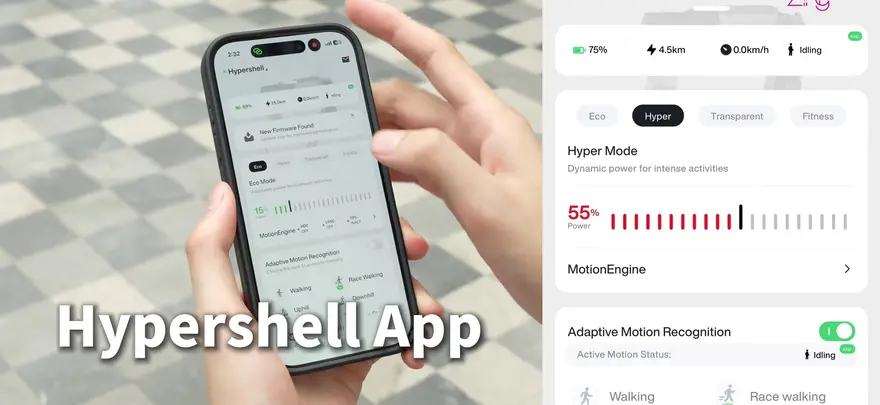
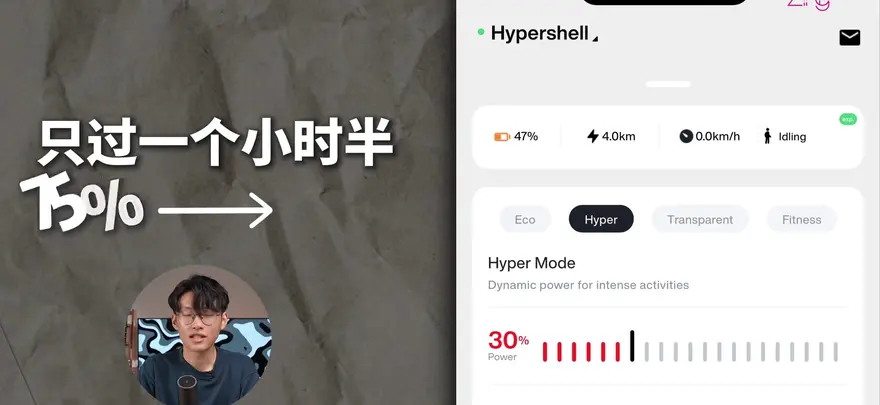
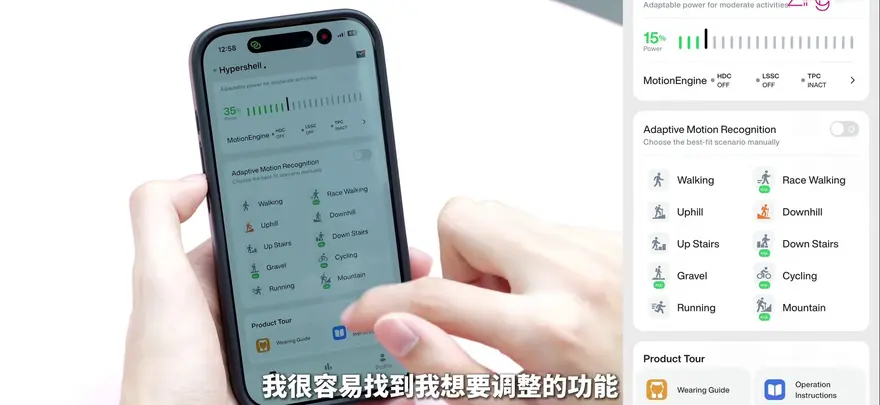
The product features multiple built-in assist levels. At the beginning of the climb, I tried switching on the high-torque Hyper-Mode (mistakenly transcribed as "HyperMood" in the video, referring to the high joint torque mode). However, as the altitude increased, my physical strain forced me to drop the assist level to 30% (in the video it is first lowered to 30%, then corrected to Eco-Mode at 40%—objectively speaking, this reflects a slight slip of the tongue or fine-tuning of the settings). Even so, the energy consumption was staggering:
After turning on the stronger assist level, the battery dropped below 50% in just about 1.5 hours. By the time we reached the area near the eighth station (misrecognized as "Ba He Mu" in the video), it completely drained and shut down.
If you have a slender Asian body type (the uploader jokingly refers to it as a "child's build"), directly using Eco-Mode during daily use or light trekking assist not only makes the powertrain run smoother and more comfortably, but also saves a great deal of battery power.
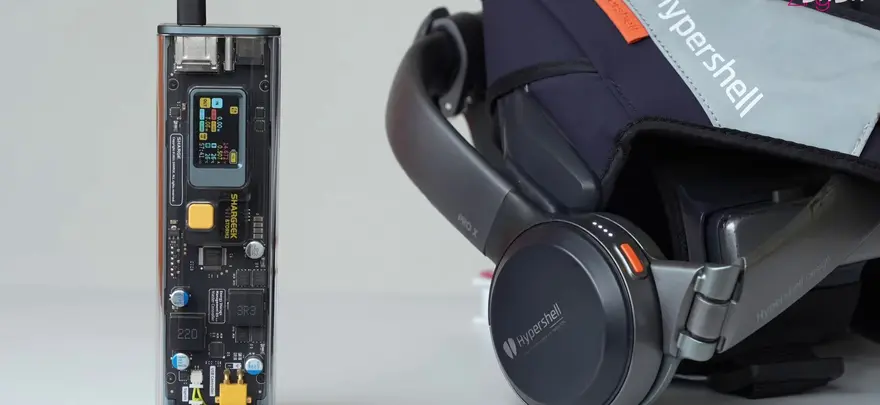
For charging, it supports PD 65W fast charging and can be fully charged from zero in about 1.5 hours. But while hiking outdoors, it's hard to find an outlet for a leisurely recharge. Charging it in camp with a small power bank is out of the question. You'll need at least a massive 20,000 mAh "brick" power bank; if you want to go hardcore, a professional outdoor portable power station with a capacity of over 90 Wh and a clear digital battery display is the real solution. Needless to say, after charging the exoskeleton, my 20,000 mAh power bank plunged to just 3%.
The Tech Debate on the "IQ Tax": Extending Tools and Human Limits
When I previously reviewed other digital gear, quite a few netizens complained in the live chat: "Ugh, wearing this to hike without building muscle is just paying an IQ tax."
I am firmly opposed to this kind of criticism—the "sin of novelty" that new forms of tech products inevitably face.
Tools exist to extend human limits, not to render people weak.
Think back to when Steve Jobs first launched the iPhone; it was mocked by the media as impractical. Early snowboards and modern hiking poles were once dismissed by old-school outdoor enthusiasts as "toys for wimps." But what happened? Everyone knows how history ended.
The essence of the exoskeleton is an evolution in the history of gear. It can save our energy from purely fighting gravity, allowing us to redirect it toward things that truly deserve our focus. For example, imagine you are a landscape photographer carrying over a dozen kilograms of tripods and gear to the summit of Mount Fuji to wait for the sunrise. With the support of an exoskeleton, the saved stamina allows you to focus 100% on composition and creation.
In a broader context, this holds an even more touching significance. Many individuals recovering from severe injuries or elderly people still yearn to travel and see the world step by step, but their bodies simply won't allow it. The emergence of the consumer-grade exoskeleton gives them one more chance to regain their freedom—allowing them to experience the beautiful world once again, even if their physical strength and muscle explosiveness are nowhere near what they were in their youth.
This is the ultimate meaning of a tech product.
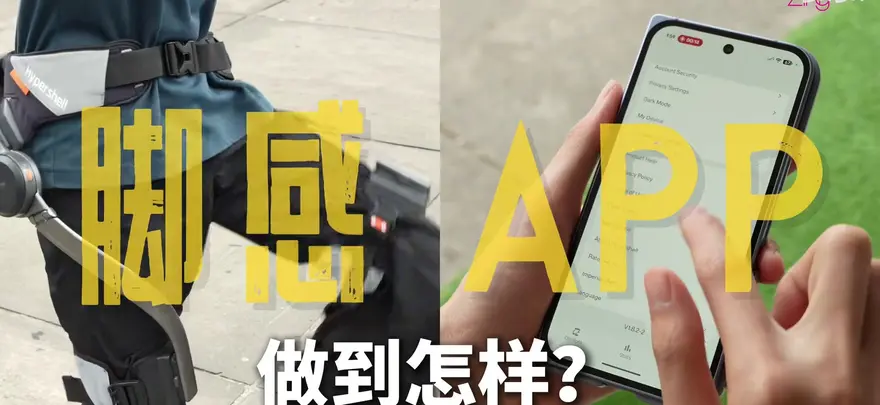
Target Users and Buyer's Guide
Strip away all the discomfort of the break-in period—when we put the Hypershell XPro on the scales as a current consumer-grade exoskeleton, is it actually worth buying?
Objectively speaking, if you’re approaching it as a “daily assistive device,” its price isn’t cheap. But once it’s on the market, you’ll struggle to find a direct competitor at the same level. And when you compare it to traditional rehabilitation exoskeletons that can cost hundreds of thousands to over a million, its price band delivers extremely strong value for money.

I strongly recommend the following two groups to try it:
- Hardcore hikers / trekkers: especially those whose legs tend to get fatigued early, but who don’t want to give up the trail completely and rely solely on cable cars.
- Heavy-load content creators / photographers: teams or individuals who frequently carry heavy optical gear across outdoor terrains.
Of course, the trade-off is this: you’ll need to change your habit of wearing a backpack and prepare a heavy, high-capacity outdoor power station to address any battery life anxiety.




Top Community Comments
As the video has not yet garnered a substantial number of comments on the platform, as a tech media writer, I have distilled five representative controversies and comments that might be raised based on observations of the broader exoskeleton user community and this product. Here are my insights:
“Spending ten thousand yuan on an iron frame to wear on my legs for hiking? Can't I just use my own muscles? It’s a pureIQ tax (IQ tax / waste of money)!”
Insight: This reflects the public consumer's natural defense mechanism against the "democratization of technology." Traditional thinking suggests that one must possess a strong physique to "overcome fatigue," rather than relying on machines. This viewpoint overlooks the value of tool evolution.
“The carbon fiber is indeed light, but the design of this version just grazes my pocket, making it extremely difficult to get my phone out. Wearing this thing out basically means saying goodbye to kangaroo pockets.”
Insight: This hypothetical comment precisely points out the contradiction between the industrial design of the exoskeleton and its compatibility with daily commuting attire. Aligning the reduction in hardware volume with human daily movement habits is a common design challenge for all wearable devices.
“Walking around in this thing in the summer feels like having a heating pad strapped to my legs. If they don't fix this heat issue soon, who would dare to buy it?”
Insight: Heat generation is an inevitable physical pain point when precise power structures are in long-term contact with human soft tissues. It is also a technical barrier that consumer-grade exoskeletons must overcome to move from "prototype" to a "daily essential."
“Does it have fall protection? If I trip and fall on rocks while hiking, and the machine directly injures my leg, who is responsible for that?”
Insight: The potential for secondary injury to the human body from safety mechanisms or collapsing rigid structures after a critical failure is the most common worry in this category of product insurance. Whether a high-joint torque output device is equipped with reliable braking and shock absorption mechanisms determines its ethical baseline for use.
“I wanted to take it on a trip, but I was forced to take it off and have it inspected by security at the airport. Plus, I have to carry a several-kilogram 'brick' power bank. Am I supposed to lose weight just for the sake of going hiking?”
Insight: This grievance highlights that exoskeletons are still constrained by aviation transport rules and the bottleneck of battery energy density development. It reminds us that the commercial maturity of the consumer-grade hardware-software ecosystem still has a long way to go.
One-Sentence Summary
The Hypershell XPro is by no means a couch-potato gadget that lets you slack off. Instead, it is a physical limit extender that requires you to "get used to it" before it can "unleash you". It is highly recommended for those hardcore explorers who still yearn to head out into broader terrains, but occasionally need an "external power-up" for their leg strength.
About this article: part of Chinese-Made Exoskeleton Review Archive — an independent, regularly updated English archive of reviews of consumer exoskeletons made in China, edited from publicly available video transcripts. Not an official manufacturer page.
For inquiries and purchasing, contact lonlonago@foxmail.com. More in Reviews · All articles.