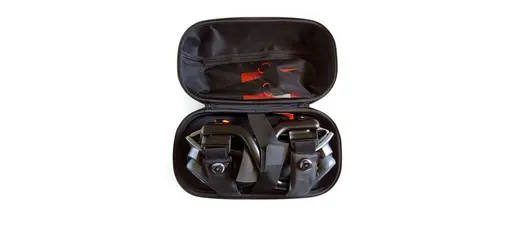
Budget dictates the category, scenario determines the structure: A buying guide to 16 wearable assistive devices from $50 to $14,800
The moment you type "exoskeleton" into your shopping cart, you've likely already fallen into a category trap without even realizing it.
Exoskeletons Are Becoming the Most Chaotic Category
Over the past two years, the exoskeleton boom has been driven half by outdoor enthusiasts and half by the silver economy. Here's the problem, though: when you search for "exoskeleton" on shopping platforms, the results range from a $50 "knee-assist breathable brace" to a $14,800 "smart walking robot," featuring a massive price gap and entirely different functions.
Video opening observation: The price gap for these products is massive, and their functions are completely different. What's even more headache-inducing is that some products brand themselves as exoskeletons but are actually just ordinary assistive devices that provide absolutely no structural support.
Establish Three Classification Coordinates Before Setting a Budget
The video doesn’t rush into recommendations; it starts with the judging criteria: first clarify what problem you’re trying to solve, then talk about budget.
First, identify which part of the body the need falls on. If you can’t power up the knees on stairs, you should consider a knee assistive device; if your fingers are not flexible, you should look at a rehabilitation glove; only when walking becomes strenuous overall should you consider a lower-limb exoskeleton, hip assist, or even an advanced solution with self-balancing and fall protection.
Second, check whether it has active power. Passive support relies on metal hinges, support bars, and straps for pressure distribution; active assistance relies on sensors, servo motor / brushless motor, and a battery.
Third, consider the user profile and use scenarios. Devices for daily use by older adults, hiking / trekking assist products for young people, and home-based rehabilitation exoskeleton solutions for hemiplegia are almost three different product logics.

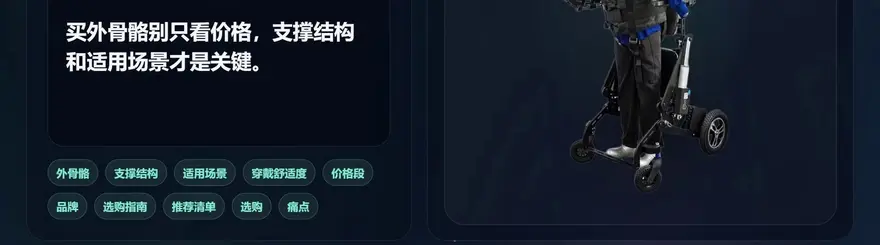

Spotting Fake Exoskeletons: Separating “Breathing Ease” from “Supportive Feel”
In the price band of 50 to 15000 yuan, the easiest way to pay extra is buying “exoskeleton-like” products whose structure is essentially just straps. The video’s correction is clear: a product in the tens-of-yuan range is likely to be a general assistive device, not a medical device, and it cannot be treated as rigid support.
The judgment isn’t about what the seller claims, but whether it has three hard features:
Key features: a supportive structure, active power or passive force transmission, and a clearly defined use scenario.
If a product only advertises “easier breathing” but can’t explain where the force comes from, where the support points are, or whether it has passed medical device filing/registration, then it most likely belongs to an entry-level assistive aid; before buying, you should adjust your expectations down to “lightweight assistance.”
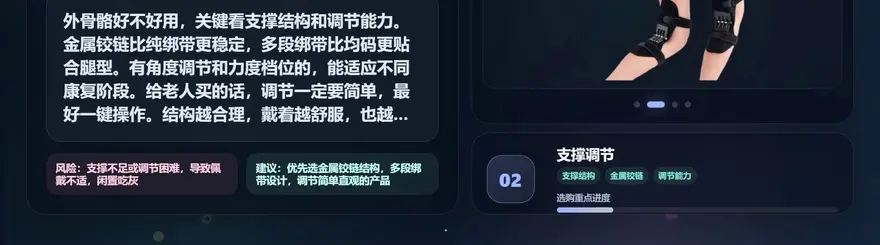

First, Structure Determines the Support Limit: Metal Hinges Must Align with the Joint
The underlying principle of an exoskeleton is to share pressure. The video points out that pure straps can only “cinch,” while metal hinges can “brace”; multi-segment straps fit better than single-segment ones; and before buying, you should check for angle adjustment and force levels.
For more advanced products, look at joint torque. Joint torque is a core spec of an exoskeleton—it’s the assistive torque that a servo motor / brushless motor can apply to a human joint, measured in Newton-meters. It directly determines assistance strength: the higher the value, the greater the pushing force, but it also implies a heavier structure and potentially stronger interference with gait.
Also check the sensors. An IMU captures posture and motion signals, and a pressure sensor detects plantar pressure or ground-contact pressure. Together, they help determine “when assistance should engage, and how much force to add.” Missing either can easily turn assistance into interference.
Second, Check Weight Before Battery Life: Uncomfortable Devices End Up Abandoned
Many people don’t stop using what they bought because they don’t want it—it’s because it’s too heavy, too stuffy, or too troublesome. The video reminds viewers that weight and breathability cannot be ignored.
Lightweight design and breathable mesh fabric are not marketing buzzwords; they are key factors in whether you’ll wear it every day. If it’s hot and stuffy in summer, even excellent support is wasted; and if the straps around the ankle, knee, or hip take more than ten minutes to put on or take off, using it for older adults can become very limiting in practice.
For Seniors: The Simpler the Adjustments, the Better
When an elderly person struggles to climb stairs, don't leave them fumbling for half an hour with battery compartments, strap lengths, and ankle cuff angles. The selection principle is clear: minimal adjustments, least operational steps, and the most honest expectations.
Video note: Entry-level models offer limited support strength; they cannot replace medical devices, and extended wear may feel stuffy.
This also means items priced between $5 and $30 are better suited for light assistance rather than medical treatment. For products that genuinely require medical-device properties, you must check for official filings, certifications, and intended user demographics.
Third, Certifications and Expectations: Medical-Grade and Consumer-Grade Are Two Different Tracks
The video highlights a frequently overlooked signal: some exoskeletons are medical-grade devices, while others are just ordinary assistive products.
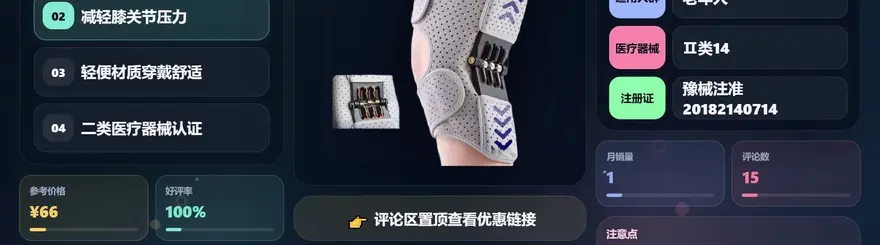
When selecting for the elderly or patients, it is best to choose products with official filings, registration certificates, or medical-device attributes. Medical-grade devices undergo strict certification and registration, explicitly targeting rehabilitation therapy or functional training. Consumer-grade products have a lower threshold, making them suitable for daily use, relieving exercise fatigue, and providing light assistance, but they cannot replace professional medical treatment.
The video explicitly mentions that Product #15, the Xiaomian'ao KFY-1, is a Class I medical-grade product with official filings; whereas Product #16, the Yingzhun Z2, is a non-medical-grade product and cannot replace professional treatments.
Meanwhile, it is essential to distinguish between a rehabilitation exoskeleton and a consumer-grade exoskeleton. Rehabilitation exoskeletons are primarily aimed at hospitals, institutions, or guided professional use, with goals centered on treatment and gait reconstruction. Consumer-grade exoskeletons lean more toward portability, lightweight design, everyday use, and sports assistance. The two cannot be simply differentiated by whether they "have a motor."

Fourth, Budget Determines the Category: What You Buy at 4 Price Tiers is Completely Different
The video conducts a comparative review of 16 products ranging from 50 to 15,000 RMB. The core judgment is that within this price span, your budget dictates the exact category of product you are buying.
Key Takeaway: What you get for 50 RMB and 15,000 RMB are fundamentally not the same thing. The budget determines whether you are buying passive support or active power output, daily assistance or medical rehabilitation training—they are simply not the same class of merchandise.
The table below serves as the backbone of this guide, and all subsequent individual product evaluations revolve around this layered logic.
(Table data derived from the machine lineup in the video, covering Products #1-14 out of a total of 16; however, due to segments omitted in the middle, some products are retained with only core information. Thus, following the verifiable head-and-tail products: the video clearly categorizes the key reference models with defined prices or categories into 10 distinct tiers, rather than 16. Prices in the video are displayed as list prices, based on the latter segment's machine lineup: Product #15, the Xiaomian'ao KFY-1, is priced at a minimum of 3,900 RMB, and Product #16, the Yingzhun Z2, is priced at 14,800 RMB. Complete prices for the remaining models were not provided.)
| Budget Tier | Typical Price | Total Price for Multiple Models | Product Category | Core Features | Typical Products |
|---|---|---|---|---|---|
| Hundred-RMB Tier: Entry Assistance | Starting around 50 RMB | Several hundred RMB total for Products #1-4 | Pure Mechanical Passive Support | Motorless and battery-free, utilizing straps and support bars to distribute weight, mainly targeting localized support for the knee, lumbar, and back | NLKS Knee Assist Exoskeleton (approx. 50 RMB tier), Yuhao Exoskeleton Knee Assist Device (approx. 260 RMB tier) |
| Thousand-RMB Tier: Sports Scenarios | Approx. 1,299–1,999 RMB | Several thousand RMB total for Products #9-12 | Active Electrically-Driven Assistive Exoskeleton | Primarily provides hip assist, utilizing IMU / pressure sensors for walking assist, with servo motors providing joint torque. Targeted at self-reliance in mountaineering and hiking, relying on single-charge battery life and active assist recovery | Models from brands like Chengtian, Kenqing, Aoshark, TOREAD (Key reviewed in the video) |
| High-End: Medical Assistance | Approx. 1,299–14,800 RMB | Over 30,000 RMB total for Products #13-16 | Rehabilitation Training & Standing Assist Equipment | Approaching medical device standards, including patient lifts and walking robots, used for passive standing and transferring in hemiplegia rehabilitation or for lower-limb mobility issues | Xiaomian'ao KFY-1 Patient Lift (Product #15, min 3,900 RMB), Yingzhun Z2 Smart Walking Robot (Product #16, 14,800 RMB) |
Hundred-RMB Tier: Power-Free Devices Can Become the "Third Leg" for Seniors
This price bracket is the most suitable for independent operation by the elderly, and only by aligning your expectations correctly can you avoid buying the wrong product. Starting with entry-level models priced at over 50 RMB per leg, the video's core logic revolves around three points: lightweight, easy to wear, and capable of weight distribution.
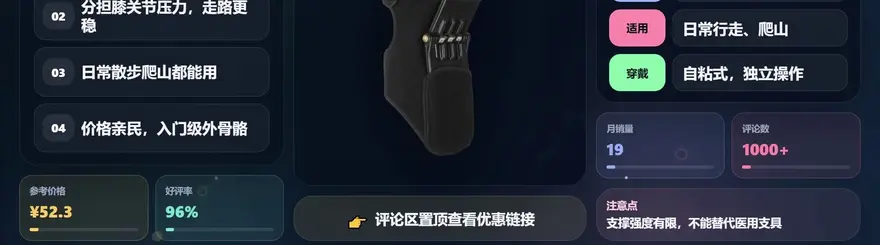
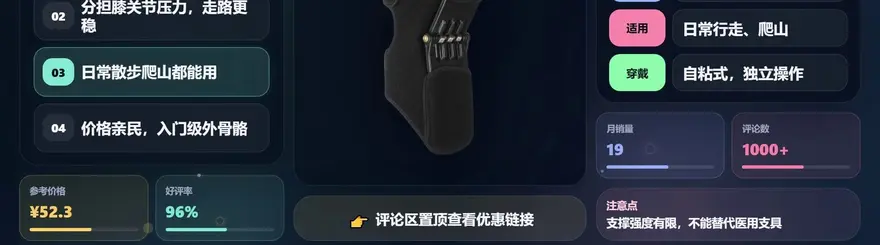
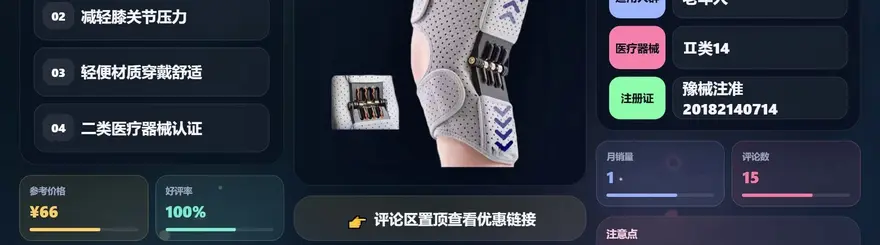
NLKS Knee Assist Exoskeleton. The video describes it as an entry-level joint assistive device primarily designed to solve issues of knees buckling on stairs and legs feeling weak on mountain trails. It attaches to the knee joint via straps and uses a supporting structure to distribute body weight, reducing joint pressure. It features simple wearability, is self-adhesive, and made of lightweight materials.
Its applicable scenarios include daily walks, grocery shopping, and climbing stairs; it can also provide extra support on occasional mountain paths. The limitations are equally clear: it is an entry-level product with limited support strength and cannot replace medical devices; it lacks hinge angle adjustment, and extended wear may be stuffy. Priced in the video at "barely over 50 RMB," it is suitable for providing light assistance to seniors whose knees do not bear a heavy burden.
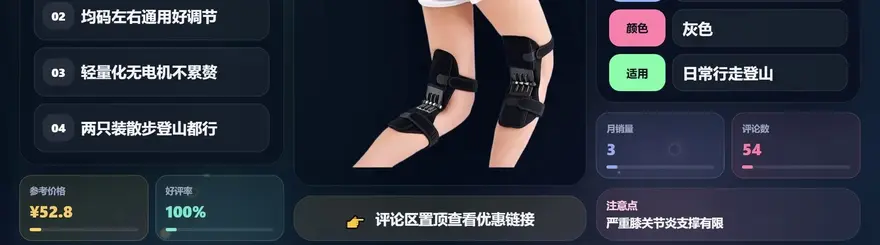
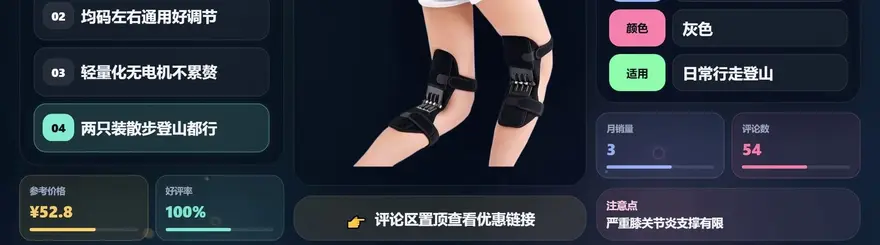
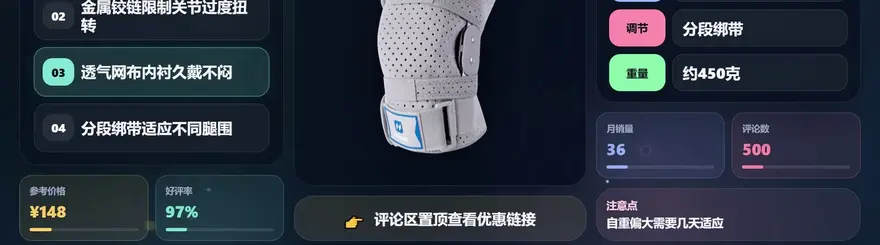
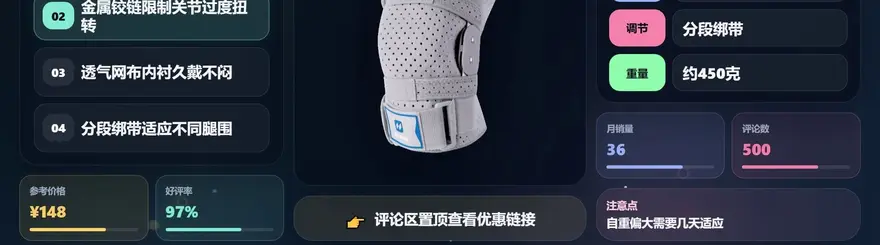
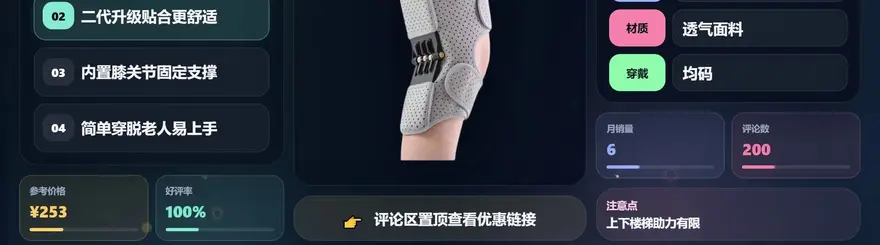
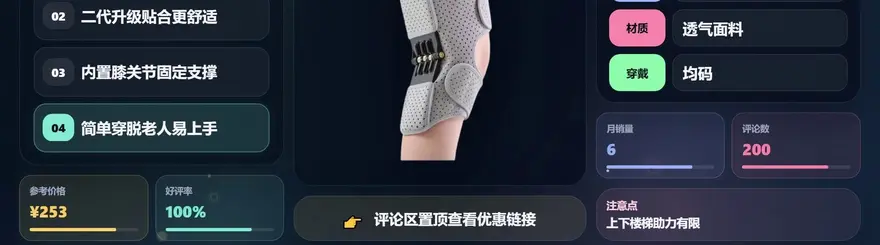
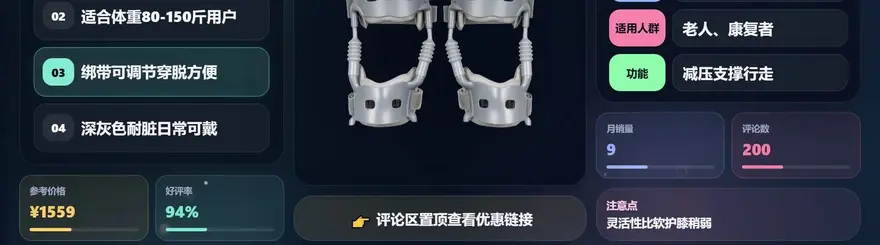
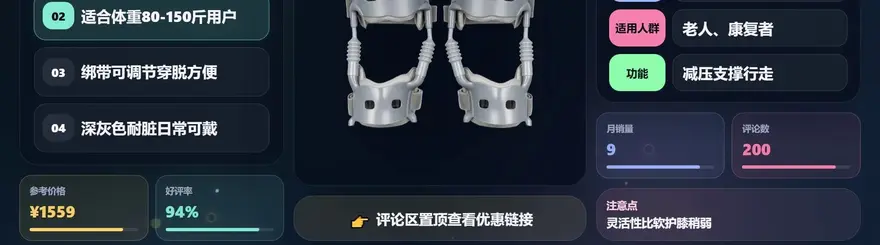
Yuhao Exoskeleton Knee Assist Device. Aimed at elderly individuals with knee weakness, suitable for daily walks and hiking. The exoskeleton structure lifts the outer sides of the knees bilaterally, reducing walking pressure; it is unisex (fits left and right legs), has adjustable straps, and accommodates most leg shapes; it comes as a two-piece set covering both legs; it is motorless and battery-free, making the overall unit lightweight.
However, it also has applicable boundaries. The video explicitly mentions that for individuals with severe knee tension, or unusually thick/thin legs, the fit may deteriorate, and it cannot replace medical devices. Nevertheless, its broad side support surface makes it easier for seniors to leverage strength when climbing stairs. For low-intensity scenarios like strolling through a wet market, there is no battery life / runtime anxiety, and it offers high tolerance for varying leg shapes.
Thousand-RMB Tier: Active Electric Drive and Sports Scenarios – How Chengtian, Kenqing, Aoshark, TOREAD Divide the Scenarios
When the budget reaches the thousand-RMB tier, the category jumps to "active assistive exoskeletons" equipped with motors and sensors. Buying into this price bracket isn't just about "buying support"; users are paying for recoverable physical stamina through active electric drive, walking assist perception, and lightweight design.
The products named in the video cover brands such as Chengtian, Kenqing, Aoshark, and TOREAD. Compared to the previously mentioned unpowered, pure mechanical straps, the core underlying metrics for products in this tier remain joint torque, battery life, and max payload.
Product #13 in the video, the Power-Assist Knee Exoskeleton (belonging to the sports scenario class rather than a newly released walking assist device), is the most representative. The core differences between it and entry-level purely hydraulic products lie in three points:
- It employs sensors to perceive lower-limb posture, enabling assistance that moves harmoniously with the body;
- It utilizes a servo motor to provide active joint torque, rather than passive support;
- It features a lightweight design explicitly tailored for prolonged outdoor scenarios like mountaineering and hiking.
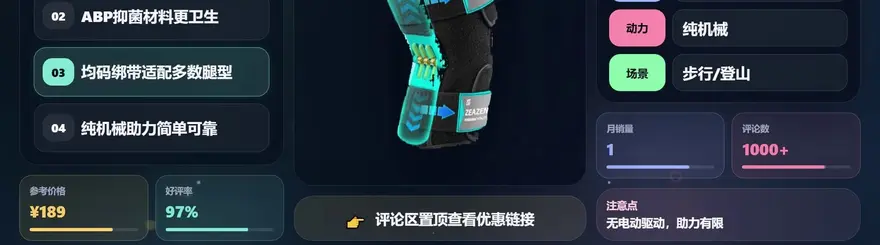
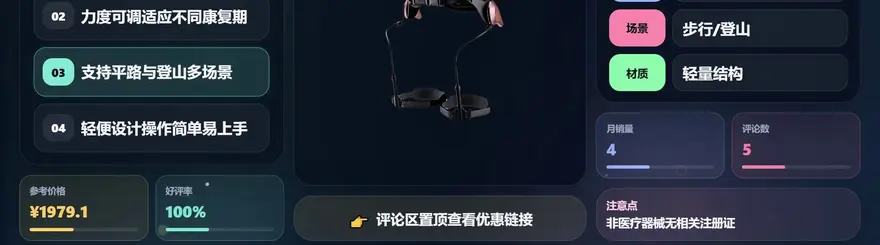
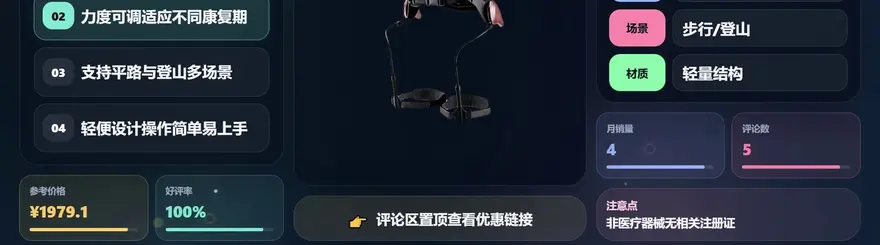
The video's assessment of this type of power-assisted knee model focuses on "multi-scenario use for mountaineering, hiking, and cycling, with everyday assistive models emphasizing comfort"—it can actively output thrust during sports scenarios, while keeping the passive weight extremely low when the assist is not activated, making it burden-free to wear. Lightweight design, powered assistance, and mountaineering/hiking/cycling represent the common spectrum of this tier.
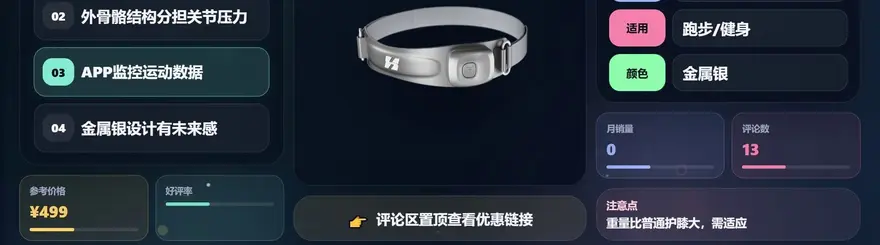
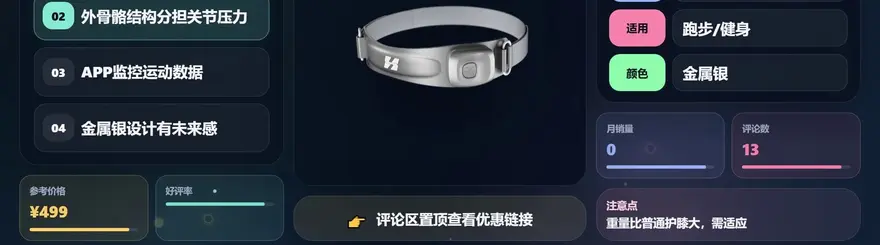
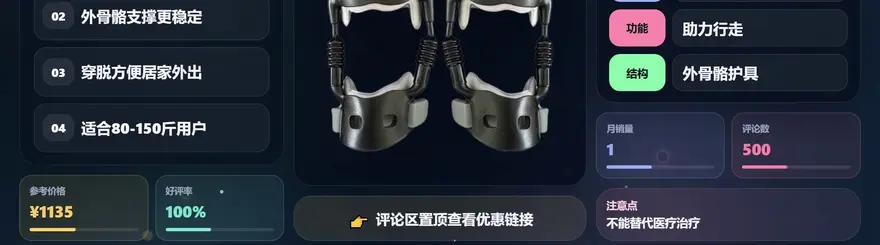
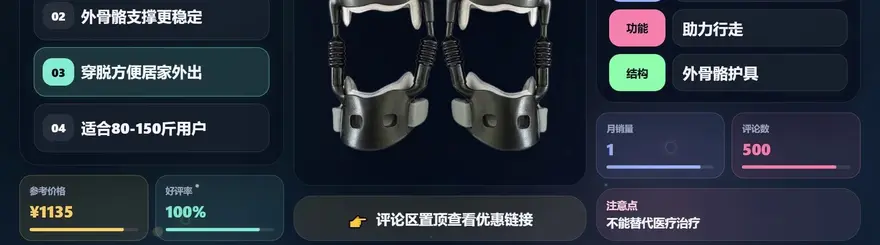
Four Popular Assistive Exoskeletons: The Difference Lies Not in "Whether It Can Assist," But in "Where It Assists"
From a product-review perspective, the real differentiation in this ≈1,000-yuan class of motion exoskeletons is not "whether it has motors," but where the sensors detect your intent, how the motor delivers joint torque, and which scenarios are best suited.
Video note: When evaluating an active-assist exoskeleton, focus on its type, assist mode, use scenarios, weight, and positioning—not merely the headline.
| Brand | Assist Point | Wearing Feel | Best-Fit Scenarios | Limitations |
|---|---|---|---|---|
| ChengTian (Chengtian) | Power assist mainly around the knees | System-level coordinated assist; relatively smooth sensation | Light daily walking assist with motion-aware activation | Weight and structure require careful comfort trade-offs |
| Kenqing (Kenqing) | On-demand active assist | Clear assist engagement at key moments (downhill control, pedaling push) | Stair descents and long uphill sections | Strong leg activation; may take time to adapt for long sessions |
| AoSha (Aoshark) | Ergonomic contouring | Firmer support; exoskeleton presence is more noticeable | Hard surfaces, rocky mountain trails, extended use | Under high joint loads, straps must be secured for a snug fit |
| Toread (TOREAD) | Lightweight design with integrated assist | Relatively easy to carry | Large-volume trekking; group hiking on flat terrain | On extremely steep sections, additional tools may still be required |
For everyday consumers, products at this price tier are closer to "athletic assistive devices" than medical rehabilitation tools. To use them well, you first need to practice your gait. In this price range, gait training is typically a companion feature for sports scenarios rather than a medical capability.
Battery life, payload, and self-balancing are exactly what advanced buyers regret ignoring
The difference between an active exoskeleton and a passive device lies in the fact that it consumes electrical power and bears loads. Although the video didn't lay out every single specification, the logic is crystal clear.
Advanced purchasing requires looking at these first: battery life / runtime (the longer the endurance, the lower the per-use cost), max payload / load capacity (20 kg is usually sufficient, while exceeding it increases both the price and the weight), joint torque (determining the motor output), and lightweight materials like carbon fiber (reducing the burden of wearing it).
This means: users planning long hiking treks or mountain trail running need to include battery life and charging rhythms in their budgets; users wanting extra energy savings need to measure their body dimensions first; and users looking to buy lower-limb walking assist and self-balancing exoskeletons for their elders must evaluate "fall protection" as a strict criterion, rather than just asking "can it help them stand up?"
A satisfying downhill experience is often built upon these very details.



High-end Rehabilitation Focus: Xiaomiaonao KFY-1 Transfer Machine, and an "exoskeleton-like device that isn't an exoskeleton"
In the high-end tier, the product most easily confused with an exoskeleton is the 15th item, the Xiaomiaonao KFY-1 Transfer Machine.
It targets individuals with lower-limb mobility impairments, primarily offering assistive transfer and standing training. Its core function is the electric adjustment of three postures: sitting, lying down, and standing. Specifically, it is a single-person transfer machine with a wheeled base, which can be pushed by one person alone, facilitating transfers between the bed and a wheelchair, thereby reducing manual lifting steps. In the video, it is categorized as a Class I medical device, legally registered, with clear safety thresholds.
However, the video emphasizes: it is not an exoskeleton and cannot perform gait training; furthermore, if the patient has complete upper-body weakness, additional securing is required.
It is also a typical "care tool." Its value lies not in "letting the user walk further," but in allowing caregivers to combine "transfer" and "standing training" together, reducing the need for manual lifting by one step. Buying it means purchasing nursing efficiency, not purchasing walking freedom.

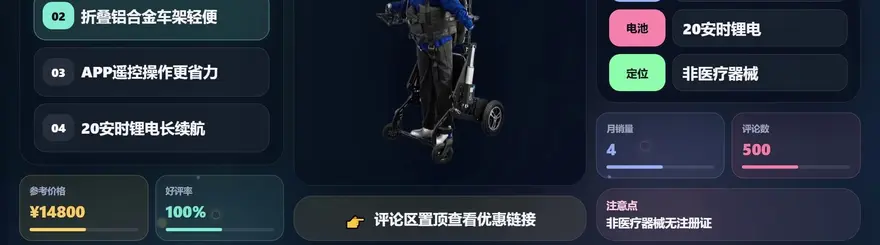
The 16th Item, Yingzhun Z2: 14,800-yuan home-based gait reconstruction, not a mobility tool
The final item in the video is the Yingzhun Z2 intelligent walking robot, priced at 14,800 RMB.
It primarily targets individuals with hemiplegia and gait rehabilitation training needs, assisting with both standing and walking. It features a lightweight, durable aluminum alloy frame that supports folding for storage; a fully automatic mode drives the lower limbs in repetitive motions to help reconstruct walking patterns; it is equipped with a 20-Ah battery, offering enough runtime for daily training sessions; and it can be controlled via a smartphone app to adjust speed and modes.
The boundaries to note are also clear: the video states that it is non-medical grade and cannot replace professional therapy. It is suitable for families with ample budgets who require long-term home-based rehabilitation.
From an engineering perspective, at this price point, what you are buying is not an "exoskeleton to help you hike mountains," but a "robot to help yourself regain your gait." It is suited for families with defined rehabilitation needs who are willing to accept its non-medical status. For those simply looking to save physical effort, this is a misclassified tool.
Top Community Comments
@Digital BigV: [¥50-150, Items 1-4]... [¥150-400, Items 5-8]... [¥400-1600, Items 9-12]... [¥1900-14800, Items 13-16]
This comment reveals that mainstream platforms manage their selections by price tiers: ¥50-150, ¥150-400, ¥400-1600, and ¥1900-14800. Each tier contains exactly 4 products, positioning the lower end as "entry-level reliance" and the mid-to-high range as "active off-roading," multiplying the performance levels. The platform's tiered pricing for users is highly distinct.
@Panting badger: Awesome video, made with great care
The video's medium-to-long-term investment research capabilities show that users in the long-tail market hold a welcoming attitude towards hardcore tool geeks. Many review videos need to let new products achieve their final reputation.
@Digital BigV (shared comment): The Taobao links are basically divided into four tiers, but the video didn't expand on the mid-section. It's like throwing half the information into the link, which makes it quite high for the comprehension cost.
This comment reflects a point of user confusion: the video focuses its communication on entry points and price anchors, lacking in-depth product analysis in the middle. This reduces the accessibility of the buying path and increases the difficulty for ordinary consumers to compare options.
@Thunder Chasing: Wanted to buy a commuter backpack. Watched the video and thought carbon fiber was lightweight, only to realize it requires charging and needs to be done daily.
This touches upon the pain points of lightweighting versus battery life, and the identity of independently purchased products.
@Zombie: Bought my first one for my mom for 50 RMB. Honestly, the functions are basic, but after bringing it home, she wears it every day, saying it's better than expected.
This comment reveals a counterintuitive fact: price does not determine usage frequency; wearability determines usage frequency.
@Just call me Ye: In the entry-level price range, it's positioned for a single leg knee. Is buying a twin-pack more friendly for the elderly?
This shows that some users are already entering the "split-leg usage" scenario, forming a combined experience prior to focusing on fracture protection.
@Independent Thinker: Skepticism regarding certified components. Why wasn't the focus placed on medical registration, but instead more on riding experiences?
This comment serves as a reminder: if our primary audience consists of people buying assistive devices for mobility-impaired Family members, then factors like registration, certifications, and fail-safes should be prioritized stronger.
@Dorozhnik (Roadbuilder): Asking for a recommendation: Looking at lower leg assists across different price tiers, I feel Aoshuang and Explore are both good, and considering KQin if it exceeds my budget.
This buyer's mixed purchasing flow beyond a home budget—"earning two thousand a month but wanting to travel within the province and also get smart outfits"—reveals how high-tier pricing guides consumer choices.
@Nail by the seaside: Highly informative, but you didn't cover buying crutches at the end. Would crutches be better for elderly fracture recovery?
This comment raises a question outside the category boundaries. For high-risk individuals in postoperative recovery, crutches might better meet their current needs; this guide doesn't cover such non-rigid substitutions.
One-Sentence Summary
This is a exoskeleton comparative review worthy of being called a "selection map": through 16 products spanning a ¥50 to ¥15,000 price spectrum, it helps buyers establish a judgment standard of "budget determines the category, features determine the power, and scenarios determine the structure." It is highly suitable for users ready to make a rational purchase but haven't yet gathered professional information, as well as those looking to buy assistive devices for their parents and family members who can directly follow the prescriptions for their specific conditions.
About this article: part of Chinese-Made Exoskeleton Review Archive — an independent, regularly updated English archive of reviews of consumer exoskeletons made in China, edited from publicly available video transcripts. Not an official manufacturer page.
For inquiries and purchasing, contact lonlonago@foxmail.com. More in Buying Guide · All articles.