Should Three Types of People Buy a Lower-Limb Exoskeleton? Hands-On with the Hypershell X Ultra S Shows How Far Consumer-Grade Exoskeletons Have Evolved
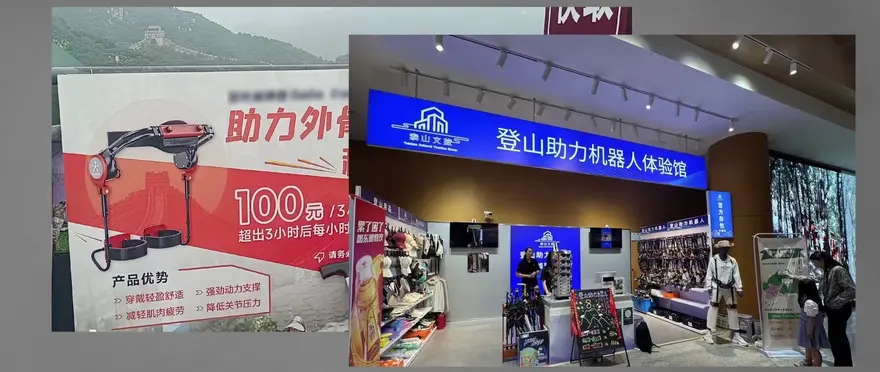
Consumer-grade exoskeletons are rapidly transitioning from "novelty toys" to "functional peripherals." In recent years, lower-limb exoskeleton rental services have sprung up at the foot of the Great Wall, the base of Mount Tai, and the Huangshan scenic area—affordable rates, easy on and off—pulling a category once confined to medical rehabilitation and industrial material handling squarely into the view of ordinary tourists and outdoor enthusiasts. This article draws on the real-world experience of a long-term user to break down "who should buy one, what to use it for, and how far it can actually go"—using the hands-on Hypershell X Ultra S as a benchmark to gauge where consumer-grade assistive exoskeletons truly stand in 2026.

Who Should Get a Lower-Limb Exoskeleton: Three Typical User Profiles
According to long-term users, the people who genuinely benefit from a consumer-grade exoskeleton aren't "everyone," but rather three clearly defined groups. Understanding these three profiles essentially means understanding today's market cross-section for consumer-grade lower-limb exoskeletons.
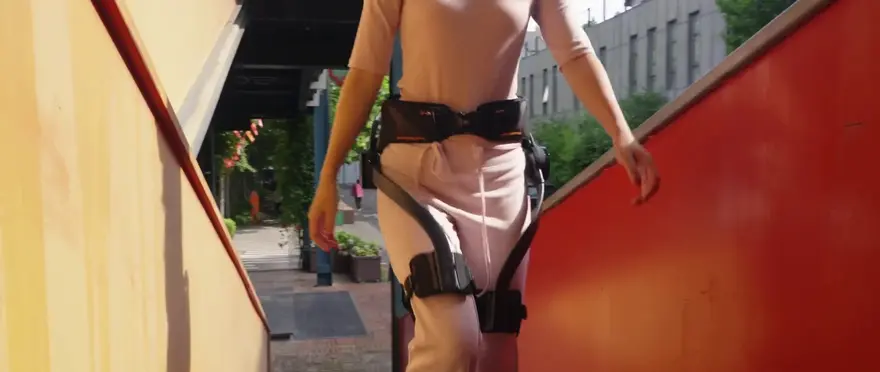
The first group consists of outdoor enthusiasts who hike frequently but have relatively weak physical fitness. The classic scenario is visiting "sightseeing" peaks like the Great Wall, Mount Tai, or Mount Huangshan — routes are well-developed, supplies are plentiful, yet the inclines are punishing. The user gave a vivid example: while hiking at high altitude alongside a professional mountaineer named "Feng Ge," he outweighed the pro by 70 to 80 jin and was left far behind the entire way, feeling "absolutely miserable." Had he worn a hip-assist exoskeleton at the time, he could have closed some of the gap with the professional.
The key value isn't "running faster," but "seeing better scenery at lower oxygen consumption and a lower heart rate."
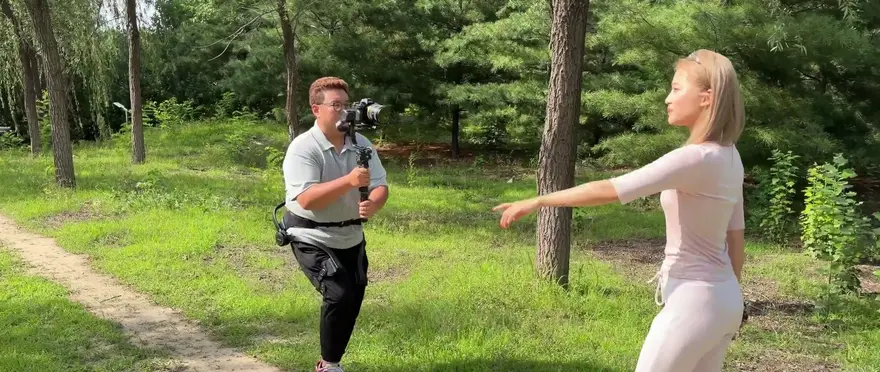
The second group is workers in high-intensity physical roles, most typified by the camera operators on outdoor productions — they have to carry filming gear while keeping pace with their subjects up the mountain. A lower-limb exoskeleton can significantly reduce their heart rate and oxygen uptake, letting them handle follow-shots with ease and even outperform the people they're filming in terms of physical condition. The user's view: companies should issue exoskeletons as standard gear for these "spearhead" roles, rather than letting employees tough it out on sheer bodily effort.

The third group requires extra caution — people in post-surgery or post-illness recovery with weakened physical condition. These users must strictly follow their doctor's advice and, only when cleared to use an exoskeleton, set it to the lowest assist level to help lift the leg and step forward, reducing overall energy expenditure during recovery and accelerating the rehabilitation process. The user stressed that exoskeletons are gradually becoming a supplementary tool in the recovery process for certain physical conditions, but they can never replace medical-grade rehabilitation exoskeletons, nor should they be used independently without a doctor's guidance.

One important counter-reminder: when heading into "wild mountains with no sausage or iced-tea vendors where people can die," do not rely on a consumer-grade exoskeleton. Its positioning is for tourism-style sightseeing, not as outdoor expedition safety equipment.
Load Relief: Gimmick or Real? Let Oxygen Consumption and Heart Rate Do the Talking
Many people's first reaction to an exoskeleton is that "the psychological effect outweighs the practical effect." But from the data repeatedly measured by users in real-world testing, at least at the "appropriate assistive level," the load-relief effect is quantifiable — and quite dramatic.

Mentioned in the video: Under the most suitable assistive setting, a single user's oxygen consumption can drop by about 40%; heart rate can drop by about 40%–45%.
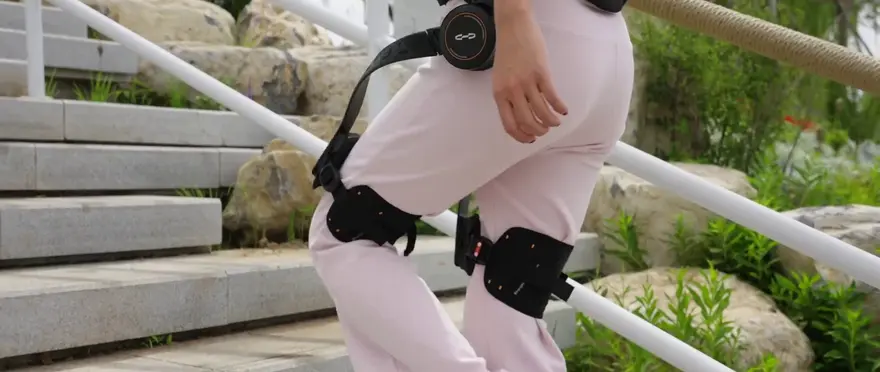
What does this mean? The user's interpretation is highly intuitive: climbing a slope at an altitude of around 3,000 meters feels almost like climbing a slope at sea level. For scenarios that are extremely sensitive to cardiopulmonary load — such as high-altitude hiking / trekking assist — this kind of reduction isn't "icing on the cake"; it's the difference between "can you make it up there or not."

Of course, it's worth being objective here: this dataset comes from the user's own perceived exertion and device feedback, not from an independent third-party laboratory; and the "most suitable assistive level" itself depends on the recognition accuracy of the automatic mode, so it cannot be stably reproduced across all terrain conditions. But even after discounting for that, the magnitude is still exceedingly rare among consumer-grade wearables.
Hypershell X Ultra S: The "Flagship Benchmark" of Consumer-Grade Exoskeletons
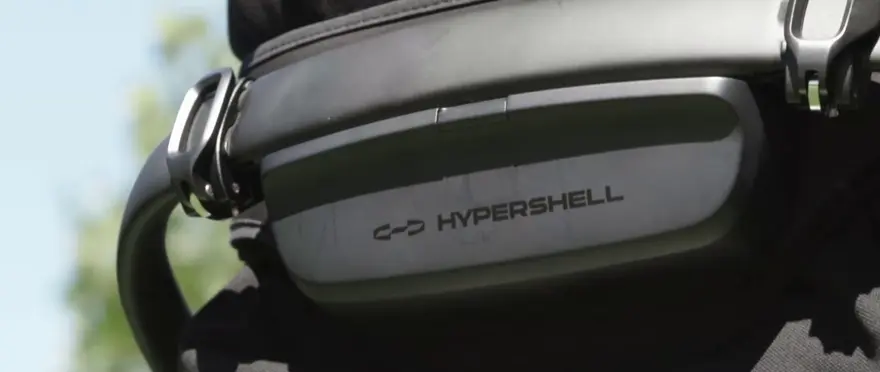
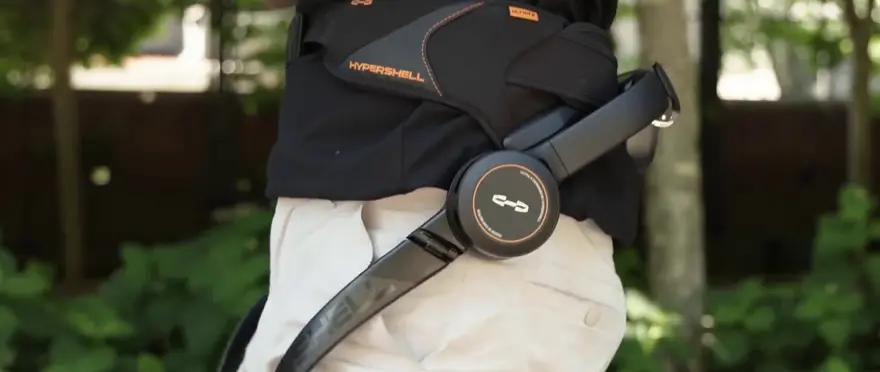
To illustrate "how far consumer-grade exoskeletons have evolved," the user simply brings out the Hypershell X Ultra S right beside them — the latest flagship offering from Hypershell, currently one of the mainstream lower-limb exoskeleton manufacturers.

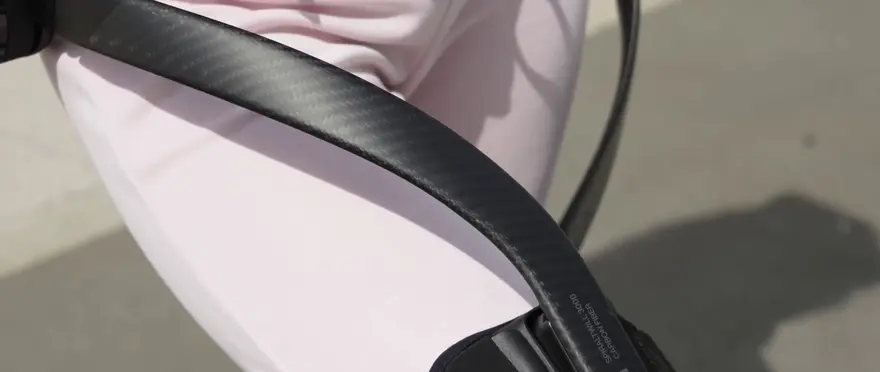
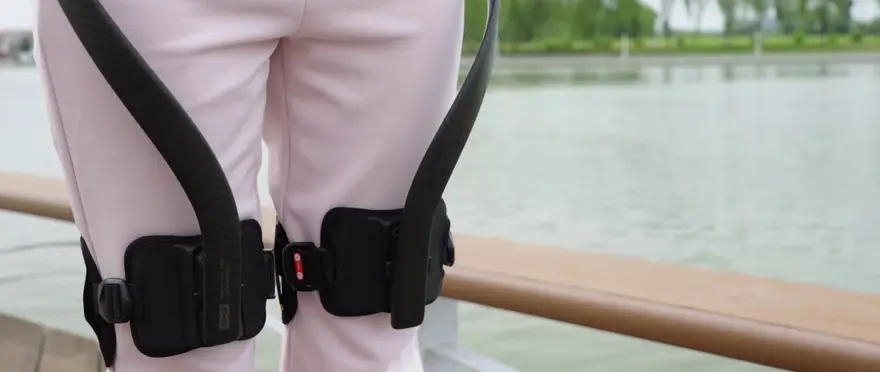
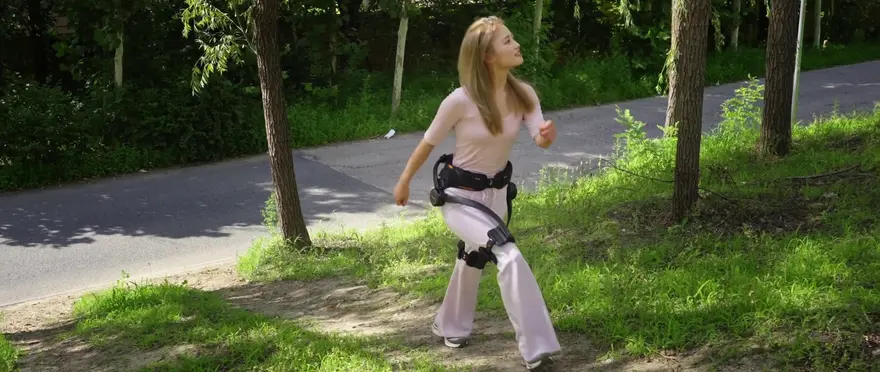
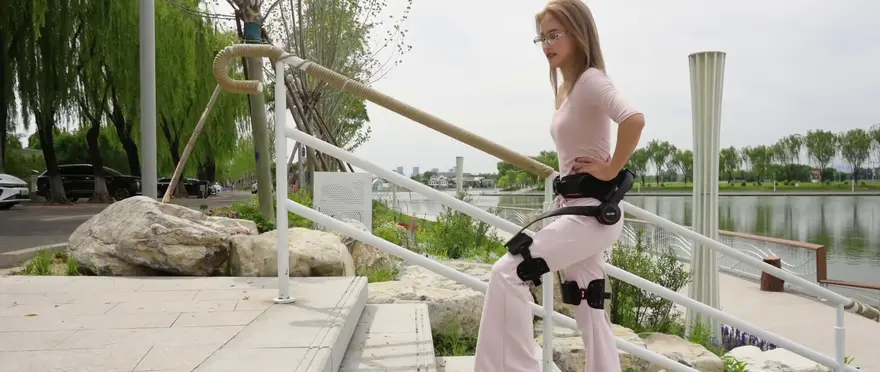
The first impression is lightweight. Once the entire system is secured to the waist and legs, "even a little girl would barely feel any burden of weight." The key to this weight reduction lies in materials engineering:
- The main frame makes extensive use of titanium alloy, noticeably lighter than steel without compromising on strength;
- The leg struts use carbon fiber material, further reducing end-effector inertia;
- The overall strategy is "high-strength lightweight materials + structural optimization," bringing the wearing burden down to an almost imperceptible level.

This marks a key inflection point for consumer-grade exoskeletons: when titanium alloy + carbon fiber transition from "concept" to "standard feature," wearing comfort truly crosses the psychological threshold of ordinary users.

It's worth noting that the video omits the mid-section item-by-item introduction of core parameters such as battery life, max payload, and joint torque (this portion of the transcript is missing), so this article will not fabricate specific figures. Based on public information, Hypershell's products in this tier typically offer an endurance of 1–3 hours, with significant variation depending on operating conditions — a point that will be reaffirmed later in the viewer comments.
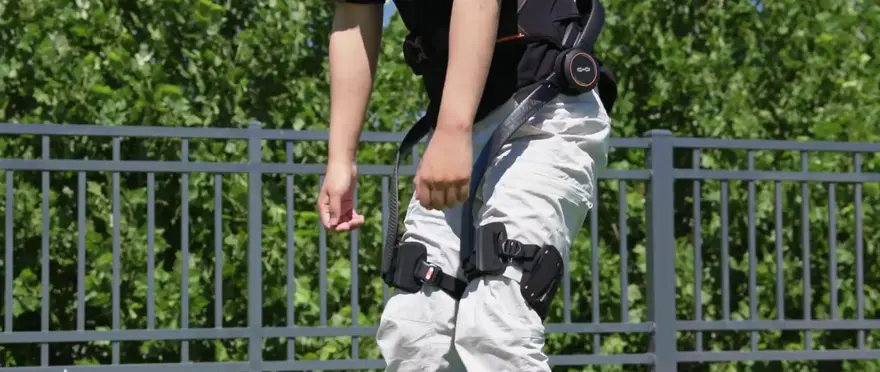
Intelligent Recognition: Automatic Mode Is the Soul of This System
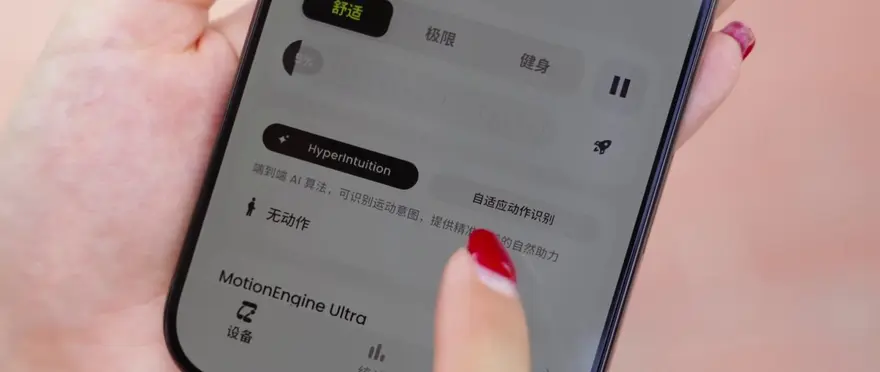
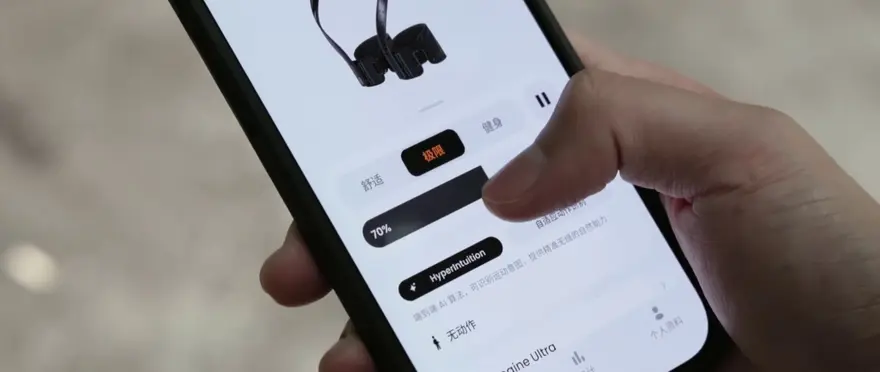
If materials determine "whether you can wear it," then control strategy determines "whether it works well." The biggest experience highlight of the Hypershell X Ultra S is its automatic mode.
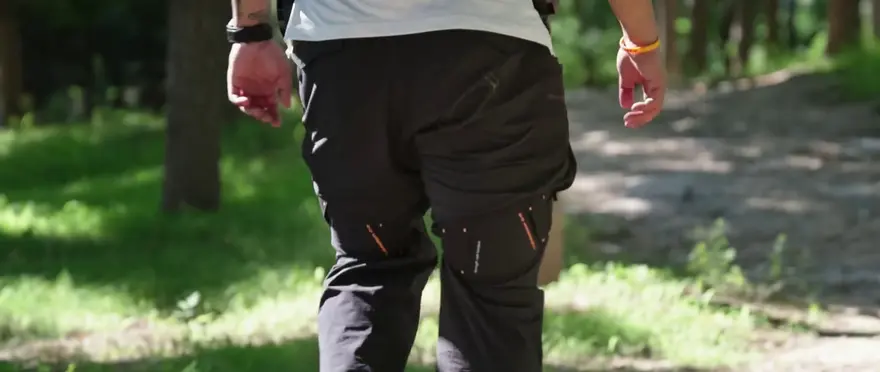
The working logic of automatic mode is quite reasonable: the system uses the user's height, weight, gait, and the energy generated by the legs during walking to judge the current terrain in real time, and dynamically adjusts the assist level —
- Flat-ground walking: shifts into flat-ground assist mode, delivering a gentle propulsion;
- Stair climbing: after recognizing stair mode, switches to the assist curve best suited for climbing;
- Light jogging and daily scenarios: quickly recognizes the activity and delivers appropriate leg assist.

This is a classic "intent recognition + adaptive assist" paradigm: the user doesn't need to manually shift modes — the system makes the decisions for you. For the vast majority of non-geek users, this is precisely what separates a consumer-grade product from industrial / medical-grade exoskeletons — reducing cognitive load.
Manual Mode: Comfort, Sport, and Berserk, Plus a Reverse Fitness Mode
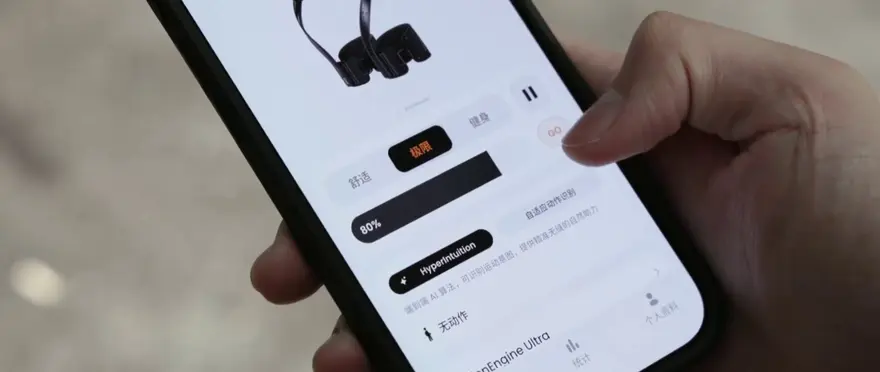
For users who prefer not to use automatic mode, Hypershell also offers three manual modes: Comfort, Sport, and Berserk, customizable on demand.

The real-world scenarios users describe for "Berserk mode" are vivid—when sprinting the final 100 meters of the Great Wall to beat a buddy to the beacon tower, switching to Berserk mode delivers the fastest system response and maximum assist: "it just pushes you upward, step after step, like you've got cheats enabled." While this kind of "short-burst explosive assist" isn't the main battlefield for exoskeletons, it does make for a highly viral selling point.
Even more noteworthy is the Fitness mode: when you want to train your legs, the system delivers reverse output force—as you lift your leg up, it applies a bit of downward resistance, like "wearing your own sandbag."

This is an interesting attempt by the consumer-grade exoskeleton to extend from an "assistive tool" to a "training device": the same hardware, with forward output reducing load and reverse output adding resistance.

For users who train at home with dumbbells and sandbags, this means a single device covers two completely opposite needs—"load reduction on the go" and "muscle building at home"—significantly boosting hardware utilization.
Sweet Spot and Limits: Don't Count on It for Sprinting
Every tool has its limits, and the exoskeleton is no exception. The user candidly points out the capability ceiling of the Hypershell X Ultra S (and currently similar consumer-grade products): it can't keep up in sprint scenarios.

The reason is control latency. In high-cadence scenarios like a 100-meter sprint, the legs swing two or three times per second or even more, and the system can't complete the "perceive—decide—execute" closed loop in time. The result is—you think it's assisting you, but it's still executing the previous movement command:
When your leg moves forward, it's still executing the previous backward motion, so it becomes a resistance. Wearing it actually makes you run slower.

So the true sweet spot of this product is light-to-moderate power assist: hiking, stair climbing, sightseeing travel, light-load work, and low-gear post-surgery rehabilitation. In these scenarios, its response speed and assist curve are "adequate and even beyond expectations"; once you cross into high-frequency explosive movements, the current control bandwidth of the exoskeleton is clearly insufficient.
This actually also frames the fundamental difference between consumer-grade exoskeletons and professional sports equipment: it's not an accelerator that "makes people run faster," but an energy manager that "makes people walk with less effort."
Who Should Buy Now, Who Should Wait: A Calmer Decision Matrix
Pulling all the information together, here's a more measured set of purchase recommendations—

- Recommended to buy: Frequent-traveler hikers, outdoor enthusiasts with weaker stamina or higher body weight, professionals in outdoor videography and load-bearing roles, and post-surgery recovery patients cleared by a doctor for use.
- Recommended for company-issue: High-intensity frontline physical roles—treat the exoskeleton as a "workplace health investment," not a perk.
- Recommended to wait: Users who are merely curious, use it infrequently, or have extreme demands on battery life and response speed—wait for the price drops and experience improvements that come with mass production.
One-sentence product positioning anchor: The Hypershell X Ultra S is currently the benchmark consumer-grade assistive exoskeleton that delivers on all three fronts—"lightweight design + smart recognition + multi-mode"—but it is not a universal add-on; it's a "labor-saving lever" built for specific scenarios.

Top Community Comments
@Reader (20 likes): Brothers, it really works!!!
Interpretation: Strong positive feedback straight from the "target user" cohort — heavier users who struggle on climbs are exactly the people who feel the exoskeleton's load-reduction benefits most directly and most intensely. This kind of comment carries far more credibility than a generic "looks nice."
@Reader (8 likes): If you're not in a rush, wait for mass production.
Interpretation: Reflects a clear-eyed view of the current consumer-grade exoskeleton market — prices are still high and iteration is still fast. This is a textbook early-market mindset: treating today as a "transition phase" rather than a "mature phase."
@Reader (4 likes): Absolute garbage, dies in ten-something minutes. Dead battery just becomes a burden.
Interpretation: This negative review hits the single most fatal weakness of consumer-grade exoskeletons — battery life / runtime. The moment the charge runs out, the exoskeleton instantly morphs from "assist" into "dead weight," making it more exhausting than going without one. This directly reinforces the earlier point that the sweet spot is "light-to-moderate assistance": runtime is what ultimately defines the boundary of usable scenarios.
One-Sentence Summary
The Hypershell X Ultra S has raised the consumer-grade assistive exoskeleton to a new benchmark—"so light it's imperceptible, smart enough to automate, multi-mode for playability"—making it a genuinely useful "effort-saving lever" for three groups: outdoor enthusiasts with limited physical capacity, workers in high-intensity load-bearing roles, and post-surgery recoverers following medical guidance. Its sweet spot, however, is light-to-moderate assist; it can't keep pace with sprint bursts, and battery life remains the Achilles' heel—if you're not in a hurry, waiting for mass production won't cost you anything.

About this article: part of Chinese-Made Exoskeleton Review Archive — an independent, regularly updated English archive of reviews of consumer exoskeletons made in China, edited from publicly available video transcripts. Not an official manufacturer page.
For inquiries and purchasing, contact lonlonago@foxmail.com. More in Reviews · All articles.