Cheng Tian Hypershell XE Wide Edition: How to Select a Daily-Wear Lower-Limb Exoskeleton Based on These Five Dimensions
Need to place a more specific H1 title.
Let's start with the conclusion: If you are waiting for a lower-limb exoskeleton that is suitable for daily wear, capable of hiking, and addresses strength discrepancies between the left and right legs, the Cheng Tian Hypershell XE Wide Edition delivers a remarkably mature performance.
This is not a flashy display of technical prowess typical of a launch event, but rather a buying guide presentation. We have reorganized the information from the original audio transcript and structured it around five dimensions—Sizing fit, mechanical power, AI intelligence, nine-fold safety, and additional configurations—plus a user experience perspective. This provides you with a detailed analysis that can serve directly as a purchasing reference.
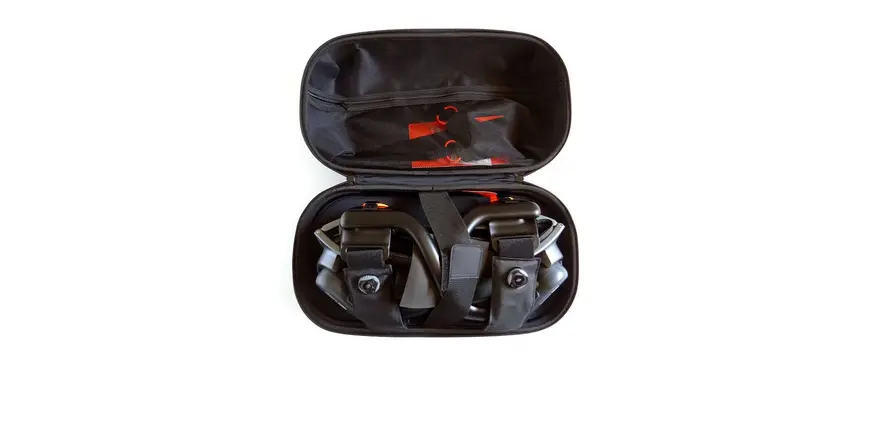
1. First, get it straight: This is a "lower-limb exoskeleton", not a knee brace
The information density is high right from the start of the video, but before making a purchase, you must clarify a fundamental question: what exactly are you buying?
This is a "lower-limb exoskeleton", specifically an assistive exoskeleton centered on hip assist + leg assist, not a passive-support knee brace or smart leg straps.
This statement directly defines its physical boundaries: it can help you lift your legs, walk, and go uphill, but it won't let you take off from the ground.
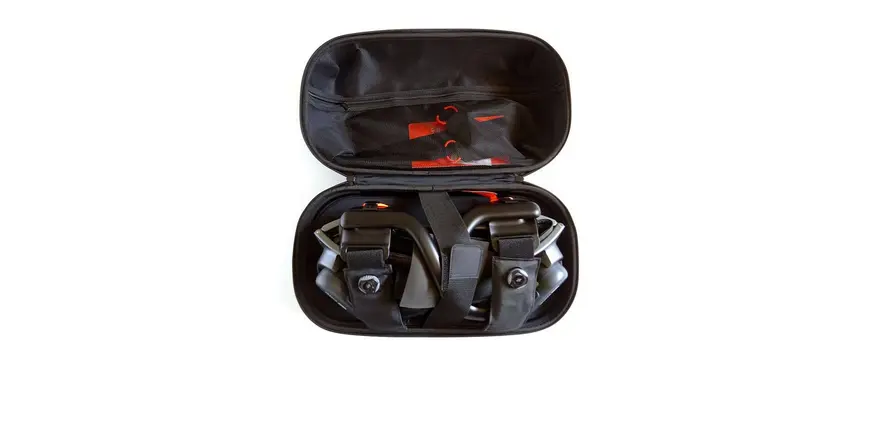
The biggest difference between a true consumer-grade exoskeleton and a rehabilitation exoskeleton is that the latter is strictly locked into professional medical scenarios, whereas the former sets its target as "daily usability and being ready to go out."
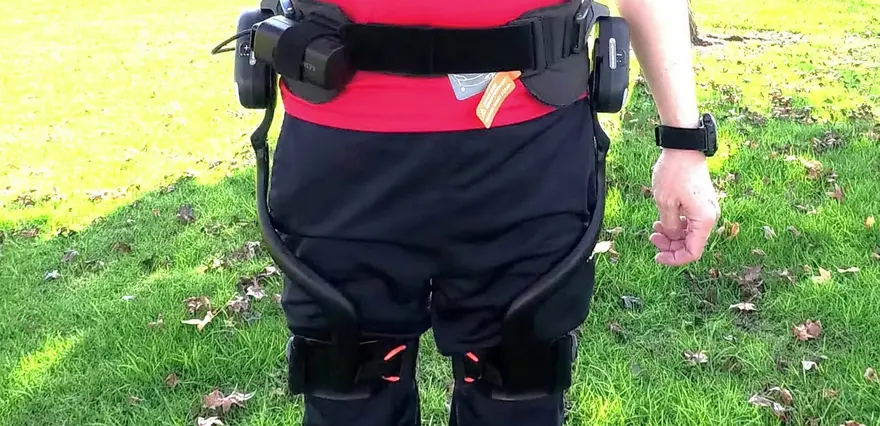
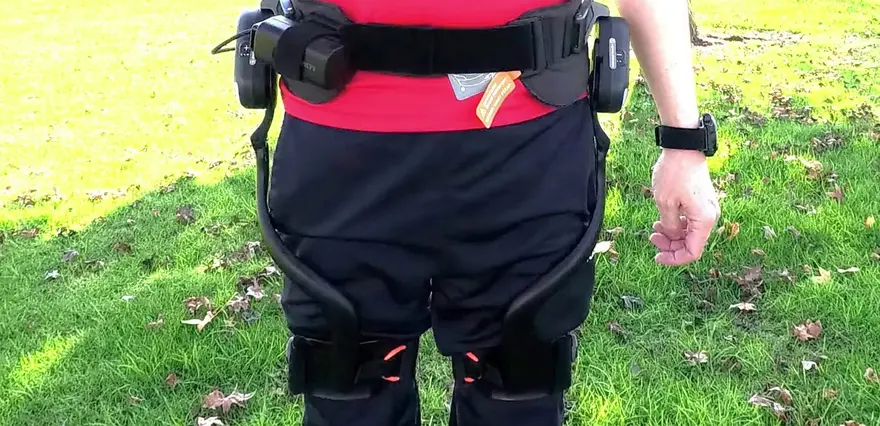
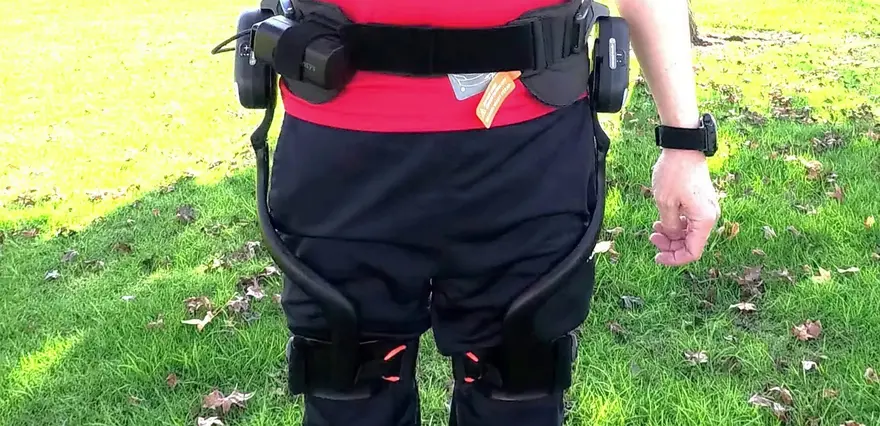
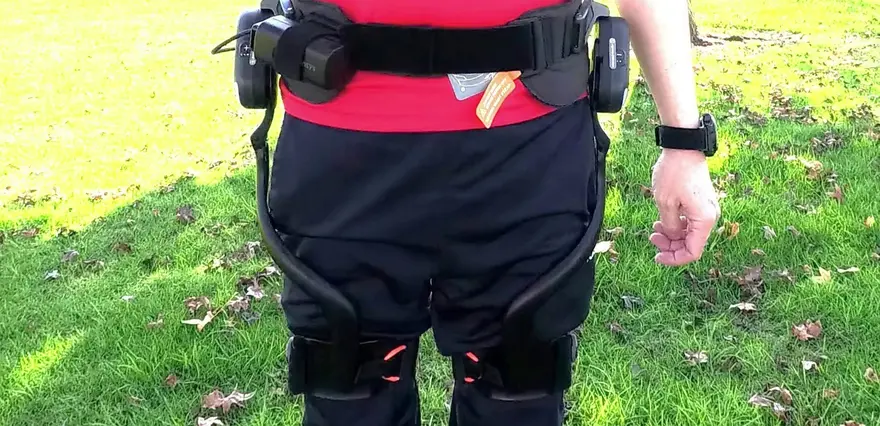
This is exactly where the ambition of the Hypershell XE Wide Edition lies—it has refined the adjustment logic to the point where a manual is practically unnecessary: three basic sizes (S/M/L) + a quadruple adjustment structure, leaving virtually no blind spots when it comes to "whether it actually fits me".
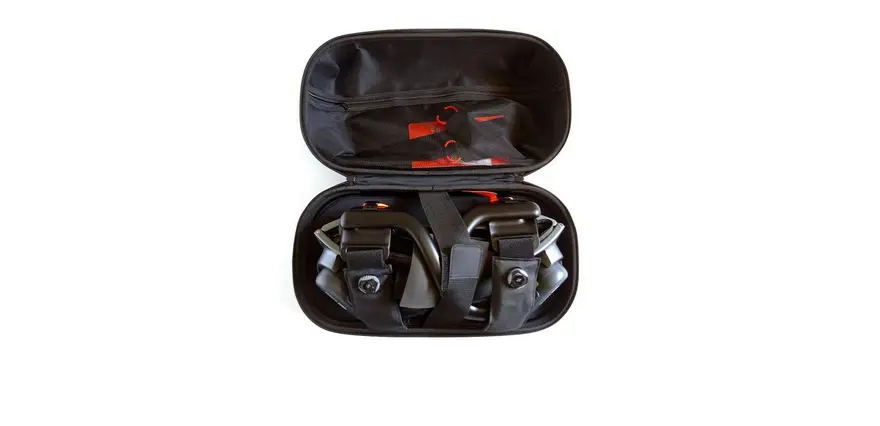
2. Sizing and Fit: The Wide Version Is Not a Marketing Gimmick—It Is a Structural Solution
Let's Start with the Most Important Numbers
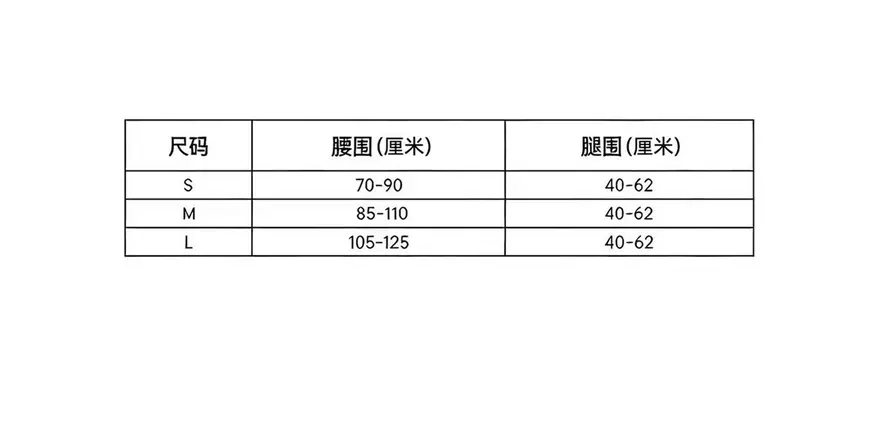
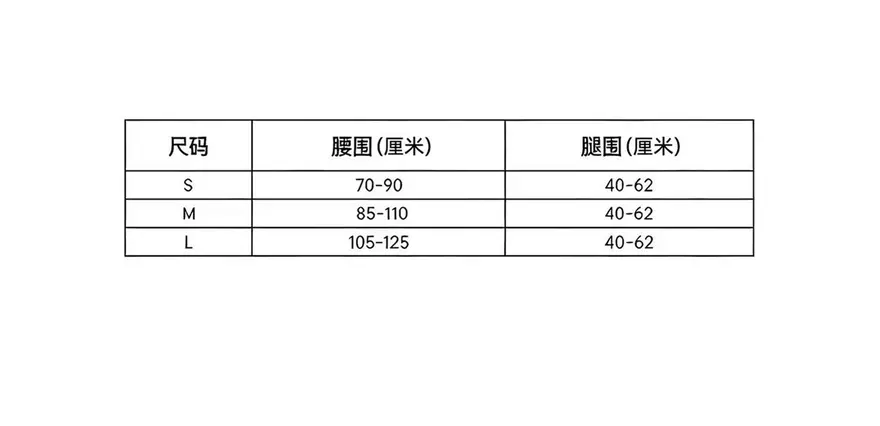
Waist circumference coverage is 70–125 cm; thigh circumference offers a unified fit for 40–62 cm.
What does this mean?
First, it covers the waist circumference range of the vast majority of East Asian users. Second, for the 40–62 cm thigh circumference, the device does not divide users into different segments like some brands do. Therefore, the likelihood of picking the wrong size ending up "trapped in inventory and unable to return" is significantly reduced.
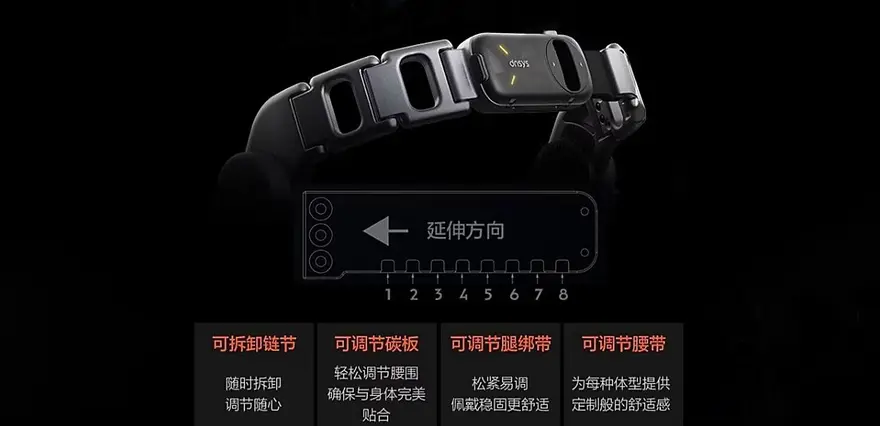
Four-Point Adjustment: Not Just "Wearable," but "Securely Fitted"
Human leg shapes vary significantly—some have longer legs, some shorter; some have thick thighs and thin calves; others have a high waist and wide hips. The solution provided by the Hypershell XE wide version is:
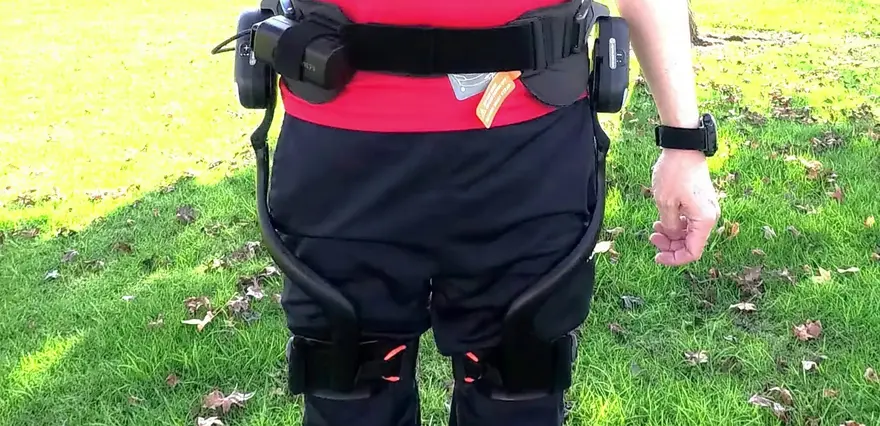
- Detachable linkages: Adjust based on leg length
- Adjustable carbon-fiber plates: Fine-tune the waist circumference
- Flexible leg straps: Thigh circumference is not locked into the core adjustment chain
- Adjustable waist belt: Ensures a snug fit around the waist and abdomen
The greatest significance of this design logic is a secure fit. The primary difference between an exoskeleton and an ordinary wearable device is that the former directly applies joint torque (joint torque) to the legs. If it is not strapped tightly enough, the device will start to shake when the motor exerts force, turning the walking assist into a mechanical fight against your legs.
Can be worn by people of all heights and sizes, staying sturdy without wobbling—this is one of the most practical selling points in the consumer-grade exoskeleton space.
Measurement Standards and Beginner Tutorial
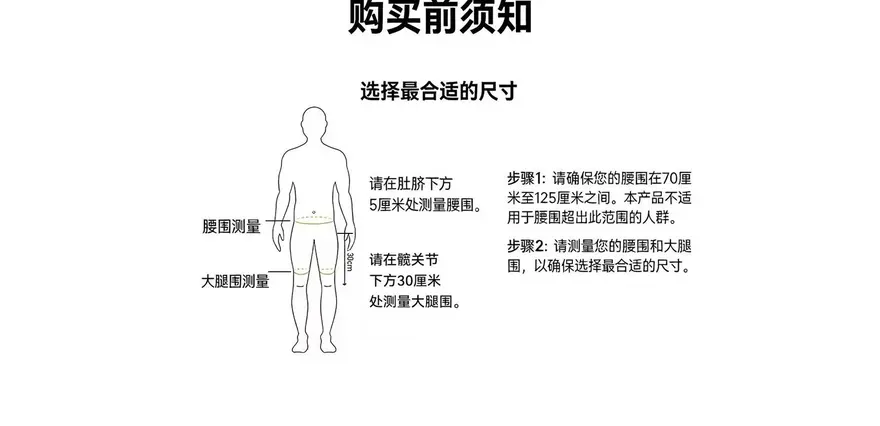
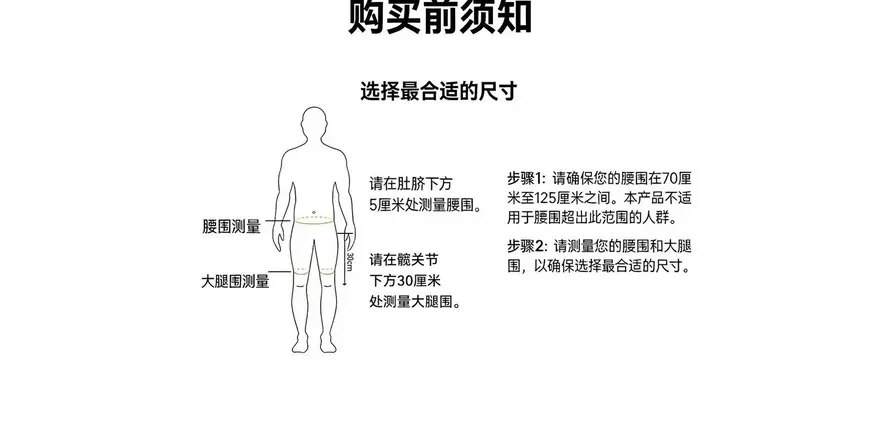
The video placed special emphasis on the measurement methods:
Waist circumference: Measure 5 cm below the navel.
Thigh circumference: Measure 30 cm below the hip joint.
If your waist circumference falls outside the 70–125 cm range, purchasing is not recommended.
This is actually a highly responsible detail. The sizing charts for many products are just a crude S/M/L/XL system, but in reality, matching the thigh circumference is often the most common point of failure for an exoskeleton. With the words "wide version," Hypershell has effectively kept this core conflict out of the equation.
There is also an operational hurdle that is easily overlooked: All features of the device must be unlocked after completing the accompanying beginner tutorial.
This follows the same "Guide—Learn—Unlock" philosophy as high-end sports watches and headphones—teaching you how to wear and adjust it first, before giving you the full-featured experience. For beginners, this acts as protection; veteran users, however, might find it a bit tedious.
III. Mechanical Power: 900W Peak – Not Just a Spec, It’s Confidence
First, Look at the Overall Structure
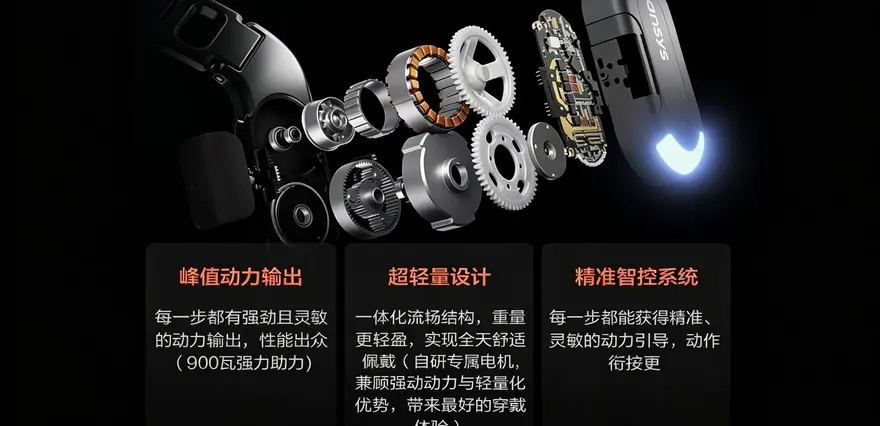
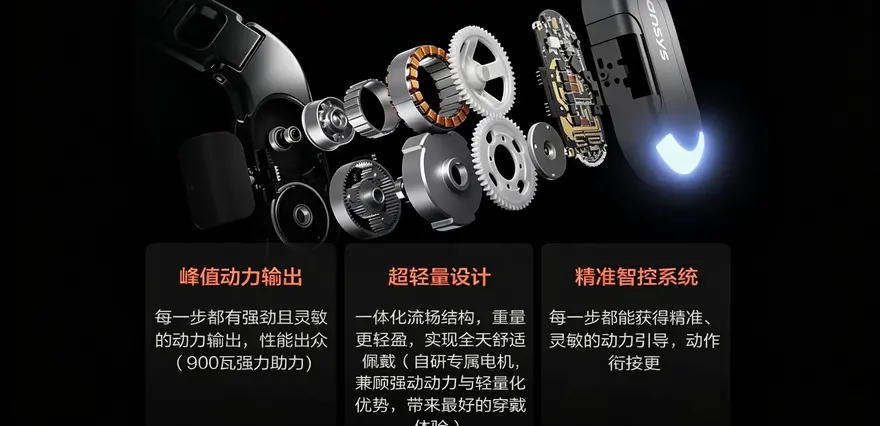
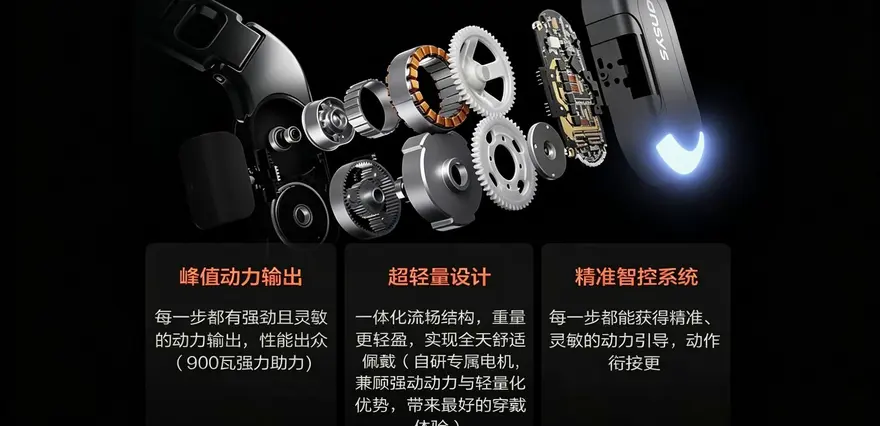
The entire unit features a fluid, streamlined structure that retains material only at stress-bearing areas.
This is effectively the engineering solution to the contradiction between a "lightweight body" and "high power." Traditional exoskeletons pile on material to ensure strength, which only adds weight and makes them less suitable for everyday use. Hypershell’s approach is to retain material only at stress-bearing parts, while hollowing out and lightweighting the rest.
The strongest confidence behind this machine comes from a self-developed powertrain.
900W peak assist on a single side (mentioned in the video).
What does 900W mean in practical terms? Conventional electric bicycle hub motors typically range from 250–500W, whereas this is the peak output of a single leg. Combined, both legs deliver a peak of 1800W. While daily walking won't constantly hit this peak, during moments requiring explosive power—like stepping up a stair or climbing over a rock—its power redundancy is more than sufficient.

Left-Right Independence: The Watershed for Consumer-Grade Products
Many exoskeletons employ a unified assist mode where the left and right legs share a single control logic. When you step with your left leg, the right leg exerts force as well, or vice versa. This leads to a classic problem—for users with inconsistent leg strength, the output is mismatched, resulting in a very awkward sensation during exertion.
Independent precision control systems are built into the left and right sides, allowing for completely separated regulation of leg power.
The technical significance of this lies in three key points:
- Synchronization: Balanced, synchronous output for both legs.
- Independence: The left leg can be strengthened while the right is weakened, or vice versa.
- Asynchrony: Since natural leg strength differs, the system must be able to adapt to these variations.
This results in two direct differences in real-world application:
1. Rehabilitation Training: For users recovering left-side strength while the right side remains unaffected, the ideal support isn't "both sides assisting equally," but rather focused help for the left leg and minimal or no assistance for the right. This system achieves exactly that.
2. Hiking / Trekking Assist: For users who habitually favor one leg (e.g., those with a previous right knee injury), the profound difference in experience provided by independent left-right adjustment on long downhills or side slopes is far more direct than raw power figures suggest.
Another easily overlooked detail is that this motor system incorporates built-in overload protection and self-balancing mechanisms. All gears, circuits, and motor components undergo component durability testing before leaving the factory. This signifies a benchmark for industrial-grade reliability, standing apart from the "annual replacement" mentality of typical consumer electronics.
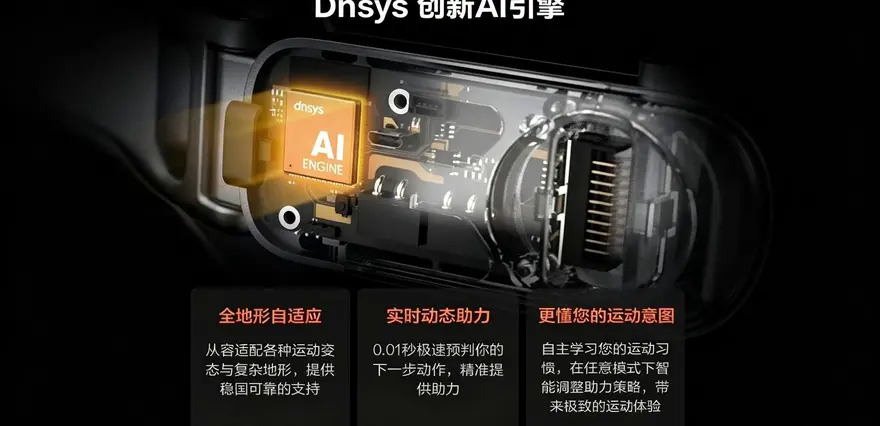
IV. The AI Intelligent Engine: Millisecond-level Prediction Is the True Soul of an Exoskeleton
The mechanical structure determines the upper limit, while the AI determines the lower bound of the experience.
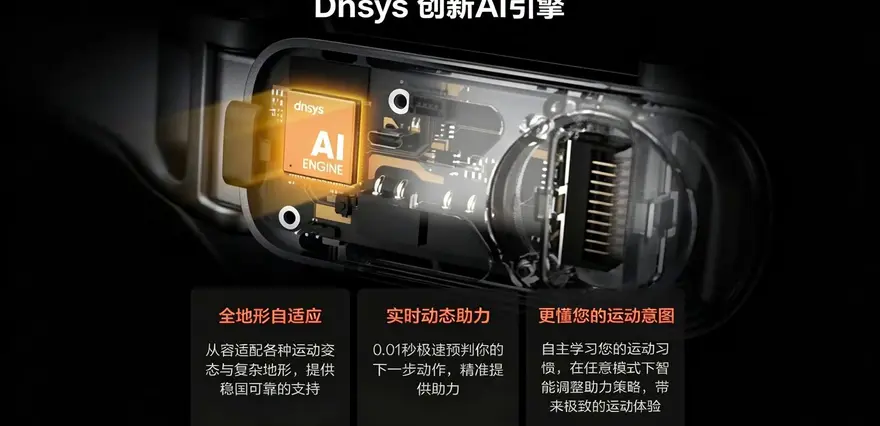
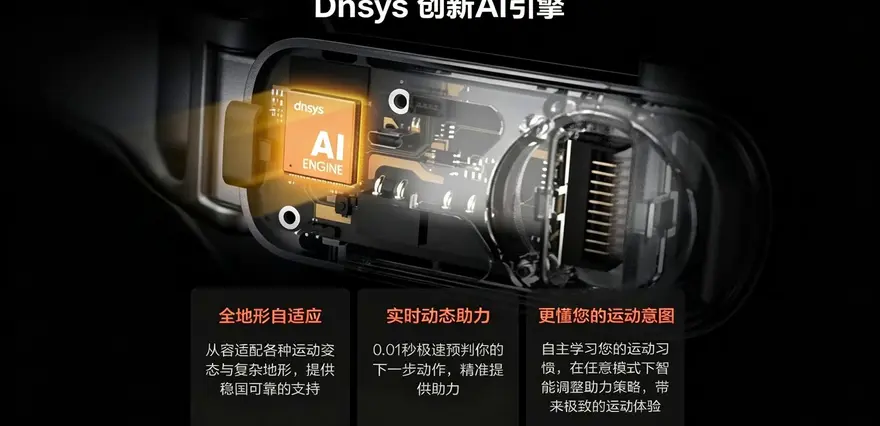
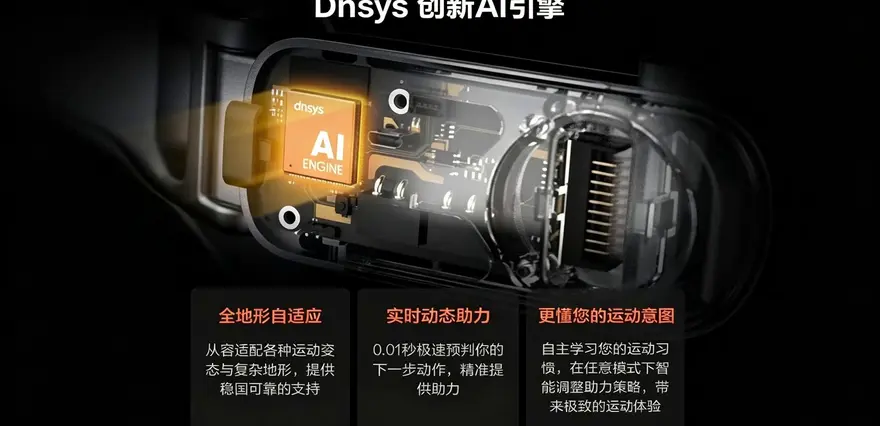
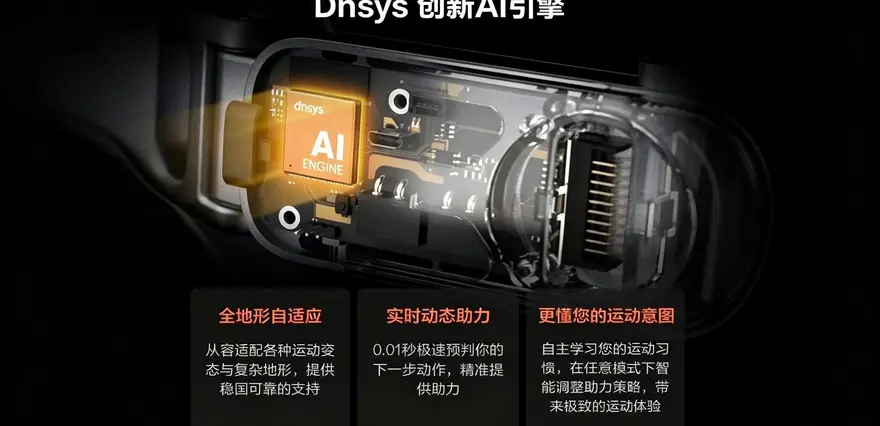
Powered by DNSYS's self-developed AI chip engine, featuring three core intelligent capabilities.
This is where the device fundamentally differs from "purely mechanical power assistance."
Capability 1: All-Terrain Adaptation
Automatically recognizes complex terrains such as flat ground, steps, and uphill/downhill slopes, adapting to various walking postures.
This capability requires the synergistic work of multi-dimensional sensors, such as an IMU (Inertial Measurement Unit) and pressure sensors, with the algorithm layer subsequently providing the current terrain classification and assistance strategy.
The difference in experience is this: a standard exoskeleton may have a stable gait on flat ground, but upon encountering steps or slopes, it often produces a pulling sensation due to a misalignment in the assistance rhythm. The goal of all-terrain adaptation is to ensure the assistance transitions smoothly the moment terrains change—this cannot be solved by mechanical structure alone and requires the algorithm to make decisions at a millisecond level.
Capability 2: 0.01-Second Level Predictive Assistance
Captures human movement at a millisecond level, predicts the next step's gait in advance, ensuring zero latency in assistance output.
This metric is the core guarantee for "zero latency." A 0.01-second level means the chain between sensor sampling and motor response must be extremely short. The true difficulty lies in whether the prediction is accurate.
If the algorithm predicts incorrectly and the motor exerts force prematurely, you will feel your leg being forcefully pushed back. If the prediction is insufficient and the motor exerts force too late, the assistance will feel delayed. Advancing the prediction window to the previous step's gait cycle is the underlying logic of this system.
Capability 3: User Habit Self-Learning
Records individual movement and exertion patterns through long-term wear, automatically adjusting assistance strategies; the more you wear it, the better it aligns with your personal habits.
This is genuine runtime adaptation. It solves a very subtle problem: when you first put the device on, it uses generic modes. However, after two months, it has formed memories regarding your stride length, force exertion timing, and points where you tend to fatigue, allowing it to exert force in a manner much more tailored to you.
This follows the same logic as a smartwatch learning your resting heart rate and daily schedule thresholds—the algorithm iterates, and the experience compounds over time.
The Final Line of Defense for Reliability
Industrial-grade CAN anti-interference communication and real-time hardware fault self-diagnostics.
This is a metric rarely emphasized in consumer-grade marketing, yet it is truly important. The CAN bus is the default communication standard in automotive and industrial control, possessing anti-electromagnetic interference capabilities far superior to ordinary consumer-grade communication solutions. In an exoskeleton, it means: the system will not experience misjudgments due to surrounding signal interference, and will not even lose control directly due to firmware issues.
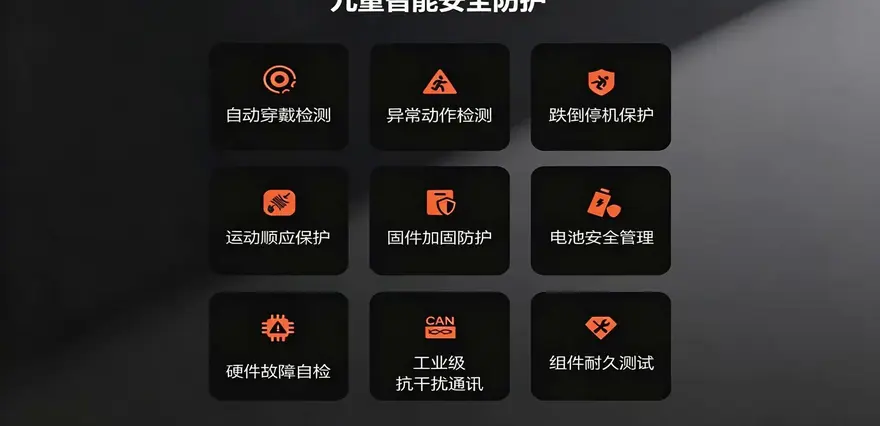
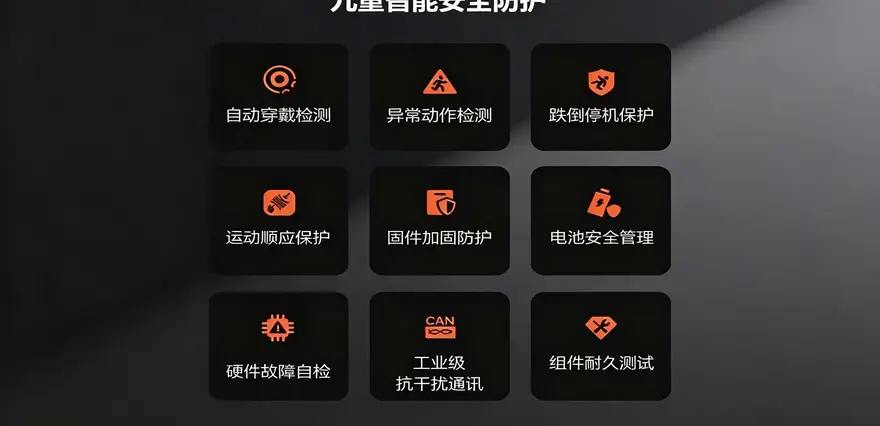
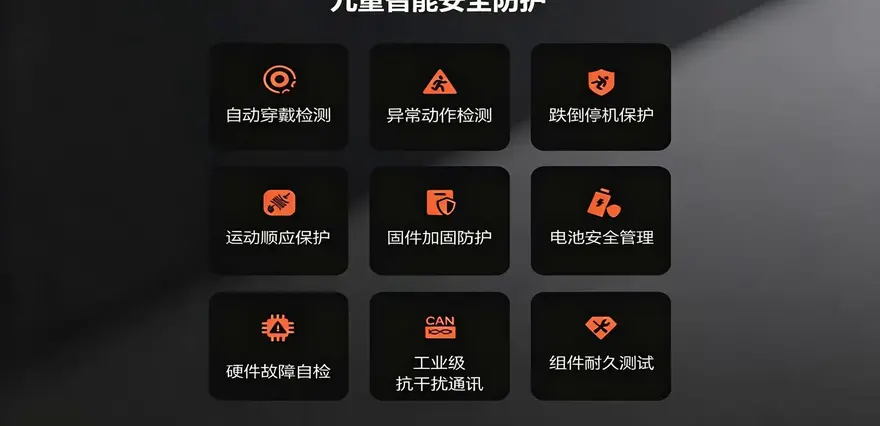
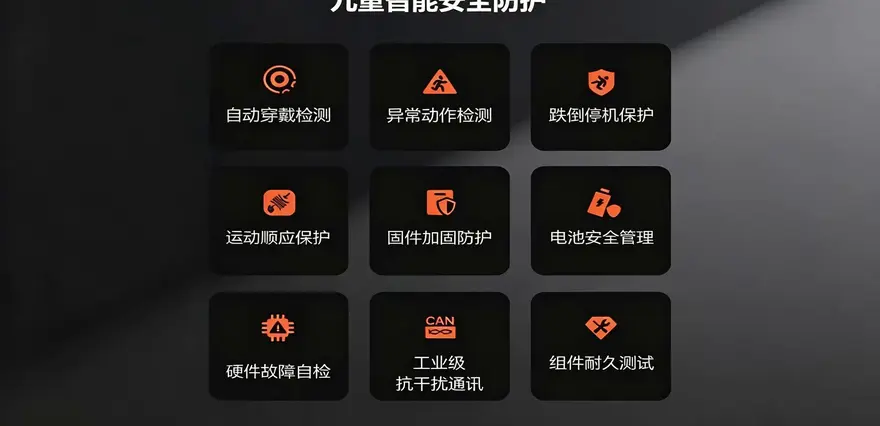
V. Ninefold Safety Protection: The Logic That Actually Enables "Dare-to-Wear-Outdoors"
The biggest difference between an exoskeleton and headphones or smartwatches is: it acts directly on your legs and controls how you walk. So safety redundancy isn’t a plus—it’s a must.
Hypershell has introduced a ninefold protection mechanism—here’s the breakdown:
1. Auto-Wear Detection The device determines whether you've worn it correctly, preventing power output if the exoskeleton isn't properly secured.
2. Abnormal Motion Detection It detects unnatural postures and triggers protective strategies.
3. Fall-Stop Protection Once a fall or posture loss is confirmed, power is immediately cut off. This shares the same logic as the self-balancing emergency-stop feature in drones—safety always takes priority over user experience.
4. Motion Compliance Protection The device won't apply a rigid opposing force, reducing resistance when you make awkward movements.
5. Hardened Firmware Protection It prevents firmware from being maliciously tampered with or written via unencrypted channels.
6. Battery Safety Management It features thermal control protection to prevent overcharging and overheating.
7. Hardware Fault Self-Test Upon power-on, the circuits, motor, and sensor (IMU / pressure sensor) are self-tested; if an anomaly is detected, the device immediately throws an error.
8. Industrial-Grade Anti-Interference Communication As mentioned earlier.
9. Component Durability Testing All critical components are stress-tested before leaving the factory.
The first three are the most critical: in the event of a fall, motion imbalance, or hardware malfunction, the device will actively cut off or limit power. This is the same underlying philosophy as a car's ESC or ABS: when out of control, the device always sides with human physical safety.
VI. Additional Features: Battery Life, Waterproofing, and Comfort—All Determine Whether You Can Actually Take It Outdoors
1. Waterproofing & Cleaning
The entire unit is rated IP54 for splash resistance—light rain, everyday splashes, and wiping it down with clean water are all worry-free.
In IP ratings, the second digit indicates the water-resistance level: IP54 means protection against splashing and spraying water, but not immersion. This is perfectly adequate for daily walking, outdoor trekking, or encountering light rain. Swimming, diving, or accidentally falling into a river are beyond the scope of this protection rating.
2. Regenerative Braking & Fast Charging
Kinetic energy can be recovered while walking downhill to recharge the battery, effectively extending battery life / runtime.
This logic mirrors the regenerative braking in electric vehicles: during deceleration or downhill movement, the motor converts part of the mechanical energy into electrical energy, feeding it back into the battery. Thanks to this mechanism, its endurance performance is promising, though the video does not yet provide specific endurance (in hours) data. For the exact hours of battery life / runtime and endurance, we recommend waiting for official figures.
On fast charging: The video explicitly mentions a Type-C fast-charging port. That means you can bring a regular power bank or outdoor power station as an emergency backup during trips.
3. Wearing Comfort
Breathable, skin-friendly soft pads are used at the waist and leg contact areas—no stuffiness or skin chafing, even after long wear.
For users planning to wear it “8 hours a day,” this might be the decisive factor. If an exoskeleton’s internal rigid structure contacts the skin directly, the wearing experience can turnharsh rather quickly.
Hypershell’s approach is to add soft padding at critical force-bearing points—sacrificing minimal torque transmission efficiency while drastically reducing pressure and discomfort. Contouring to the human body isn’t just a design cliché; it’s the physics that determines whether you can wear it all day.
4. Applicable Scenarios
Four use scenarios are explicitly listed in the video:
- Daily walking and mobility assistance
- Outdoor long-distance hiking / trekking
- Lower-limb rehabilitation training
- Light-load travel
This breadth is actually impressive. It signals that the product isn’t a niche device for a single group, but rather a shared-use gadget for the household—one person wearing it daily, another picking it up when needed, or bringing it along on trips. This aligns more closely with the real path consumer-grade exoskeleton products take toward mainstream adoption.
7. Comparing with Similar Products: The Battle for Consumer-Grade Exoskeletons
When we put products of the same tier side-by-side, the competition for consumer-grade exoskeletons has narrowed down to two core points:
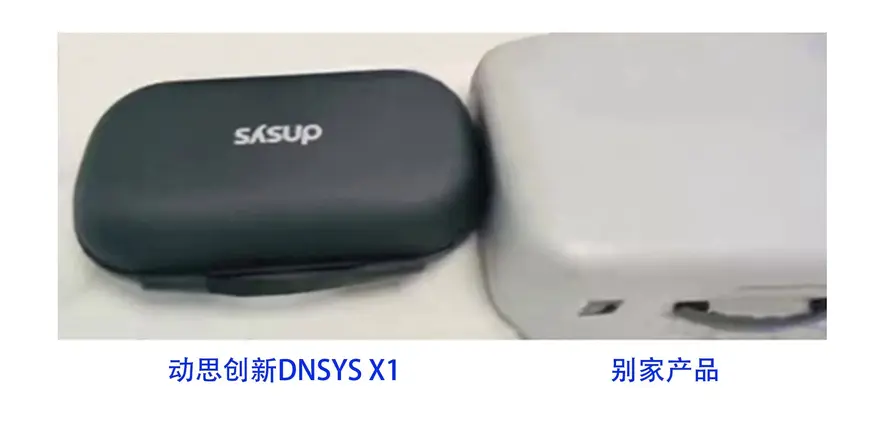
First: Weight and Portability.
The Hypershell XE folds into a compact form, making it extremely convenient to carry for daily outings.
This mirrors the "lightweight + ready-to-wear" marketing angle emphasized by some competitors (such as AoJing and Tanluzhe, which utilize similar structures), though the actual volume performance still requires a hands-on comparison.
Second: The Level of Intelligence.
Hypershell features 0.01-second predictive capabilities, all-terrain adaptability, and personal movement habit learning. Its algorithmic sophistication is quite high within this tier. However, it is important to clarify one point: this is a lower-limb assistive exoskeleton, not a robot that allows you to jump in place. Expecting to "run a marathon while wearing it" is unrealistic.
Conducting a horizontal comparison between these brands is inherently difficult because their target users overlap, yet their core scenarios do not completely align: AoJing leans more toward industrial and logistics scenarios while moving toward consumer-grade applications; Kenqing (Dnsys) initially entered the market through rehabilitation exoskeletons; whereas Hypershell designed its products directly for the consumer-grade market.
Regarding the question of "whether ordinary people can buy and use it daily," players in this track have already achieved the leap from 0 to 1.
8. Purchase Advice: Who Should Buy It Now, and Who Should Wait for the Next Generation
Who It’s Most Worth Buying for Right Now
1. Users with lower-limb recovery needs In rehabilitation training scenarios, independent left/right adjustment means you can set different assist levels for each leg based on your recovery progress. This logic, once reserved for professional institutions, is now trickling down into consumer-grade exoskeletons.
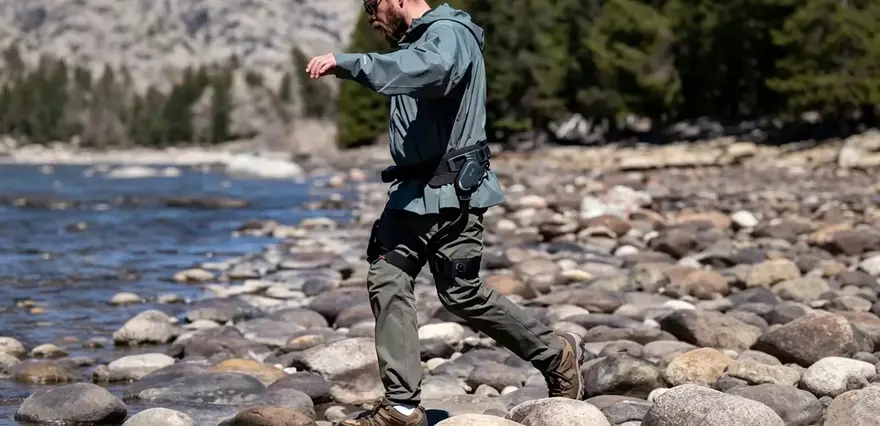
2. Outdoor Hikers and Trekkers This demographic is exactly the core user base for consumer-grade exoskeletons. When climbing long uphill stretches or ascending with a load, the immediate boost it gives to leg strength is striking. IP54 water resistance, kinetic energy recovery, and a lightweight structure all point squarely in this direction.
3. Older Adults Who Need Effortless Daily Walking Assist What they need isn’t off-road capability, but “easy to put on and easy to take off.” The wide size range and high adjustability, combined with fall protection and abnormal motion detection, make this a genuinely valuable household shared device.
4. Families Needing a Device That Fits Different Members If one family member wears a 75 cm waist and another wears 115 cm, the broad adjustability of the wide version lets them share the same exoskeleton. That makes it an economic calculation worth doing.
People Who Should Wait and Watch
If you’re expecting the exaggerated promises of “effortless running” or “flat-road hiking,” today’s consumer-grade exoskeletons can’t deliver that. They are assistive exoskeletons that help you walk longer, steadier, and more easily, but they cannot replace your muscles.
9. Final Thoughts
The core contribution of the Hypershell XE wide-width is that it turns the consumer-grade exoskeleton from a “concept” into a real product you can buy by size, wear every day, take outdoors, and even use for rehabilitation training.
On the technical side, it turns nine layers of safety protections into a selling point rather than a slogan; it brings independent left/right power and AI gait adaptation down to consumer-grade pricing; and it places safety at the highest priority. That is exactly the kind of clarity the current market most lacks—an era of exploded specs, over-the-top marketing, and rampant pseudo needs.
Just as smartwatches were once gadgets for a handful of geeks before they became wrist-worn companions for fitness and health, consumer-grade exoskeletons are following the same path.
Top Community Comments
(No comments available)
Since the data in this review is incredibly robust, we can predict that if the comments section were active, the most frequently repeated points would likely revolve around a few core areas:
- "Can I wear this weight all day?"
The comfort of the waist and leg contact zones and the prolonged pressure are the biggest hidden hurdles for any consumer-grade exoskeleton.
- "Will IP54 be completely ruined after just one walk in the rain?"
IP54 is more than sufficient for light rain, but users often confuse "water-resistant" with "waterproof.Is the 900W single-side peak output just a marketing gimmick?"** This is peak power, not rated power; actual battery life performance also depends heavily on the battery capacity and the output strategy.
- "Is independent left and right force output a gimmick, or does it make a real difference in physical perception?"
This requires an in-person experience to truly judge. For those with unilateral strength asymmetry, it represents a qualitative transformation; for the average person, the perception might not be as pronounced.
One-Sentence Summary
The Hypershell XE Wide Edition is a consumer-grade exoskeleton precisely tailored for daily commuting, outdoor trekking, and lower-limb rehabilitation—if you are looking for "a last-generation lower-limb exoskeleton that is wearable, helpful, and truly practical for going out," it is well worth a serious try.
About this article: part of Chinese-Made Exoskeleton Review Archive — an independent, regularly updated English archive of reviews of consumer exoskeletons made in China, edited from publicly available video transcripts. Not an official manufacturer page.
For inquiries and purchasing, contact lonlonago@foxmail.com. More in Exoskeleton · All articles.