Climbing "Shanghai's Second Highest Peak" in a 2.5 kg Exoskeleton: Just 10 Seconds Faster to the Summit—Yet It Feels Like Riding an Elevator
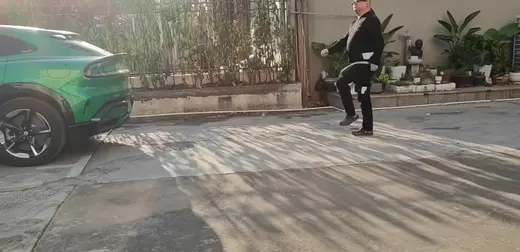
Consumer-grade exoskeletons have been all the buzz over the past couple of years, but one question hasn't changed in most people's minds: is this thing a "cheat code for your legs"—or a cheat code that just drags you down? The hip assist exoskeleton we tested this time comes with an official list of use cases spanning walking, hiking, cycling, and running. So to find out whether the word "assist" actually holds water, we strapped it on and headed up Shuangzi Mountain—jokingly dubbed "Shanghai's Second Highest Peak"—for a simple controlled comparison test.
"Does wearing a 2.5 kg device like this really make things easier for us?" —The original question behind this review (as mentioned in the video)
Let's get straight to the answer: the effort savings are real, but you'll pay for them in the device's own weight, your freedom of gait, and just how "obedient" the thing actually is.
Unboxing: A 2.5 kg Hip Assist System
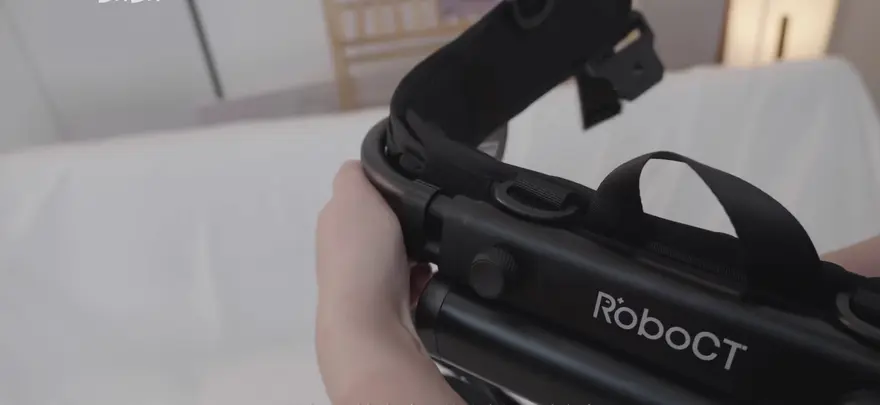
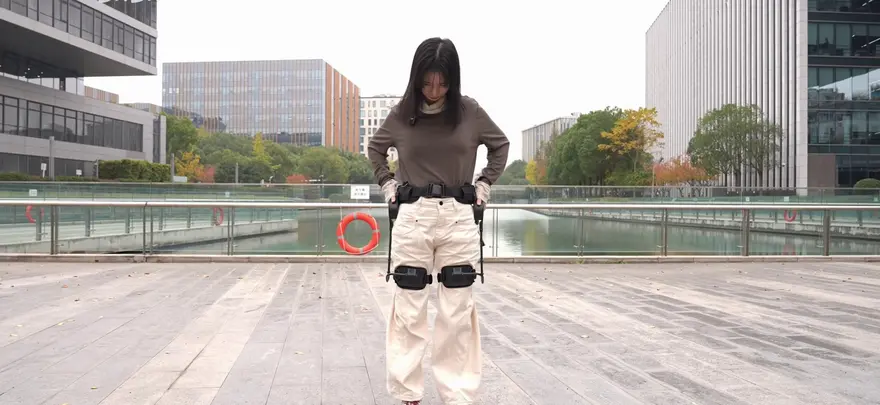
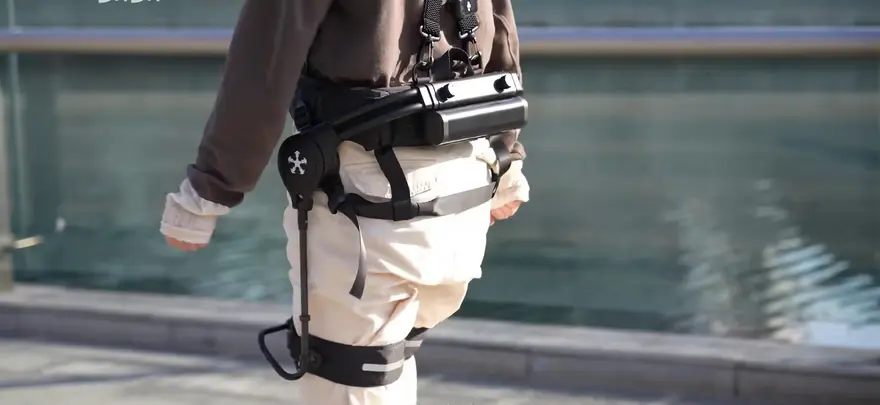
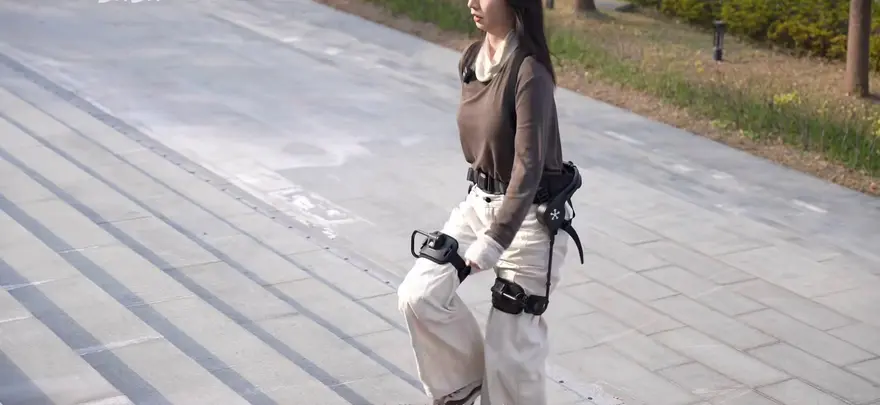
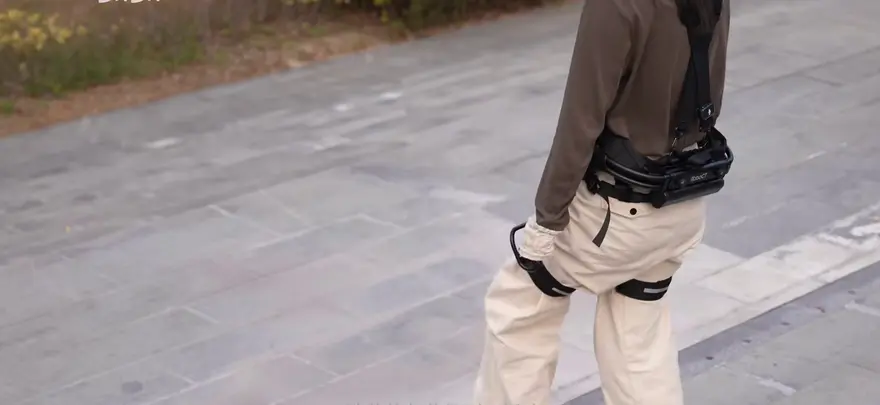
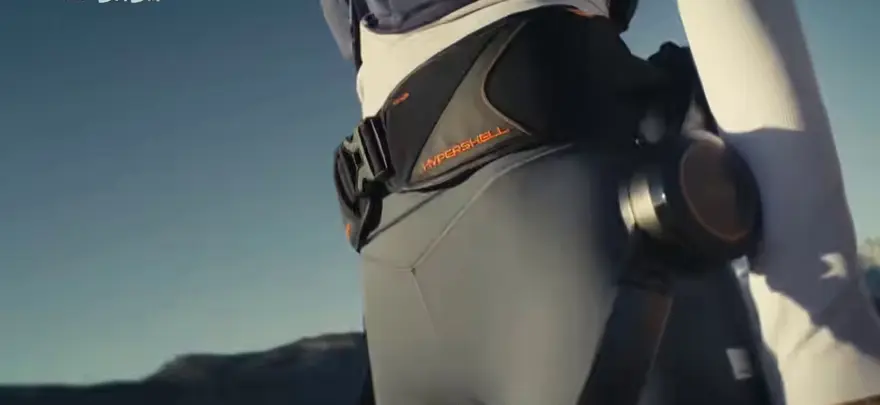
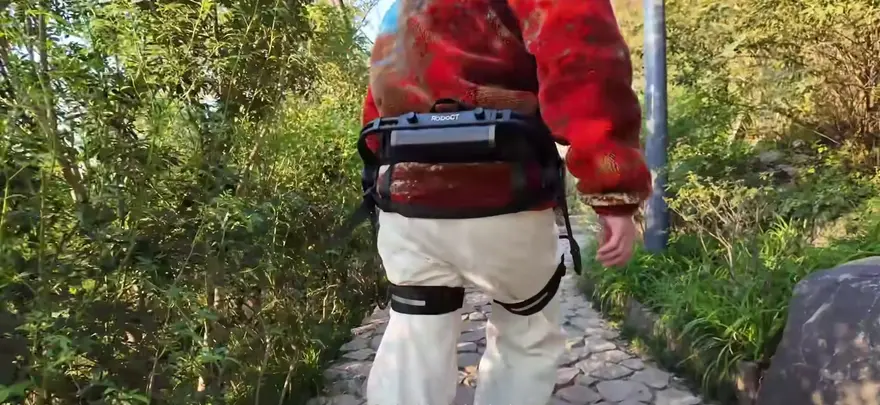
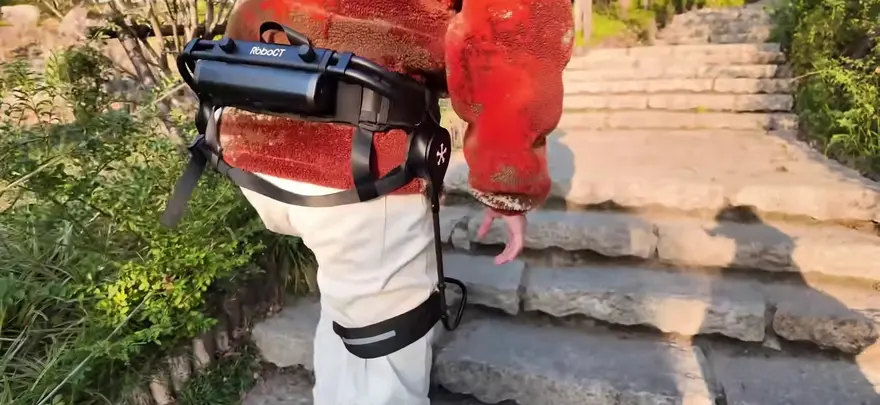
The system follows the classic hip assist architecture: a ring of mech-style armor around the waist houses the "brain" and the "heart," with rigid assist arms extending down both sides, secured to the thighs via straps. When providing assistance, motors drive the assist arms, applying supplemental joint torque directly to the hip joints. Power comes from a battery that plugs straight into the back of the waistband.
Battery capacity: 2900mAh, mounted directly at the lower back (mentioned in the video)
Official endurance: 3-4 hours (mentioned in the video)
Total system weight (unit + battery): approx. 2.5 kg (mentioned in the video)
What does 2.5 kg actually feel like? Think two and a half 500ml bottles of water, or a gaming laptop plus a power bank. It doesn't sound like much—but strap it around your hips and climb hills all afternoon, and it's a whole different story. That context sets the tone for everything that follows. One caveat: the video doesn't explicitly mention the brand, model, or price, so we'll simply refer to it as "this exoskeleton" throughout.

Wearing: One-Person Setup, But It Slides Down Over Time
The good news: unlike a medical-grade rehabilitation exoskeleton that requires a dedicated assistant for fitting, you can put this on entirely by yourself. First, adjust the lumbar section to match your hip width and secure it; then attach the thigh segments to your legs and fasten the quick-release straps, with the tightness infinitely adjustable via a single knob. Long-press the power button, dial in your assist level, and you're ready to go.
"Don't be fooled by how big this device looks—you don't actually need anyone's help. You can put it on all by yourself." (mentioned in the video)
The bad news is also hidden in the weight: even with the lumbar and thigh sections locked down as tight as possible, the 2.5 kg unit still gradually slides down after extended walking—the longer you go, the more it "sags." The fix offered in the video is refreshingly simple: add a shoulder strap to shift part of the weight onto your shoulders.
Long-wear tip: Add a shoulder strap to reduce device slippage (mentioned in the video)
Gait Learning and Three Modes: Downhill Assist Is the Hidden Gem
The first few steps after powering on aren't exactly pleasant.
"During the first few strides, it feels like the machine is fighting against your legs—that's because it's learning your walking gait and cadence." (as mentioned in the video)
Walk a few more steps, and the algorithm locks onto your power cadence and stride length. The resistance fades away, and the assist starts landing "right on the beat." The trade-off: the moment you suddenly change your pace, it has to re-adapt, and those few steps revert to a "human-vs-machine tug-of-war."
As for modes, beyond flat-ground walking assist, there's also a hiking mode and a downhill assist mode:
- Flat ground / hiking: delivers an assistive force at the thighs to help push each step forward and upward—the two feel quite similar;
- Downhill assist: a completely different philosophy—the lumbar area pushes out a supporting force that cancels out the sensation of added weight, while leg assist is dialed back, giving your knees noticeably more cushioning.
"It feels like your whole body is being held back, offsetting the extra weight of wearing the device."—downhill mode experience (as mentioned in the video)
For anyone whose legs turn to jelly on descents, this mode might just be the most thoughtful design on the entire device.



AI Switching and the App: Right Direction, but Latency Holds It Back
Beyond manual switching, double-tapping the button on the unit itself lets the AI automatically recognize the terrain and switch assist modes. A great idea in principle—but in real-world testing, the switching lags behind: the terrain has already changed, and the mode hasn't caught up yet.
"In testing, the switching does come with a delay, so if you're climbing stairs, going straight to hiking mode will feel more comfortable." (as mentioned in the video)
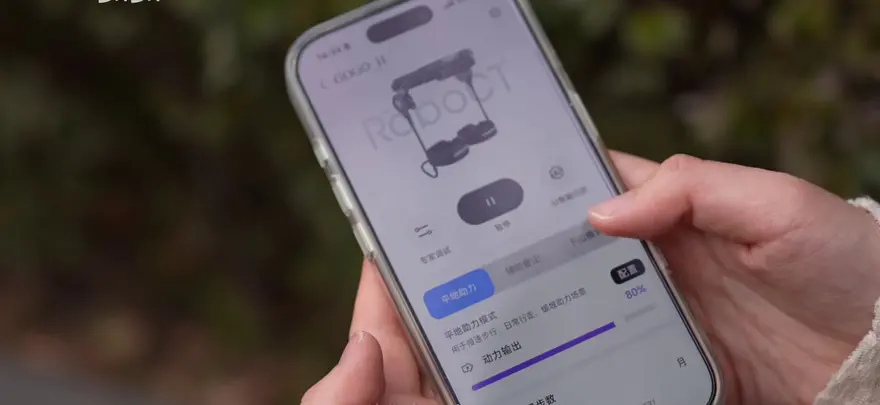
The app serves as the fine-tuning complement: it enables more precise control over the exoskeleton, even letting you adjust the assist level for each leg independently—a genuinely practical feature for users with uneven strength between their legs (such as those in post-injury recovery). On top of that, the app also tracks your step count and calories burned.



The Principle: Assistive Exoskeletons on the Market All Run on the Same Underlying Logic
The video lays down one blunt truth:
"Although there are many different forms of exoskeletons on the market, the principle behind how they help you walk and hike is actually pretty much the same." (as mentioned in the video)
To unpack that: when you walk, the bulk of your body's energy expenditure comes from the lower limbs, especially the muscle groups around the hip joint. The standard approach for consumer-grade assistive exoskeletons is to use sensors such as IMUs and pressure sensors to identify which phase of the gait cycle you're in, then have the motors deliver assistive joint torque at the instant of leg swing and push-off—in effect "sharing" part of the workload with your thighs. The differences between products lie not in the principle itself, but in weight control, endurance (in hours), motor response speed, and the maturity of their gait-recognition algorithms.
Two misconceptions worth flagging while we're at it. First, these products are not rehabilitation exoskeletons—those are mostly medical-grade devices aimed at institutions and patients, whereas consumer-grade exoskeletons are positioned as sports and outdoor assistance for healthy users. Second, they don't provide self-balancing or fall protection—they assist you, but they don't "hold" you up; balance remains entirely on you. Also, the video doesn't specify the motor type (servo or brushless) or the torque figures. Judging by the design, the assist arms appear to be made of metal, which is a major contributor to the 2.5 kg device weight—some comparable products have already adopted carbon fiber structural components to cut weight.



Controlled Experiment: Two Sets of Data on "Shanghai's Second Highest Peak"
To avoid relying on one side of the story, the test was moved to Shanghai's Twin Hills — a man-made hill jokingly dubbed "Shanghai's Second Highest Peak," standing roughly 48 meters tall. Throughout the video, it's referred to as "4,800 centimeters," the ultimate geographic gag, with the two hosts bantering the whole way up: "I've never climbed a mountain as tall as 4,000 centimeters — absolutely terrifying."
The experiment design was simple: same route, same starting point — one climb without assistance, one wearing the exoskeleton — recording summit time and heart rate data for each run.
The first run: climbing under pure human power. Before setting off, he even declared, "My walking pace might actually be faster than wearing the machine," only to be gasping the entire way up — "how is 4,800 centimeters this exhausting?" Final time: about 5 minutes 30 seconds. Heart rate was measured on the spot at the summit, with readings falling from 115 to around 110, then 101.
First run (unassisted) summit time: approx. 5 min 30 sec; post-summit heart rate readings: 115 → 110 → 101 (as mentioned in the video)
They then returned to the starting point to rest, waited until heart rate dropped back to pre-climb levels, strapped on the exoskeleton, and "took on Twin Hills once more."
Note: No heart rate chest strap was worn at any point, so data precision is limited — "just for fun" (as mentioned in the video)


Results and Feel: Only 10 Seconds Faster, But "Like Riding an Elevator"
The second summit took about 5 minutes 20 seconds—only around 10 seconds faster. "Not a huge difference." But the gap in how it felt was far bigger than the numbers suggest.
The flat sections showed the most immediate difference:
"It feels like there's a stool under my foot, like the force of a stool pushing you forward—your stride feels lighter than before." (as mentioned in the video)
Then came the real challenge—the steps, where the exoskeleton really kicked in:
"You basically don't have to exert any effort at all—it's entirely these two motors assisting you up the mountain... I feel like I could do high knees right now. In a minute, none of you will be able to keep up with me." (as mentioned in the video)
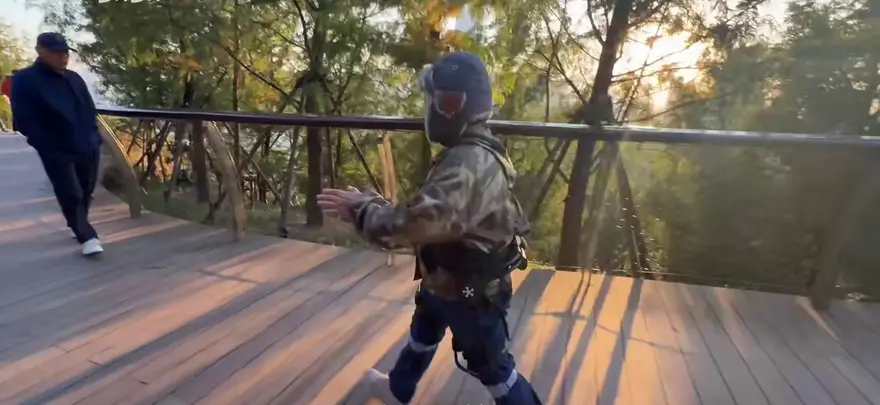
But there was also a clear source of frustration: its gait is "mechanical." If you want to stop and go, or vary your speed at will, it won't cooperate—you're forced to rigidly follow the pace and force level it dictates. To change your rhythm, you first have to "counteract" it a bit. As the video puts it, "it's a little at odds with human intuition.It's a mechanical pace... whatever speed you're going when you start up, it just keeps climbing at that same speed." (as mentioned in the video)
"It's a bit like riding an elevator—it lifts your legs for you. But either way, your upper body is still doing work, so you'll still get a little winded. There's no way around that." (as mentioned in the video)
Two details beyond the raw numbers are worth noting: first, the heart rate reading after the second summit was actually slightly lower than the first (though all that talking along the way could be a confounding variable); second, on a subjective level, after climbing under my own power, my thighs were sore and slow to recover, whereas with the exoskeleton, my legs were noticeably less sore on the way up.
"With this robot on, my legs weren't nearly as sore going up... which goes to show this thing is actually somewhat useful for hiking." (as mentioned in the video)



Passerby's Perspective: What the Auntie Who's Climbed Mount Hua Has to Say
The test drew quite a crowd of onlookers, and we randomly interviewed one auntie — the host made a point of stressing that she wasn't a plant: "This auntie walks fast; even the two of us couldn't keep up."
Her first impression was that it was "pretty amazing," and her assessment after trying it on was remarkably on point:
"It's like carrying a backpack." — The weight gets distributed across your whole body, not as heavy as you'd imagine (mentioned in the video)
Since it was her first time wearing one, the host set the assist to the lowest level to let her ease into it. Once she got walking, the auntie delivered some very "user-perspective" feedback:
"You feel the strain on your waist and legs ease up a bit. Going downhill doesn't hurt your legs — it supports your waist, and both your legs and waist feel relaxed." (mentioned in the video)
This auntie's hiking résumé is seriously hardcore — mountains in Shanxi and Mount Hua are both on her list, and she climbed Mount Tai entirely under her own power. Her verdict: she'd be willing to use a tool like this for hiking. And her read on the industry might just be the most clear-eyed line in the entire video:
"This kind of industry iterates fast. Give it a bit more time, and it'll get even better." (mentioned in the video, paraphrased)
Her hope was equally specific: when she gets older, she'd like to see this kind of device become even lighter and more compact.




Opinion: A Consumer-Grade Exoskeleton's "Usefulness" Comes with Conditions
Boiling an entire episode of hands-on experience down to a verdict, we believe it validated three things—and exposed three others.
First, what it validated:
- The assist is real, but highly scenario-dependent. On flat ground, the 2.5 kg self-weight roughly cancels out the gains from assistance, so the perceived improvement is limited; once you hit sustained stair climbs, the motor takes over most of the work your thighs would otherwise do, and the benefits immediately outweigh the cost. In other words, it's designed for "climbing" and "long distances," not for "strolling."
- Downhill assist is an underrated must-have. Descending puts far more impact on the knees than walking on flat ground, and the combination of lumbar support + reduced leg output + knee cushioning hits precisely where middle-aged and older users, as well as hikers, feel the most pain.
- "It helps the weak, not the strong." The video's conclusion is honest: it delivers the most value to people with weaker legs, older users, and anyone who needs assistance; for young users with plenty of leg strength, it's more like a "load-lightening cheat code."
Now, what it exposed:
- Gait coupling remains an industry-wide challenge. Complaints like "it rigidly makes you follow its rhythm" and "changing your cadence means fighting against it" show that the algorithm still relies primarily on rhythm prediction and responds poorly to spontaneous human intent; the latency in AI mode switching is another manifestation of the same problem.
- Self-weight is a tax you can't avoid. With 2.5 kg hanging on your hips, flat ground is pure burden—only enough elevation gain can "earn back" that tax. The debate in the comments about knee load (see below) is, at its core, asking about the same ledger.
- Endurance is enough for a day outdoors, not for long hauls. 3–4 hours of battery life easily covers weekend hikes, but fully loaded, multi-day treks mean facing the recharging problem—the video doesn't mention a battery-swap option or the price, and both points should be confirmed with the manufacturer before purchase.



Top Community Comments
@CriminalLawArticle236_ (206 likes): My bold prediction: to achieve high-speed movement, future exoskeletons will cover the entire body. To reduce wind resistance, the human body itself will switch to a seated posture, operated via pedals and a dial.
This top comment is an elegantly crafted joke — decode "full-body exoskeleton + seated posture + pedals and a dial," and what you're actually describing is a car. But behind it lies a real question: when machines supply enough power, where does the line fall between "augmenting the human" and "replacing the human"? It also echoes the core experience in the video — even hip assist on just two joints can end up "fighting you for rhythm," and coordinating intent across a full-body setup would only get exponentially harder.
@RadioWave42 (158 likes): The battery voltage in the video is 21.6V — do NOT compare its capacity directly with your phone's battery!! The voltages are different!!!
A classic technical correction. Battery energy = voltage × capacity. This pack runs on a 21.6V platform (the nominal voltage of six lithium cells in series), so 2900mAh works out to roughly 62.6Wh — about three times a mainstream phone battery (around 19Wh). That makes "2900mAh isn't even as much as my phone" a textbook cross-voltage misreading — 3–4 hours of endurance is entirely reasonable against that energy base.
@NPmeetsP (183 likes): All the parts that touch the body are above the knee? Then let me ask you — doesn't that mean the knees are now bearing an extra 2.5KG?
This comment lands right on the biggest point of contention for consumer-grade exoskeletons: whose joints ultimately foot the bill for the device's own weight. The contact points sit at the waist and thighs; statically, the weight is distributed through the pelvis. But during dynamic walking — especially downhill — the knee joints still have to absorb the extra inertia and impact the whole machine introduces. The downhill mode's "lumbar support + knee cushioning" design in the video can be read as the manufacturer's answer to exactly this problem. Still, the net ledger of "2.5 kg of self-weight vs. assist benefit" can, for now, only be judged by feel — rigorous testing at the metabolic or EMG level is still needed.
These three top comments map neatly onto the three long-term issues facing consumer-grade exoskeletons: form (how human and machine couple), energy (battery and runtime), and load (self-weight and joint mechanics). The "water level" of a comment section is, in a sense, exactly the distance between this product category and the general public.
One-Sentence Summary
This is a consumer-grade hip assist exoskeleton built for hiking / trekking assist and everyday walking: 2.5 kg in weight, 3–4 hours of battery life, three assist modes plus independent left/right leg adjustment through the app — the effort savings are real, but "the cadence has to follow its lead." It's a good fit for middle-aged and older users with weaker legs, long-distance hiking enthusiasts, and geeks eager to try something new; if you're after a truly imperceptible wearing experience or regularly take on long routes with a heavy pack, it may be worth waiting — as that auntie put it, this industry iterates fast.
About this article: part of Chinese-Made Exoskeleton Review Archive — an independent, regularly updated English archive of reviews of consumer exoskeletons made in China, edited from publicly available video transcripts. Not an official manufacturer page.
For inquiries and purchasing, contact lonlonago@foxmail.com. More in Exoskeleton · All articles.