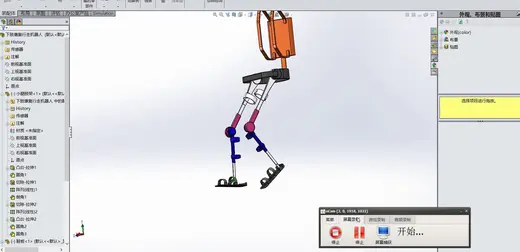
OpenXO Open-Source Exoskeleton Teardown: Modular Lumbar Belt + Direct-Drive/Cable-Drive Dual Transmission, Cutting Walking Energy Consumption by 18% and Doubling Weightlifting Endurance
"An exoskeleton that you can actually assemble like giant building blocks — drive whichever joint you want to drive." — mentioned in the video
The exoskeleton category has long been split into two disconnected worlds: on one side, the medical-grade rehabilitation exoskeletons found in hospitals and rehab centers — often costing hundreds of thousands, bulky, and closed systems; on the other, the lightweight assistive exoskeletons that consumer-grade exoskeleton makers such as Hypershell, Dnsys, Kenqi, Aosha, and Chengtian are testing in small batches. What has always been missing in between is an open-source reference design that lets enthusiasts build their own and freely swap joints.
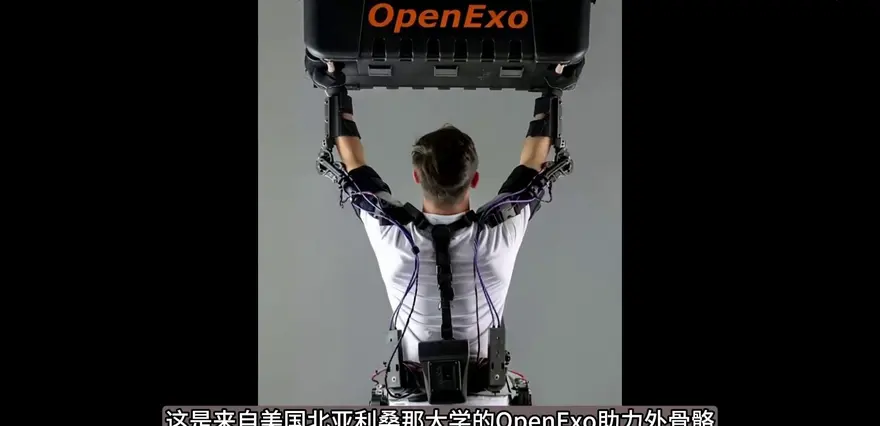
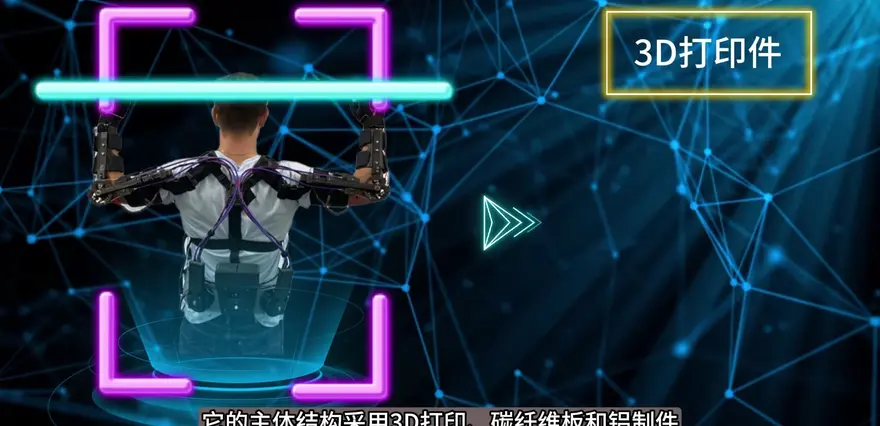
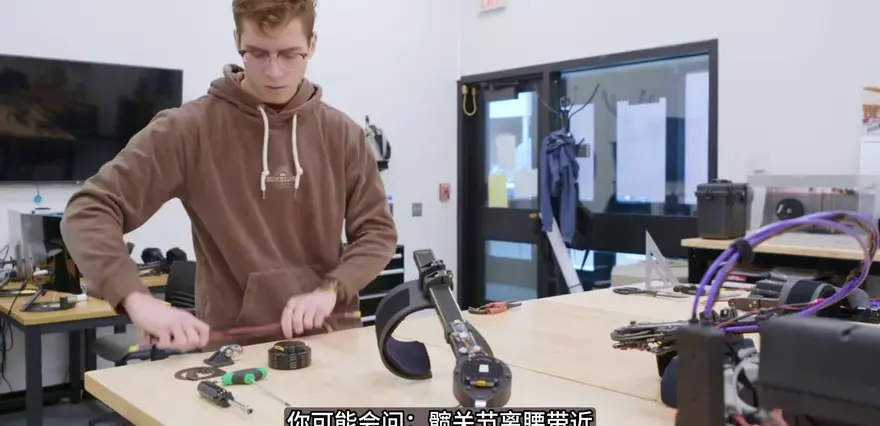
OpenXO, from Northern Arizona University in the United States, aims to fill that gap. It is a fully open-source assistive exoskeleton whose main structure is built from 3D-printed parts, carbon fiber plates, and aluminum components — and the team even supplies a fairly detailed build manual. More importantly, its approach of "modular lumbar belt + direct-drive/cable-drive dual transmission" turns the idea of on-demand assist into a genuinely deployable engineering solution.

1. A New Species of Open-Source Exoskeleton: What Is OpenXO
OpenXO is not a single-form exoskeleton, but an open platform built around a "powertrain + swappable joint modules" architecture. Its positioning is razor-sharp: to let researchers, makers, and even consumer-grade exoskeleton makers rapidly validate different joint assist strategies on a unified platform.
The selling points of the entire system center on four layers:
- Fully open-source: Hardware drawings, assembly instructions, and control software are all open. The open-source link is pinned in the video comments section.
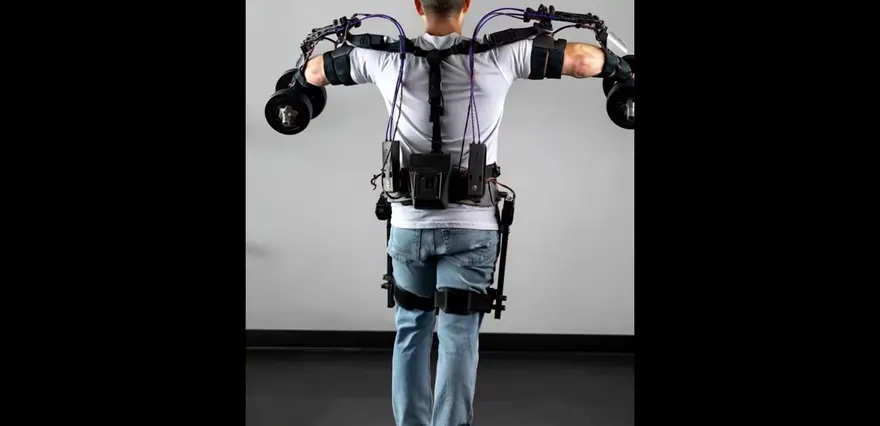
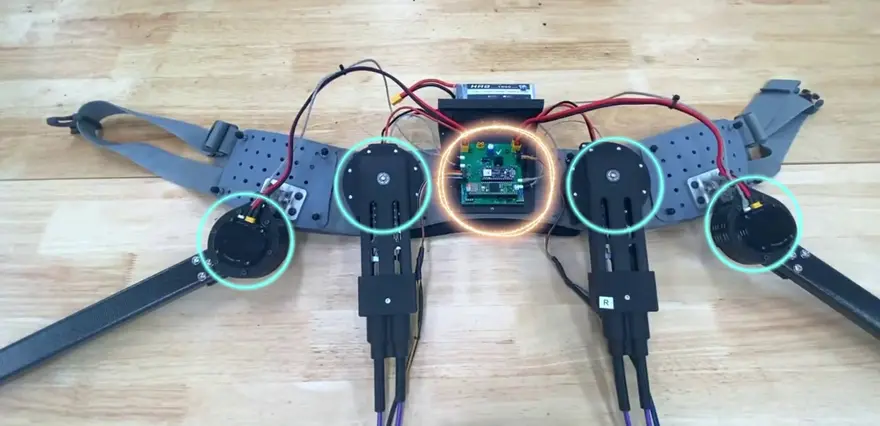
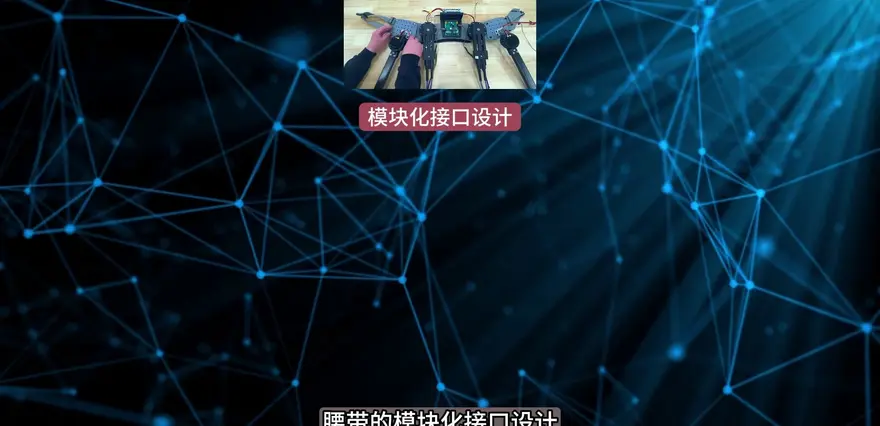
- Modular assembly: The waist belt reserves four interfaces and can drive up to four joints simultaneously.
- Low-cost, replicable: The main structure uses 3D-printed parts, carbon fiber plates, and aluminum components, making small-batch production easy.
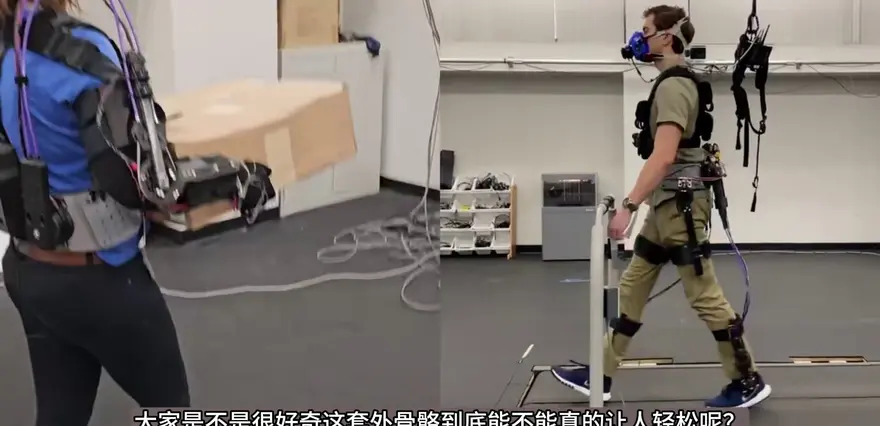
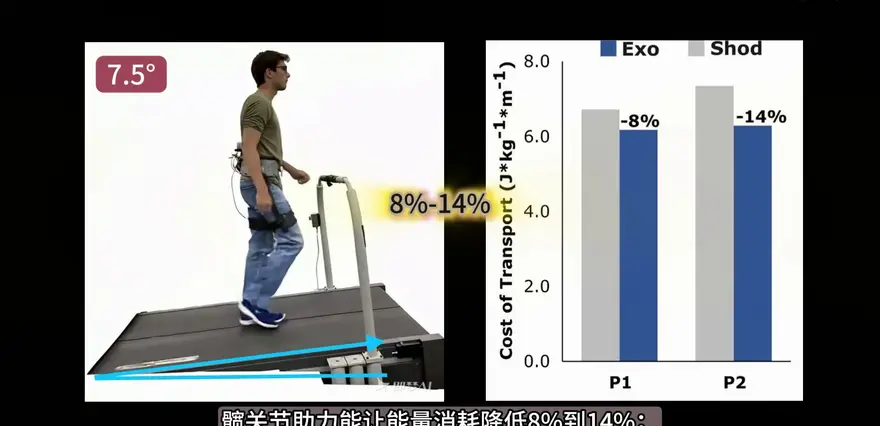
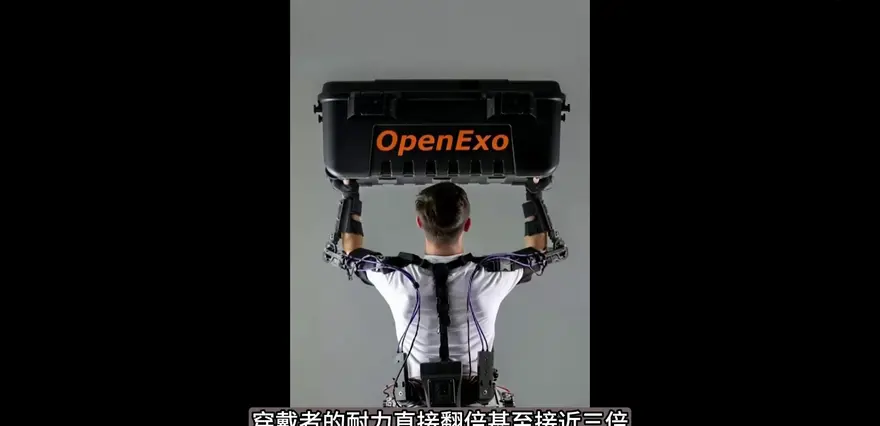
- Proven effective: When walking on a 7.5° incline, hip assist can reduce energy expenditure by 8%–14%; after switching to knee-joint mode, weightlifting endurance doubles outright, and in some cases approaches 3x.
The cost for a set of joint actuator modules runs between 1,000 and 2,000 USD. — Mentioned in the video
That price is not cheap within the consumer-grade exoskeleton context, but in the realm of research-grade open-source hardware, it is already remarkably restrained.
2. The First Recipe of the Mechanical System: Modular Belt-Driven Electric Drive Platform
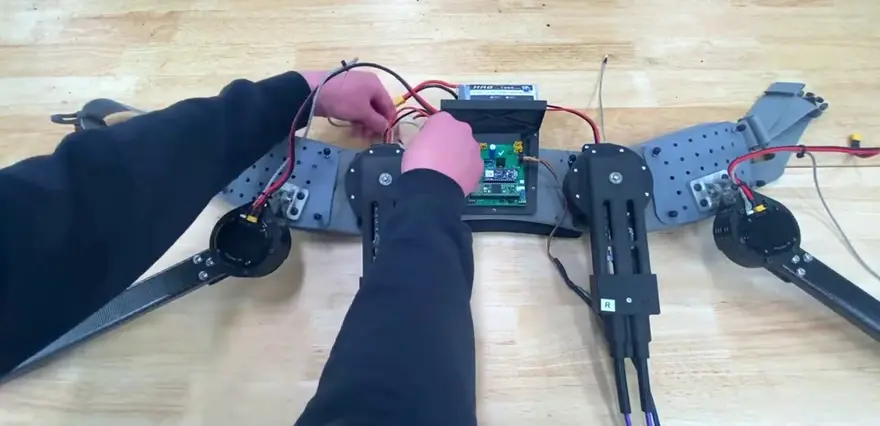
The first "recipe" of OpenXO's mechanical design is the modular belt-driven electric drive platform. The positioning of this belt is crystal clear — it is the "powertrain" of the entire exoskeleton.
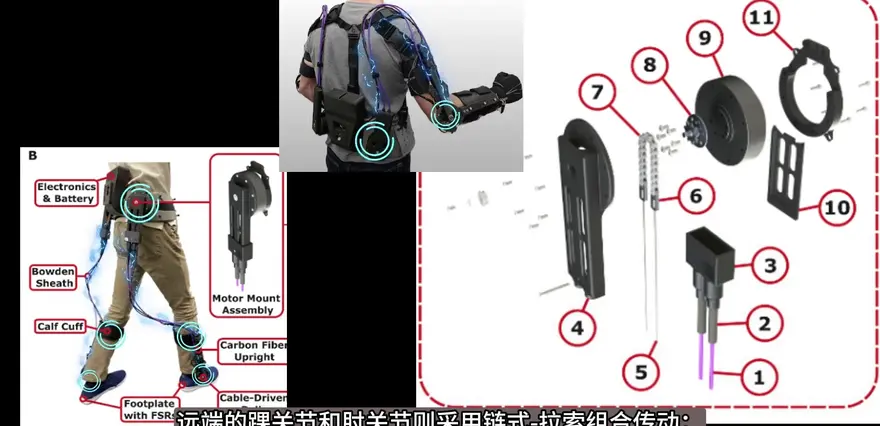
All joint actuators, batteries, and electrical systems are concentrated at the waist, with four standardized interfaces reserved on the belt. Want to drive a single joint? Plug in one module. Want multi-joint coordination? Just plug in more modules. This design truly achieves "on-demand assist" and is the core differentiator that sets OpenXO apart from traditional integrated exoskeletons.

Traditional lower-limb exoskeletons typically use a tightly coupled structure of "one motor + one controller per joint," meaning a joint swap means replacing the entire unit. OpenXO, however, concentrates the power source at the waist, leaving only the transmission and sensing at the joint end — essentially physically isolating the "brain + heart" from the "hands and feet."
The benefits of this approach are obvious:
- The waist has strong load-bearing capacity, so placing heavy motors and batteries here minimizes the impact on human gait.
- With standardized interfaces, joint modules can be iterated independently without having to start over every time.
- For researchers, it becomes possible to conduct experiments on just "one joint" without paying for a complete exoskeleton.


3. The Mechanical System's Second Secret: Direct-Drive + Cable-Drive Dual Transmission
The modular waist belt solves "where the power comes from"; the second secret solves "how the power is transmitted to the joints."
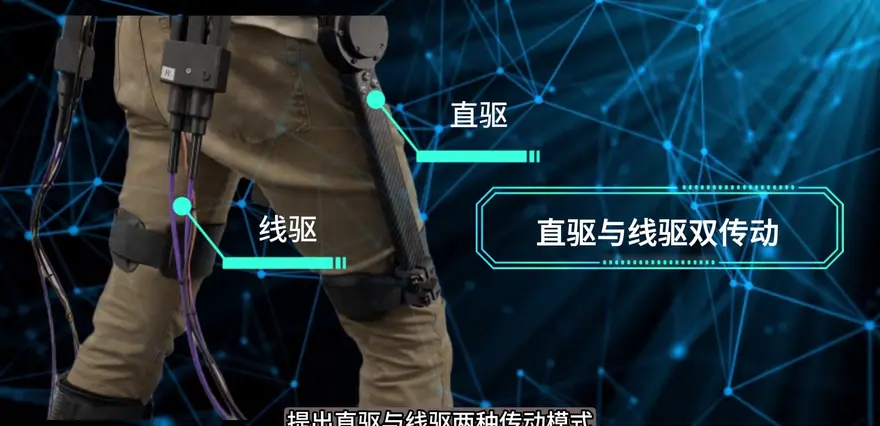
The hip joint is close to the waist belt, while the ankle and knee joints are far from it — relying on a single transmission mode is clearly insufficient. OpenXO offers two solutions:
The proximal hip joint uses a direct-drive mode. Direct drive eliminates intermediate transmission components, both delivering the large joint torque the hip requires and boosting transmission efficiency to reduce energy loss.
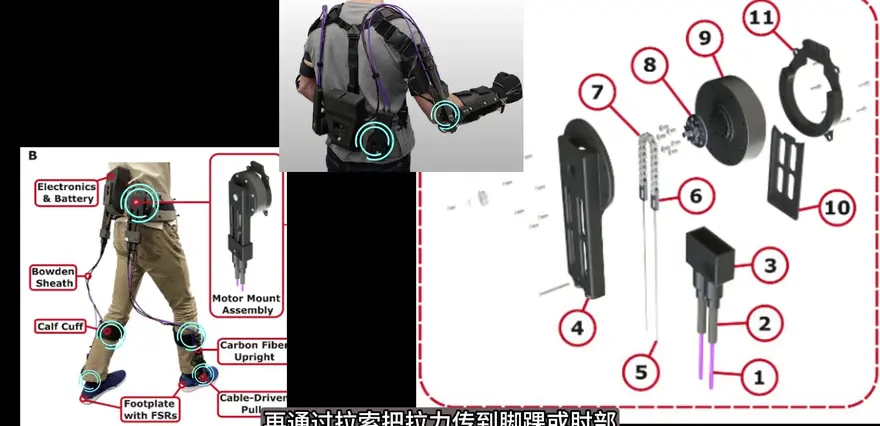
The distal ankle and knee joints use a chain + cable combination transmission. The brushless motor on the waist belt first rotates the chain, then transmits the pulling force to the ankle or knee via the cable, and finally achieves the exoskeleton joint's rotational assist at the distal joint through a pulley.
This "chain + cable + pulley" distal transmission essentially replaces rigid linkages with flexible tendons, freeing the distal joints from carrying a heavy motor. This is a classic engineering trade-off that consumer-grade exoskeletons make between weight and battery life — you can't have every joint equipped with its own motor while still keeping the whole unit light enough to wear all day.
The distal ankle and knee joints use a chain-and-cable combination transmission, achieving rotational joint assist through a pulley. — Mentioned in the video
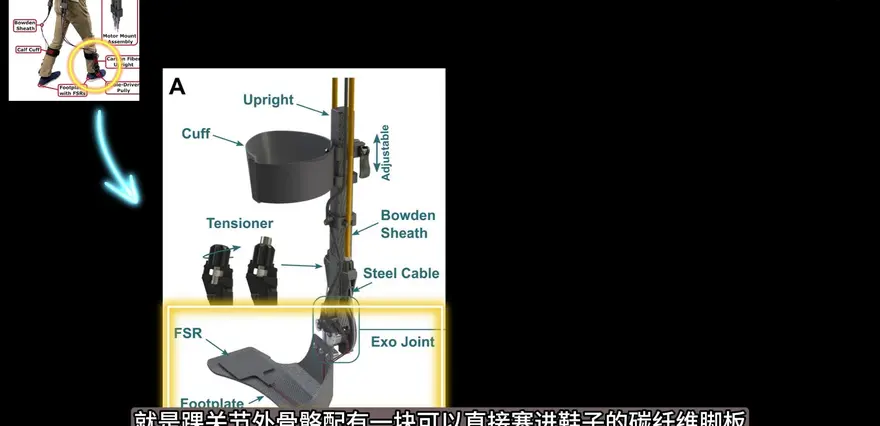
One more clever detail worth highlighting: the ankle joint exoskeleton is paired with a carbon fiber plate that can be slipped directly into a shoe. This plate's job is to stably transmit the exoskeleton's joint torque to the forefoot and heel, preventing the assist from acting only on a localized area and causing discomfort. Pressure sensors can also be arranged on the plate to detect gait, enabling higher-precision closed-loop control.
IV. Electrical Architecture: Dual-Core Division of Labor and CubeMars Brushless Motor
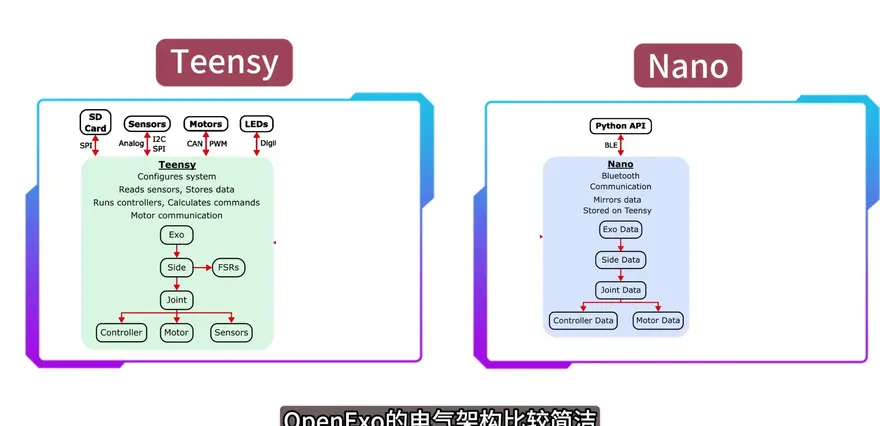
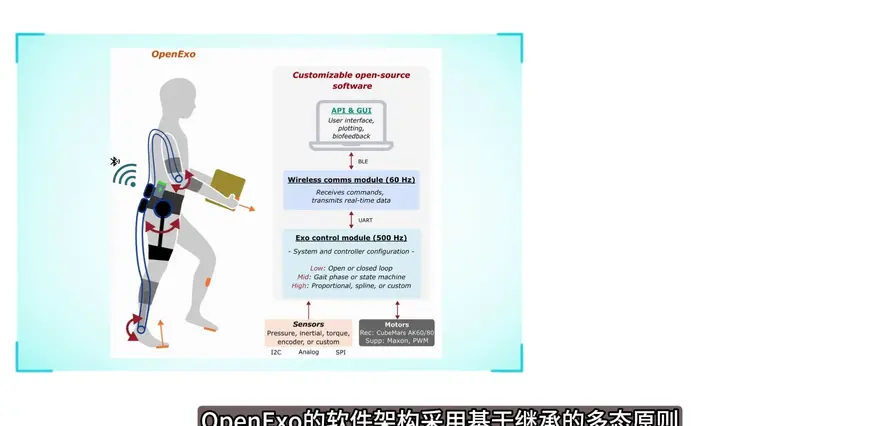
OpenXO's electrical architecture follows a "clean but clearly divided" approach, adopting a dual-core controller design:
- Teensy handles core control: collecting sensor data and driving the exoskeleton joints.
- Arduino Nano is dedicated to Bluetooth communication, wirelessly transmitting data to the host PC.
The benefit of this division is that it completely decouples the two tasks of "real-time control" and "wireless interaction," which would otherwise compete for resources. The control loop runs fast, and Bluetooth communication doesn't drop packets — critical for torque closed-loop control that requires millisecond-level response.
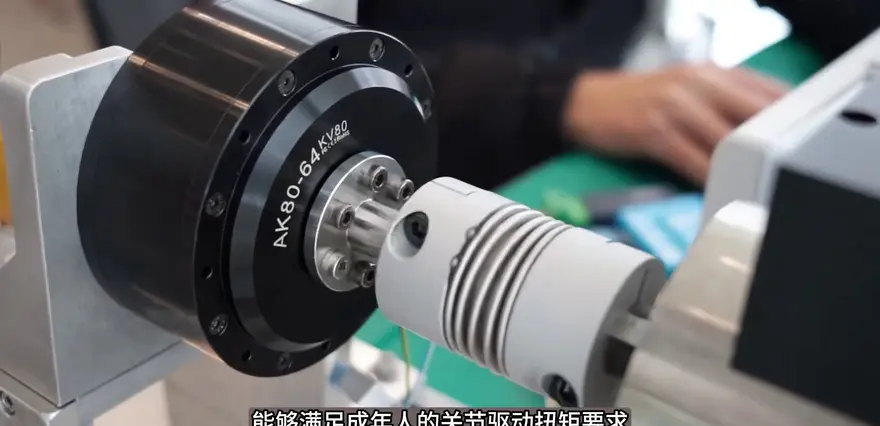
For the motor, OpenXO chose the CubeMars AK series brushless motor. This motor lineup is practically a "standard part" that everyone in the robotics circle owns — high power and ample joint torque, capable of meeting the joint drive torque requirements for adults.
But the trade-off is the price:
A single joint driver module costs $1,000–$2,000, with the CubeMars AK series motor being the main expense. — mentioned in the video
If we calculate based on "driving up to four joints simultaneously," the joint drivers alone cost $4,000–$8,000. Add in carbon fiber plates, 3D-printed parts, sensors, and the battery, and the complete machine's BOM easily exceeds $10,000. This is also OpenXO's biggest barrier to real-world adoption today — it's an excellent open-source reference platform, but still far from "consumer-grade pricing."

V. Control System: Low-Level Joint Torque Closed-Loop + High-Level Gait Control
The control design is the part of OpenXO that most deserves close attention from industry insiders. It handles both low-level and high-level control simultaneously, rather than addressing only one of the two.
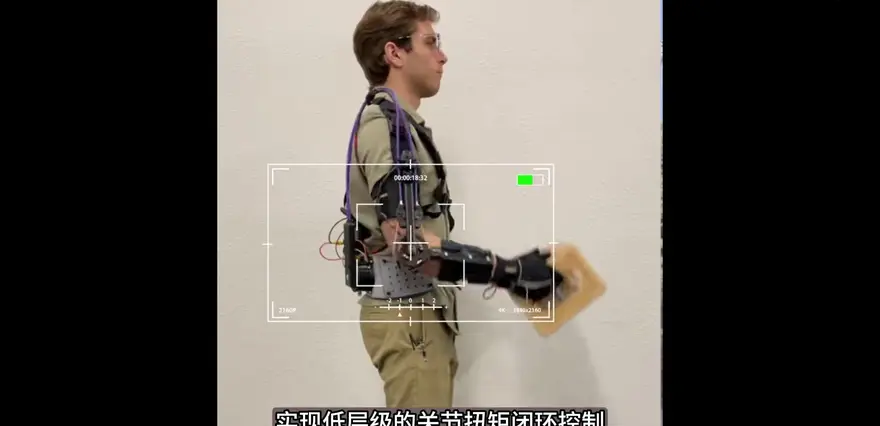
Low-Level Control: Joint Torque Closed-Loop. A torque sensor is integrated inside each joint to measure actual torque in real time, enabling low-level joint torque closed-loop control. This is the foundation for ensuring the exoskeleton "delivers force when it should, and steps out of the way when it shouldn't" — only when the torque tracks the setpoint curve can the wearer avoid feeling that "the machine is fighting against them."
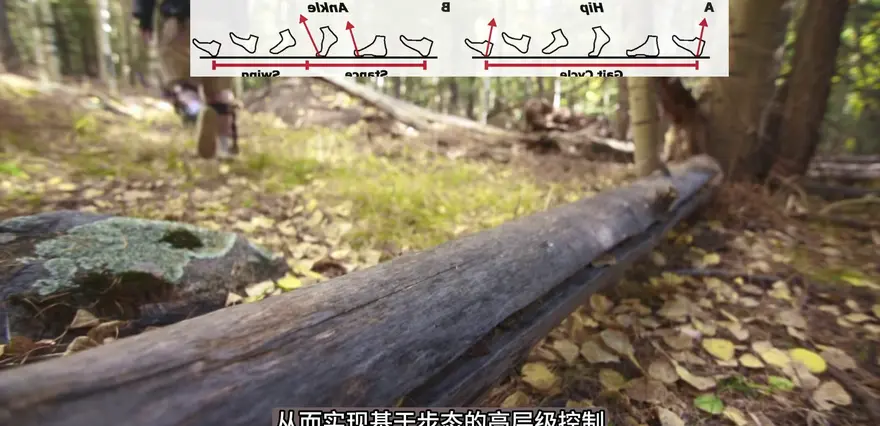
High-Level Control: Gait-Based Phase Recognition. Resistive pressure sensors placed at the sole and heel can detect key gait phases such as heel strike and toe-off, thereby enabling gait-based high-level control. In simple terms: when the heel strikes the ground, the system applies hip assist to the hip joint; when the toe leaves the ground, it delivers a push to the ankle joint — aligning the timing of assist with the human body's natural gait.
State Monitoring: Hall-Effect Angle Encoder. The Hall-effect angle encoder can evaluate joint angle and velocity in real time, monitor motion state, and provide closed-loop feedback for the control algorithm.
Even more thoughtfully, this system reserves expansion interfaces, allowing new sensors or custom controllers to be freely connected. For researchers, this means OpenXO is not a "use-and-discard" black box, but an open platform on which experiments can be conducted over the long term — you can plug in your own IMU, your own EMG sensor, or even your own reinforcement learning policy.


6. Software Architecture: Object-Oriented Programming Makes Modularization Real
Hardware modularity is only the first step; whether the software can keep pace is what truly determines whether a modular exoskeleton is actually usable. If every joint swap means rewriting the control code from scratch, then "modularity" is nothing more than a marketing slogan.
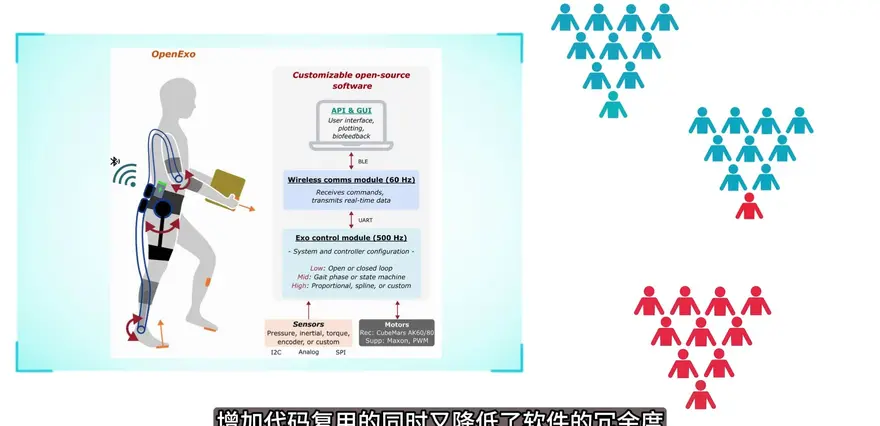
OpenXO's solution is based on the principles of inheritance and polymorphism:
If a controller can be used across multiple joints, you only need to define it once and then call it on all of those joints — increasing code reuse while reducing software redundancy. — Mentioned in the video
In essence, this brings the most classic paradigm of object-oriented software engineering into robot control: "joint" is abstracted as a base class, while the hip, knee, and ankle each inherit and override key methods, and the controller is written as generic logic targeting the base class. When swapping a joint, you only need to specify the instance in the configuration — no need to modify the control code itself.
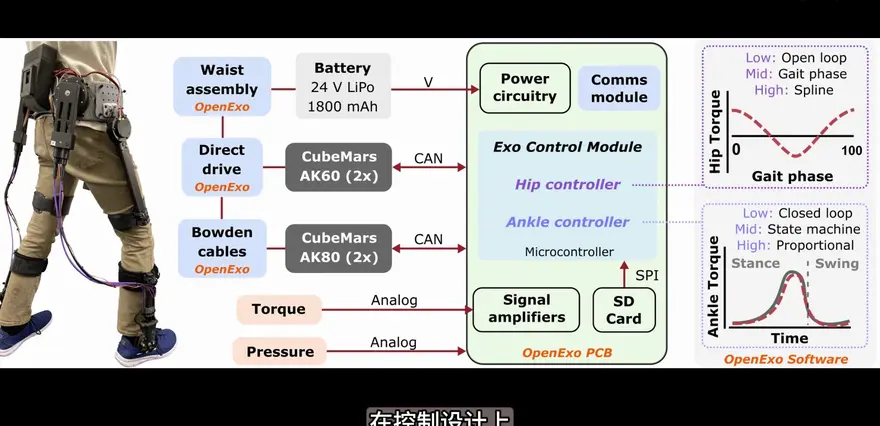
Even more clever is the configuration management: whether it's single-side or dual-side joints, the default controller, the PID parameters for each joint, or the set maximum joint torque — all of it is written onto a small SD card. This means swapping a joint no longer requires reflashing firmware; just insert the card and it works.
The research team also developed a host-side interface that communicates with the SD card over Bluetooth, letting wearers easily customize control parameters. For a consumer-grade exoskeleton, this kind of "tunable parameters, hot-swappable configuration" experience is far friendlier than a hard-coded, closed product.
Seven. Performance Testing: 18% Metabolic Savings, Weightlifting Endurance Doubled
After reviewing the design, only one question truly matters—can this exoskeleton actually make things easier for the wearer? The real-world test data from OpenXO is quite impressive:
Hip Joint Assist Mode (7.5° ramp walking):
Energy consumption reduced by 8%–14%. — Mentioned in the video
Ankle Joint Assist Mode (outdoor testing):
Stride increased by 9%, speed improved by 15%. Subjects not only expended less effort but also walked faster with longer strides. — Mentioned in the video
Knee Joint Assist Mode (weightlifting experiment):
Wearers' endurance doubled directly, even approaching 3x. — Mentioned in the video

Look at these three sets of data together, and the value of OpenXO becomes clear: it is not a toy built "for the sake of being open-source," but rather an engineering platform that delivers quantifiable gains across different assist scenarios. The hip joint suits hiking / trekking assist, the ankle joint is ideal for everyday gait acceleration, and the knee joint shows remarkable endurance improvements in load-carrying scenarios.
Walking energy consumption reduced by 18%. — Mentioned at the start of the video (combined multi-joint mode)
With a combined multi-joint coordination mode, overall energy consumption reduction can reach 18%—a figure that holds its own even in the first tier of consumer-grade exoskeletons.

8. Cost, Weight, and Adoption Barriers
OpenXO's engineering philosophy deserves applause, but as a serious tech review, we have to lay its problems on the table too.
First, the weight. A sharp critique from an industry insider, @huashui-er-bei-mo-de-yu, surfaced in the video comments section:
"You're using AK80-64 — one motor is 800g, four motors come to 3.2kg. Top and bottom, four of them — just imagine how heavy that gets."
This comment hits the most realistic pain point of OpenXO's current solution. A single CubeMars AK80-64 motor weighs about 800 grams; if four joints are driven simultaneously, the motor section alone comes to 3.2 kilograms. Add the waist belt, battery, transmission, and carbon fiber foot plates, and the total weight could easily break past 5 kilograms. That weight is fine inside a lab, but to genuinely step into consumer scenarios, it has to lean on quasi-direct drive, high-torque-density motors to shed weight — and the OpenXO team is indeed pushing in that direction.

Second, the price. A module cost of 1,000–2,000 USD per joint means OpenXO is currently a better fit for research institutions and university labs than for ordinary consumers. For consumer-grade exoskeleton makers, OpenXO's value lies more in its "design paradigm" — modular waist belt, dual transmission, object-oriented software architecture — ideas that domestic manufacturers could pick up, swap in cheaper domestically produced brushless motors and injection-molded parts, and ship a mass-produced version at roughly one-third the cost.
Third, the wearing experience. The cable-and-pulley flexible transmission does lose some efficiency, and whether prolonged wear will lead to cable slack, pulley wear, or rising noise is something the video doesn't expand on — but it's a durability question every exoskeleton taking the "cable-driven" route has to answer.

IX. Industry Significance & Future: Quasi-Direct-Drive Ankle, Direct-Drive Knee, Gaming Interaction
OpenXO's true value lies not in how many units it can sell today, but in how it transforms "modular exoskeleton" from a concept into a reproducible engineering reference. For the rapidly rising domestic consumer-grade exoskeleton track — brands like Chengtian, Kenqing, Aosha, Toread, Yuanye, Hypershell, and Dnsys — this is an open-source template well worth dissecting.
What's exciting is that the authors are pushing forward several new directions:
- Quasi-direct-drive ankle joint design: Using high torque-density motors to replace the current cable-driven approach, further reducing distal transmission losses.
- Direct-drive knee joint design: Upgrading the knee joint to direct drive as well, forming a unified proximal direct-drive system together with the hip joint.
- Exoskeletons for gaming interaction: Applying the sensor and force feedback capabilities of assistive exoskeletons to VR/gaming scenarios — a highly imaginative expansion direction. An exoskeleton is not just a "labor-saving tool"; it can also be a "force feedback peripheral."
The robotics era is coming toward us. — Mentioned in the video
This may sound like a slogan, but in the 2026 consumer-grade exoskeleton context, it is becoming reality. Once the open-source community has laid down the infrastructure — modularization, dual transmission, object-oriented software — what remains is for the domestic supply chain to drive costs down, push weight down, and elevate the wearing experience. These three things happen to be exactly what Chinese hardware teams do best.

Top Community Comments
@Reader (10 likes): Absolutely absurd. I used to work on exoskeletons — the AK80-64 motor weighs 800g apiece, four motors come to 3.2kg, and with four upper and four lower, just imagine how heavy that gets.
Interpretation: This is a weight challenge from a frontline practitioner, pinpointing the biggest engineering soft spot of OpenXO's current scheme — the CubeMars AK series motors deliver ample joint torque but are heavy, and the total weight of the four-joint parallel scheme will instantly deter consumer scenarios. It shows OpenXO is better suited as a research platform; to enter the consumer-grade space, it must switch to quasi-direct-drive high-torque-density motors.
@Reader (10 likes): Domestic exoskeleton tech is about to explode soon [doge]
Interpretation: This comment reflects domestic viewers' high expectations for the consumer-grade exoskeleton track. Brands like Chengtian, Kenqing, Aoshark, Hypershell, and Dnsys have been rolling out products in dense succession over the past two years, and layered on top of the "knowledge spillover" from open-source reference designs like OpenXO, the domestic supply chain genuinely has the conditions to push both price and weight down at the same time — the "explosion" is no empty talk.
@Reader (9 likes): With this, when I'm old I should still be able to keep carrying bricks and shining bright, right?
Interpretation: Behind the joke lies the most authentic consumer demand for lumbar / back assist and lower-limb exoskeletons — middle-aged and elderly manual laborers and heavy-load carrying scenarios. This demographic is extremely price-sensitive and most in need of lumbar / back assist and knee joint endurance gains. OpenXO's data showing doubled endurance in its weightlifting experiments happens to map directly onto this rigid demand.
@ (typical researcher-perspective comment): The open-source link is pinned at the top of the comments — interested friends are welcome to download it.
Interpretation: This reflects OpenXO's core appeal that sets it apart from commercial exoskeletons — fully open-source + detailed build instructions. For university labs and makers, the draw of "being able to download the complete drawings" far outweighs any spec marketing from commercial products, and that is also the foundation on which it can build a community.
@ (typical cost-perspective comment): A single joint driver module costs USD 1,000–2,000.
Interpretation: This data-driven comment points to OpenXO's current price threshold. It shows there is still an order-of-magnitude gap between an open-source reference design and consumer-grade mass production, and the opportunity for domestic manufacturers lies precisely in using domestic motors + injection molding to compress that number to one-third or even lower than its original value.
@ (typical extensibility-perspective comment): The system reserves interfaces so you can freely plug in new sensors or custom controllers.
Interpretation: This reflects OpenXO's positioning as a research platform rather than a consumer product — extensibility is its moat. Any sensor — EMG, IMU, vision, and so on — can be wired in, which means it can eventually carry the full research chain from gait recognition all the way to reinforcement learning.
One-Sentence Summary
OpenXO is an open-source exoskeleton reference design that clearly lays out three things: a modular waist belt, a direct-drive/cable-drive dual transmission, and object-oriented software. It is well suited as a technical foundation for university researchers, exoskeleton makers, and the engineering teams of consumer-grade exoskeleton brands; however, constrained by the weight and unit price of CubeMars motors, it still has a stretch of "domestic localization, weight reduction, and price reduction" to cover before reaching ordinary consumers.
About this article: part of Chinese-Made Exoskeleton Review Archive — an independent, regularly updated English archive of reviews of consumer exoskeletons made in China, edited from publicly available video transcripts. Not an official manufacturer page.
For inquiries and purchasing, contact lonlonago@foxmail.com. More in Tech & Design · All articles.