Wearing 1.8 kg of "Black Tech" on Your Legs: This Consumer-Grade Exoskeleton Is Light Enough to Wear for Hiking


This "exoskeleton robot" isn't anything like Iron Man's suit
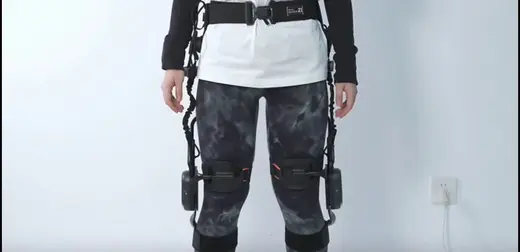
At the beginning of the video, everyone is expecting to see some advanced tech, but it features no hydraulics or steel casing. Instead, it's a lower-limb exoskeleton so lightweight you can carry it in your hand or even fit it into a backpack.
The product we tested outdoors this time is a consumer-grade exoskeleton with a total weight of just 1.8 kg (source: as stated in the video). Unlike industrial or rehabilitation exoskeleton systems designed for seamless human-machine integration, this one is actually more like "a leg exoskeleton that actively helps you lift your legs": as you walk forward, it follows you; when you feel a load, it provides a boost at the key phase of your motion.
The biggest takeaway: It's not like "wearing a machine," but rather "having an extra leg that helps out."
While walking, it doesn't replace your motion. Instead, it utilizes the logic of an assistive exoskeleton to provide a well-timed assist at the moment you lift your leg. This "non-invasive" method of walking assist is the core element distinguishing a consumer-grade exoskeleton from heavy-duty exoskeletons.


1.8 kg is the Key Highlight: Light Enough to Take with You
If traditional exoskeletons were "gym monsters," then this 1.8 kg leg exoskeleton is the "commuting companion for urban youth."
The overall rigidity and carbon fiber material are not designed for brute-force durability, but to ensure this assistative exoskeleton is lightweight and snug during walking. The additional weight is primarily attributed to the lithium-ion battery and servo motors, rather than the outer shell.
How compact is it? Roughly the length of a folded umbrella, yet slightly more "tech-ready" than you might imagine.
In the realm of lower-limb exoskeletons, the 1.8 kg figure stands as a benchmark for lightweight design. Equivalent to the weight of a slim laptop, it manages the dual tasks of leg lifting and load bearing.


Is It “Getting Kicked Along,” or Has It “Grown Its Own Assist”?
The tester said something quite telling: “Why does it feel like someone is kicking me along?”
That feeling is actually a very typical “phase-assist” feedback in an assistive exoskeleton—the system uses sensors (such as an IMU / pressure sensor) to detect the instant you lift your leg, then has the servo motor / brushless motor deliver a joint torque at that precise moment. This “push-from-behind feel” isn’t stiff at all; instead, it creates the illusion of “human-machine collaboration.”
When you walk on flat ground, its rhythm keeps up; when you climb, it gives you more room in your stride. This isn’t just “effort-saving”—it feels more like “gait expansion.”


It Understands Your Gait: Not a Robot Walking, But an "Exoskeleton Walking With You"
A superior assistive exoskeleton shouldn't turn your gait into a robotic one. It should be an "extension" of your walking style, not a "substitute."
From the climbing stairs segment in the video, this consumer-grade exoskeleton shows a impressive understanding of gait: when you lift your leg, it provides assistance; when your foot lands, it immediately "retracts." There's no awkward "human-machine confrontation"—instead, it feels like "the exoskeleton is skimming just above the ground."
Even for young people, first-time users adapt quickly, with no sense of dissonance or feeling "like you're wearing a robot."


Is It a "Strong Contender" in the Same Arena?
When comparing this 1.8 kg consumer-grade exoskeleton to other products on the market, it feels more like a "wearable personal gait coach" rather than a "heavy-duty mech that redefines walking."
In the domestic and international consumer-grade exoskeleton market, brands like Hypershell are also making similar attempts at walking assist, but many products still struggle to balance "structural rigidity" and "weight".
The design trade-offs for this device are clear: it sacrifices "higher rigidity / max payload / load capacity" to prioritize "long-term wearability"—this is exactly the "last mile" that a consumer-grade exoskeleton must conquer: it cannot be too heavy, too expensive, or too difficult to wear.


Who Is It For? Liberation for Hands, Knees, Lumbar, and Legs
While the video features a young wearer, when considering a wider demographic, this device truly solves the burden of walking.
It is incredibly appealing to three distinct types of users:
- "Light outdoor enthusiasts" who want to hike or climb but prefer a more effortless experience.
- Commuters racking up 20,000 steps daily in the city with exhausted knees and ankles.
- "Silver-haired explorers" eager to keep hiking and seeing the world after retirement.
If you are considering this for an older adult, it might be a better fit than a heavy-duty rehabilitation exoskeleton. It is lightweight, easy to adjust, and allows your gait to sync naturally after just a short practice period.


Is It Fair To Compare It With a Medical-Grade Exoskeleton?
Truth be told, putting a consumer-grade exoskeleton side by side with a medical-grade exoskeleton is already a mismatched comparison—the former leans toward everyday walking assist, while the latter is built for functional recovery.
This device indeed lacks the heavy, clinical presence you get from a rehabilitation exoskeleton. It feels more like a fashion statement than a medical device. Wearing it around the city won’t rattle passersby; if anything, it reads like a pair of high-tech boots.
A consumer-grade exoskeleton isn’t about giving everyone steel armor—it’s about offering a more effort-saving option for everyday walking.


Price, Materials, and "Can It Get Smaller in the Future?"
The video doesn't mention the full price or complete technical specs of this exoskeleton, but judging from the tags and the hands-on experience:
- It utilizes a carbon fiber shell, resulting in a lightweight structure.
- The battery is likely centralized around the lumbar area or thighs, with the main control unit positioned at the hip.
- Details on battery life / runtime, endurance (in hours), and the length of the carbon straps have not been disclosed yet (complete specs were not provided in the video).
Compared to similar consumer-grade exoskeletons, if it can remain within an acceptable price range, it has a high potential to become a hot contender in the exoskeleton market in the coming years.


If You're Buying: A 3-Minute Guide to Getting Started
The video actually contains a crucial tip for the user experience: after putting it on, don't rush to start walking. First, try to find "the exact step where it gives you a push" on flat ground.
This is essential. It is a device that requires "you to adapt to it," rather than one that "automatically carries you the moment you turn it on."
It requires you to wear it comfortably and walk naturally, leaving the assist timing to be determined by the sensor (IMU / pressure sensor). This is why consumers might feel "like someone is kicking them forward"—that is actually the device performing "phase recognition."


```
Top Community Comments
@IAmAlsoAnExoskeletonEnthusiast: Seeing "1.8 kg" really blew me away, that's so incredibly light!
— This comment directly strikes at the biggest pain point for consumer-grade exoskeletons: being too heavy. The 1.8 kg figure itself is inherently a topic of discussion.
@CuratorOfLifesFinestIsLive:
— This comment is clearly promotional/sales-driven content, which indirectly shows that this product has gained some commercial traction on the video platform, though it offers limited information.
@NonSlipSocks: Just wondering, can you wear it on rainy days?
— The public's stereotype of an "exoskeleton = metallic machinery" still remains, and everyday waterproofing and rain resistance are among their most practical concerns.
@AlreadyHaveThreeExoskeletonsAtHome: This one is my "daily driver," while the others are my "gym type."
— This indicates that consumers have already developed the habit of using exoskeletons for different scenarios, further proving that there is a real demand for lightweight consumer-grade devices.
@TheNightOwlChampionXiaoWang: The video makes it sound amazing, but nobody in the comments is asking about the price. Whether it can be cheaper is the key.
— No matter how brilliant the video is, a user's final decision is still driven by the price, which is also the biggest bottleneck for the popularization of consumer-grade exoskeletons.
@ZhangTheLimperDoesntWantACrutch: Will the hip assist module press against my thighs?
— This touches on details of "wearing comfort" and "joint friction"; many people have a hidden concern that a wearable exoskeleton might "dig into their legs."
@iFanlyOldFan: Can you use it for running? The video only mentioned climbing stairs and walking.
— Many in the comments have high expectations for "sports scenarios," but currently, consumer-grade exoskeletons mainly serve "walking" rather than running.


One-Sentence Summary
It subtracts the "heaviness and rigidity" from industrial-grade exoskeletons, retaining the core experience of instantly boosting your legs. By weighing just 1.8 kg, it achieves versatile all-terrain capability across outdoor hiking, urban commuting, and lightweight senior walking assist, making it a product you can actually wear outdoors among today's consumer-grade exoskeletons. If you are eager to try the futuristic walking tech that gives you the sensation of being "pushed forward from behind as you walk," or want to give your legs a break from the strain of long distances and numerous stairs in your daily life, it is a top-tier starting point worth your consideration.














About this article: part of Chinese-Made Exoskeleton Review Archive — an independent, regularly updated English archive of reviews of consumer exoskeletons made in China, edited from publicly available video transcripts. Not an official manufacturer page.
For inquiries and purchasing, contact lonlonago@foxmail.com. More in Exoskeleton · All articles.