Driven by Taobao: Assembling an Exoskeleton Armor from Garbage Bags — A Hardcore Low-Cost Protection Test
1. The Taobao-Driven Foundation: From Drafts to the Essence of the exoskeleton
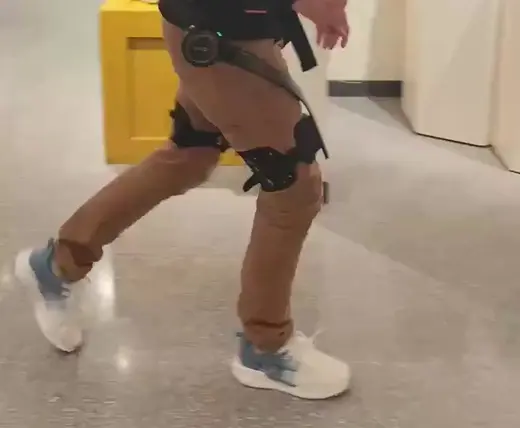
Wearable robots require a complete hardware foundation—sensors, servo motor, IMU, and thin-film-grade carbon fiber—which forms the underlying architecture of the exoskeleton. consumer-grade exoskeletons and rehabilitation exoskeletons belong to two distinct spectrums: the former targets the consumer market with a pursuit of general utility, while brands like Aoshark, Kenqing, and Chengtian focus on the B2B sector, iterating their core technologies multiple times.
Most consumer-grade exoskeletons aren't just about stacking parameters; they require long-term optimization of joint torque, battery life / runtime, self-balancing algorithms, and fall protection, which determines their distinctly different technical baselines.



2. Why the First Design Was Tossed: Insulating Tape, Not Sweet Dreams
When it came to insulating tape, we initially thought we could simply loop it around the arm to serve as a rough-and-ready securing padding. However, actual drills quickly revealed massive resistance.
"Insulating tape is incredibly tough to manage, drains the supply at a huge rate, the economic cost quickly becomes unsustainable, and the results fall far short of expectations." — Here, we need to make a frank admission: this was a terrible choice.
In the IMU coordinate system, changes in the arm's torque cause the padding to undergo brittle failure — the tape lacks an elastic modulus and yield hinge points, meaning once stretched tight, it completely loses its ability to deform.



3. The Garbage Bag Approach: Keeping Costs Below the Knee
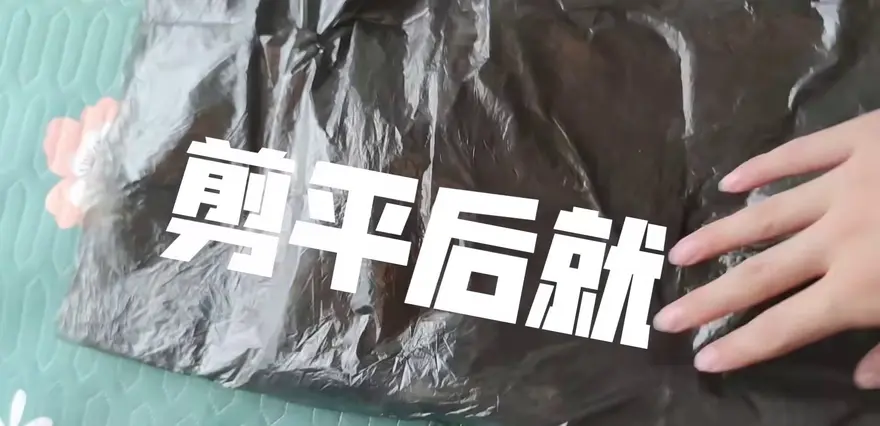
After ruling out advanced designs repeatedly, she chose the most basic, least stable, yet highly cost-effective alternative—garbage bags.
Garbage bags essentially act as floating weight. They are low-cost while possessing a certain thickness and elasticity. The key lies in the underlying armor logic: whenever a joint fails, wears out, or is under pressure, they keep all the "edges" outside the armor.
The critical point: garbage bags do not have zipper pressure dead points, nor do they develop rigid fatigue during use—this "sacrificial armor" is actually the greatest difference between the brushless motor route and the programming route.



4. The Evolution of Fixation Schemes: The Velcro and Glove Paradox
At this stage, we found that the V1 scheme was a complete failure—the gloves concentrated all the pressure directly at the metacarpophalangeal joints. Once sweat seeped in, the consequences for the environment [of the wearable] were severe.
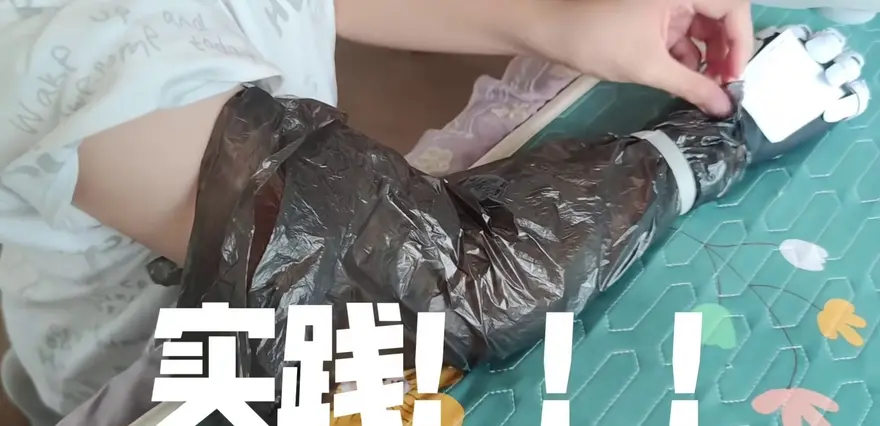
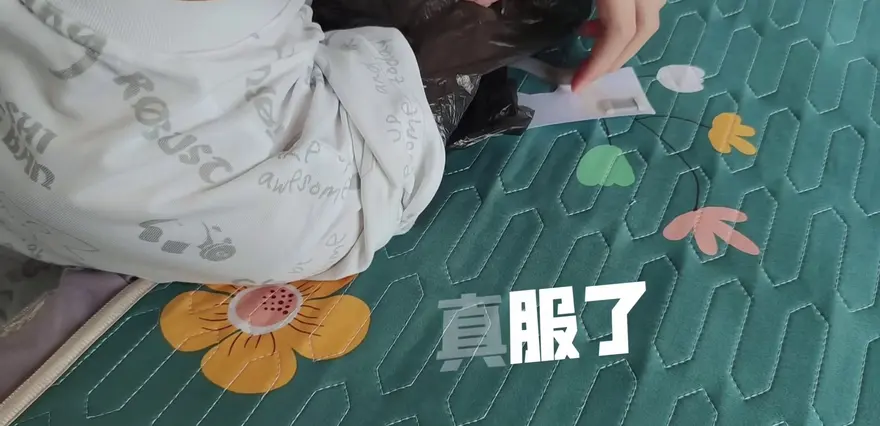
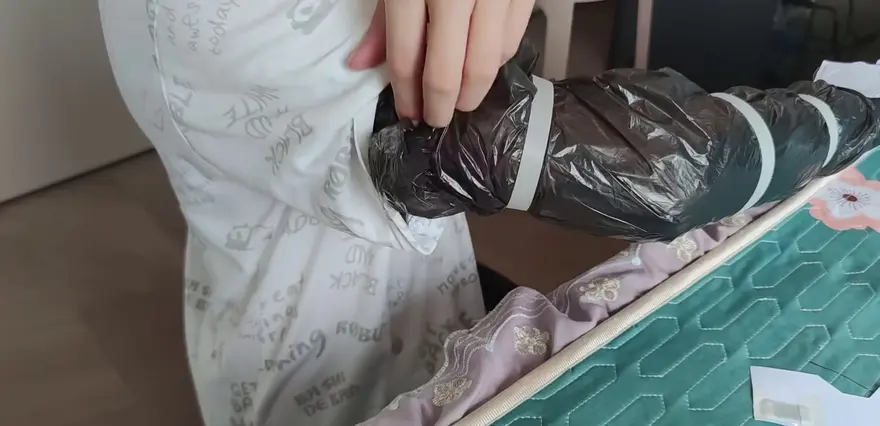
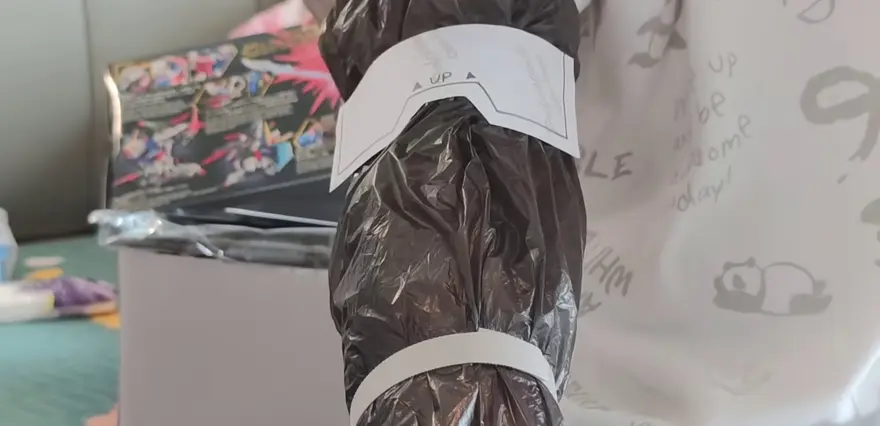
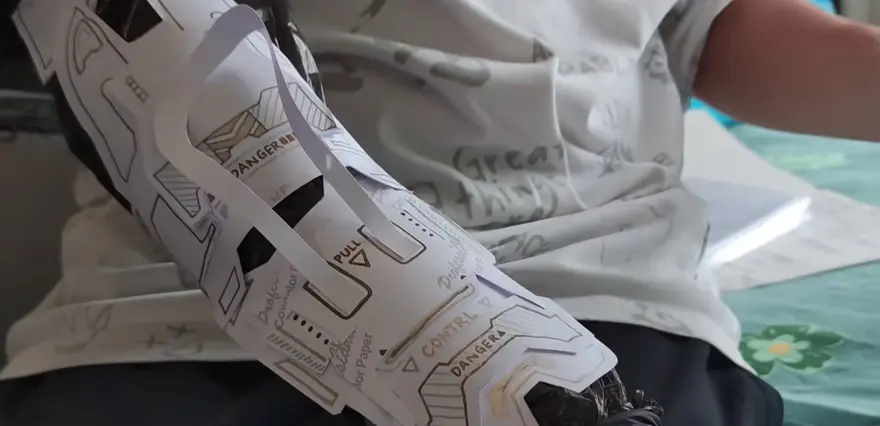
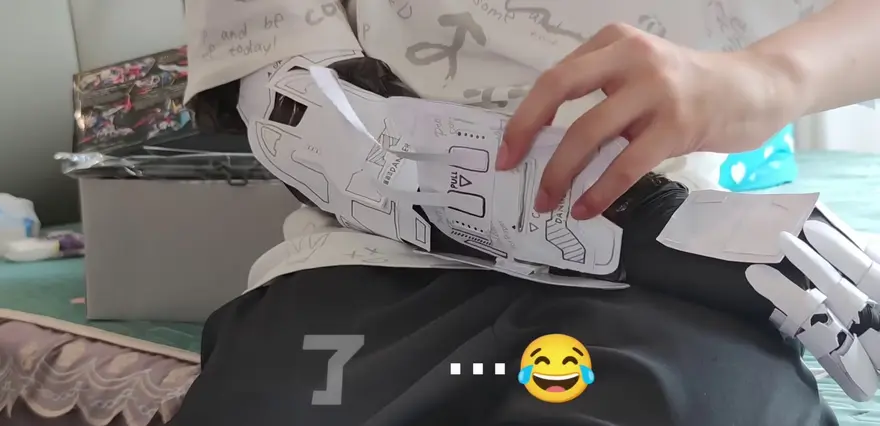
The upgraded solution proposed in the experiments was as follows: use Velcro (adhesive-backed nylon fasteners) to tightly wrap a trash bag around the forearm, and then affix the outer armor plates directly on top using Velcro.
This actually parallels the strapping logic found in walking assist exoskeletons—when wearing equipment for extended periods, sweat wicking and thermal management are absolute necessities.


5. Suiting Up in Armor: A Chaotic yet Restrained Assembly
"Finally finished the assembly—though the script might be off, the overall logic is flawless. You can even feel the off-center load distribution on the armor during movement."
5.1: Organizing the Wearable Catalog
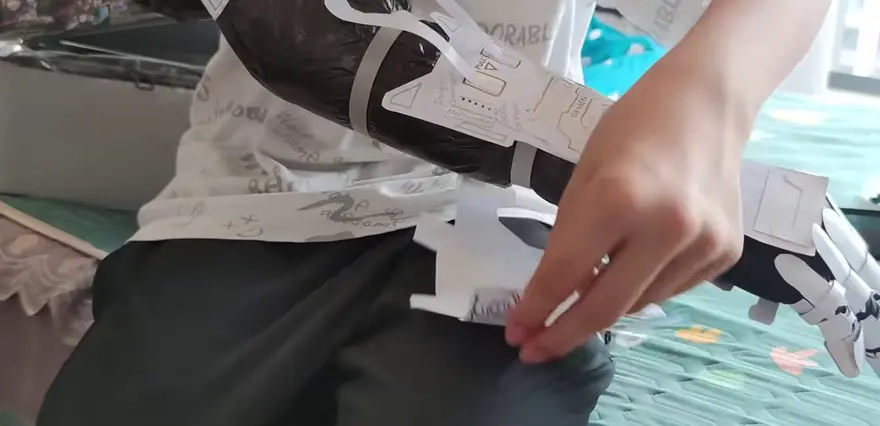
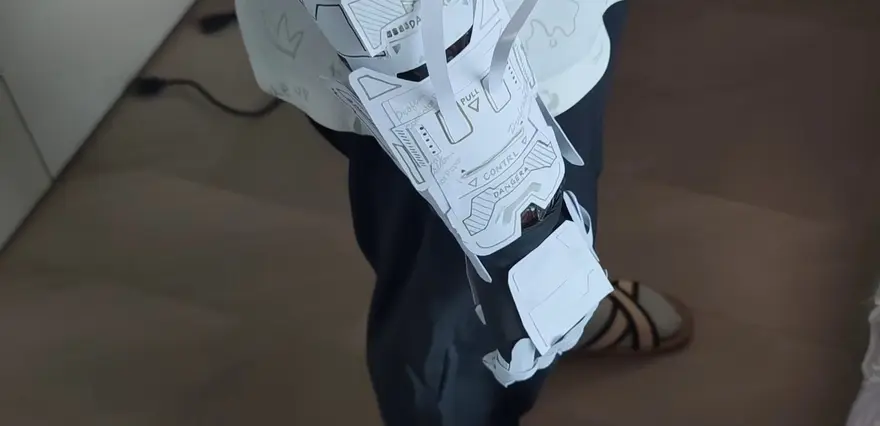
The starting point for this entire solution was building a consumer-grade exoskeleton with zero armor. Now, the supplementary requirements are: adding a layer of "black base" + a layer of "white armor plates," much like a movie set prop.
As for the question of "is it possible to over-protect?" This might be a crucial future direction for consumer-grade exoskeletons: should users "wear it like walking in a market" rather than "wear it like marching" in most scenarios? This requires redefining the usage boundaries of wearable robotics by combining gait recognition sensors (IMU / pressure sensor) and self-balancing algorithms.



6. After Wearing: A Review from Commercial Competitors
Notably, commercial exoskeletons from brands like TOREAD, Hypershell, and Dnsys on the market have gone much further in terms of ergonomics and lightweighting —
If the armored carrying system is too heavy, thick, or stuffy, and exceeds the load-bearing capacity of the knee, it actually turns the entire exoskeleton into pure additional weight. Looking at the exoskeletons made by Haier might offer some inspiration regarding the human-machine interface and fault tolerance logic.
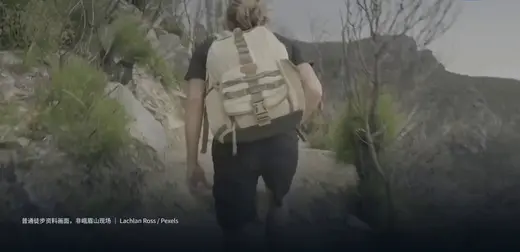
For hiking / trekking assist directions, the biggest pain point currently may not be insufficient assist, but rather questionable breathability of the backboard and straps, along with adding weight onto them — this might be an issue that both industry and R&D need to synchronistically solve.


7. Display: Donning the Armor
"Turning to Armor Building—(the spinning marketplace of the armor core)"
A close-up of the hands after donning: Although the assembly still looks utilitarian, the kinematic validation has been successfully verified—the entire suit successfully channels sufficient energy through the force arms, allowing the crankshaft joint torque of its three main assemblies to translate effectively into real-world scenarios.
If it can be successfully verified, it means the computational cost of the system is sufficiently low; if it fails, it would only be suitable for static displays in a studio.

8. Burning Hot: An Interception from Nature
The outer armor plates absorb sunlight and heat up, while the black base layer exacerbates thermal resistance. It is here that the design logic of ants regarding reptiles truly stands out:
Adding heat dissipation vents to the armor and adjusting the ventilation pathways is the key to balancing thermal comfort and mechanical support.
Insights from the literature, such as papers titled "Mask Design and Thermal Comfort", have long highlighted a natural contradiction between the structural strength of an exoskeleton's exterior and ultra-thin primary heat dissipation. In heavy-load guarding scenarios, boosting passive heat dissipation (natural draft convection) is far superior to active air cooling.

9. Sacrificial Protection, Lightweighting—The Next Chapter for Exoskeletons
If I had to distill this experiment into one takeaway, I would call it a measurable case study in “sacrificial protection” and “lightweighting.”
A structural component or consumable doesn’t need to be perfect; it just needs to fail independently without taking down the entire device. That is the mindset every exoskeleton solution—including those from Kenqing and Chengtian—should adopt.
Trade the chassis’s structural deformation to offset armor reliability, and use sacrificial consumables to exchange…
Top Community Comments
@FLYSHHH: Do you have any suggestions?
[Interpretation] The direction of the gear [in the comment] exposes the challenge of exoskeletons not being profitable: even if you build armor-like hardware, how to sell it to consumer-grade users is the new puzzle facing the industry.



@Xiaotanjia de Paopao Xiaofeiyu: The material is wrong, but a robotic hand is definitely there.
[Interpretation] The audience's focus has long moved beyond the cool factor; they are starting to pay attention to whether the exoskeleton's max payload is correctly targeted—this is the user experience ordinary people need most.
@FLYSHHH: Do you have any suggestions?
[Interpretation] It's hard to tell the logic behind the 'armor plating,' but the audience's concern is: with this level of armor weight, is it practical for consumer use?
One-Sentence Summary
This video provides a high-value DIY solution for exoskeleton enthusiasts, clearly pointing out that while armor can be expected to deliver high performance, it cannot be as lightweight as an exoskeleton. It's more suited for collecting and novelty; we're still a long way from being able to wear it out in the real world.