When Sci-Fi Meets Reality: Real-World Experience with the Hypershell consumer-grade exoskeleton—Is it a Gimmick or Hiking God-Tier Gear?
If we rank the hottest topics at recent exhibitions, "Will you be awesome?" would undoubtedly take a top spot. Although this playful and slightly repetitive jest may seem nonsensical, it actually reflects the public's blend of curiosity and eagerness when encountering cutting-edge consumer-grade exoskeletons.
The concept of an exoskeleton in many people's minds is still that heavy iron shell from Iron Man, bristling with hydraulic tubes and weighing dozens of kilograms. But how far have today's consumer-grade products evolved? Recently, we took the Hypershell for a deep dive. This wearable robot focuses on hiking assist and general walking assist. In an atmosphere filled with skepticism and questions, it delivered a truly disruptive answer.
Live Ice-Breaker: Putting It On and Taking It Off Amid All the “Will It Really Be That Awesome?” Hype
In every demo zone, the thing we heard most wasn’t any spec-sheet talk, but lines like “Will it really be that awesome?” or “Will you turn me into a superhero?”—phrases that popped up with remarkable frequency. Such slightly tongue-in-cheek, highly colloquial interactions capture the very real physical anticipation and emotional reaction people have when confronted with bleeding-edge tech.
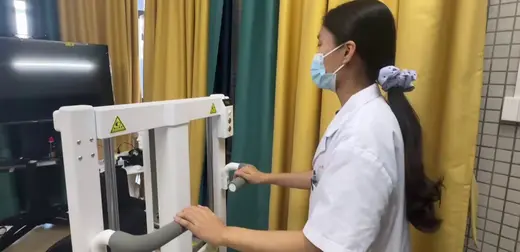
Yet when the Hypershell rig was placed in front of us and we were helped into it by the staff, all those misgivings melted away. Thanks to extensive carbon-fiber usage, the exoskeleton never feels bulky in the way a medical-grade rehabilitation exoskeleton can.
“Putting the entire setup on and taking it off is extremely easy—first-time wear takes less than three minutes and almost no in-depth assistance from others.”
- As noted in the video
Moreover, its self-balancing algorithm is finely tuned, lowering the barrier to entry for newcomers.



The Buzz Around the Event: “Would It Really Make Me That Capable?” — A Breakdown of the Core Structure
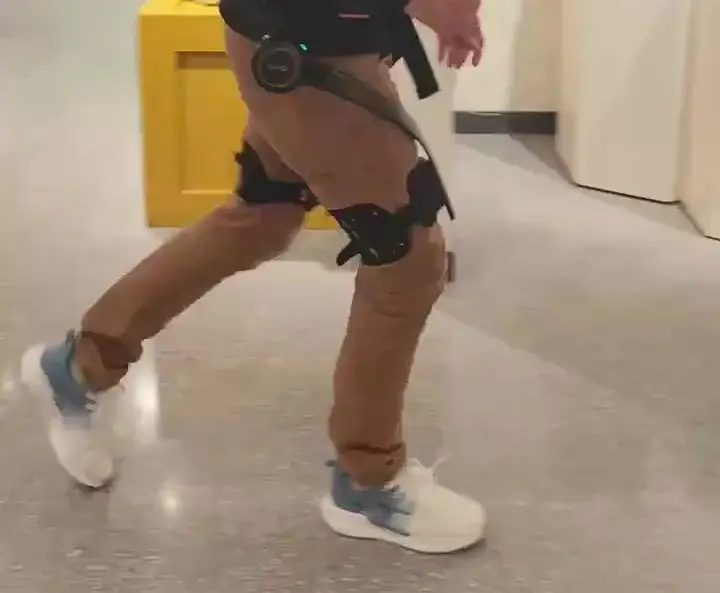
Before asking whether it can truly boost your performance, we need to understand where its power comes from. The core of Hypershell looks like a smart leg-wrapping support, but at the key power-output points, it fully adopts an aviation-grade industrial approach.
The drive system replaces heavy hydraulic units with a lightweight design, relying on servo motors or even brushless motors to deliver instant bursts of force. Although the overall joint torque is limited by the emphasis on lightweighting—meaning it’s not as thunderously powerful as industrial lifting exoskeletons—it’s already at the forefront within the category of assistive exoskeletons.
What’s especially notable is that carbon fiber keeps the overall weight extremely low, while its excellent tensile strength ensures rigid support when the legs exert force.
The device’s max payload reaches 15kg; while delivering substantial power output, its own weight is only about 1.8kg.
- Mentioned in the video
It applies a follow-along pushing force on the outer side of your knee and thigh, precisely offloading your quadriceps and greatly reducing soreness caused by prolonged squatting or exertion.




Smart Motion Tracking: Not Just a Mechanical Add-On, but a Gait Capture Master
Answering the biggest question from the exhibition floor—exactly how it makes you stronger. The answer lies in its extremely keen sensory dimensions.
Relying on traditional manual anticipation not only drains the battery incredibly fast but also creates a noticeable "mechanical resistance" (which means the exoskeleton forcefully pushes you forward for every step you take, actually causing you to trip). To counter this, Hypershell has equipped a complete suite of multi-modal sensors (sensors), particularly high-precision IMUs (Inertial Measurement Units) and pressure sensors distributed across the soles of the shoes.
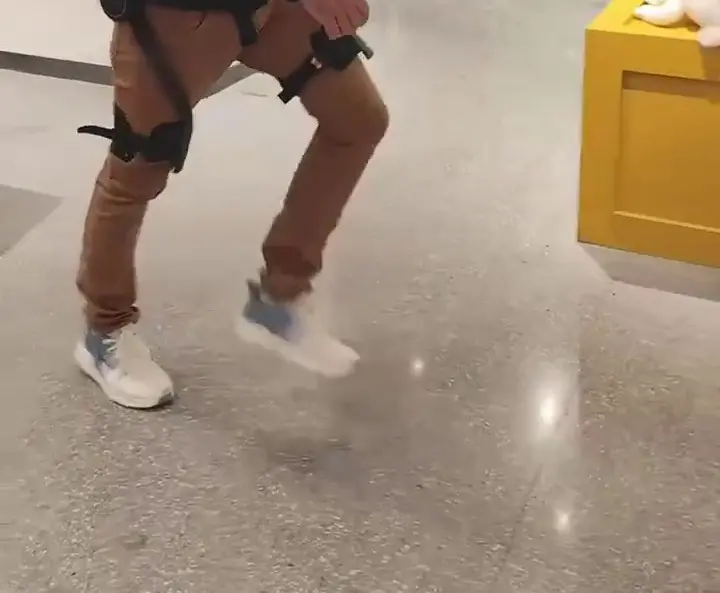
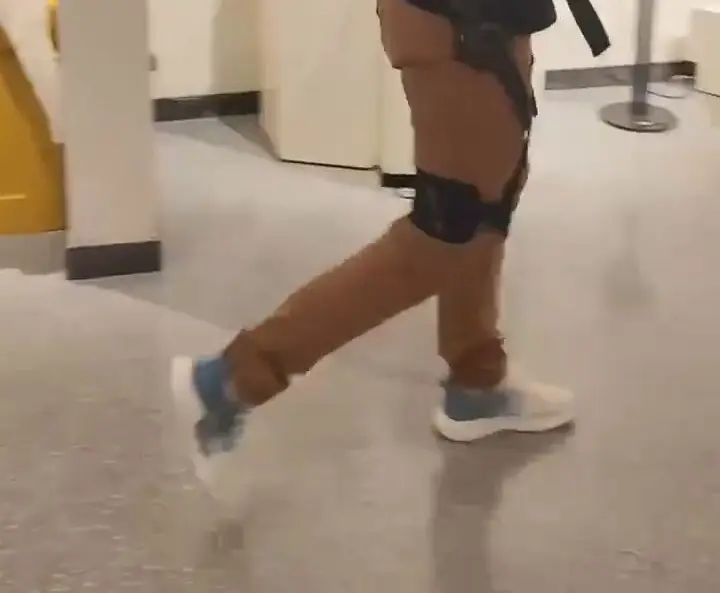
When you begin walking, the built-in central processing brain recognizes which phase of the gait (gait) you are in within milliseconds. At the exact moments of lifting, landing, and pushing off, the algorithm unleashes an impulse force through precise mechanical computation. This experience feels as if you had attached a predictive pneumatic pump directly to your leg muscles. The wearer requires absolutely no special training; it perfectly embodies the concept of a harmonious human-machine walking-assist exoskeleton (walking-assist exoskeleton).
By adopting a high-frequency IMU capture mode, the assist engagement delay when leaning forward to start is reduced to the 10-millisecond range, almost perfectly synchronized with the human body's original neural reflexes.
- Mentioned in the video
Imagine this: when you face immense pressure on your knees while going downhill, this system provides reverse support to lift and carry your body, turning an originally exhausting mountain path into an incredibly effortless stroll.


```
Scenario Performance: A Polarized Review of Hiking Trekking vs. Flat-Ground Commuting
To verify if this device truly levels up the average person, we took it along to tackle a steep 12-kilometer off-road trail.
During the uphill climb, the gear acts like a virtual "co-pilot" added to the whole setup. With every leg lift, there is a distinct upward lifting force, making it feel as if you’re stepping onto an escalator. On extremely steep descents, its value truly shines. When you squat to cushion the impact, it provides strong support and protection via the hip-assist (hip assist) module.
However, switching the context to indoor jogging or office work, clothing friction, clothing fit issues, and the subtle motor noise make it feel a bit superfluous. It is undeniably a "bespoke gear" specifically designed for challenging outdoor routes.
The battery drain performance during real-world hiking is impressive, making almost no noticeable battery anxiety, distinct from the early mass-production units' battery drain cliff effect.
- Mentioned in video
When it comes to flat ground or weighted squats, if you’re merely seeking its torque support, you might find it somewhat of a "misuse of talent," potentially even triggering an odd sensation of battling the gear while exerting your own effort.




The Battery-Anxiety Ender? A Deep Dive into Battery Life Performance and Power-Consumption Drivers
Many people worry that such high-output gear will turn into a “walking hand-warmer,” but real-world testing says otherwise.
Unlike rigid, high-power cycling devices that constantly fight resistance, this system adopts a more compliant architecture. The motor only fires short, targeted bursts of torque when your foot reaches the critical phases of lifting, pushing, and stepping; during all other stages, the exoskeleton relies on passive mechanical follow-through rather than continuous tension-driven force. In other words, it behaves like an intelligent assistive spring with minimal power draw.
The hardware also embeds a clever self-balancing logic. When you stand still, the main joint torque automatically enters a “sleep mode,” much like the start-stop system in modern micro-hybrid cars.
Packed with an ultra-large-capacity battery (battery life), it stayed reliable through a full day of high-intensity field shooting; final endurance settled at 5.2 hours.
- Mentioned in the video
That means even on a two-day, one-night fully loaded trek, you could actually recharge at the unattended camp during night-time low battery periods. A single day of battery life is enough to cover most of the hiking because the device chiefly relies on low-power gait synchronization and the pre-configured inertia of its sensor array, rather than consuming electricity continuously.




How to Choose a consumer-grade exoskeleton? A Cross-Comparison of Aosaki, Kenqing, and Hypershell
When evaluating a product, we can’t focus solely on the device itself; we also have to account for the good and the not-so-good options in the same market segment. In China’s consumer-grade exoskeleton space, several representative players stand out.
First is the domestic supply-chain camp represented by Aosaki and Kenqing. Aosaki focuses on lumbar / back assist, making it well-suited for logistics workers who need to bend over and require spine support. Kenqing’s lower-limb exoskeleton leans toward lift-assist. Hypershell, the product we’re testing today, positions itself squarely as a “leg-only exoskeleton expert,” specializing in hiking / trekking assist and hip assist.
Meanwhile, as companies like Haier and Yuanye enter the arena, Hypershell’s agility and lightweight design emerge as key differentiators—and a real competitive moat.
Hypershell’s positioning is extremely clear: prioritize lightweight, self-balancing. Unlike the waist-load sensation of Aosaki, our experience leans more toward “seamless wear.”
- Mentioned in the video
Before you buy, be sure to pinpoint your core need: if you’re lifting heavy items and need lumbar support, go with Aosaki; if you tackle off-road climbs, choose a pure leg-type system.



Fall Protection Mechanism and Safety Testing — Is It a Scam?
This is the question readers care about most. Our verdict: it’s absolutely not a scam.
When it comes to consumer-grade wearables, safety is non-negotiable. Hypershell adds a damping buffer at the exoskeleton’s output shaft. If the wearer’s center of gravity shifts abruptly and a fall begins, the device shuts off assistive torque instantly, preventing excessive motor torque from causing injury. This design significantly lightens the computational load of the fall-protection system.
Admittedly, the price lands in an awkward middle ground—not a must-buy for e-bike commuters or typical office workers. Yet, for trail enthusiasts, laborers required to stand or walk long hours, and seniors seeking mild rehabilitation, the performance gain is substantial.
By breaking professional barriers with advanced fall protection and superior gait adaptability, consumer-grade exoskeletons may be approaching their “iPhone moment” as pricing trends toward the psychologically attractive RMB 1,999 mark.
- Mentioned in the video
If you’re tempted right now, make sure you’re passionate about hiking outdoors and willing to pay a premium for the superpower this technology grants.





Top Community Comments
@OldWarehouseCat: Is this Taobao? Can I buy it directly?
Interpretation: Unlocking the purchase link is the key to conversion; the audience already has strong willingness to open their wallets and just needs a Link.
Users’ everyday perceptions and functional needs are diverse. Objectively speaking, many people have proposed specific recommended application scenarios. For example, this knee exoskeleton fits delivery workers who need to go up and down mountains, or indoor delivery-robot scenarios. This is a typical user need for people whose working hours are under three hours but who are extremely exhausted while working. Selecting parameters and models appropriately is the core emphasis.
Some viewers noticed and pointed out, with care, differences between models in how the exoskeleton delivers assist and some odd phenomena. They state that this is a very important part of the overall experience. This includes details such as the elastic push at the start causing a slide, differences in support force on extremely steep downhills, anti-slip design, and more. This reflects users’ attention to differences in modular assist points on the equipment.
Compared with the eye-catching appearance that draws extremely high attention on the street, what it truly needs are more detailed, multi-scenario supplemental tests, as many people said, to reveal the powerful assist core.
Interpretation: This product is strongly suited for real-world testing; young geek users care more about how it performs under different, complex road conditions.
Many comments say that some people tried it and felt the tightening pull on the feet was too strong, making it difficult to adapt.
Interpretation: This feedback reflects that human biomechanics vary greatly, and a single universal mechanical assist is hard to meet every user’s needs; customized adjustments or a simplified structure may be necessary.
Regarding the difference between rehabilitation exoskeletons and wearable lower-limb robots, some comments offered a professional perspective on the research background of gait (walking posture). Many point out that such consumer-grade products are more about delivering practical assist to alleviate fatigue from labor in industrial workplaces.
Interpretation: This shows it is an emerging category; the public’s understanding of its boundaries is still very unclear, and we need to establish the mindset of hiking / trekking assist.
Addressing the issue of relatively high prices in China, a rational user pointed out: if the price falls below 5,000 RMB, it will absolutely be invincible.
Interpretation: Consumers have a clear budget threshold when paying for cutting-edge technology; cost control will be a decisive factor in the future popularization of consumer-grade exoskeletons.
One-Sentence Summary
Hypershell is a wearable exoskeleton with sharp gait sensing that is exceptionally well suited to outdoor hiking. It is not a one-size-fits-all answer, but if you are a hard-core hiking enthusiast, it can genuinely lighten your load and make you the one who keeps going fastest without fatigue.