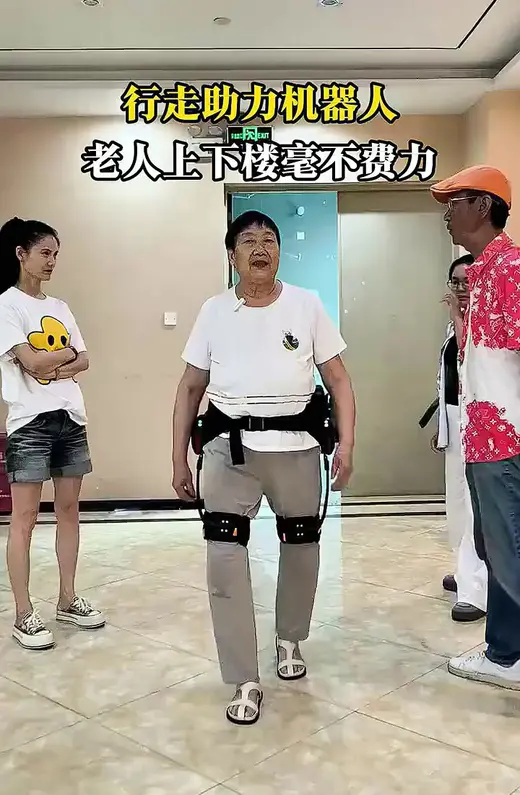
Want to Crush You, Then Save You? Let's Talk About the Truth Behind Emei Mountain's "Scan-to-Rent" exoskeleton
Want to climb a mountain with less effort, but why start by carrying an extra four pounds of gear?
If you want a machine to lift your legs for you, you've got to pay a certain price first—this is the vivid, hands-on lesson in consumer-grade exoskeletons that Emei Mountain taught us during this year's National Day holiday. As the tourist site placed "scan-to-rent" exoskeleton robots right at the mountain gate, an old question was sparked once again: Do these assistive exoskeletons actually save your physical strength, or are they merely saving you from the thought of giving up?


Scenario: When exoskeletons become shared power banks in tourist parks
During this year’s National Day holiday, Mount Emei Scenic Area rolled out exoskeleton robots that visitors can rent by scanning a QR code. A reporter from National Business Daily observed at the site that the device clips around the waist, with mechanical arms running along the outer thighs and securing above the knees.


Its rental model is strongly “shared economy”: it turns hardware that typically costs well over RMB 10,000 into a low-barrier, hourly-billed service:
RMB 49.9 per hour, with a cap at RMB 300 (as mentioned in the video; the price cited in the reporter’s on-site coverage)


The park deployed around 200 units across 8 rental points (as mentioned in the video)
Background information was also provided: according to public disclosures, Mount Emei Tourism’s H1 2026 report has disclosed that its subsidiary Sichuan Lingchuang Digital has rolled out products including exoskeleton robots. This marks a frontier robotics technology moving from labs and geek garages into one of China’s most traditional cultural-tourism settings.


Anatomy: An electro-mechanical system strapped to the waist and legs
What does the device in the footage look like? The report leaves a significant gap: the scenic area did not disclose the exact model of these devices. A quick clarification of scope—the structural diagrams we show below cannot be taken as a genuine teardown of the Emei Mountain scan-code unit. Nor can you simply merge the weight, battery, and assist parameters of different brands into a single machine.

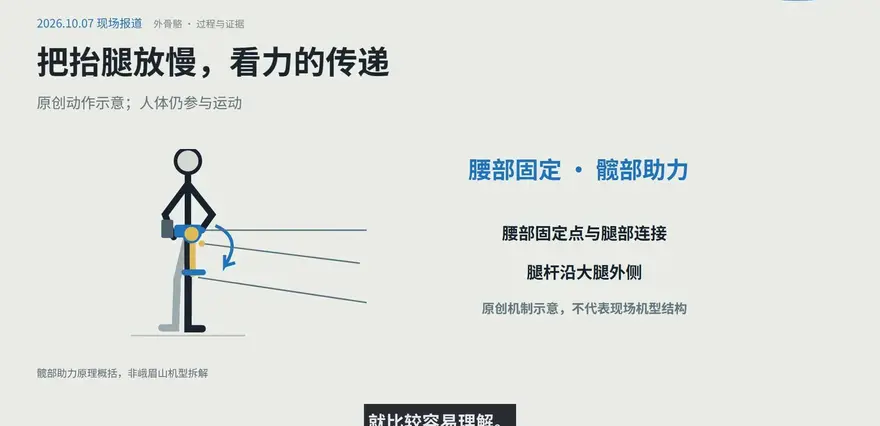
But the “broad-assist” principle behind consumer-grade exoskeletons is clear from publicly available materials. Taking products publicly introduced by brands such as Kenqing (Kinqn) Technology as an example, the system is structurally divided into several integrated parts:
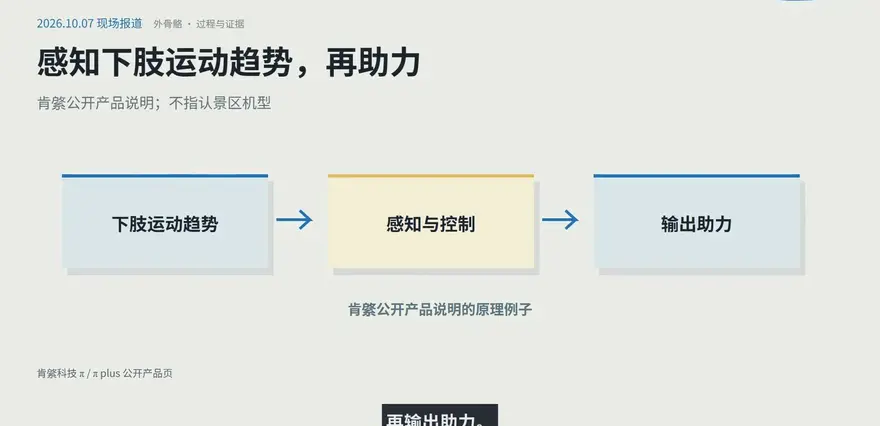

- Sensing system—sensors (IMU / pressure sensors): capture motion information and pressure sensing, reading your movement cues before anything else;
- Control system—the brain: computes and decides when to exert force and how much;
- Battery and servo motor / brushless motor: the battery supplies power, and the motor generates rotational force;
- Structure and transmission—the connecting frame: carbon fiber leg rods and a waist-mounted structure transmit force downwards, applying it to the lower limbs.


In short: the exoskeleton senses the movement intention of the lower limbs and then outputs assistive torque. The overall logic is “human-led, mechanically coordinated”—as you lift your legs, you receive a portion of the assist, but the movement remains initiated and executed by your body. That fits the consumer-grade positioning well: this is not a medical-grade rehabilitation exoskeleton, which typically follows a fixed gait pattern and hands control over to the machine.
Timing of Assistance: The Most Critical Science in the Leg Lift
The challenge is never about "whether there's enough power," but about coordination. When walking, a leg goes through two completely different phases: supporting the body and swinging forward.
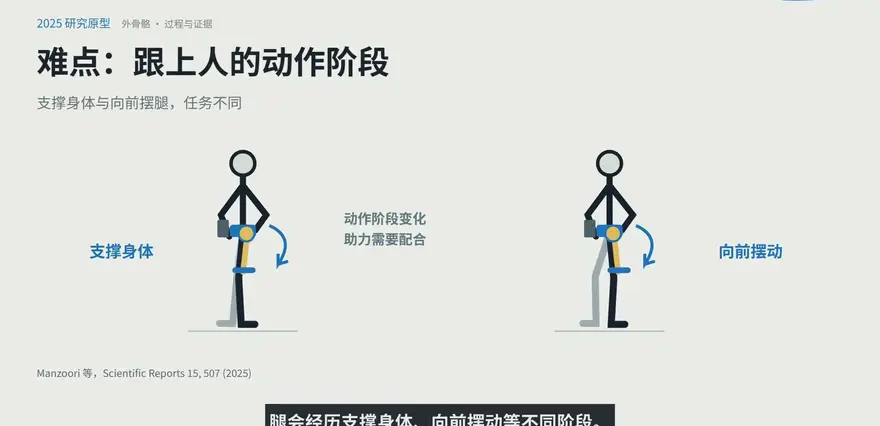

A 2025 study on a consumer-grade exoskeleton applied assistance separately during the stance and swing phases on an experimental prototype.
Note: This preliminary exploration studied an experimental prototype, not a rental-grade product for scenic spots, but it clearly illustrates the real problems engineers face.


The core problem engineers face is known as the "timing of assistance": in addition to how much force is applied, the timing of when that force appears is also critical. If you slow down a leg-lifting motion, the sensor system captures the movement trend, and the control system determines "when to give you a push." The rotation of the servo motor is then transmitted via a carbon fiber linkage to the outside of the thigh—a precise assist is, in itself, a carefully orchestrated electromechanical collaboration.


Scientific Assessment: It Absolutely Reduces Exertion, but Cannot Be Measured Solely Against Its Unpowered State
Returning to the paradox we started with: the extra two kilograms.
The device itself must be carried by the wearer with every step. Evaluating whether it actually reduces exertion means the assessment methodology is the key to cracking the puzzle.
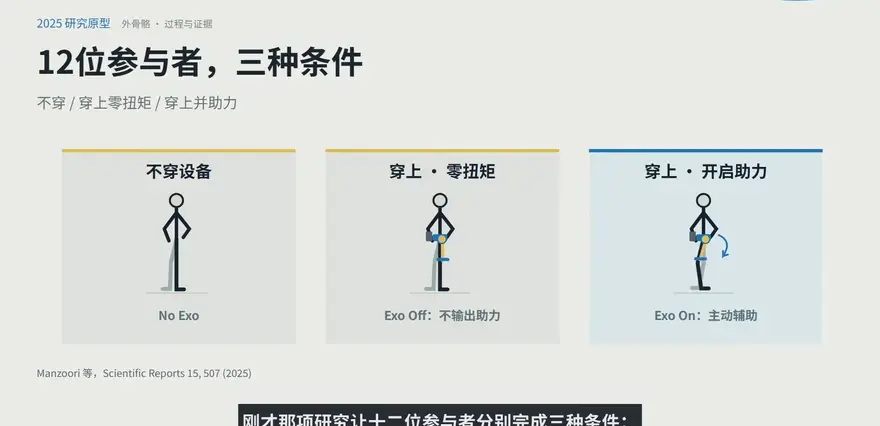

The 2025 comparative experiment mentioned earlier recruited 12 participants to complete tasks under three distinct conditions:
- Control group: Wearing nothing, relying purely on human power;
- Passive group: Wearing the device without active assistance (solely bearing the weight of the equipment);
- Active group: Wearing the device with assistance enabled.

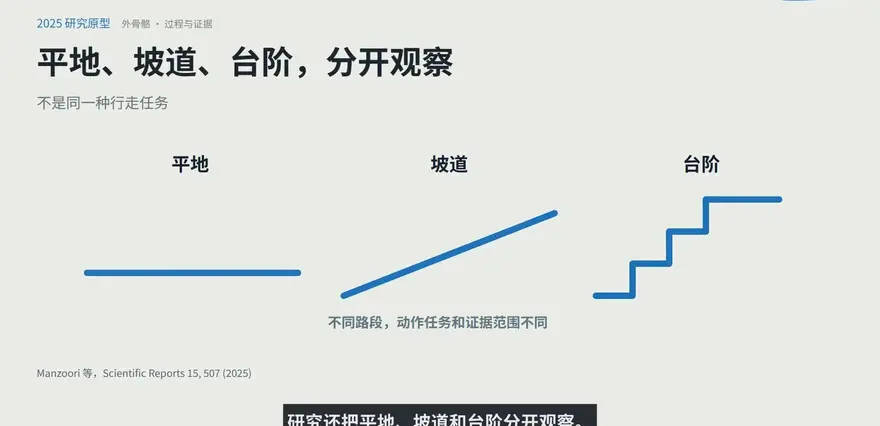
These three comparative setups respectively help researchers observe the pure burden of the equipment's weight, as well as the actual difference brought by active assistance.
The experimental design goes beyond this—the researchers deliberately separated observations across flat ground, ramps, and stairs. A simple direct comparison between the powered and unpowered states is insufficient to prove that the experience is definitely lighter than wearing absolutely nothing at all. Only by combining a direct comparison with comprehensive terrain coverage does the evidence of reduced exertion hold up to scrutiny. This reminds us that looking light-footed for a couple of steps on camera and the actual changes in oxygen consumption or metabolic equivalent across the entire route are fundamentally two completely different types of statistical evidence.


Somatosensory Feedback, Evidence, and Restraint: Real-World Feedback on Mountain Trails
Returning to Mount Emei. The personal physical feedback recorded by the journalist on-site was authentic, but also highly prone to bias:
During uphill climbs, the propulsive assistance was quite noticeable; however, the support on flat ground and during downhill descents was not as obvious (mentioned in the video, the journalist's on-site physical feedback).


Why was the assistance less noticeable on flat ground and downhills? This can be understood by analyzing the timing of the assistance: when lifting your legs uphill, your body exerts the most effort, and the hip joint naturally becomes the weakest link. Here, the motor outputs the highest proportion of its torque, making it immediately obvious to an outside observer that "someone is giving him a boost from behind." However, when walking on flat ground or gentle downhill slopes, your body naturally rides on the momentum of gravity. If the system forcibly applies a propulsive force to counteract gravity at this moment, it could actually disrupt the user's gait. This implies that for powered exoskeletons, the biggest challenge in human-machine coordination is inappropriate interference.

Nevertheless, we must maintain restraint: this description serves only as a single sample of on-site experience. It cannot draw an absolutely consistent conclusion on behalf of the vast number of tourists with varying physical conditions. Gravel, moss, and uneven steps on the mountain trail—any of these variables can amplify the instability of one's walking technique. Being able to document that "a few steps benefited from assistance" already constitutes first-hand experience material. However, extrapolating this to conclude "how much effort was saved throughout the entire hike" crosses the boundary of what the evidence can support.
Behind the Rentals: A Logistical Support System That Cannot Be Overlooked
In field reports, journalists mentioned that staff at the rental locations assist with donning the device and offer battery swaps during use. This perfectly highlights the "last mile" problem—often the most overlooked aspect when hardware technology goes from the lab to real-world deployment.

The convenience provided by the motor requires an entire logistical ecosystem to sustain it:
- Donning Assistance: The configuration of buckles and straps must be foolproof, allowing staff intervention to ensure rapid inventory turnover.
- battery Management: Fresh batteries must be available for swapping on demand. Otherwise, the moment the device loses power, the extra weight quickly transforms into a pure burden.
- Product Scheduling and Maintenance: The circulation across 8 rental points implies a heavy-asset management logic focused on equipment depreciation.
At this current stage, we have not obtained the complete manual for the Emei Mountain rental models, nor have we observed standardized conditions for assistive-force testing. Therefore, we will not treat any advertised torque or assistive percentages as definitive performance guarantees. Such rigorous restraint is exactly the lesson the consumer-grade exoskeleton market must learn to achieve maturity—those selectively ignored data points and parameters often serve as the true indicators of a product's quality.
Cognitive checklist and ultimate judgment: What exactly are you wearing
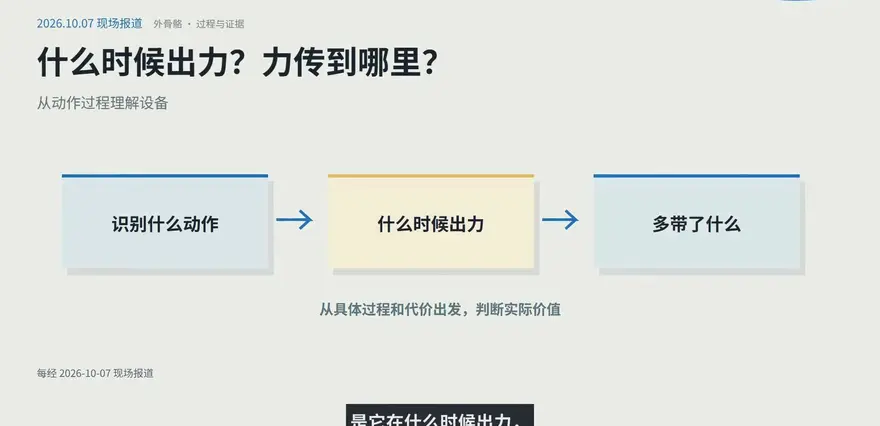
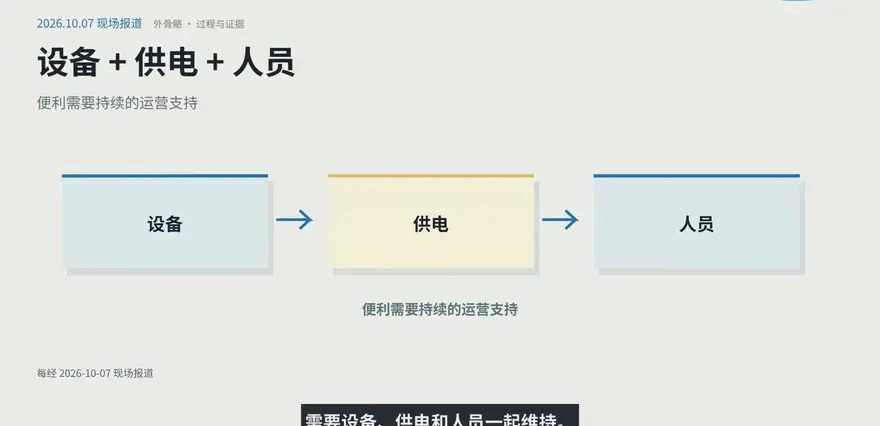
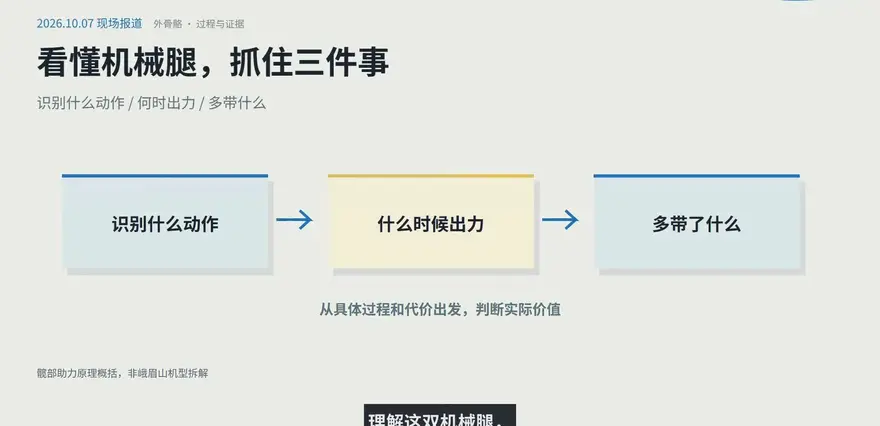
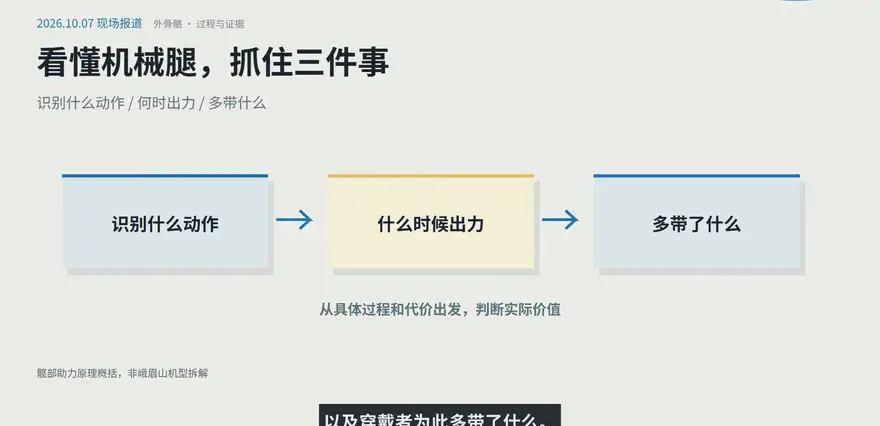
To understand these mechanical legs worn at your waist, you only need to focus on three things:
- What movements it recognizes;
- When it exerts force;
- And what costs the wearer takes on as a result.
Then, you can draw three more fundamental core judgments:
- It assists only a portion of the movement: From route planning to mastering your center of gravity during sharp turns, it still relies entirely on the human brain and feet.
- The reliability of reducing physical effort remains to be verified: Whether it can continuously alleviate the burden on muscles and metabolism during a long, real-world journey depends on the specific device parameters and the terrain of the route.
- Its application scenarios have limitations: We cannot draw overemotional conclusions just based on a single leg lift in the footage.
The future direction of the consumer-grade exoskeleton isn't about turning humans into Iron Man, but rather becoming an "amplifier" for the physical capabilities of ordinary people. This scan-to-rent device on Emei Mountain, much like our testing of the latest neckband noise-canceling headphones, delivers a highly vivid and practical report card with clear boundaries.
Top Community Comments
49.9 yuan per hour is still not cheap, but it’s way cheaper than hiring a porter guide.
This comment underscores the clash of price anchors: viewers are benchmarking traditional human labor against modern electromechanical rental, exposing just how fuzzy the consumer’s yardstick for the “value of effort saved” really is.
The key is where those “four jin” of extra weight end up.
This comment zeroes in on a core concern for hardcore users: where the exoskeleton distributes its mass—carbon-fiber thigh bars, strap placement—often determines whether the device feels assistive or becomes dead weight.
How exactly is that “effort saved” percentage measured? Without peer-reviewed data, anyone could claim a 30 percent reduction.
The comment reveals hardcore geeks’ guarded stance toward marketing jargon; they’re demanding quantifiable joint torque figures and validated metabolic-equivalent comparisons.
“Sure, it pushes you uphill,” one user notes, “but descending feels dead—actually, the machine drags me backward.”
The observation pinpoints assist timing as the pain point, highlighting that current IMU and pressure sensors, as well as gait recognition algorithms, still fail to deliver seamless support between stance and swing phases.
This beats a rehabilitation exoskeleton by a mile—at least it’s something ordinary consumers will actually pay for.
Here the commenter draws a clear line between medical-grade gear and a consumer-oriented walking assist, underscoring an intuitive grasp of each market’s potential.
Constantly swapping batteries shows that battery life isn’t up to snuff. Call this the sharing economy? It’s just a megaphone for mobile power banks.
The reviewer zooms in on real-world practicality, spotlighting an often-overlooked flaw: battery life hasn’t kept pace with the rollout of the business model.
Glad the creator finally explained why downhill mode felt useless—it was all about assist timing.
This nod to educational value confirms that, when separating genuine tech from gimmicks, respect for design detail and hard data is exactly what readers crave.
One-Sentence Summary
This episode serves more as a "long-term test sample" of the tourist attraction rental model, combined with an in-depth breakdown of the core principles of exoskeletons. It is an ideal starting point for outdoor sports enthusiasts who want to understand the real-world performance of electromechanical exoskeletons on actual terrain, as well as industry investors tracking the commercialization progress of cutting-edge mobility tools: it demonstrates the "assist boundary" of consumer-grade exoskeletons and reminds you to think carefully about your true tolerance for the trade-off of "carrying four extra pounds for intermittent thrust" before booking an experience.