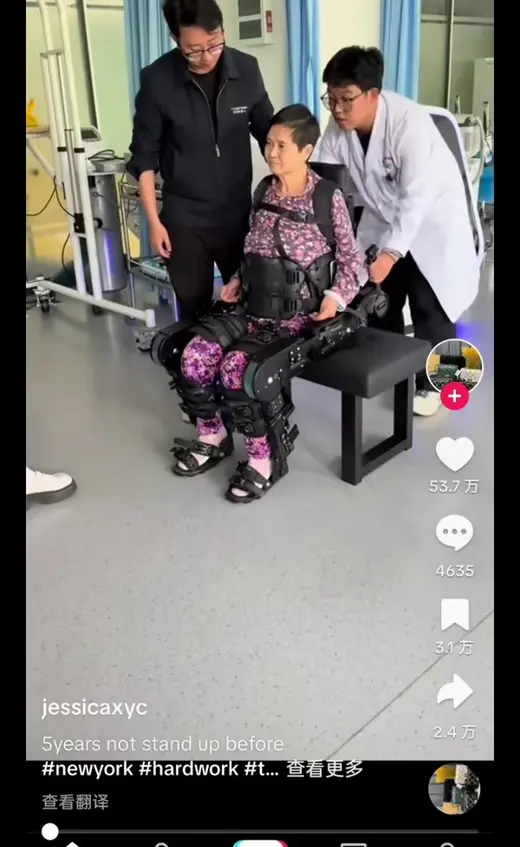
Field Test: Lumbar / Back Assist Exoskeleton — A Day Wearing an "Effort-Saving Gadget" and What We Saw
When Exoskeletons Move from "Concept" to "Consumer-Grade"
The opening remark, "No one in their right mind would want to be an elder-care blogger," actually points to a profound truth: you can't possibly know how evolved today's elder-care tech—and the broader field of "wearable robotics"—has become without actually trying it out. We can't afford the "humanoid robots" showcased at the Spring Festival Gala, but in the realm of the consumer-grade exoskeleton, you can at least own a piece of the future: a "physical power-up" that you wear, integrating motors, sensors, and algorithms.
"How would you know how advanced current elder-care tech is if you don't get into it... You can at least claim one of the most powerful physical power-ups for yourself." — Mentioned in the video
This time, we are getting hands-on with a "lumbar assistive exoskeleton" brought in by a content creator. Its core goal is to provide walking assist and reduce the physical burden in everyday scenarios, such as climbing stairs and walking on ramps. This is different from a rehabilitation exoskeleton: the latter is typically medical-grade, emphasizing training and correction, while a consumer-grade exoskeleton prioritizes plug-and-play usability, comfort, and a comfortable safety margin.



Unboxing and Wearing: Is It Really a "Backpack" or an "exoskeleton"?
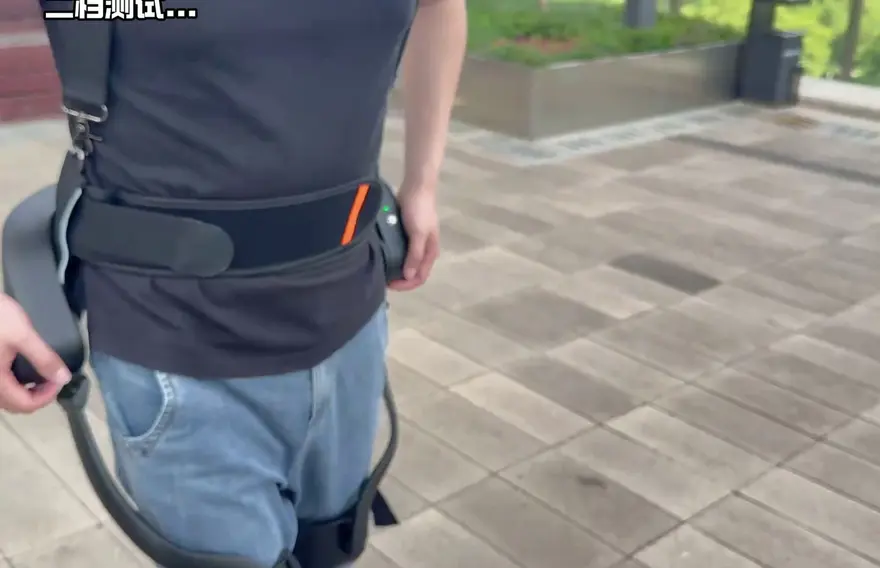
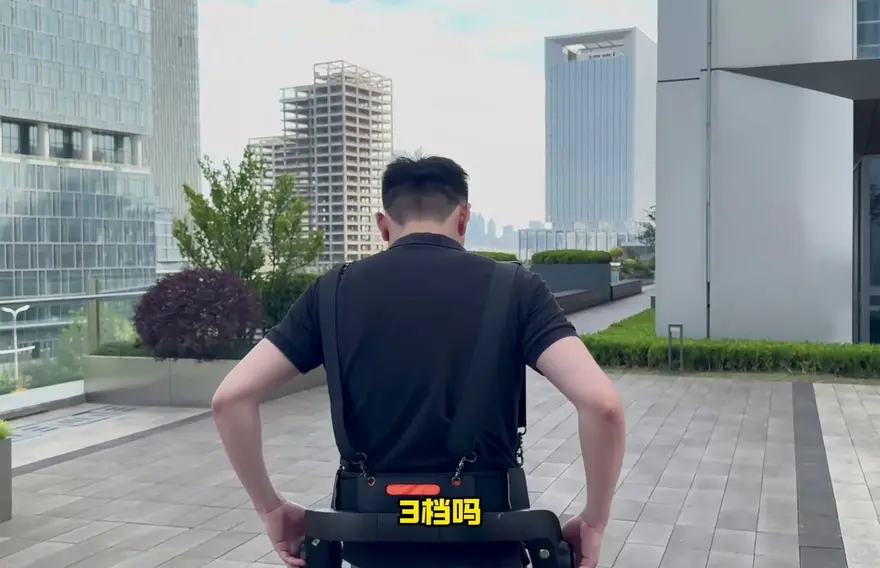
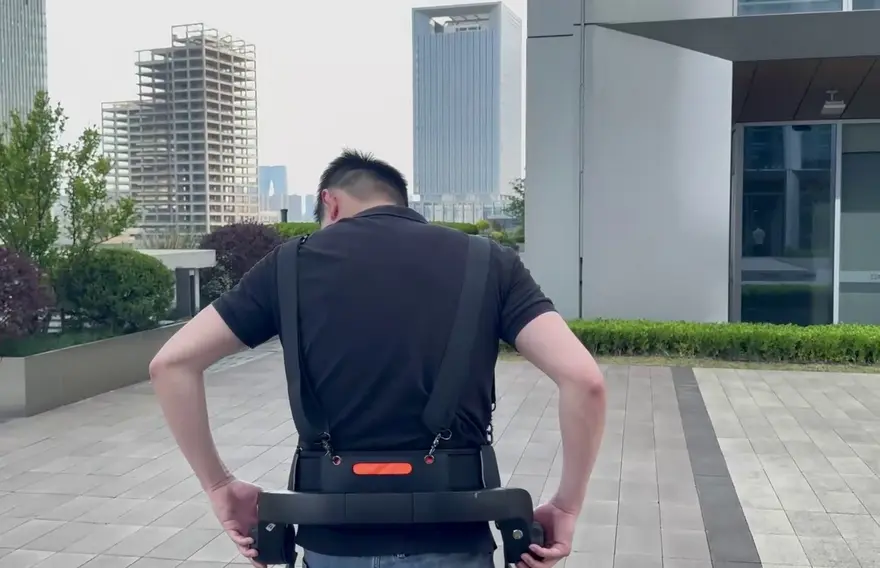
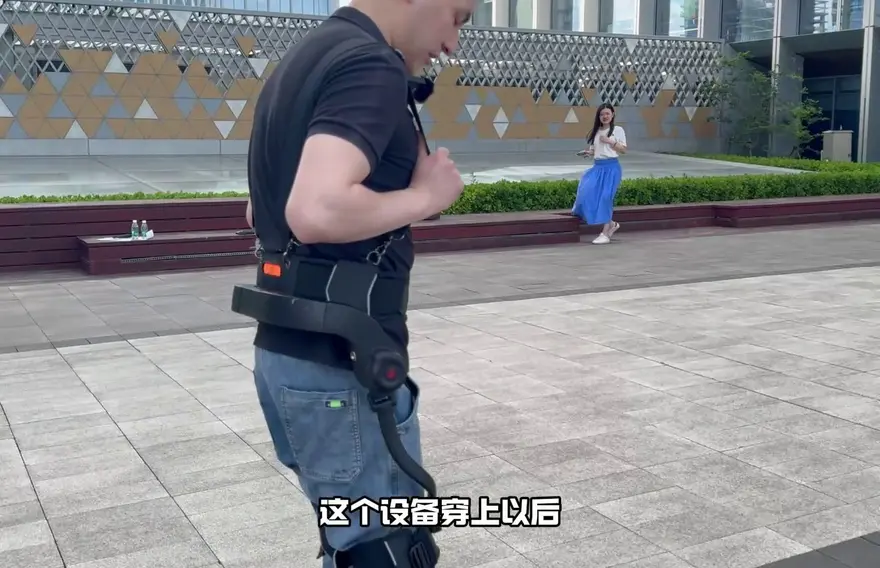
The main body of the device is centered around "wearing at the waist," connected to the lower limbs on both sides via flexible straps and a support structure. The blogger jokingly remarks in the video that "wearing it like a backpack is actually fine." This also highlights the industrial design direction of this type of product: keeping the weight as close to the body's center of gravity as possible to reduce the moment of inertia and lower fatigue during extended wear.
"Is it worn on the waist?Yes... wearing it like a backpack is actually fine." — Mentioned in the video
There are three key points when getting started:
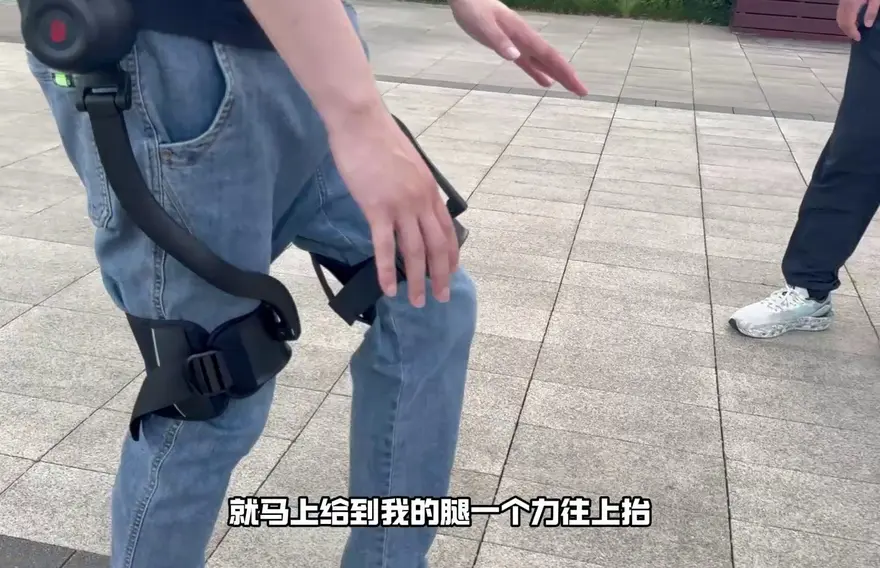
- The wearing structure primarily relies on a two-point "waist-leg" connection, following a design concept similar to a "belted frame + lateral leg traction."
- Although the device appears quite heavy and bulky, its backpack-style layout keeps the center of gravity close to the hips, making the actual experience easier than it looks.
- All adjustments focus on "aligning the assist channel with the rotation center of the joint," particularly the knee joint and hip joint.

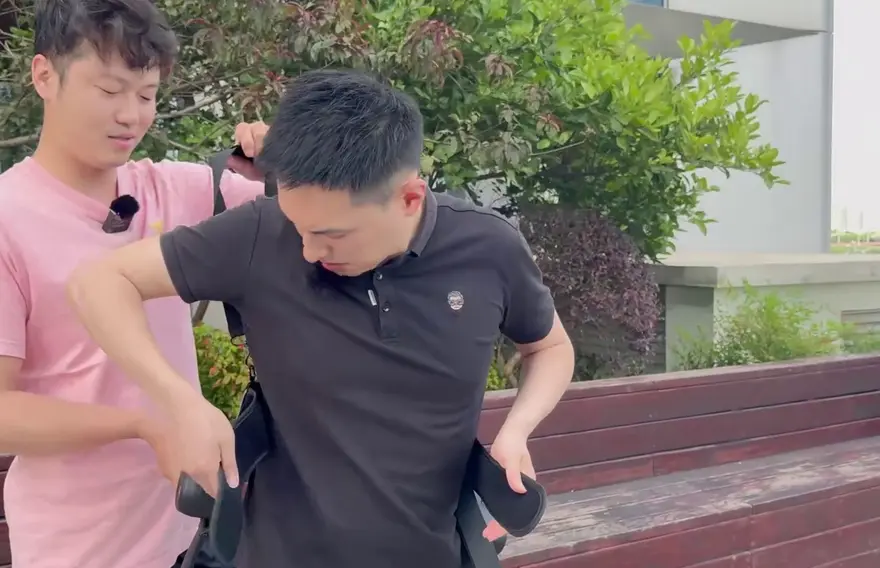
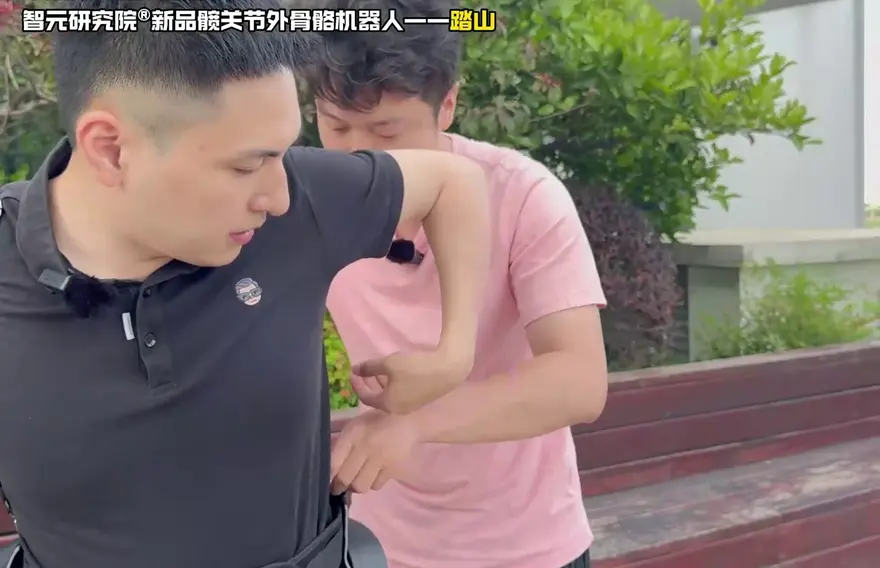
Note: The common power sources for such lumbar assist / back assist exoskeletons are servo motors and brushless motors. Their structures typically use carbon fiber or lightweight alloys to reduce weight; however, the specific configuration and materials of this particular model were not clarified in the video.
Gears and the "Assist Feel": Level 1 is Just the Appetizer, Level 3 is the Main Course
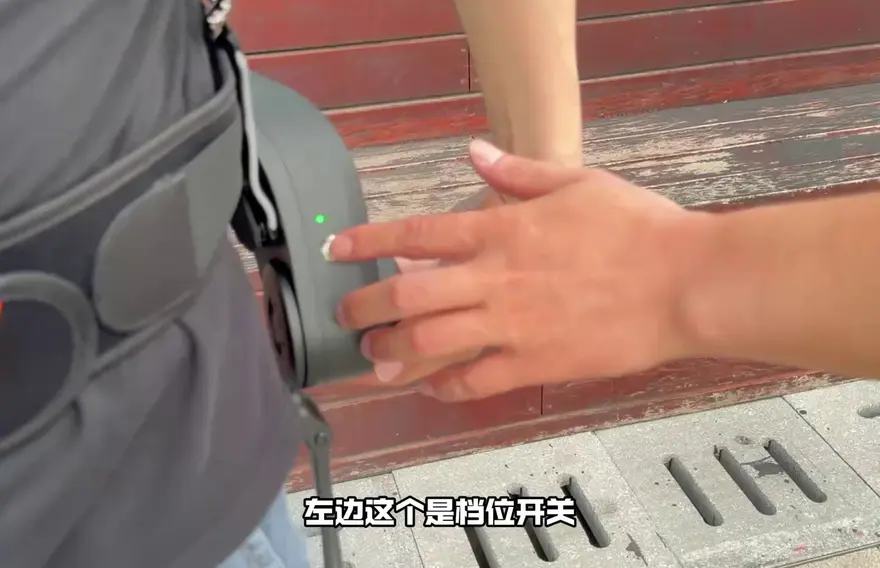
The control logic is very straightforward:
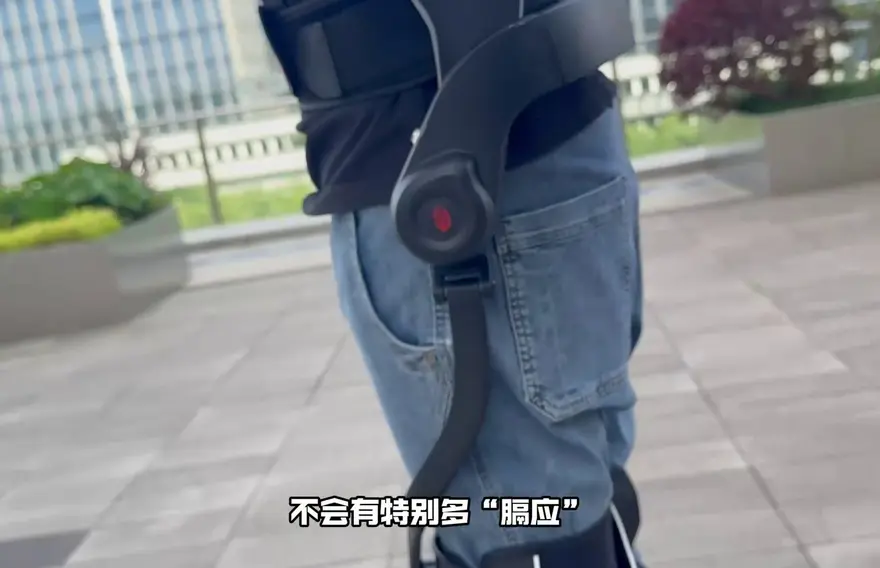
- The right side is the power switch;
- The left side is the gear selector;
- The video clearly demonstrates the differences between Level 1, Level 2, and Level 3.
“Level 1... the walking assist feels a bit light for me; Level 2... the assist is noticeably stronger; the highest Level 3... you can feel it quite significantly while running.” — Mentioned in the video
In Level 3, the motor drive provides an upward traction during the critical phase of the gait cycle (especially during the leg lift phase), creating a subjective feeling of "lifting your knee upward." This is a common strategy for many hip assist and lumbar / back assist devices: using a servo motor to provide joint torque at specific stages of the gait cycle, thereby reducing the peak force of the quadriceps and hip flexors.


“The faster I run, the greater its assist becomes.” — Mentioned in the video (The more likely meaning: the assist becomes more aggressive at higher gear levels, and the physical sensation is more obvious, rather than the device automatically amplifying linearly with speed.)
Gait Tracking and the “Self-Balancing” Boundary: You Handle Intent, It Handles Compensation
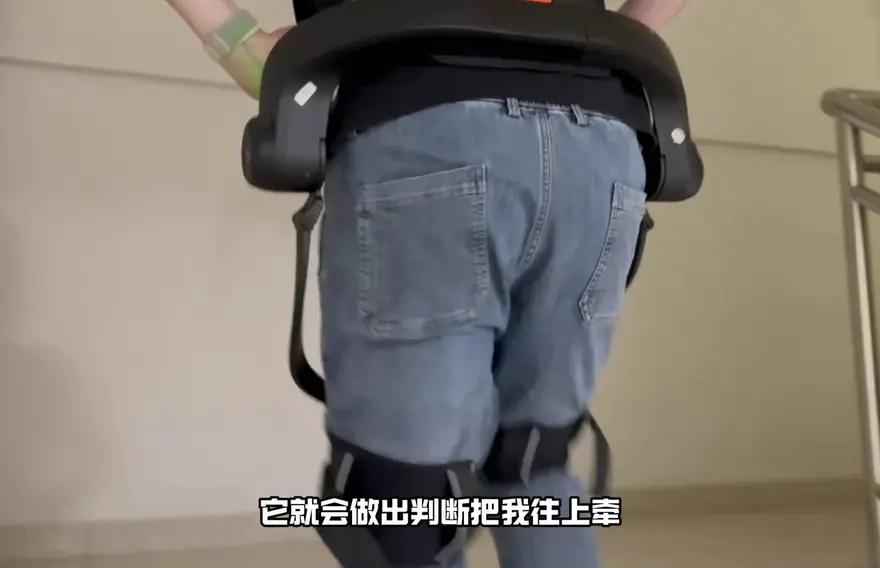
The hardest part of an exoskeleton has never been “applying force,” but rather “applying the right force at the right moment.” The video includes a key perceptual description: “As soon as there’s a slight tendency to lift the leg, it makes a judgment and pulls me upward into the step.” This suggests the device adopts sensor fusion (commonly IMU and pressure sensor) to identify gait phase and trigger assist based on intent.
“The moment I have even a slight tendency to lift my leg, it makes a judgment and pulls me upward… The force it provides also adapts to our physical condition, so it’s never too aggressive.” —mentioned in the video
From a control-strategy perspective, these systems typically make trade-offs across three areas:
- Trigger latency: The time window from “you intend to lift the leg” to “the motor starts assisting” must be short enough—otherwise the rhythm can misalign.
- Assist profile: The ideal joint torque should behave like a “soft gain,” not a stiff “knee push.” The video’s subjective description of “a smooth, even force” indicates the tuning is relatively gentle.
- Safety margin: Consumer-grade products must preserve sufficient active participation from the user to avoid dependence where “the exoskeleton drags you along,” while also leaving mechanical/algorithmic headroom for fall protection.
Key reminder: self-balancing and fall protection are critical in consumer-grade exoskeletons, but the video does not clarify whether this product includes a complete safety system.
Still Feels "Supported" Even When Running: The Sensory Experience and Limits at 9 km/h
Another information-rich clip in the short video is the running test:
"This product can reach a top speed of 9 km/h… up to three gears and a half." — as stated in the video
The phrase "one and a half" here very likely refers to an endurance of "one and a half hours," i.e., about 1.5 hours of endurance (in hours). The specific battery capacity and battery life / runtime should be based on the manufacturer's stated specifications.
What's most worth emphasizing about the running experience:
- The device doesn't change your cadence; instead, it lowers the relative energy cost of each step via phased assist;
- At the third level the assist is clearly noticeable, yet the sensation of "legs leading" is preserved;
- A top speed of 9 km/h positions it closer to light running / brisk walking scenarios than to professional running training.


Stair Climbing Is the Ultimate Test: 18-Floor Timed Run and the "Heart Rate vs. Fatigue" Paradox
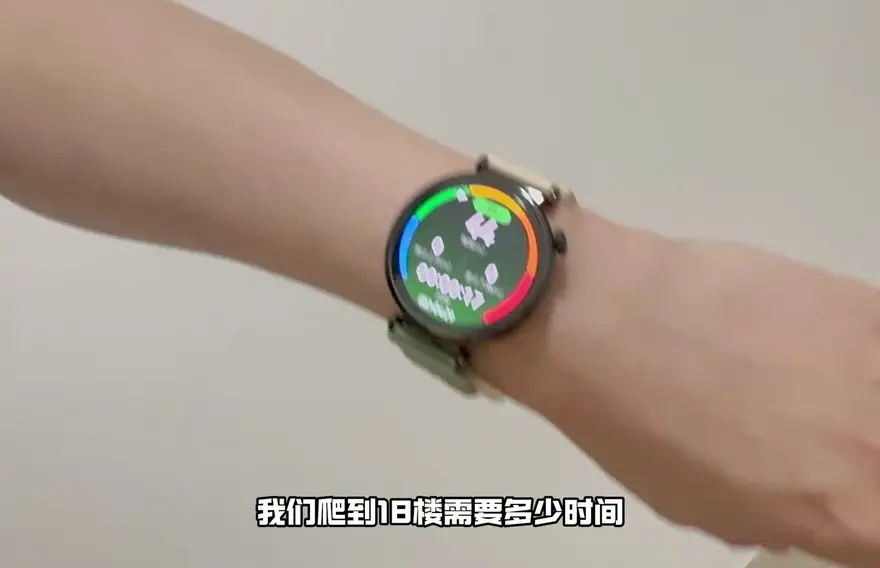
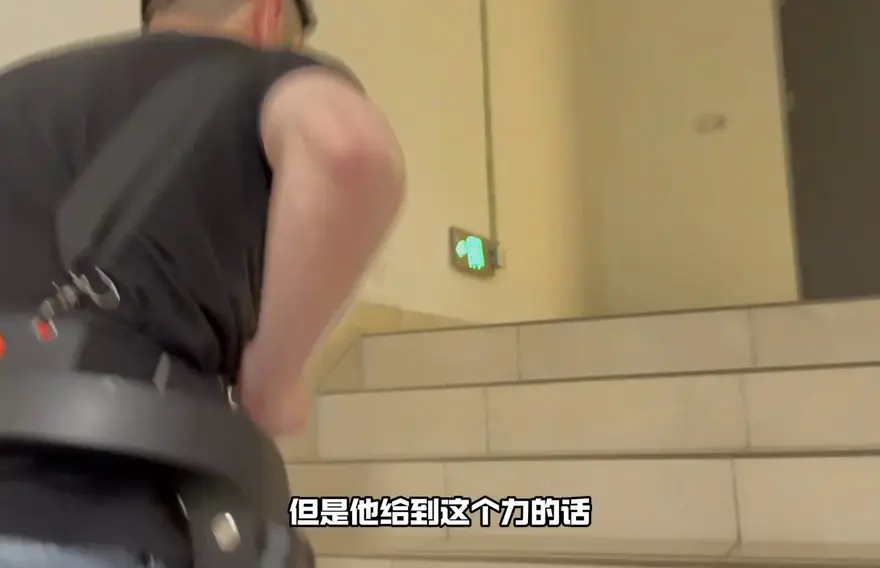
A scene that truly tests the value of a consumer-grade exoskeleton is often not walking on flat ground, but stair climbing and ramps against gravity. The video starts timing from the 4th floor of a tall building, climbing a total of 18 floors.
"We are on the fourth floor... a total of eighteen floors... let's run a timed test to see how it goes." — Mentioned in the video
In the experience of climbing, "semi-automated" is a highly impactful term: when you initiate the intent to lift, the device delivers an upward "lifted" force; however, this force is not a crude push on the knees but rather a more uniform pull upward.
"When climbing, the sense of assistance is even more obvious—it’s essentially semi-automated." — Mentioned in the video
Even more interesting is the physiological feedback: after the blogger finishes 18 floors, the heart rate pounds rapidly ("thump-thump-thump") and sweat breaks out, but the subjective leg fatigue hasn’t reached the point of "exhaustion." This aligns perfectly with the typical value proposition of an exoskeleton: . The cardiopulmonary system still accelerates because overall metabolism increases (heart rate rises); . The musculoskeletal system reduces peak load thanks to the assist (legs are "clearly not so tired"); . Therefore, it’s more suitable as a tool to "make daily exercise more sustainable" rather than "making you completely effortless."


Consistent assist feels great—but it hides engineering challenges
The creator’s comment—“its assist is very consistent, and the feeling on both sides of the knee matches normal walking, without much uncomfortable pressure points or a foreign-body sensation”—points to one of the most important product indicators for a consumer-grade exoskeleton: consistency.
“The assist it gives me is very consistent… without much uncomfortable pressure points or a foreign-body sensation—like it’s part of my body.” —mentioned in the video
What consistency depends on:
- joint torque control: delivering the right torque curves during the flexion/extension phases of the gait;
- sensor (IMU / pressure) fusion: determining phase, triggering, and assist intensity;
- mechanical rigidity and fit: if the structure slips or has play, discomfort such as “knee jamming” or “chafing” can occur.


It Is Not a "Marathon Panacea," but Definitely Has "Room for Speed Improvement"
The joke near the end of the video about "just slipping on a suit and running a marathon" is naturally meant to be humorous. But within the joke lies a real product boundary:
- The 9 km/h maximum speed positions it more for "brisk walking / light jogging" scenarios;
- Marathon paces are far higher than this, and sustained output over long periods poses higher-level challenges for battery life, heat dissipation, and structural reliability;
- However, as a fitness aid that "makes people want to move more," its value is clear: lowering the barrier to entry and allowing you to reduce early-onset fatigue during daily training.
"Can I just slip on a suit and enter a marathon?" — Mentioned in the video (an expression of opinion, not a product commitment)


Who is it for? Do you actually need a lumbar / back assist exoskeleton?
Based on our hands-on experience in this video, we can broadly divide the target audience for lumbar / back assist exoskeletons into three categories:
A. Typical users (Best match)
- Office workers or commuters who walk long distances daily, frequently taking stairs or walking up inclines;
- Casual fitness enthusiasts and hikers looking to reduce physical strain during hiking or trekking;
- Individuals with average lower-limb strength who want to improve the sustainability of their workouts.
B. Users who should proceed with caution
- People with a history of knee or hip joint pain or injuries (we highly recommend consulting a professional for specialized rehabilitation advice beforehand);
- Those who are highly sensitive to having their gait dictated by a device and require a strong sense of control (notably, consumer-grade options emphasize "assist" rather than "replacement").
C. Not recommended / Expectations need adjusting
- Runners looking to significantly boost professional running performance;
- Enduro athletes tackling ultra-long-distance or ultra-long-hour challenges (battery consumption and safety will become major variables).

Parameter Credibility and “max payload / load capacity”: What the Video Mentions and What’s Still Missing
The key verifiable information revealed in this episode is as follows (all mentioned in the video):
- Three assist levels (Level 1 is light, Level 2 is noticeable, Level 3 is the most noticeable)—mentioned in the video
- Top speed around 9 km/h—mentioned in the video (suspected marketing figure)
- Endurance (in hours) around 1.5 hours—mentioned in the video (spoken as “one and a half hours,” but needs confirmation on the spec page)
Hard parameters that still need to be filled in (to assess max payload / load capacity, long-duration stability, and safety):
- Max payload / load capacity
- Total weight and adjustable user size range
- Peak and continuous joint torque output
- Battery life / runtime as officially rated, and degradation under typical load conditions
- Protection rating and reliability (e.g., sweat resistance, water resistance, fall protection mechanisms)




Top Community Comments
@Feige005: What happens if the battery runs out? Or if water gets in from rain and causes a poor connection?
Analysis: This comment captures the most critical "reliability anxiety" for a consumer-grade exoskeleton — battery life and environmental tolerance. It determines whether users can truly integrate the device into daily life rather than treating it merely as a "demo product."
(Original comment pending)
Analysis: If authentic community comments are added later, we will focus on three key areas: long-term wearing comfort, the real-world comparison between perceived load and endurance gains, and price/affordability.
(Original comment pending)
Analysis: If the comments focus on the safety of climbing stairs, this touches on more specialized biomechanical questions — such as whether the activation of walking assist could cause users to lose balance, or whether additional shear forces are applied to the knees.
(Original comment pending)
Analysis: If discussions about "marathon feasibility" arise, it signals that users will directly link product performance with professional athletic goals. This is both a marketing opportunity and an expectation-management challenge that manufacturers must navigate carefully.
One-Sentence Summary
This video puts a "lumbar assistive exoskeleton" through its paces, turning the "effort-saving gadget" concept into real hardware. With three adjustable levels, a speed ceiling of 9 km/h, and roughly 1.5 hours of Battery Life based on the narrator’s comments, the most telling comparison was this: after climbing 18 floors, the heart rate was soaring—but the legs were far less fatigued than usual. That shift—from just looking like high-tech gear to actually being useful—underlines how a consumer-grade exoskeleton is moving from mere form to real function.
It’s aimed squarely at users who want a more sustainable way to hike, climb stairs, or walk daily—not serious runners seeking a performance-enhancing shortcut for race day.
About this article: part of Chinese-Made Exoskeleton Review Archive — an independent, regularly updated English archive of reviews of consumer exoskeletons made in China, edited from publicly available video transcripts. Not an official manufacturer page.
For inquiries and purchasing, contact lonlonago@foxmail.com. More in Reviews · All articles.