The First Step After Five Years of Lying Down: What One Exoskeleton Rehabilitation Video Reveals About the Divide Between "Medical-Grade" and "Consumer-Grade" Exoskeletons
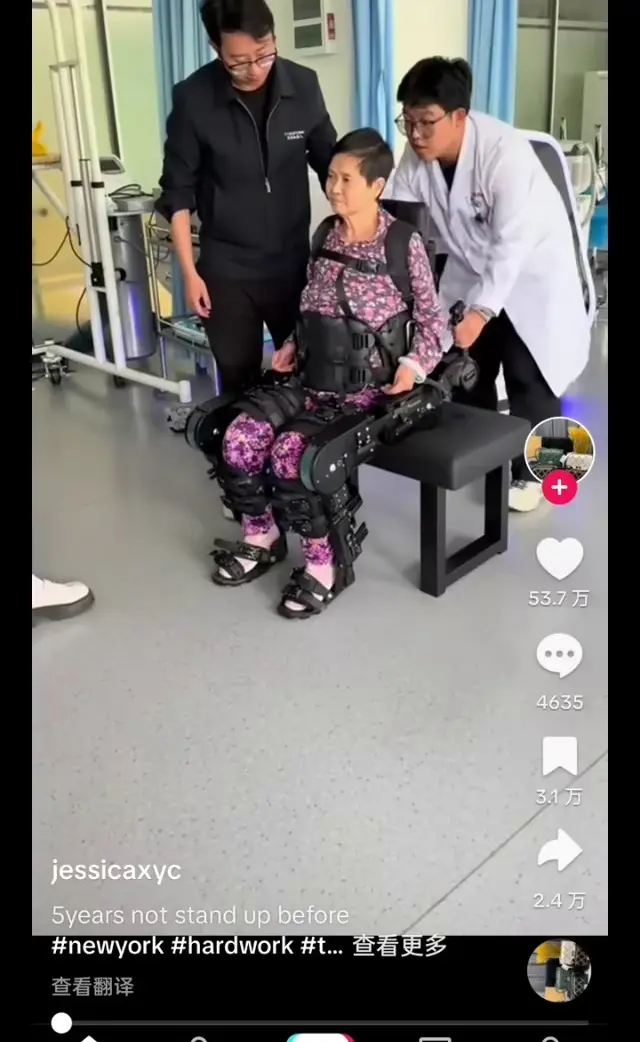
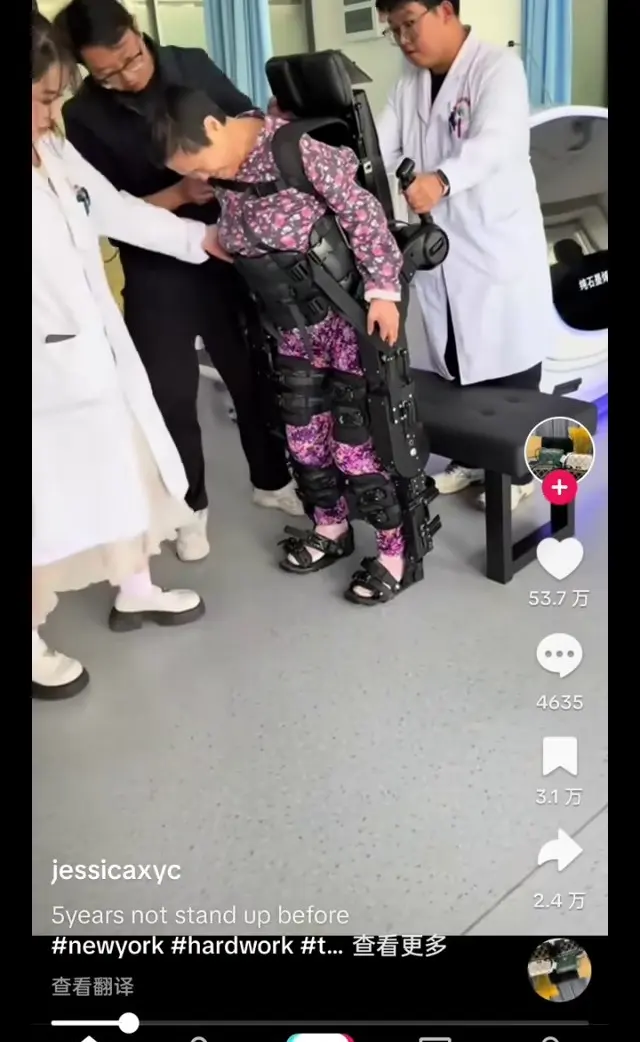
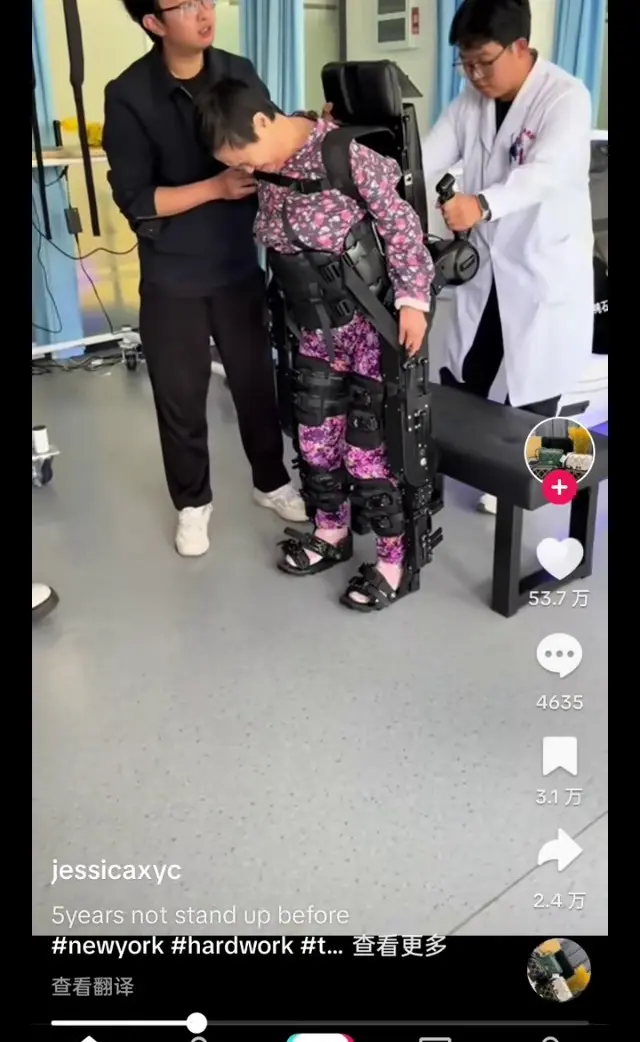
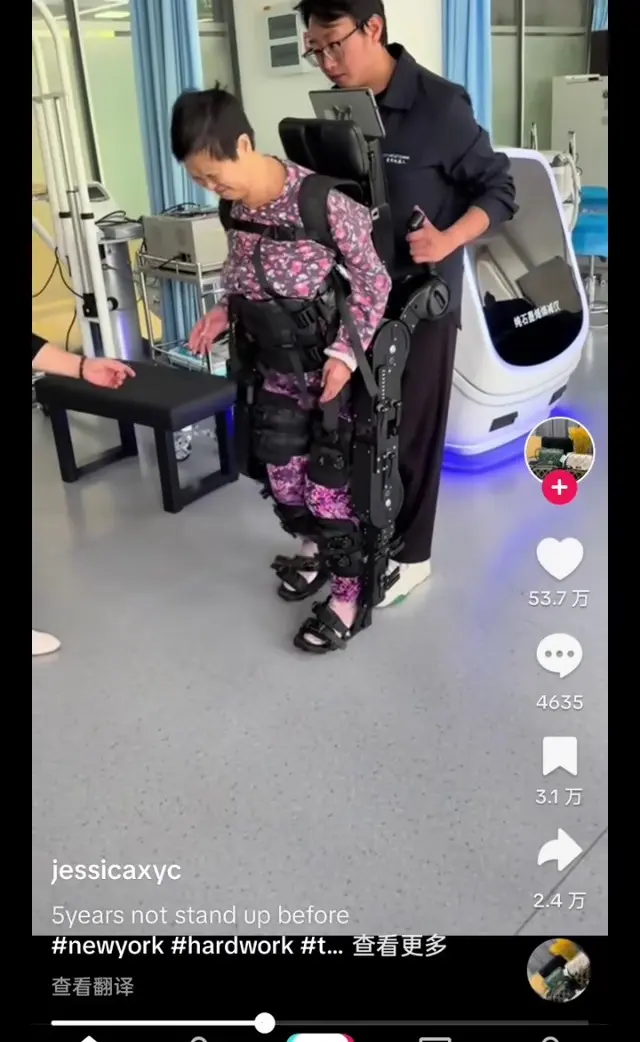
This video has no narration, no background music, not even a single full shot of the machine itself. In thirty-eight seconds, all you hear is a handful of people talking around a trainee:
"Now we're walking. Time to walk.Head up. Don't keep it down—if you don't lift it, your head just slumps forward.Shift your weight to the left first. Weight on the left foot, step down with the right.Does it hurt badly?"
(Note: The transcript contains obvious ASR misrecognitions—for example, "xiān chī" should, based on context, be "xiān qǐrise up first"), and "jǐ tóu" should be "dī tóulower your head"); these have been corrected. The video itself provides no specific specifications; all figures cited in this article are drawn from public sources and commonly accepted industry levels, and are annotated accordingly.)
If you've scrolled across this video, chances are you stopped at the comments section. The most-liked comment comes from @DoomsdayBattlefield: "If your legs go numb after half an hour on the toilet, getting up hurts just as much. Never mind someone who's been lying down for five years. Pain means the nerves still work.Five years lying down"—those four words give weight to every mundane command that came before. Combined with another viewer's comment in the section, "I've seen this thing at a rehabilitation hospital too," it's safe to conclude: this is not an outdoor gear review, nor an unboxing of a consumer-grade exoskeleton, but a gait training session with a rehabilitation exoskeleton. A long-term bedridden trainee, guided by a lower-limb exoskeleton and a therapist's verbal cues, is relearning "walking"—something most people never imagine they'd ever need to learn.
Yet precisely because of that, this video makes for a perfect cross-section of the exoskeleton industry: it lands squarely on the two most easily confused concepts—rehabilitation exoskeletons and consumer-grade exoskeletons—and puts the question "what can exoskeletons actually help people do, and what can't they do?" right on the table.
What Kind of Machine Can "Hold a Person Up": The Anatomy of a Lower-Limb Exoskeleton
Judging by the training mode and details in the footage, the device in the video is a textbook lower-limb exoskeleton—and specifically a configuration geared toward medical/rehabilitation use. Its basic structure isn't complicated; the hard part is the engineering:
- Actuator modules sit on both sides of the hip and knee joints, built around brushless motors (a servo motor setup) paired with gear reducers, outputting joint torque to drive the legs through flexion and extension;
- Thigh links, shank links, and a lumbar support form the frame, with mid-to-high-end models commonly using carbon fiber to cut weight;
- The sensor system includes IMUs (inertial measurement units) and plantar pressure sensors to determine gait phase—when to lift the leg, and when it should touch down;
- Waist and leg straps rigidly couple the device to the wearer—the prerequisite for it to "carry" a person as they walk.
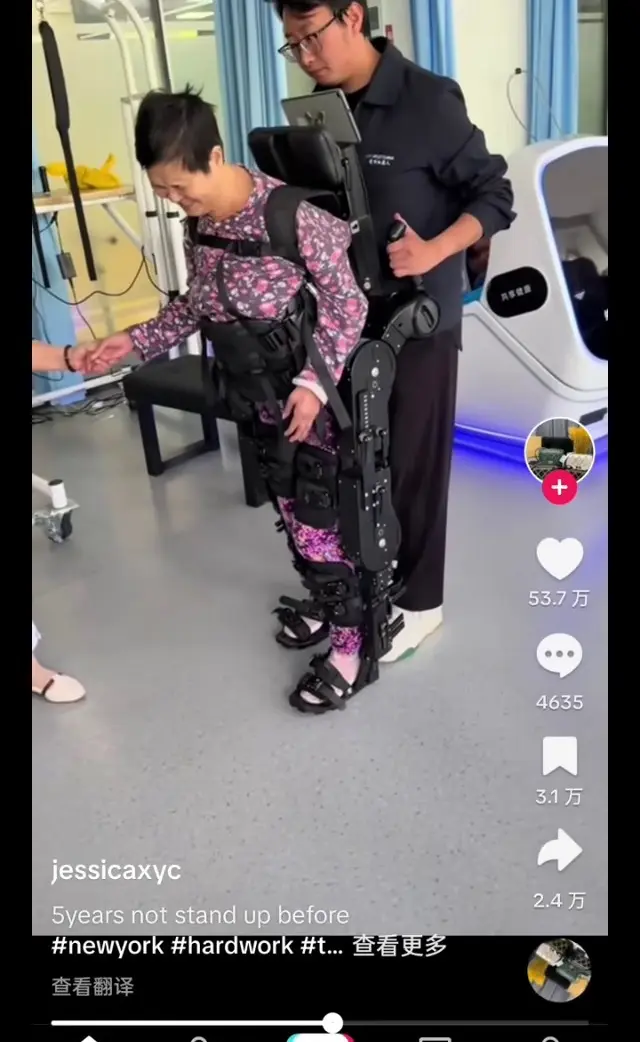
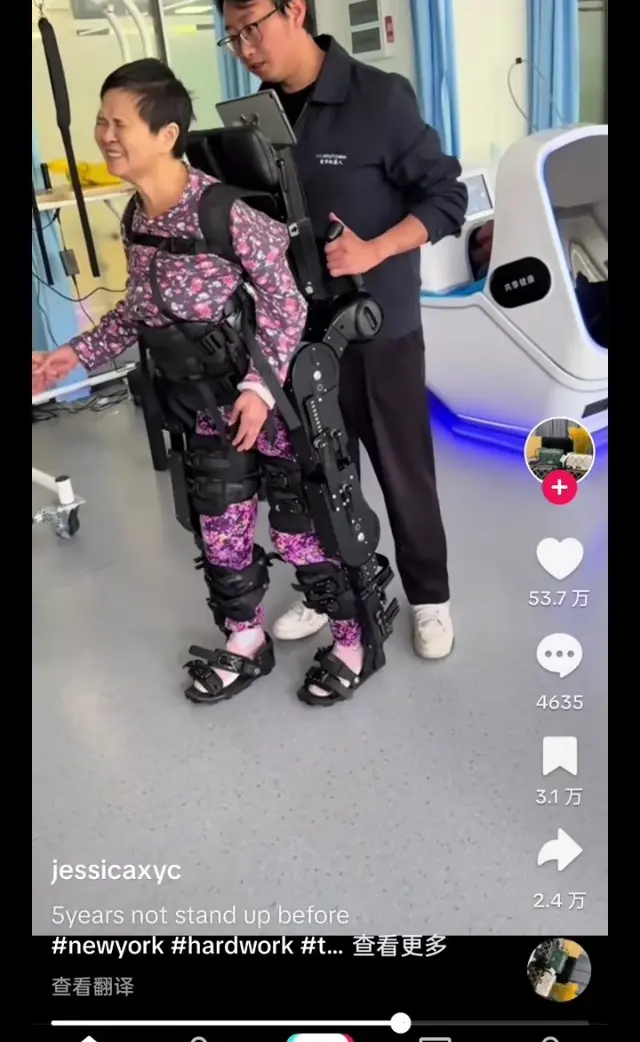
The working logic boils down to one sentence: sensors identify the gait phase, the controller outputs joint torque to the hips and knees along preset gait curves, and "walking" is broken down into repeatable mechanical cycles. For a healthy person, that's redundant motion—but for someone bedridden long-term or with insufficient lower-limb muscle strength, this machine does the work their muscles can't.
Based on publicly available information, the typical specs for this class of rehabilitation-grade lower-limb exoskeleton look roughly like this:
Overall device weight generally falls in the 15–25 kg range (a substantial share of the load is transferred through the straps and frame to the ground or a therapist, rather than resting entirely on the user); battery life typically runs 2–5 hours; training walking speed is around 0.2–0.5 m/s; and the device carries a max payload (matched to user body weight) limit, with publicly cited upper bounds commonly in the 85–100 kg range.
Note the last two figures. The slow, halting rhythm in the video—one careful step at a time, synced to verbal commands—isn't a sign of an underpowered device; it's what rehabilitation training actually looks like. The primary goal isn't "walking fast" but "walking correctly and safely." Some newer models have begun introducing self-balancing control to reduce reliance on therapists, but in the vast majority of rehabilitation settings, there is always a person standing beside the device.
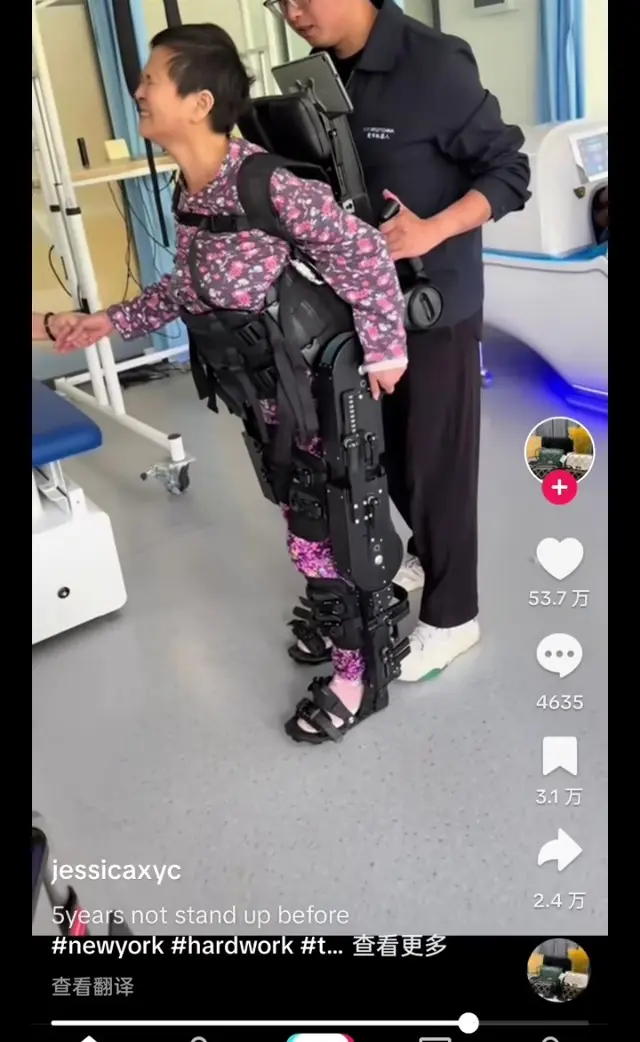
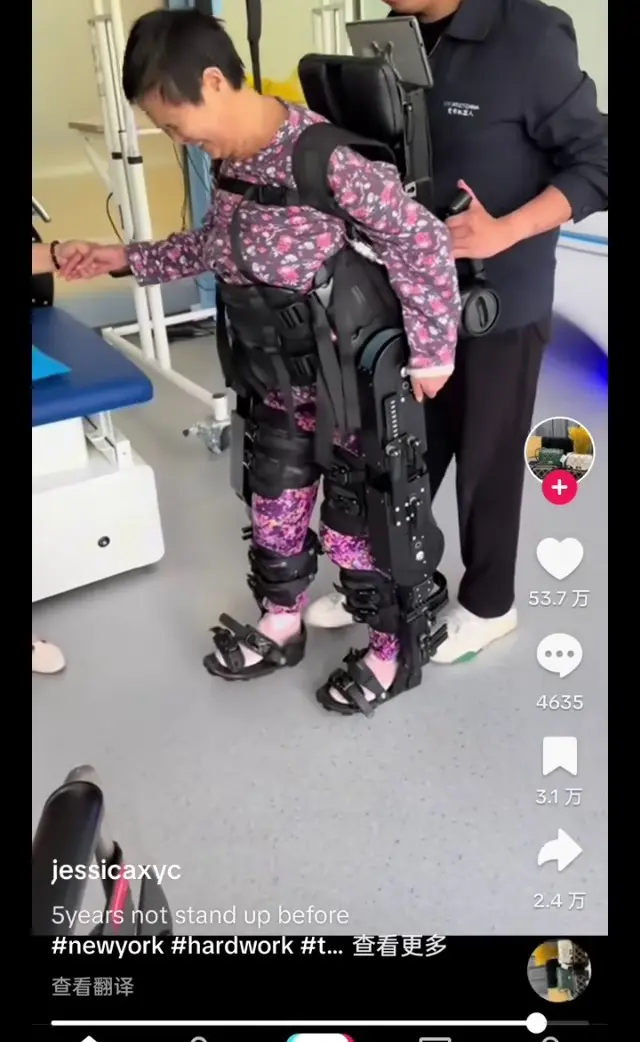
"Head Up,Weight on Your Left Foot": The Part an Exoskeleton Can't Replace Is Called Gait
Many people assume an exoskeleton means "put it on and you can walk." This video shows exactly the opposite: the machine handles the power, while the human has to relearn how to control it.
Those opening lines that sound like casual chatter—"Stand up first,Head up, don't look down"—are actually the standard preliminary steps of gait training. People who have been bedridden for a long time often develop compensatory postures: a forward-jutting head, a hunched and rounded back. If the torso can't stay upright, the center of gravity can't be adjusted properly; and if the center of gravity is off, the legs won't step correctly. That's why the therapist first corrects the entire postural chain—head, chest, pelvis, hip, knee, ankle—working through it from top to bottom before even talking about taking a step.


Then comes the most crucial command of all:
"Shift your weight onto your left foot, then step down with your right."
This is the core logic of gait training. Human walking is a cycle of the "stance phase" and the "swing phase": one leg bears the weight and holds steady (stance phase) so the other leg can lift off and swing forward (swing phase). An exoskeleton can output the joint torque needed to lift your leg, but "handing over your body weight" is something no machine can do for you—if your center of gravity doesn't shift onto the left leg, the right leg's step becomes a wasted motion, or even a dangerous one.
That's why, throughout the entire video, the therapist says more than the device does. It also explains why rehabilitation exoskeletons still can't leave professional settings to this day: it's a powered machine, but more than that, it's a training system that requires a human to fine-tune it. The device provides the force; the therapist provides "when to apply it, and how much."


"Does It Hurt Badly?" — Pain Is Proof That the Nerves Are Still Working
The exchange at the end of the video hits hardest:
"Does it hurt badly?It hurts, but..."
The trainee never stopped. In the comments, a reply from @DoomsdayBattlefield with 1,737 likes explained this moment with striking clarity:
"You call this pain? Sit on the toilet for half an hour until your legs go numb, then try to stand up — it hurts just the same. Never mind someone who has been lying down for five years. Pain means the nerves still work."
From a rehabilitation medicine standpoint, this isn't mere consolation. Prolonged bed rest leads to disuse muscle atrophy, joint contractures, and reduced bone density. When a patient stands again, atrophied muscles have to bear weight once more, and stiff joints have to bend and extend again — soreness is almost inevitable. And that very "soreness, swelling, and pain" is precisely the sign that the sensory neural pathways are still sending signals back to the brain. In neurological injury rehabilitation, feedback is what makes neural remodeling possible; a complete loss of sensation is actually far more difficult to work with.


That said, the full picture matters: pain is a signal, not a goal. Pain during rehabilitation training must stay within the safety range assessed by a therapist; pain beyond that range may indicate joint or soft-tissue injury and calls for an immediate stop. The question "Does it hurt badly?" in the video isn't small talk — it's a safety check repeated at every single session. This is also why we have always advised against using rehabilitation-grade lower-limb exoskeletons at home on your own: fall protection, joint angle limits, and emergency stop — these safety mechanisms require trained professionals on site.

Don't Be Fooled by the Word "Exoskeleton": Rehabilitation-Grade and Consumer-Grade Are Two Different Machines
After watching the video and then browsing "exoskeletons" on e-commerce platforms, you might be confused: why do some sell for hundreds of thousands while others cost just a few thousand? Because they aren't the same category of product at all.
The core capability of a rehabilitation exoskeleton (mostly medical-grade) is "support": through straps and joint limiters, it bears part of your body weight, the knee joint can be locked, and paired with fall protection and therapist assistance, it enables people who cannot stand on their own to complete standing and gait training. It solves the problem of going "from 0 to 1."
The core capability of a consumer-grade exoskeleton (mainly hip assist) is "assistance": it doesn't carry your weight; it simply delivers an extra burst of joint torque as your hip joint swings, helping you save effort. It solves the problem of going "from 1 to 1.2"—provided you can already walk in the first place.


One sentence to sum up the difference between the two:
A rehabilitation exoskeleton "carries you along," while a consumer-grade exoskeleton "pushes you along." A machine that carries you can catch you when you fall; a machine that pushes you cannot.
This also dictates their completely different product forms and price bands: rehabilitation-grade units are heavy, slow, and expensive—clinical systems generally run in the several-hundred-thousand-RMB range (public information)—and require professional settings and trained personnel; consumer-grade units are light (mainstream complete units mostly come in at 2–3 kg, public information), fast, and relatively affordable, with retail prices roughly ranging from a few thousand to 20,000 RMB (public information), all built around the idea of "put it on and forget it." The trainee in the video clearly needs the former—hand him a consumer-grade hip assist unit, and he wouldn't even be able to stand up.


Mapping China's Exoskeleton Industry: Chengtian, Kenqing, Aoshan, and Yuanye — Each on Its Own Path
Pull the camera back from the hospital ward, and a bigger picture emerges: China's exoskeleton industry has quietly spread out across several tracks, with the leading players each holding down a distinct segment:
- Chengtian Tech: The flagship of the rehabilitation exoskeleton route. Its products are already in service at multiple rehabilitation hospitals and rehab centers, and scenes like the one in the video — bedridden patients relearning to walk — are precisely its home turf;
- Kenqing Tech: Taking the lightweight consumer route, with a focus on hiking / trekking assist. According to public reports, it has launched exoskeleton rental pilots at Mount Tai and other mountain scenic areas, letting ordinary people spend a few dozen to a hundred-odd yuan to be "carried up the mountain";
- Aoshan Intelligence: Zeroed in on industrial scenarios. Its lumbar assist and upper-limb assist exoskeletons target B2B customers in logistics handling, airline ground services, and automotive production lines — solving, quite literally, the back-strain problem of material-handling workers;
- Yuanye Tech: Championing the soft exoskeleton ("muscle armor") route, using flexible actuation to build lightweight walking-assist exoskeletons, aimed at everyday walking for older adults and people with limited mobility;
- Toread: An outdoor brand crossing over into the space. Per public information, it has already folded exoskeletons into its hiking and trekking gear ecosystem — a clear signal that the consumer-grade market is heating up;
- Haier: Entering from its health-and-wellness and elder-care ecosystem, exploring how exoskeletons can land in home-based, real-life scenarios.


Overseas and on crowdfunding platforms, Hypershell and Dnsys stand out as two representatives of the consumer-grade hip-assist exoskeleton: carbon fiber structures, brushless-motor hip joint drives, built for hiking, trekking, and everyday walking assist. Both have secured substantial order volumes through overseas crowdfunding — solid proof that "people will actually pay for consumer-grade exoskeletons."
An industry consensus is taking shape: rehabilitation exoskeletons are responsible for making the technology "usable and safe," while consumer-grade exoskeletons are responsible for bringing the price down to a point where people "dare to buy it and use it every day." The two tracks share the same technical foundation — motors, sensors, and control algorithms — but their product logic is completely different.


What Consumer-Grade Hip Assist Actually Feels Like: Going Uphill, It's Like Someone Is Supporting the Back of Your Thighs
Now let's talk about the product line most people are actually likely to encounter. Drawing on publicly available hands-on feedback for consumer-grade hip assist exoskeletons like Hypershell and Dnsys, the on-body experience can be summed up as: on uphills, the back of your thighs and your hips get an extra "lifting" force, and perceived exertion drops noticeably; on flat ground, the assist is subtle, more like a gentle push; on downhills, most products provide cushioning or simply scale back their intervention.


But the pain points cluster just as tightly:
- Battery life: Official claims mostly sit in the 3–5 hour range (per public sources), but in real use with high assist mode engaged on steep slopes, runtime takes a noticeable hit—long-distance treks mean you'll need to pack extra charging solutions;
- Weight and donning: 2–3 kg hanging at your waist and hips—you'll feel it in your shoulders and hips after a full day of walking; donning and adjustment isn't exactly beginner-friendly, and strap tightness directly affects how efficiently the assist transfers;
- Gait adaptation: The algorithms are designed around a "standard gait," but individual gaits vary widely—assist timing occasionally misses the mark, creating an awkward sense of "jumping the beat" or "lagging half a beat";
- Noise and heat: Brushless motors paired with reduction gearboxes produce an audible hum at high torque output, and the motor housing heats up noticeably during long climbs in summer.


The target users are therefore clear: outdoor enthusiasts who hike and trek regularly and want to cut down on long-distance fatigue; seniors whose stamina has declined but who can still walk; and outdoor workers who spend long hours standing and walking. Those who shouldn't buy are just as clear: anyone who cannot stand or walk unaided—that's the territory of rehabilitation exoskeletons, so don't buy the wrong product.
Battery Life, Torque, Weight: The "Impossible Triangle" of Consumer-Grade Exoskeletons
Consumer-grade exoskeletons have yet to break into the mainstream, held back by three physical quantities that constrain one another:
Want more joint torque? You need bigger motors and reducers. Want longer endurance? You need a bigger battery. But motors and batteries both add weight—and that weight ultimately all bears down on the user's hips and waist.

The current solution is "good enough": consumer-grade products generally cap peak assist torque in the 10–20 N·m range (based on public data)—enough to offset a substantial share of the hip joint's work during uphill walking, but without chasing the full-body actuation capability of rehabilitation-grade systems. Structurally, carbon fiber is used to keep frame weight down, at the cost of a higher price. Batteries, meanwhile, almost universally adopt a removable design, using quick battery swaps to compensate for limited energy density.

Another frequently overlooked bottleneck is control. Roughly 80% of how an exoskeleton feels comes down to how precise its "assist timing" is: the sensors must identify which phase of your gait you're in within tens of milliseconds, and the controller then decides how much torque to deliver—and when to pull it back. Trigger too early and it "jumps the beat"; too late and it "drags." Either way, your body feels something is off. That's exactly why every player is racing to refine sensor fusion and gait recognition algorithms—hardware specs are easy to copy; tuning finesse is not.

From the Rehabilitation Ward to the Hiking Trail: The Eve of the Exoskeleton Boom
Back to this video. There's another fascinating comment in the comments section — @JinshuiKegui wrote: "I'm still not quite used to seeing comments from overseas viewers." — This video, shot in a rehabilitation setting in China, has clearly made its way abroad, where it's being watched by audiences in different languages. A person bedridden for five years taking steps again — that kind of emotional resonance needs no translation.
This also reveals a truth about the exoskeleton industry: what moves the public most is often not the specs, but the act of "walking again" itself. Here, the narrative around this technology returns to its most unadorned form — the machine isn't built to look cool; it exists so that one specific person can do one specific thing again.


Looking ahead, the two product lines will most likely reinforce each other: rehabilitation exoskeletons hone safety redundancy, gait algorithms, and fall protection in clinical settings, and these technologies will gradually trickle down to consumer-grade products; meanwhile, the consumer-grade market uses sales volume to amortize the costs of motors, carbon fiber, and batteries, which in turn lowers the barrier to entry for rehabilitation equipment. Add in the certainty of an aging population, and exoskeletons may well be entering a stage much like the eve of the drone and e-bike booms — the products already work, prices haven't yet come within everyone's reach, and use cases are being validated one by one.


At the end of the video, the trainee is still walking step by step to each spoken command. No miraculous, effortless strides — just the repetition of "weight on the left foot, step with the right." But this may be what exoskeletons truly look like: they don't promise to make you run; they simply stay by your side, helping you relearn "walking," one piece at a time.
Top Community Comments
"I've seen this thing at a rehabilitation hospital too, but my lower limbs recovered quickly, so I never got to use it." — @Cifangde⑨Mao (2,339 likes)
Analysis: This comment reveals the real access barrier for rehabilitation exoskeletons — they are mainly deployed in institutional settings such as rehabilitation hospitals, and are typically reserved for patients with long recovery cycles and more severe lower-limb functional impairment. The fact that someone who recovered quickly "never got to use it" actually confirms that these devices hold a clearly defined indication within clinical pathways; they are not general-purpose gear that "anyone can wear.You call this painful? If you sat on the toilet for half an hour and your legs went numb, getting up would hurt just as much. Never mind someone who has been bedridden for five years. Pain means the nerves still work." — @Morishachang (1,737 likes)
Analysis: The most-liked comment uses an everyday analogy to "translate" the video, filling the biggest gap in public understanding of rehabilitation training: relearning to walk hurts — and to some extent, pain is good news. Its high engagement shows that viewers don't want spec sheets; they want an empathetic explanation of "why is this so hard.I'm not quite used to the comments on overseas platforms [doge]" — @JinshuiKegui (1,064 likes)
Analysis: This comment indirectly confirms that the video has spread to overseas platforms. Rehabilitation exoskeleton content has natural cross-language appeal — "a person standing up again" is a universal narrative. The sense of not quite fitting in also hints at the difference in atmosphere between Chinese and international comment sections; overseas, this type of content tends to spark heated discussions about healthcare accessibility and payment models.
"With a bedridden elderly parent at home, what I care about most is: how much does this cost, can I rent it, and is it covered by public health insurance?" (paraphrased from multiple comments)
Analysis: Payment is the topic rehabilitation exoskeletons can never avoid. A full-unit price in the hundreds of thousands of RMB (based on public information) makes outright household purchase unrealistic; rental models, hospital-shared equipment, and public health insurance reimbursement policies are the key variables that determine how widely this technology actually reaches people.
"No matter how good the equipment is, it can never replace a therapist's hands. How to shift the center of gravity, when to deliver the assist — a human is always making those adjustments." (paraphrased from multiple comments; the commenter appears to be an industry practitioner, likely a rehabilitation therapist)
Analysis: This perspective echoes the video itself — the verbal cues never stop from start to finish. It captures the current state of the industry: rehabilitation exoskeletons remain "human-machine collaborative" systems. However automated the equipment becomes, individualized adjustments during gait training still depend on therapist expertise — which is why, in the short term, rehabilitation settings are hard to replace with purely consumer-grade products.
"This is nothing like the hiking exoskeleton I tried at a trade show — one supports your body as you walk, the other pushes you along." (paraphrased from multiple comments)
Analysis: This comment shows that the "rehabilitation-grade vs. consumer-grade" confusion is indeed widespread, while anyone who has tried both types of products in person quickly builds the correct mental model. The difference between "supporting you as you walk" and "pushing you along" is, at its core, the difference between having body-weight support and fall protection versus not — which is exactly why we advise consumers to choose based on their actual needs and avoid cross-category mispurchases.
One-Sentence Summary
This video doesn't document the unboxing of a consumer-grade exoskeleton—it's a gait training session with a rehabilitation exoskeleton: the machine provides joint torque, the therapist provides verbal cues, and the trainee provides the will to stand up again. If you're a tech enthusiast following the exoskeleton industry, it's the perfect slice for understanding the "medical-grade vs. consumer-grade" divide; if you're searching for a walking assist solution for a family member, remember this—someone who cannot stand on their own needs a lower-limb exoskeleton at a rehabilitation facility, not a hiking hip assist device from an e-commerce listing.
About this article: part of Chinese-Made Exoskeleton Review Archive — an independent, regularly updated English archive of reviews of consumer exoskeletons made in China, edited from publicly available video transcripts. Not an official manufacturer page.
For inquiries and purchasing, contact lonlonago@foxmail.com. More in Rehab & Mobility · All articles.