Hands-On Test: The 12.2kg "Cyber Cheat Code" — Chengtian GoGo HPRO Consumer-Grade Exoskeleton Gets an 80-Year-Old Grandpa Back Up the Stairs
Every year, wandering the World Robot Conference (WRC) feels like getting a sneak preview of the future: soccer-playing, coffee-making, laundry-folding, and lab-experiment-running robots all lined up in a row. But at the 2026 edition, what truly made me stop in my tracks wasn't the robots "standing" on display — it was a category meant to be "worn on your body": the consumer-grade exoskeleton.
The marketing pitch says it makes lifting your legs and taking steps easier, and can even restore mobility for seniors with limited leg function. Is it really that miraculous? With this Chengtian Technology GoGo HPRO (a shaping assistive exoskeleton) on the show floor — and the very same model in my hands — let's put it to a serious test.
At WRC, I Met a "Robot You Wear"
First, the initial impact this category had on me. The skeleton inside the human body is called an endoskeleton; the "mechanical frame" worn on the outside that moves together with you is an exoskeleton. The vlogger even played a joke on site: "This is an endoskeleton, that one is an exoskeleton." Wearing it feels like installing a cyber assist system on yourself: the machine doesn't walk for you, but every time you lift a leg, take a step, or head downhill, it quietly lends you a bit of power.
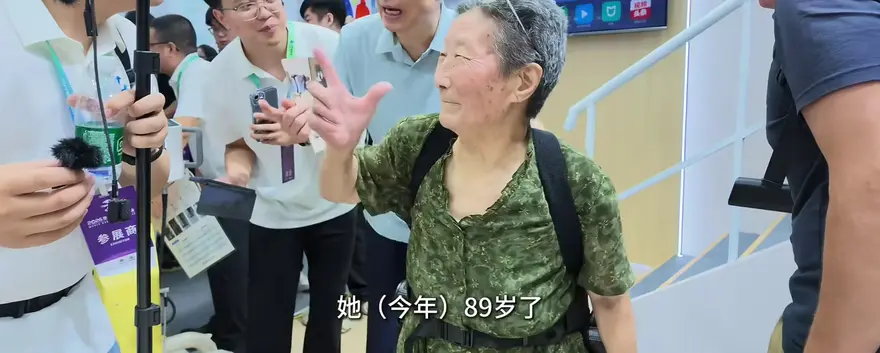
The most touching moment on site was a grandmother with limited mobility who, after putting on the device, walked faster and faster — people nearby couldn't help shouting: "Grandma, you're walking so fast!"
But however moving it was, the questions still need asking: how far has the consumer-grade exoskeleton actually progressed by 2026? Is it a show-floor performance, or can it genuinely enter daily life? Let's break it down below.



Unboxing: A 12.2kg Body That's Lighter Than Expected
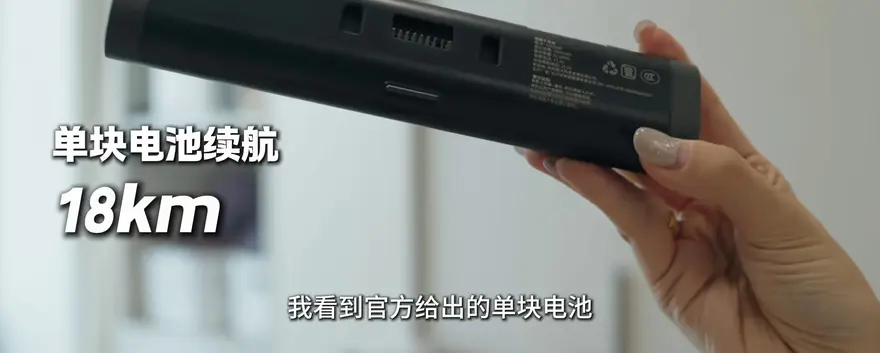
Let's start with the packaging. Inside the box you get the exoskeleton main unit, one 2900mAh battery, a pair of shoulder straps, and a set of interchangeable leg straps — no flashy extras beyond that.
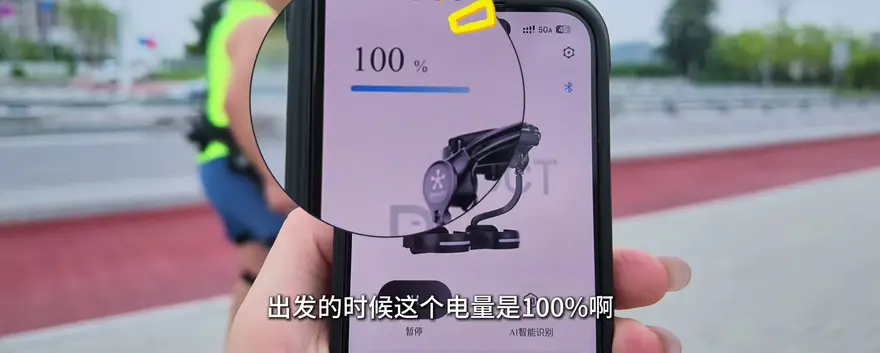
Official total weight: 12.2 kg; battery capacity: 2900mAh (both as mentioned in the video)
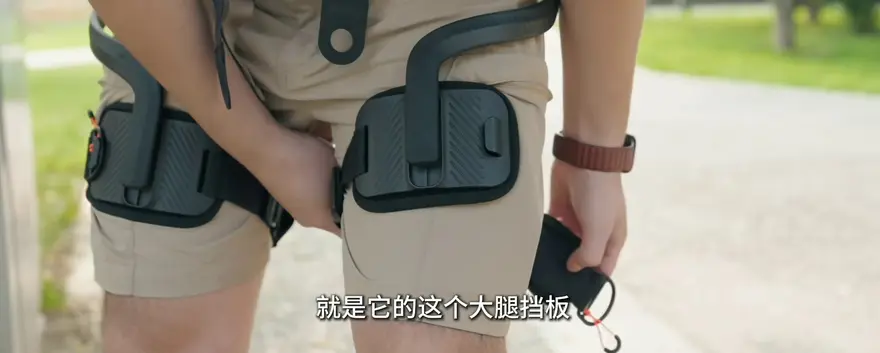
12.2kg doesn't sound light, but the very first impression in hand is "lighter than expected": the leg linkages and guards are made of a relatively lightweight carbon fiber, and as a woman, I could lift the entire unit with one hand.
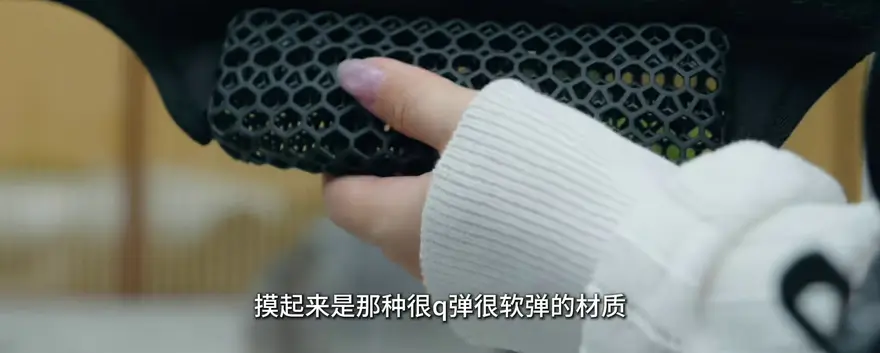
Design-wise, the most endearing detail is the 3D-printed bionic lumbar support at the lower back — it's a soft, springy material that feels pleasantly bouncy to the touch, and against your waist it delivers a strong sense of wrap-around fit and support, easing lumbar pressure without digging into your waist.
Here's one personal observation: purely by the numbers, 12.2kg is of course far heavier than a hardshell jacket. But the cleverness of the hip assist architecture lies in concentrating most of the mass around the hips — right near the body's center of gravity — and carrying it snug against the body, so the actual perceived weight is far less than "hauling a main unit on your back." That's also why consumer-grade assistive exoskeletons almost universally go with hip assist designs rather than lower-limb exoskeletons with actuators spread across the entire leg: dropping the motors at the knee and ankle joints brings an across-the-board reduction in weight, power consumption, and donning complexity. The trade-off is that it behaves more like an "assist device" than a "personal transporter" — it amplifies every step you take rather than walking for you.
Also, for a device built primarily for hiking / trekking assist, battery life is always the first order of business. The 2900mAh capacity reads more like a balance struck between overall weight and endurance (in hours); for the exact endurance figures, we recommend going by the official rated specs.

Wearing and Adjustment: 46 Seconds for a First-Timer, 42 Seconds for an Auntie
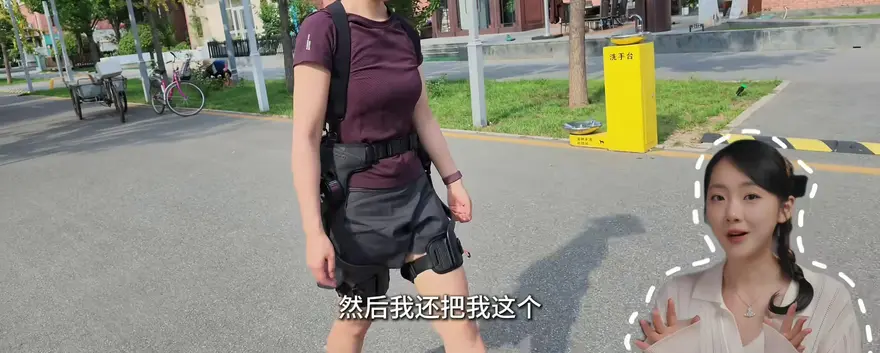
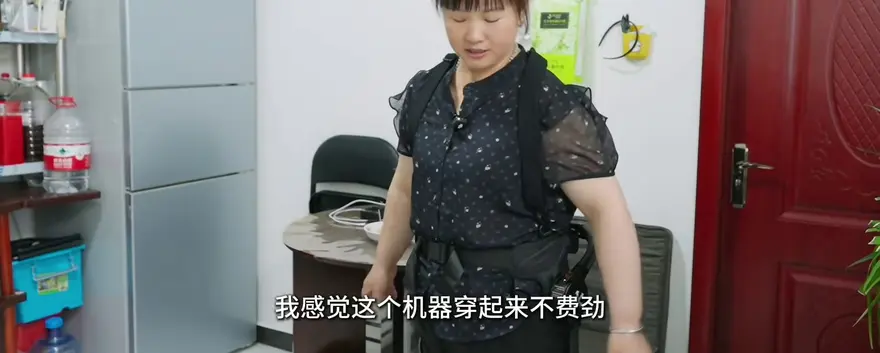
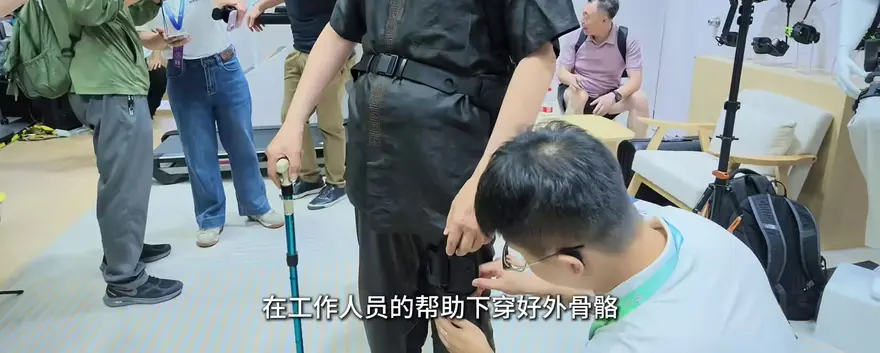
Putting on the exoskeleton works just like wearing a backpack: sling both shoulder straps over your shoulders first, secure the fit at your waist, then fasten the straps around both thighs — and the basic setup is done.
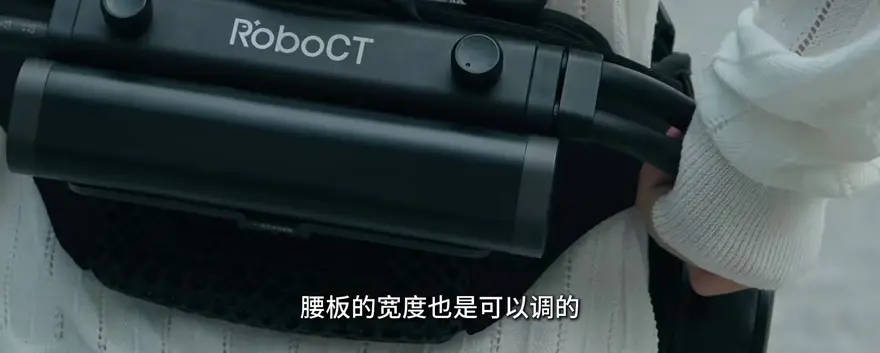
There's plenty of adjustability: shoulder strap length is adjustable, the width of the back lumbar panel is adjustable, and thigh tightness is controlled by a knob. The official wearing method is to first widen the lumbar panel to slightly wider than your waist, put the exoskeleton on, adjust everything into place, and finally twist the knob tight. The lumbar panel knob sits on your back, but it's the kind of design where "touch it once or twice and you'll know exactly where the knob is" — you can basically operate it blind.
As for body-type compatibility, pear-shaped users don't need to worry — I'm pear-shaped myself, and the adjustment range for the waist, hips, and thighs was all more than enough.
We also ran a little experiment: we brought in a friend who had never worn an exoskeleton before, walked him through the entire process once, then had him put it back on from scratch, starting with the adjustments — 46 seconds on the clock. Note that these 46 seconds include re-adjusting the shoulder straps and waist belt; if everything is already dialed in for daily use and you're practiced at putting it on, it only gets faster.
First-timer's first independent wear (including re-adjusting the shoulder straps and waist belt): 46 seconds (timed on video)
Also, when men and women of different builds take turns wearing it, the shoulder straps, lumbar panel width, and thigh tightness all need to be re-adjusted — but the whole process is quick. In other words, buy just one unit and the whole family can share it.


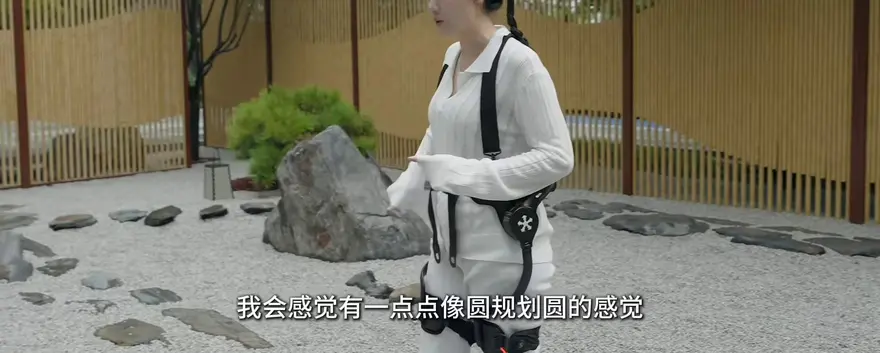
Flat-Ground Mode: A Force That Pushes You Forward
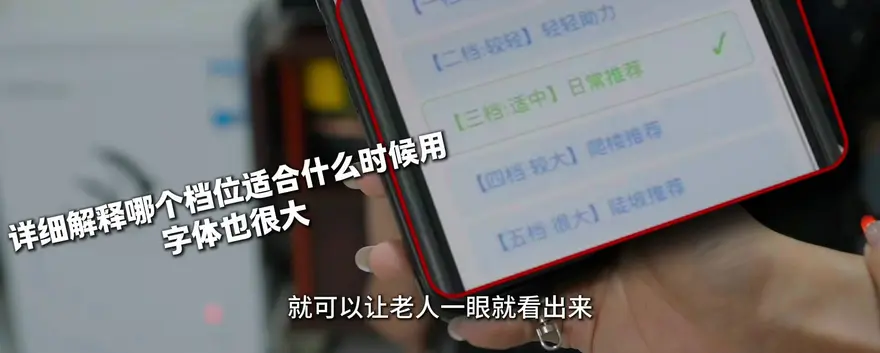
Press the switch on the side of the unit and the device powers on. Modes can be switched on the device itself or in the Chengtian app: three options — flat-ground assist, hiking/trekking assist, and downhill; the button on the right adjusts the assist levels — the lowest level is barely noticeable, and in daily use I basically go straight to level five (mentioned in the video).
The flat-ground experience is fascinating: a force pushes your legs forward, and your legs stay in a "barely exerting" state — the moment you show the slightest intent to step forward, it carries your leg along.
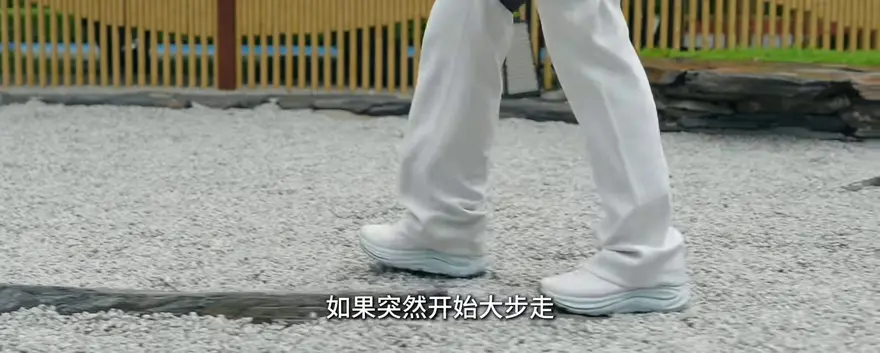
At first I worried it would "hijack" your gait at a fixed rhythm, but that's not the case at all: its stride and cadence follow your gait — walk slowly and the pushing frequency slows down; suddenly take big strides and the force scales up accordingly. In practice, "it adapts to you," not the other way around, so the adjustment cost is very low.
"It feels like your legs aren't even yours, you know? Like that wonderfully carefree feeling of just strolling around." — original quote from the creator
When turning, you can sense a slight "compass drawing an arc" feel: each leg receives a different amount of force support to help carry you through the turn, yet overall it remains smooth. When you sit down, the linkage rods change angle along with your hip joints — nothing jabs into you uncomfortably; stand up, and it returns to the standing posture — so you can sit down for a normal rest when tired, then get up and keep walking, no problem.
There are downsides, though: in the first few minutes after putting it on, your walking posture looks a bit silly — a friend said I walked like an old man out for a stroll; also, the assist at lower levels is rather "gentle," and you basically need to crank it to a higher level to feel it clearly.
From a technical perspective, the core of this kind of device is sensors (IMU, etc.) recognizing gait intent, followed by brushless motors delivering assist torque at the hip joints — how accurately it recognizes and how quickly it follows is the dividing line between an "electric toy" and a "usable daily device." On the flat-ground test, the GoGo HPRO passes.




Uphill and AI Mode: 1kW of Power, the "Invisible Hand" on the Stairs
Flat ground was just the warm-up—time to crank up the intensity: hiking.
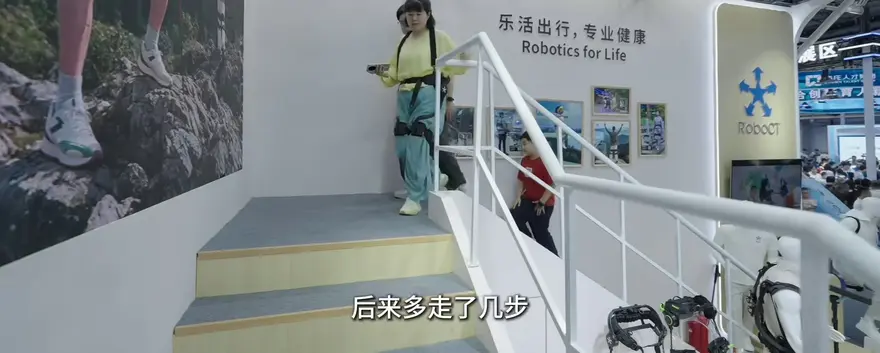
Hiking is a classic mixed-terrain scenario—flat stretches, uphills, and downhills alternating. In this kind of situation, there's no need to manually toggle modes back and forth; just switch on AI mode: on flat ground it assists with flat-ground logic, the moment you start climbing it automatically shifts into hiking mode with noticeably stronger leg assist, and heading back down it switches to downhill mode. The switching latency is low—the sense that "it changed" is very obvious in practice. It can even pick up on a tiny flat patch just a few steps long in the middle of a descent, quickly reverting to flat-ground logic.
Official power output: 1000W (1 kilowatt) (as mentioned in the video)
On the way up, the pad at the front of your thigh delivers a very distinct forward pull: every time you're just about to lift your leg, it sends the leg upward along with the motion. By the second half of a long flight of stairs—when your legs would normally be starting to ache—with it on, the feeling is "for some reason I'm in surprisingly great shape today." That's a subjective impression, but you won't truly know until you try it yourself.
"Normally, my legs would already be aching by now, but with it on, there's this feeling that I'm somehow in surprisingly great shape today." — the blogger's own words
We also ran a dedicated test of its "people-reading" ability: we had a friend deliberately lengthen their stride to simulate big-stride walkers—and it quickly adapted to the spacing between their feet, widening the assist amplitude on the very next push. Add in this round of testing where a man and a woman of different builds took turns wearing it, and it's fair to say that its adaptability to different people and different gaits was one of the most impressive things about this hands-on review.

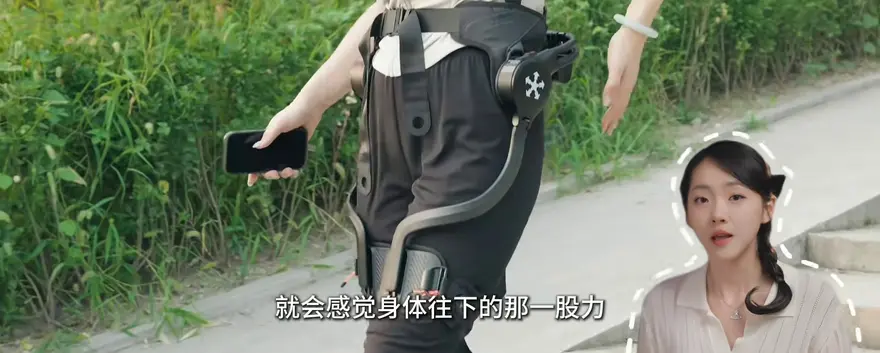

Downhill Mode: Don't Let Your Knees Act as the Sole "Brake Pads"
As the old saying goes, going up is easy, coming down is hard. Uphills tax your heart and lungs; downhills punish your knees—on a descent, the knee joints have to repeatedly absorb braking loads far greater than on flat ground, and that's exactly how many veteran hikers have wrecked their knees.
After switching to downhill mode, you can see the lumbar support at the back of the waist perform a subtle sinking motion, and the sensation of support becomes noticeably more pronounced. As you step down, the force of your body dropping no longer presses entirely on your knees and legs—part of it gets dispersed through the lumbar area, and the whole leg feels distinctly lighter.
"Going up is easy, coming down is hard... On the way down, your knees really take a beating." — The blogger's own words
Here, I want to seriously engage with one viewpoint: "Any exoskeleton that can't share the load of gravity and ease the strain on your knees is a fake exoskeleton." It sounds harsh, but it cuts straight to the essence of this product category: an exoskeleton cannot eliminate gravity. What it can do is redistribute the burden of joint torque—shifting part of the "braking" work from the knees to the hip joints and the lumbar support. And "easing the strain on the knees" is precisely the bullseye of the hip-assist approach. Based on how it felt this time, the direction is right; that said, exactly how much load is actually offloaded still needs to be proven with quantifiable biomechanical data—and that's my expectation for the industry as a whole.



Cranking Up the Intensity for Auntie: Carrying Oil Up the Stairs One-Handed
With the scenario tests done, it was time to hand the device over to the real "target users"—the elders at home.
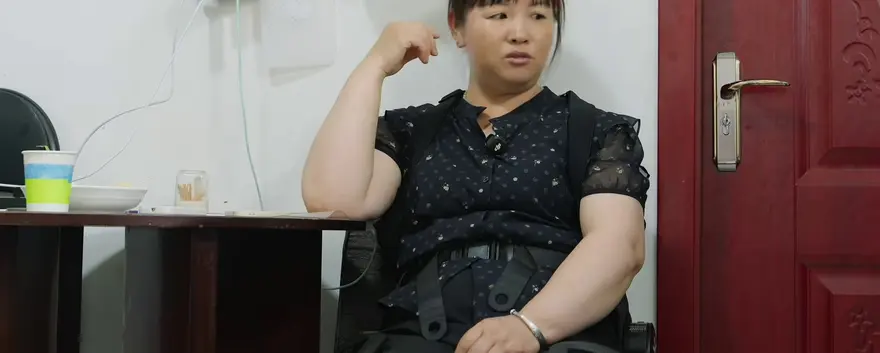
First, donning. After being walked through the full process just once, Auntie put it on by herself—and the timer read a surprising 42 seconds, faster than the young folks. Impressive, Auntie. In her own words: "I feel like this machine isn't hard to put on. You showed me once and I got it on." At least for seniors whose hand mobility and day-to-day movement are still fairly normal, donning it independently isn't complicated.
Auntie's independent donning time: 42 seconds (measured on video)
One unexpected finding came from a static scenario: Auntie usually sits on a soft stool, and her lower back goes numb after a while. This time, sitting with the exoskeleton on, her back didn't stiffen up at all—the lumbar support does its job while seated too. For seniors who sit for long stretches, this could be an underrated bonus.
Then we went straight to hard mode: Auntie carried fairly heavy bottles of cooking oil and drinks up the stairs one-handed. With the walking assist on, climbing the stairs was effortless. Her take was refreshingly honest: "I'd never have dared to carry it like this before. Couldn't do it—how could I possibly? This time on the way back, I hauled two jugs up in one hand."

The Moment an 80-Year-Old Grandpa Walked Up the Stairs, Applause Broke Out
At Chengtian Technology's booth at the 2026 WRC, I saw demo users of all ages and physical conditions.
There were young people who were simply there out of curiosity, strapping one on right away to find out "what hiking uphill actually feels like." One user's feedback was pretty representative: "Going up, I didn't feel much at first, but after a few more steps it got noticeably easier. When coming down, there's a force behind you that holds you back a little.I would definitely use this when I go hiking—hiking is exhausting for me, so this would make it so much easier."
What moved me even more, though, were the elderly visitors in their 80s—some on canes, some in wheelchairs—who had come to the booth specifically for this.
One grandpa who could barely walk and could no longer climb the stairs at home—his family told us, "We used to live on the 6th floor and he couldn't get up anymore, so we eventually moved to the 1st floor"—put on an exoskeleton with help from the staff, walked up the steps one at a time, and then made it successfully back down. At that moment, people in the crowd genuinely couldn't help but applaud. A grandma who arrived in a wheelchair put one on as well, and afterward she walked, and went up and down the stairs, fairly smoothly. She said her lower back has always given her trouble, but with this on, she "dares to go upstairs again"—and she seemed visibly more at ease.
"Seeing this, I finally truly understood what it means when people say technology changes lives."—the vlogger's own words
Of course, a sober caveat is in order: this is a consumer-grade walking-assist exoskeleton, not a medical-grade rehabilitation exoskeleton. It cannot replace medical treatment or rehabilitation training. The on-site demos also had staff assisting nearby, and there's still some way to go before elderly users can operate it fully independently in daily life. But it proves at least one thing: for seniors whose mobility is starting to falter, "walking up the stairs again" is no longer science fiction.

Consumer-Grade Exoskeletons in 2026: How Far Have They Come?
After a full round of hands-on experience, plus feedback from friends around me, my read is this: consumer-grade exoskeletons are genuinely starting to enter different people's everyday lives — hiking and trekking for the young, stair climbing and casual strolls for the elderly, grocery runs and heavy lifting for daily errands. Every scenario has found its own reason to exist.
From an industry perspective, this space is clearly heating up: from the show floor at this year's WRC to the sector as a whole, players are already lining up — specialized manufacturers like Chengtian, Kenqing, Aosha, and Yuanye; consumer-grade brands like Hypershell and Dnsys; and cross-industry giants like Toread and Haier. The category is moving from "trade-show spectacle" to "shelf-ready product," and the competition is only just beginning.
Looking a step further ahead: if exoskeletons become more widespread, maybe one day you'll be able to rent one at a scenic spot the way you rent a trekking pole today; older family members could slip one on before heading out for a walk without ever feeling like they're wearing some sci-fi gadget. I believe that day isn't far off.
September 3–5, China National Convention Center, Beijing — Chengtian Technology will be exhibiting at the 2026 China International Assistive Devices Expo, where you can try this exoskeleton in person (as mentioned in the video).
One last question to leave you with: if you owned an exoskeleton, what would you most want to use it for? Tell me in the comments.

Top Community Comments
@Yizhaoxingchen (133 likes):
This is great! If the price is right, buying one for my elderly parents would be absolutely perfect!
Our take: This highly upvoted comment pretty much captures the broadest common denominator of demand for consumer-grade exoskeletons — "buy one for the elderly." But that "if the price is right" caveat also lays the barrier bare: filial-piety spending only happens when the price falls within a range where adult children can hit "buy" without a second thought. Price will be the first gate this product category has to clear on its way from the expo booth to the living room.
@Honglangwoshuaideyaomingzhende (78 likes):
After I get the exoskeleton...
Our take: An unfinished half-sentence that still pulled in 78 likes — everyone is waiting for the rest of the story. It reflects viewers' curiosity about the long-term, real-world experience "after you take it home": is it tiring to wear for a full day straight, does the battery life hold up, how often does it break down? None of these are questions a trade-show demo can answer — and they're exactly the direction most worth a follow-up video.
@Jianghemuying (50 likes):
Any exoskeleton that doesn't offload gravity and ease the strain on your knees is a fake.
Our take: The most "hardcore" debate over standards in the comment section, and it captures the skepticism of core enthusiasts: an exoskeleton is not a toy — it has to genuinely unload the joints. Strictly speaking, what a hip-assist design provides isn't an offloading of "gravity" itself, but assistive and braking torque at the hip and knee joints — yet in terms of intent, "easing the strain on the knees" is precisely the bullseye it aims at. This comment is also a reminder to manufacturers: beyond marketing talk, quantifiable biomechanical data is the key to winning over this group of users.
Beyond the comments section, the words of several everyday users in the video are just as worth factoring into a purchase decision:
Auntie:
I feel like this machine is easy to put on — you showed me once and I got it on myself.
Our take: Whether seniors can put it on independently is the invisible threshold for walking-assist exoskeletons entering the home — and a 42-second donning time shows that threshold isn't a high one.
Auntie:
I'd never have dared to carry things like this before. Couldn't carry them — how could I ever carry them like this?
Our take: Lugging heavy groceries home is the most mundane and most frequent scenario there is, and that "I never dared before" says more about the real value of the assist than any spec ever could.
Grandpa's family member:
We used to live on the 6th floor, but he couldn't make it up, so we eventually moved to the 1st floor.
Our take: Stairs are the last barrier in an elderly person's life at home, and moving house over a single staircase is a very real choice for many Chinese families. This long-unmet need is exactly what exoskeletons are aiming at.
On-site attendee:
When you're coming down, there's a force behind you holding you back... I'll definitely use it when I go hiking.
Our take: From "that's something new" to "I'd actually buy one to use," the felt sensation of downhill cushioning is the key touchpoint that turns curiosity into willingness to pay — and outdoor hiking will most likely be the first commercial scenario where consumer-grade exoskeletons prove out their business case.
One-Sentence Summary
The Chengtian GoGo HPRO is a hip-assist consumer-grade exoskeleton that brings the "suit-up" threshold down to the 40-second class: it won't turn you into Iron Man, but it genuinely saves you real effort on everyday movements like climbing hills, descending slopes, and hauling heavy loads upstairs. It's a solid pick for outdoor enthusiasts who hike and trek year-round, families with stairs whose elderly members are starting to struggle with mobility, and early adopters eager to get their hands on the "cyber cheat code" future right now.
About this article: part of Chinese-Made Exoskeleton Review Archive — an independent, regularly updated English archive of reviews of consumer exoskeletons made in China, edited from publicly available video transcripts. Not an official manufacturer page.
For inquiries and purchasing, contact lonlonago@foxmail.com. More in Reviews · All articles.