More Than Just Looking Cool: How This Hardcore Mechanical Exoskeleton Nails "Load Transfer"?
If you're following the consumer-grade exoskeleton space, you've likely noticed a subtle "divergence" within this category over the past two years. On one side, brands like Hypershell, Dnsys, and Yuanye are polishing their products toward "daily usability" in the hiking assist and load assist tracks. On the other side, there are always teams willing to take a more rugged approach—integrating the exoskeleton and a tactical vest into a single system, allowing the wearer not just to "walk with ease" but to mount heavy gear, effectively turning into a mobile firepower base.
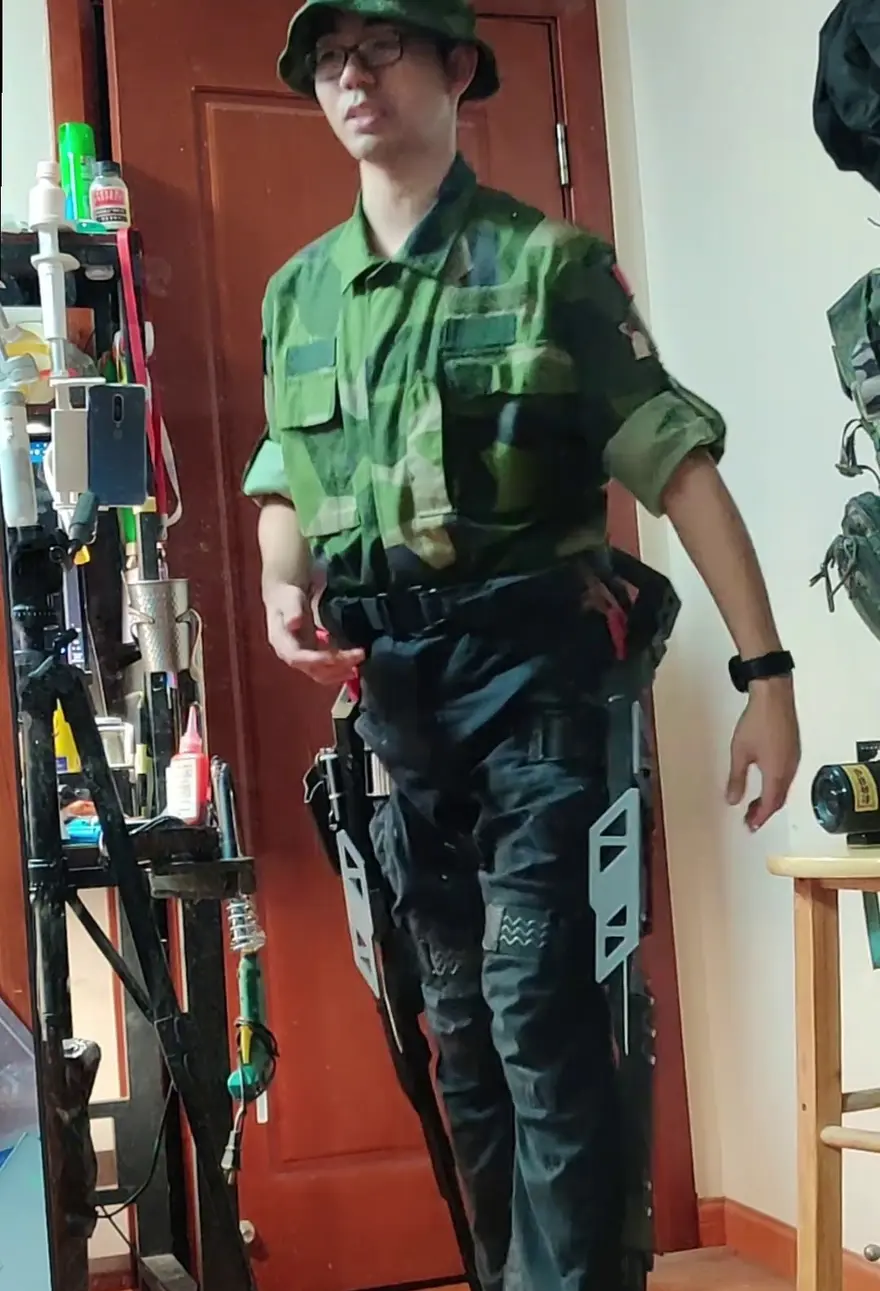
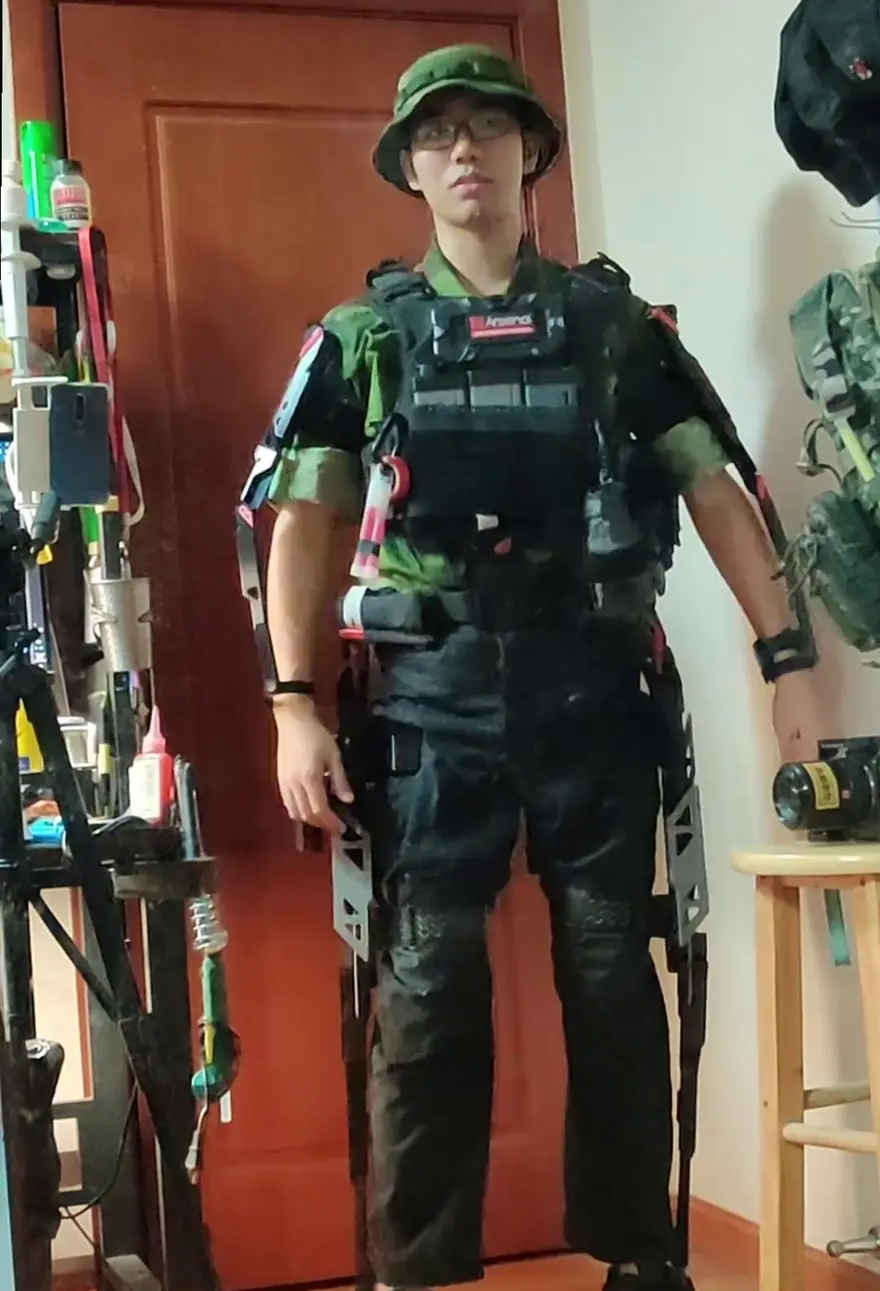
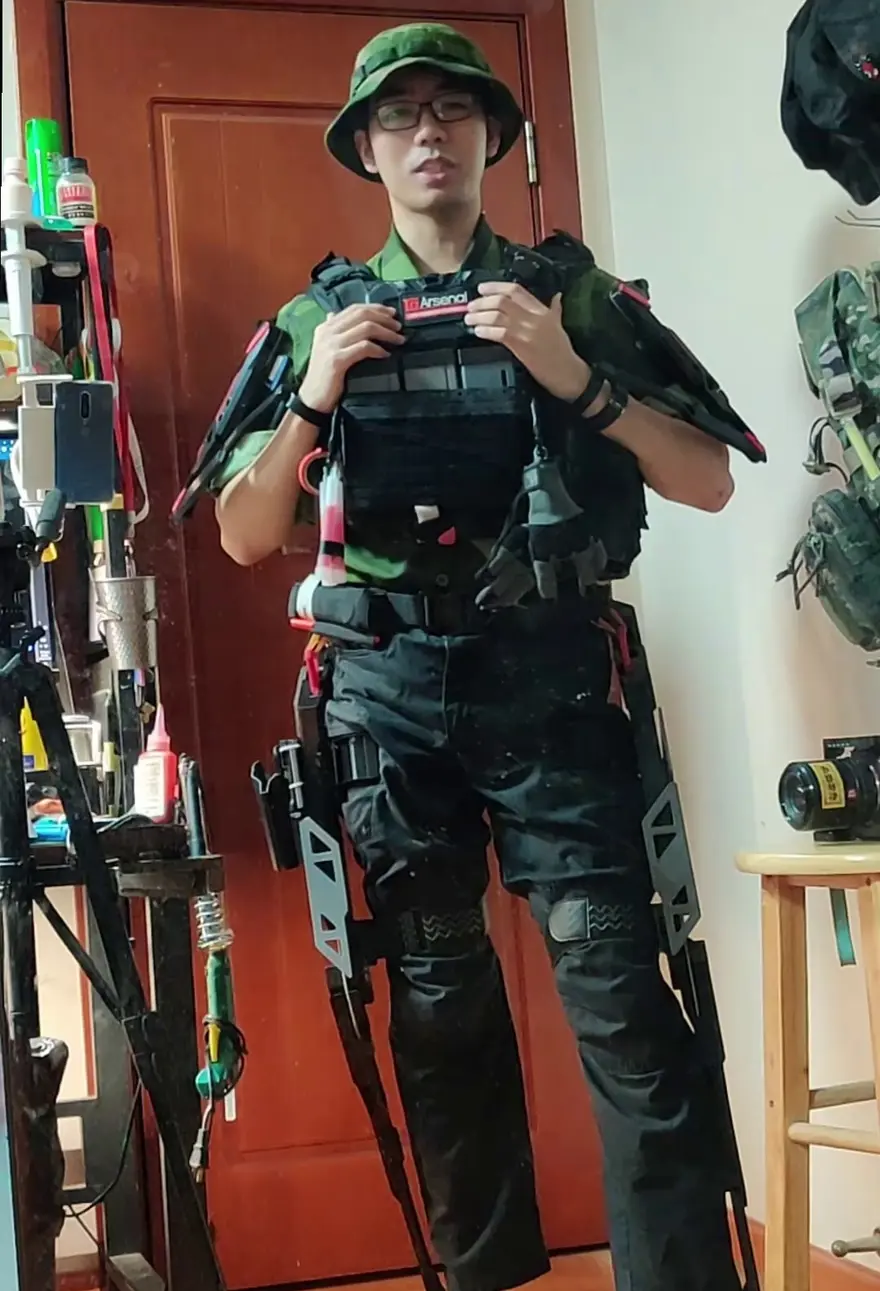
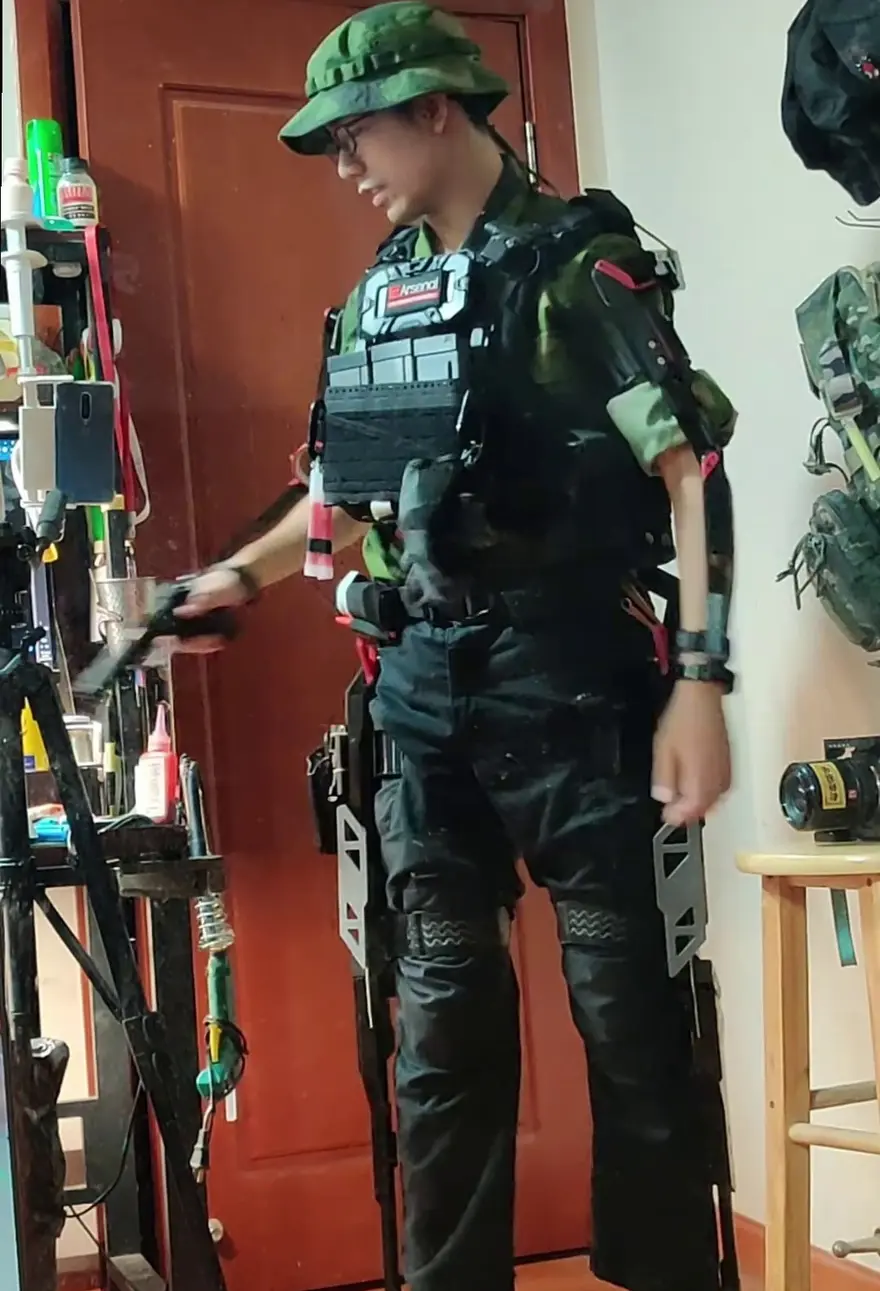
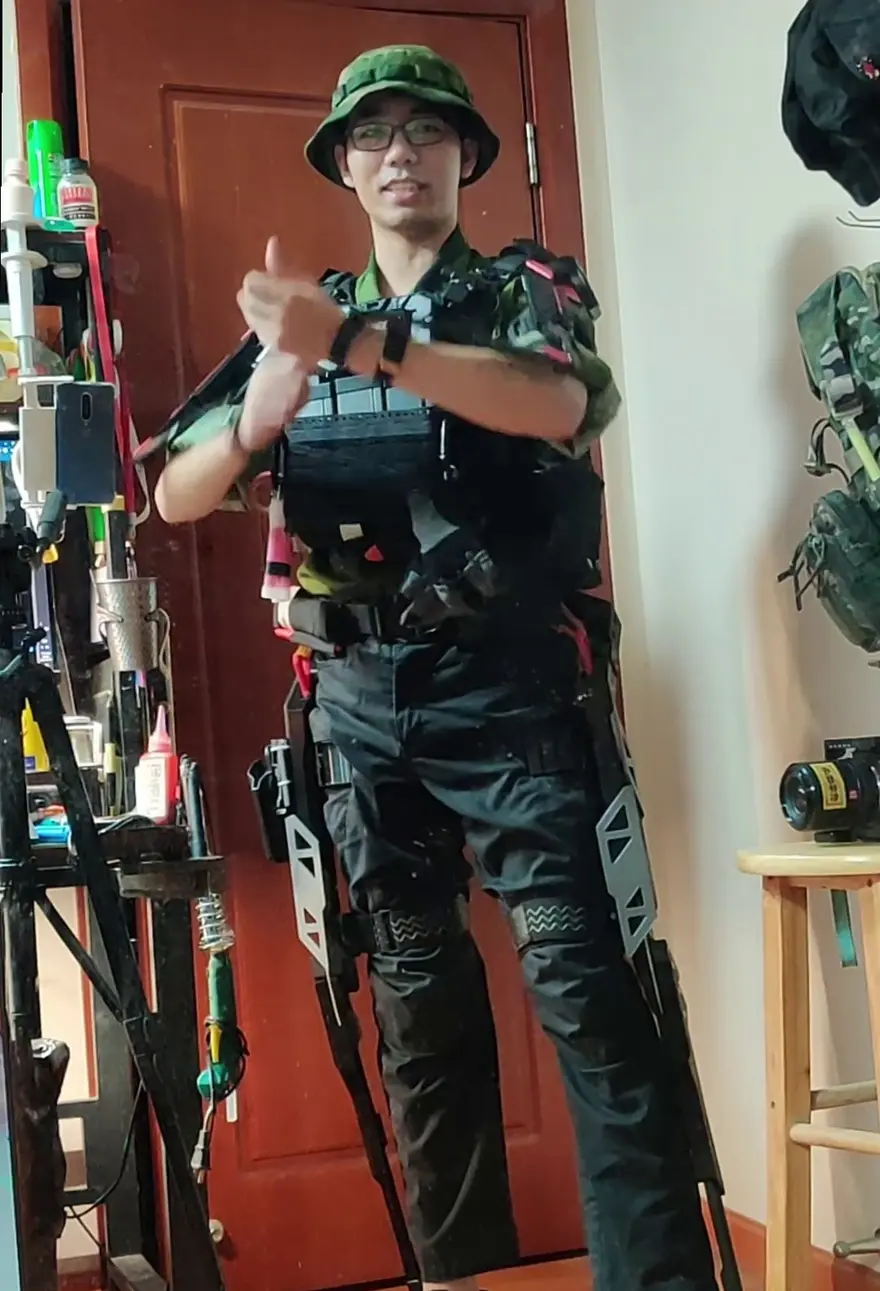
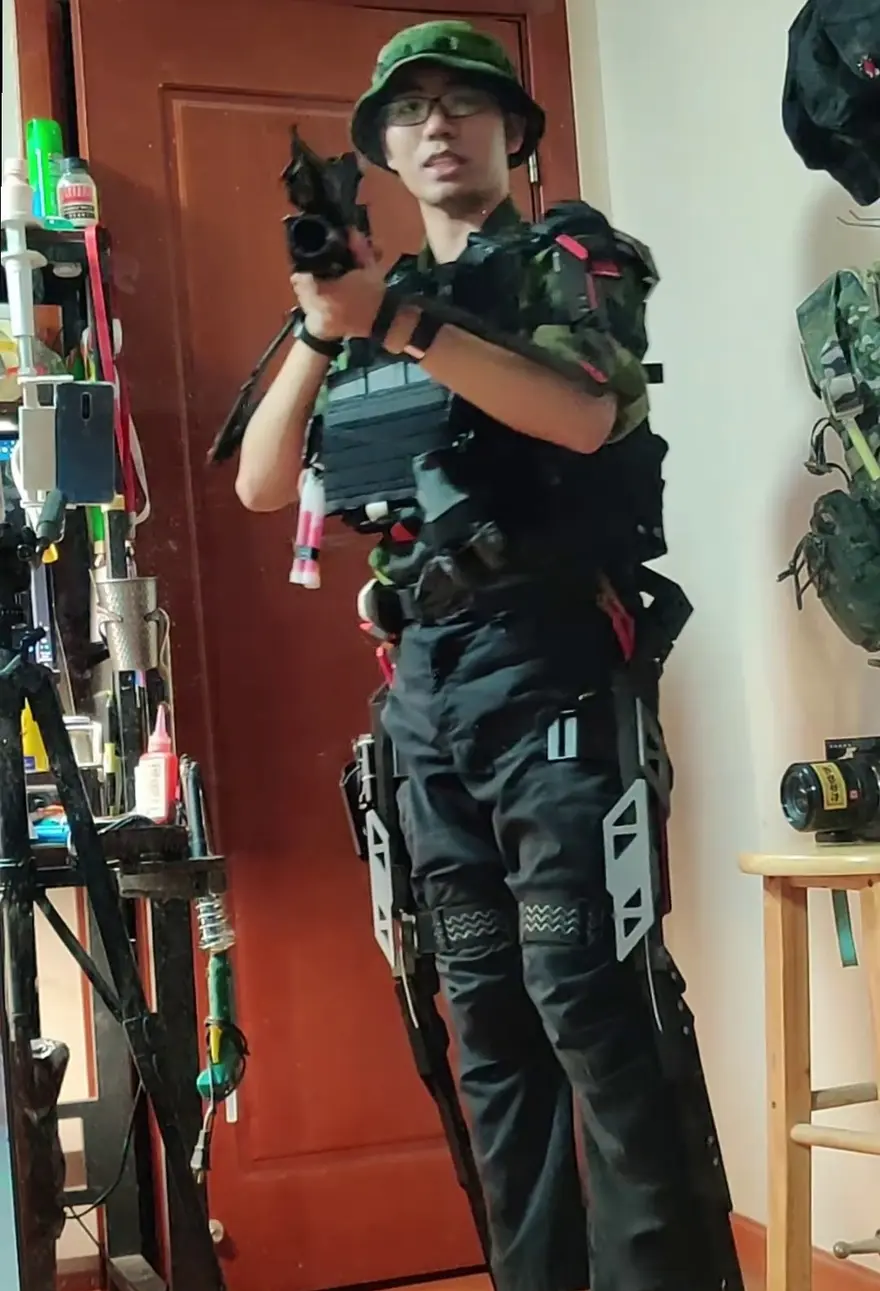
The video we're discussing today comes from a team creating a "fully 3D-printed, ground-contacting, and attachable" tactical exoskeleton. Instead of throwing specs at us right away, the creator starts with "getting dressed," clearly demonstrating how a lower-limb exoskeleton, an upper-limb exoskeleton, and a tactical vest combine into one complete system. After watching, my biggest takeaway is: the appeal of a consumer-grade exoskeleton is never about "lifting your legs for you," but rather transferring the weight from your body to the mechanical structure.
1. Wearable Experience: Starting with the Waist Belt is the Right Way to Wear an exoskeleton
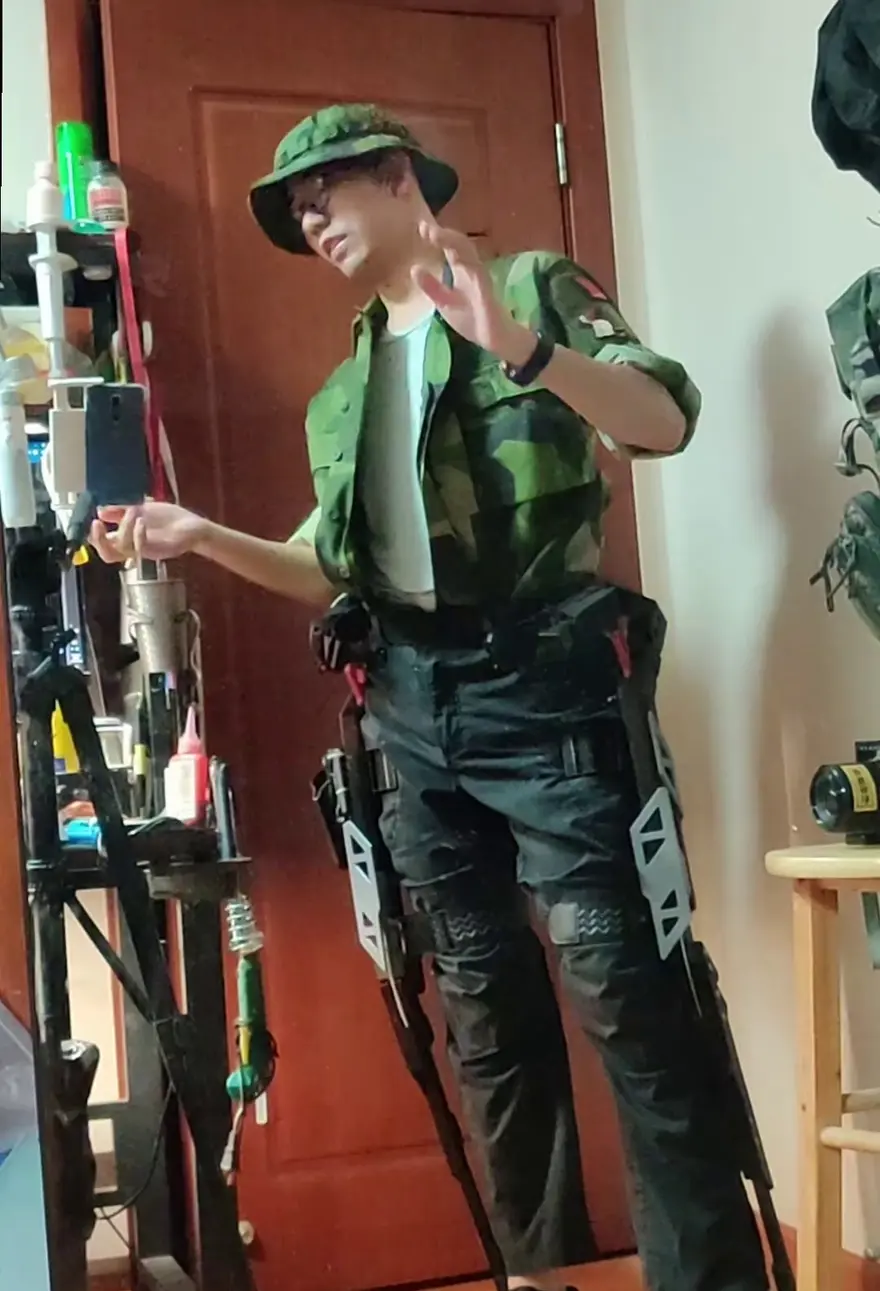
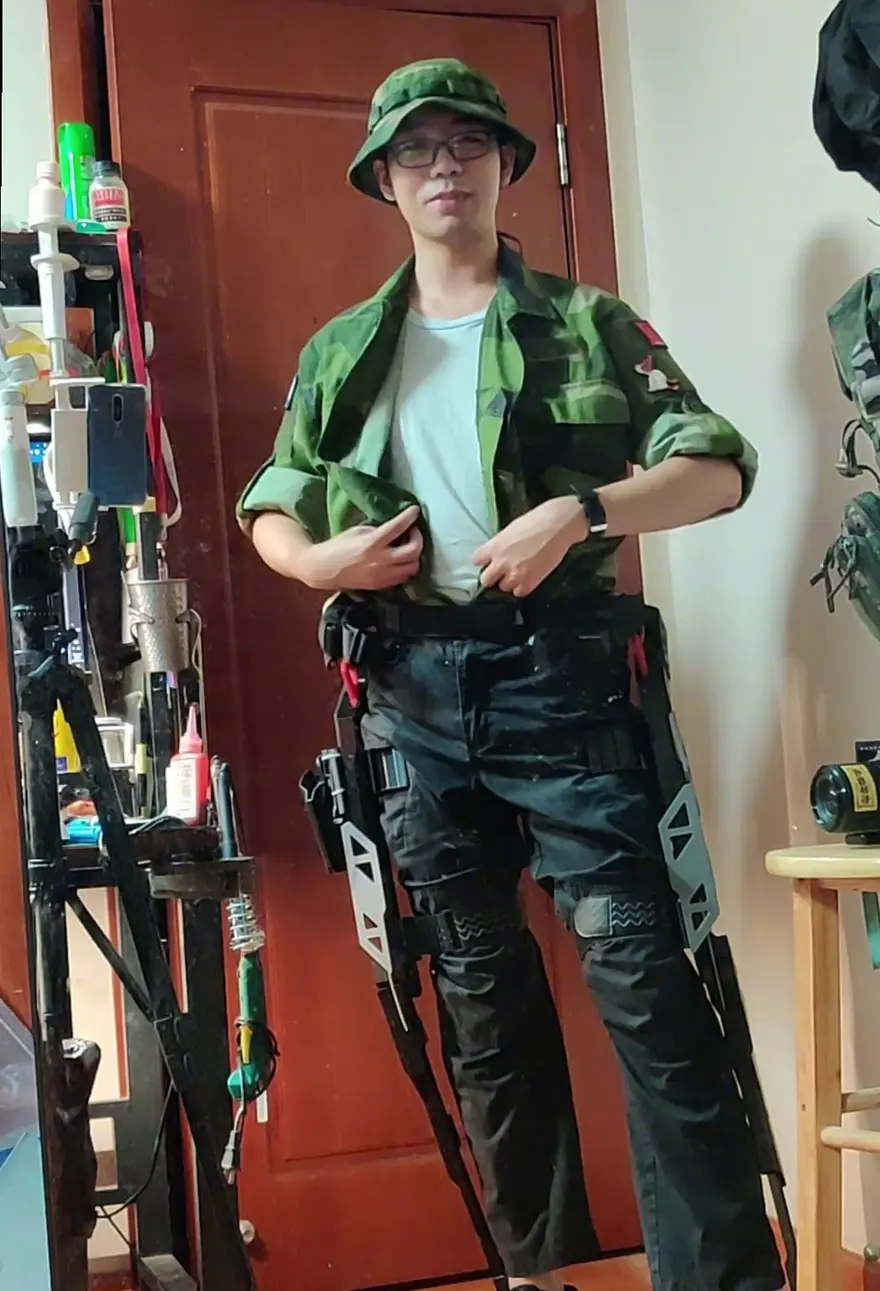
Many people still associate the lower-limb exoskeleton with straps everywhere and an experience of getting in and out that feels like an instrument of torture. What surprised me most about this system in the video is how it lowers the difficulty of putting it on and taking it off. Moreover, the logic of "borrowing force" from the exoskeleton begins right at the waist fixing belt.
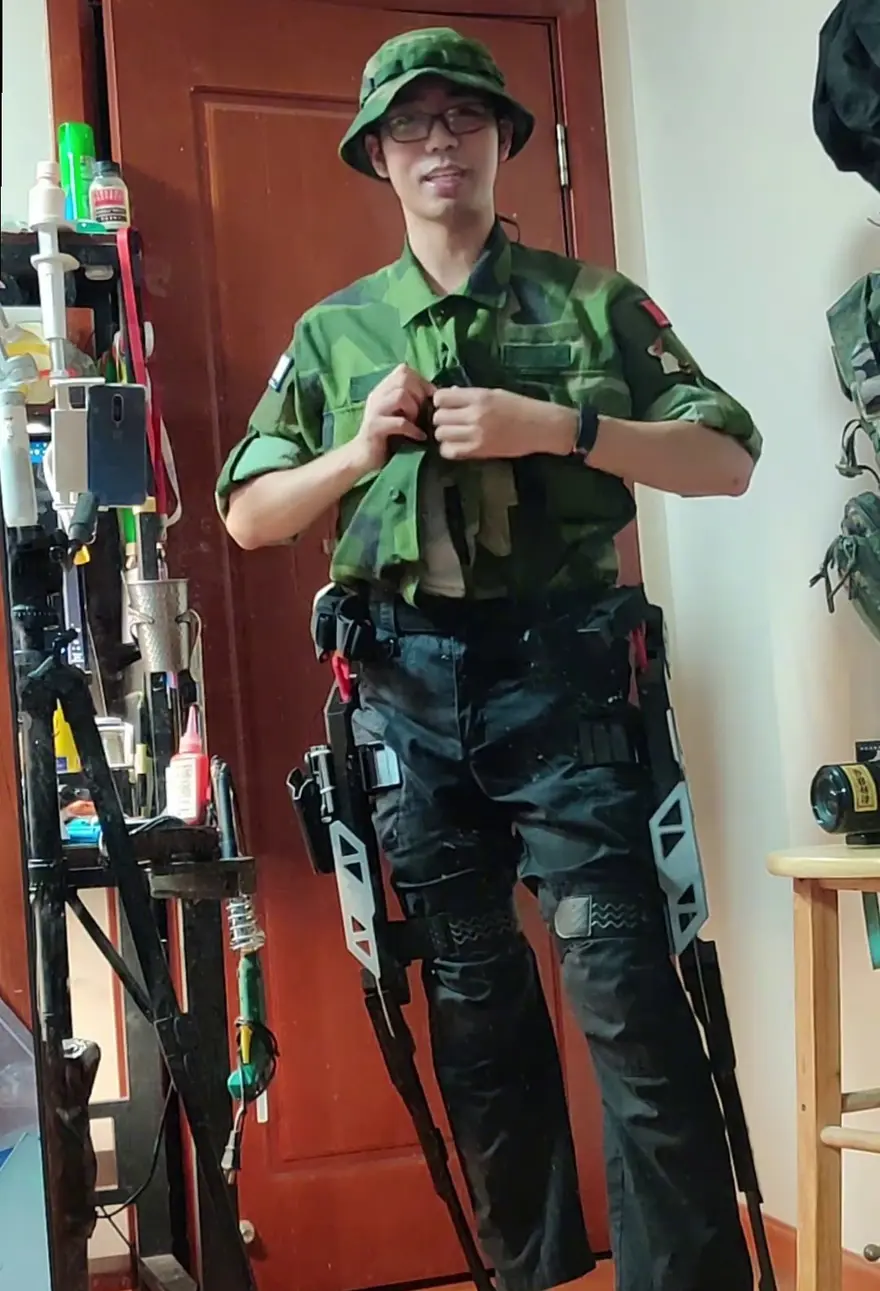
The creator wears a velcro waist belt with an inner fleece layer and an outer hook layer. Once fitted snugly, the entire lumbar region is securely locked.
The fixing logic for the lower-body exoskeleton is straightforward: first, secure the velcro structure of the waist belt all at once, then tackle the leg tubes. The entire process is efficient and unburdened.
The fit of the waist belt directly determines whether all subsequent loads can be stably transferred onto the exoskeleton. If the waist belt is fastened loosely, the weight mounted on the upper body will quickly press back onto your lumbar spine, rather than being distributed to the hard frame structure under your armpits and on both sides of your torso.
2. Strap Reduction on the Lower Limbs: The More They Subtract, the More Confidence the Structure Shows
Across the entire video, what I focused on most wasn’t “how many plates were hung on the upper body,” but the evolution of the lower-limb straps.
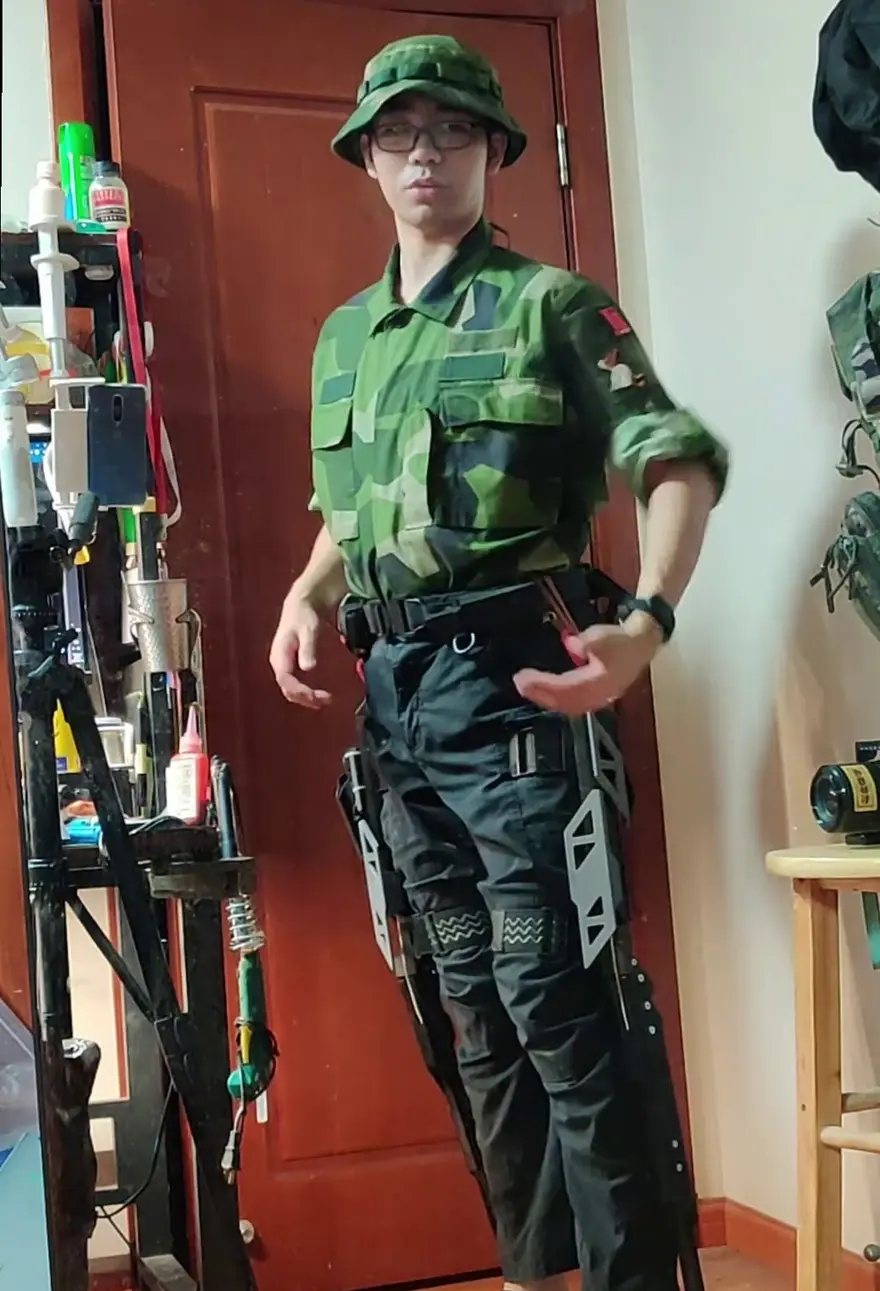
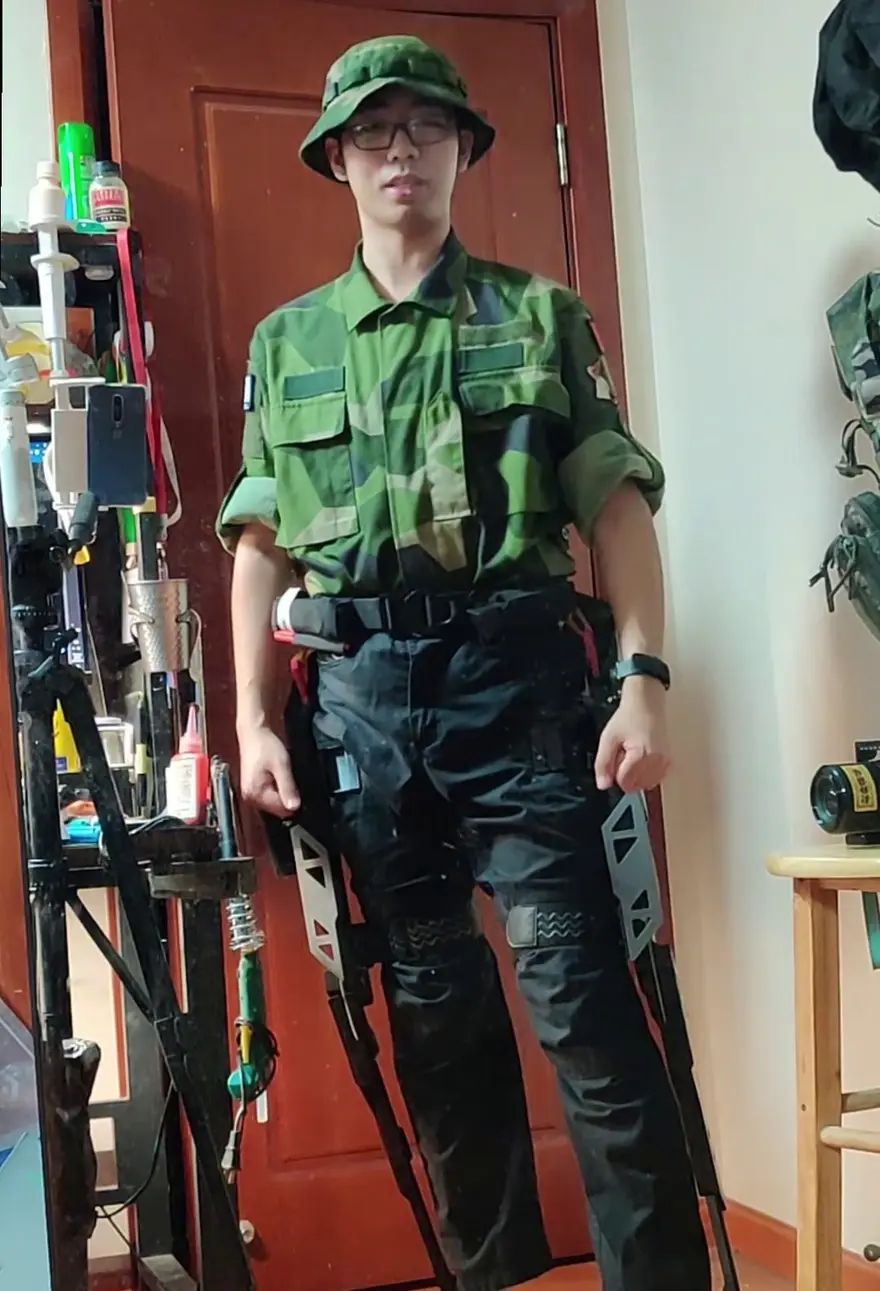
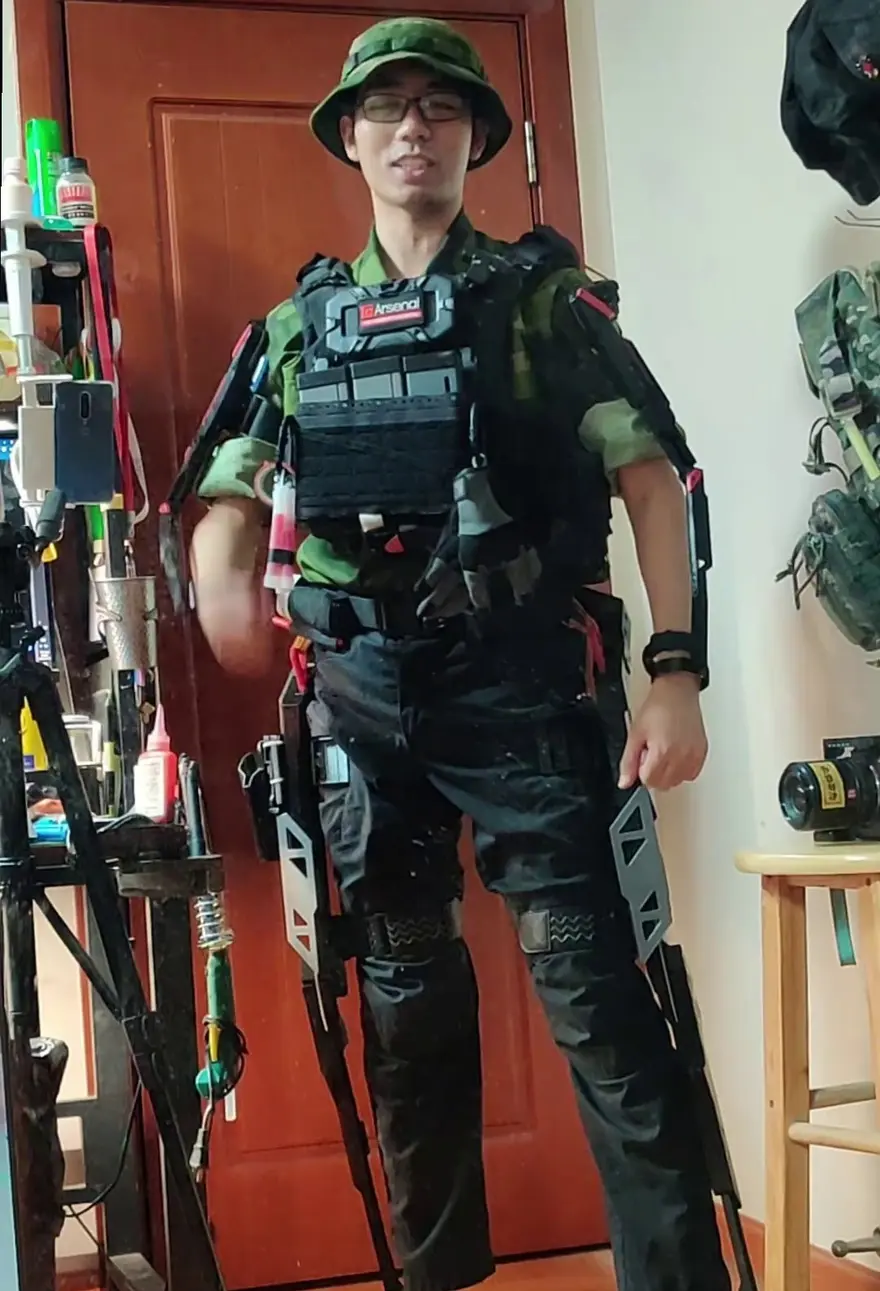
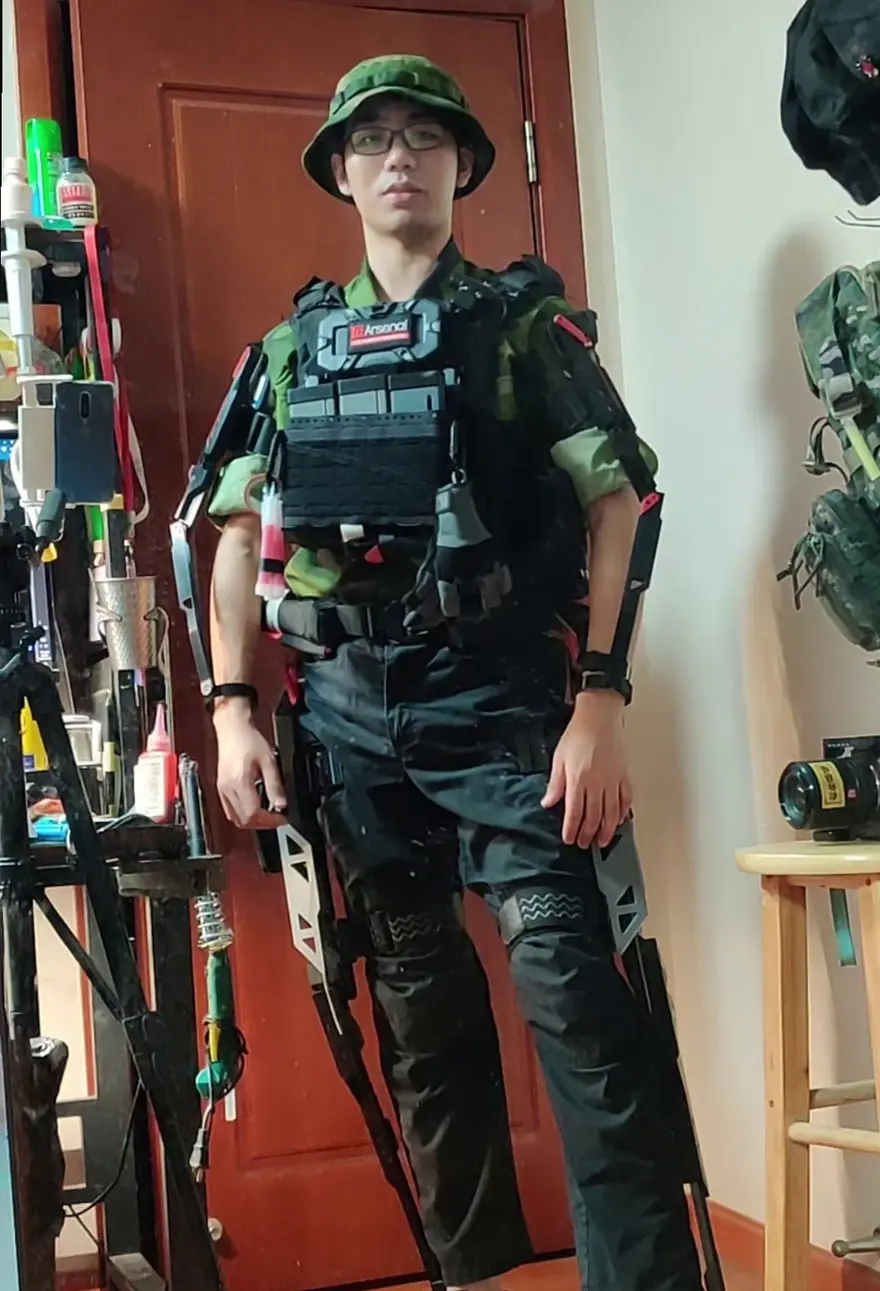
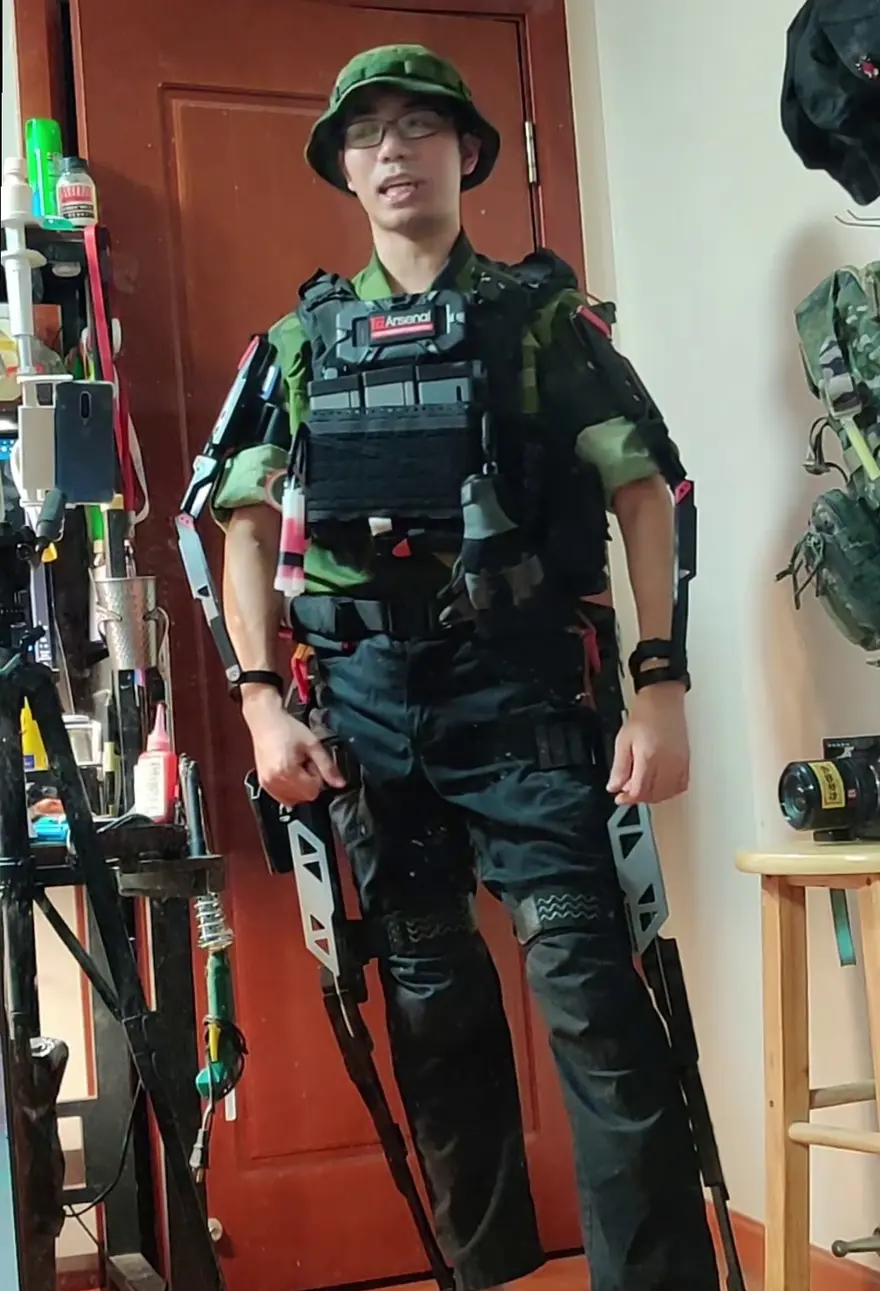
The creator admits that previous lower-limb exoskeleton designs had straps all over—one for the thigh, one for the knee, and one for the foot. This time, they’ve compressed the number of straps from three to two: one at the foot and one at the waist. The separate thigh and knee straps have been removed. That’s the clever part—he even adds:
“The thigh piece is still mounted there,” but he’s simply too lazy to remove it—it’s already useless, now purely resting on the rigid frame.
This means lower-limb fixation relies entirely on the elastic return system provided by the new structure. With fewer straps, you avoid tripping over them. For a system that’s meant to scale mountains, wade through seas, hold a rifle, or crawl on the ground, “staying out of the way” is a more critical engineering point than “helping to hold you up.”
3. Upper-Body Integration: Connecting Upper and Lower-Body Exoskeletons with a Single Quick-Release Buckle
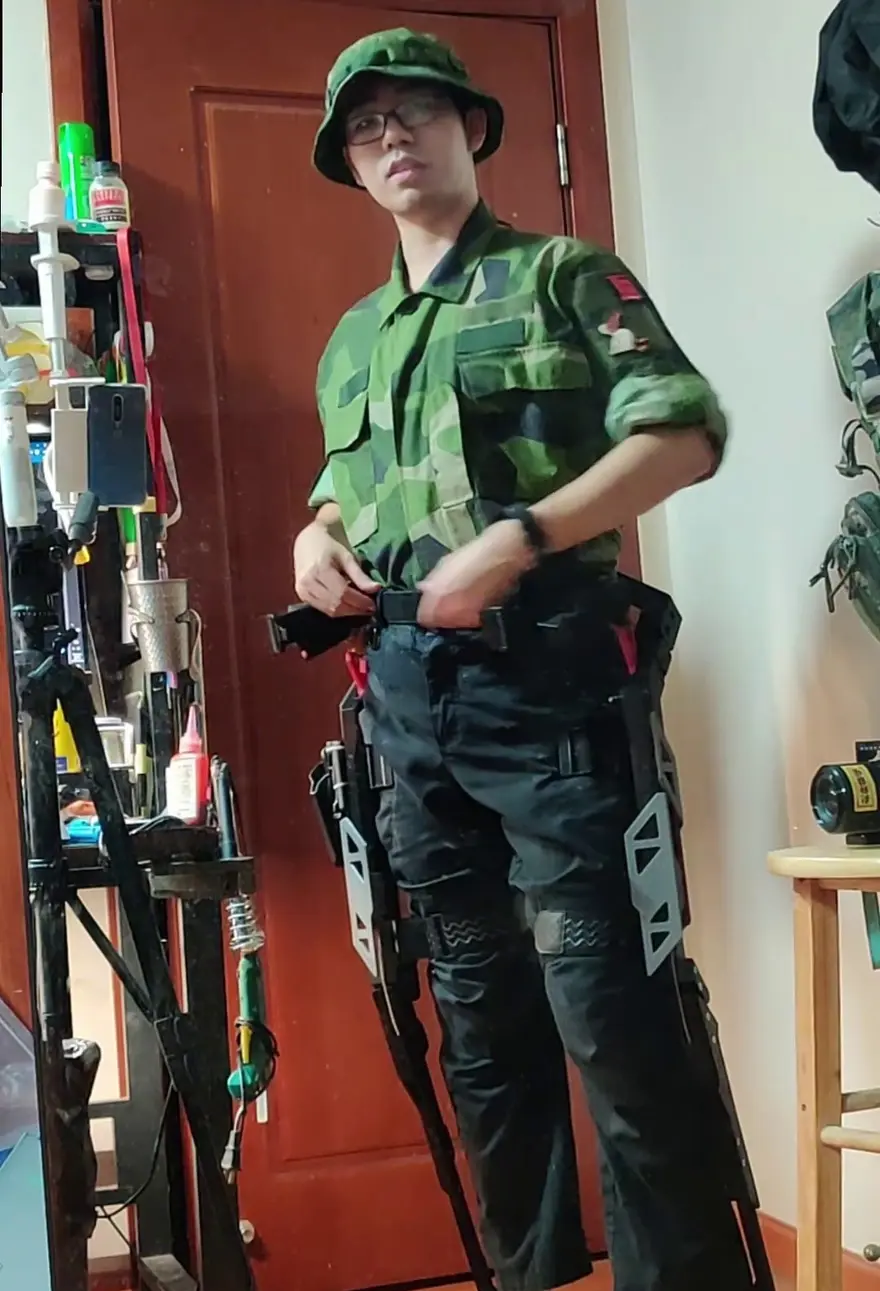
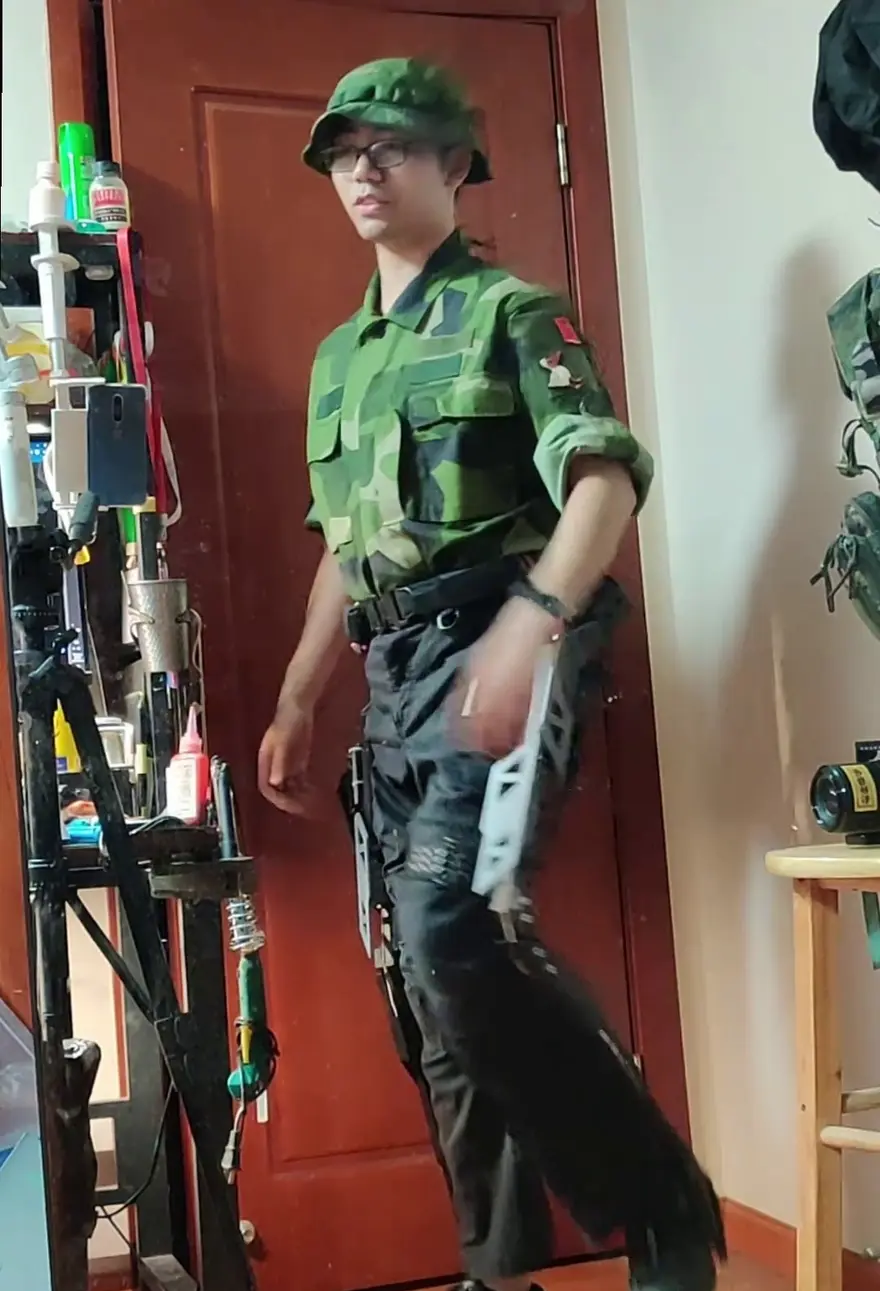
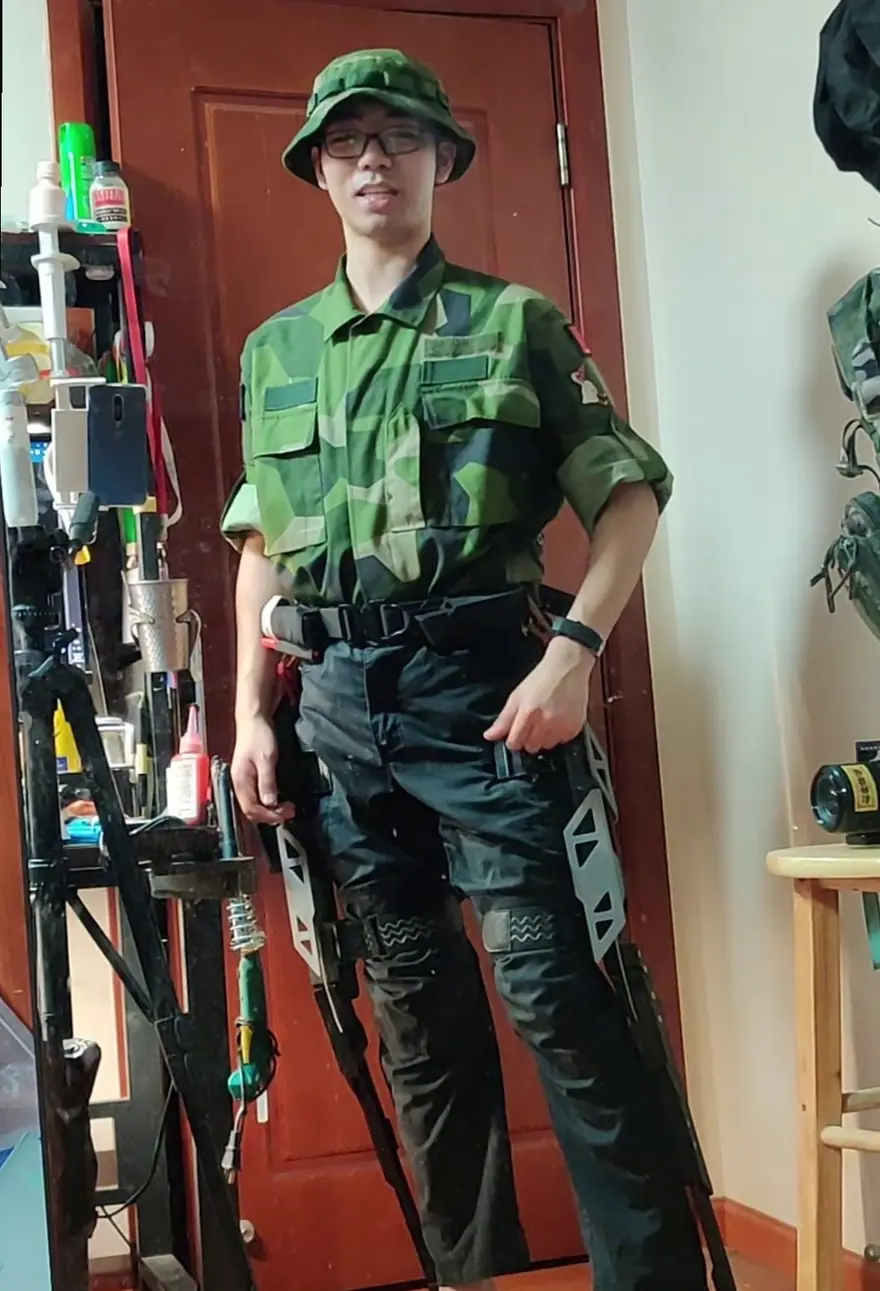
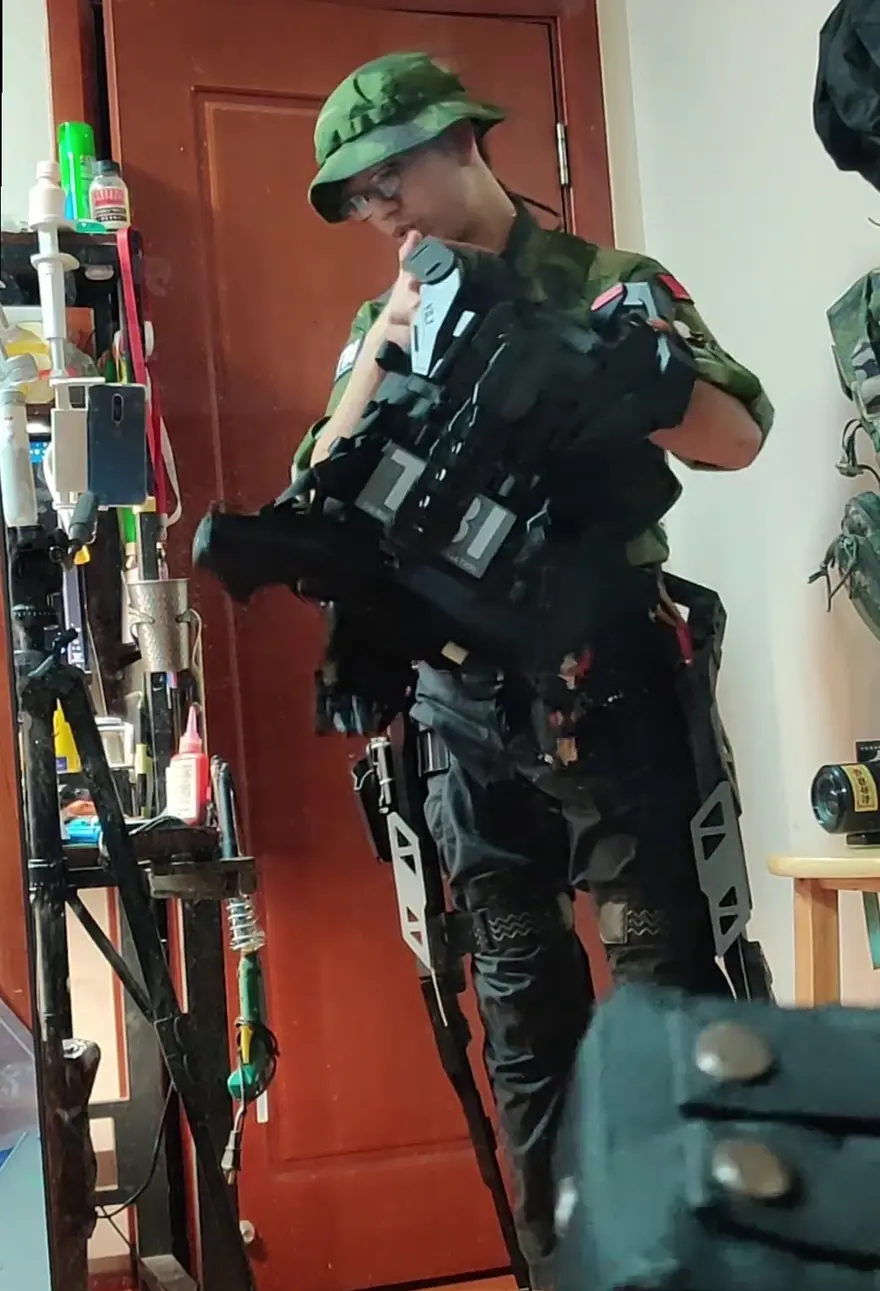
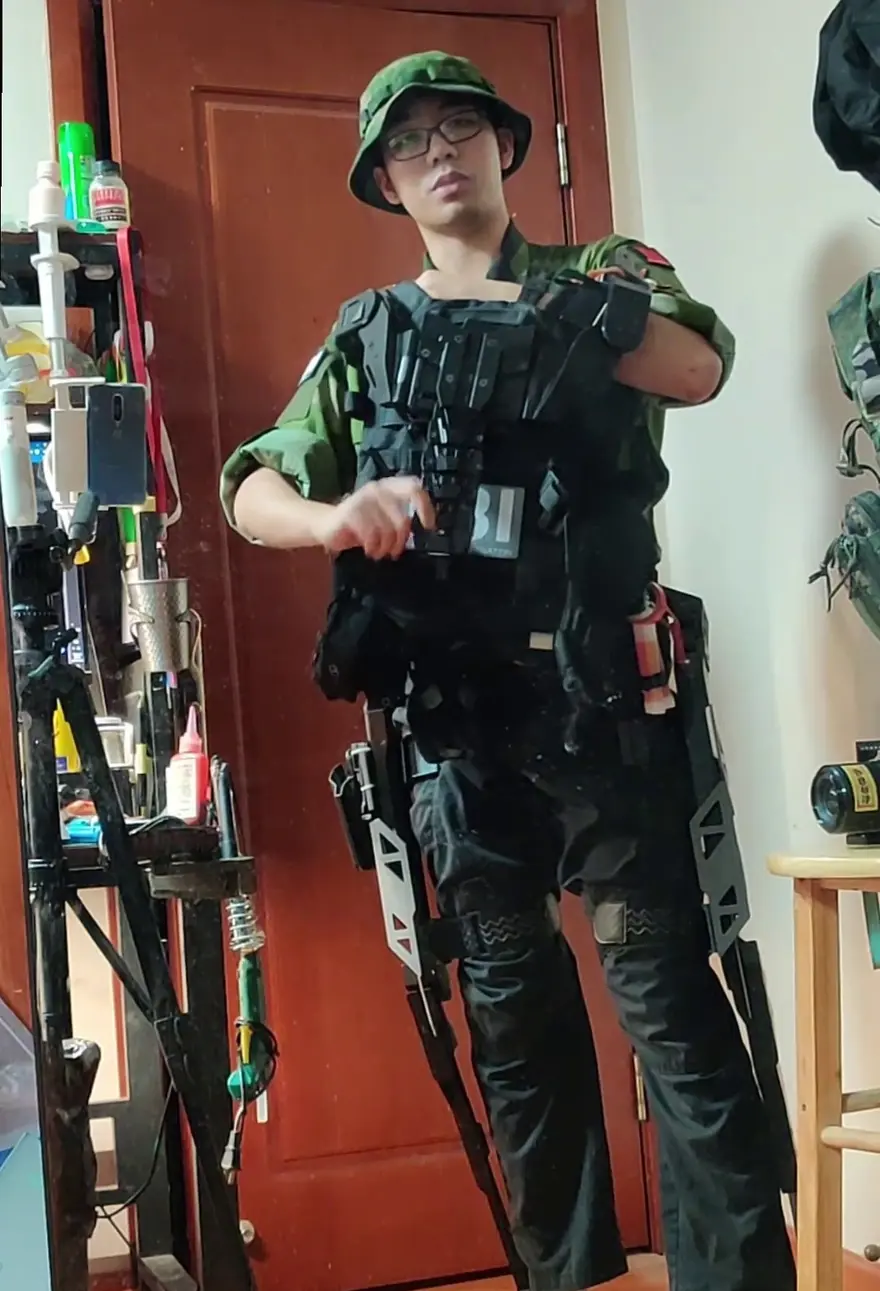
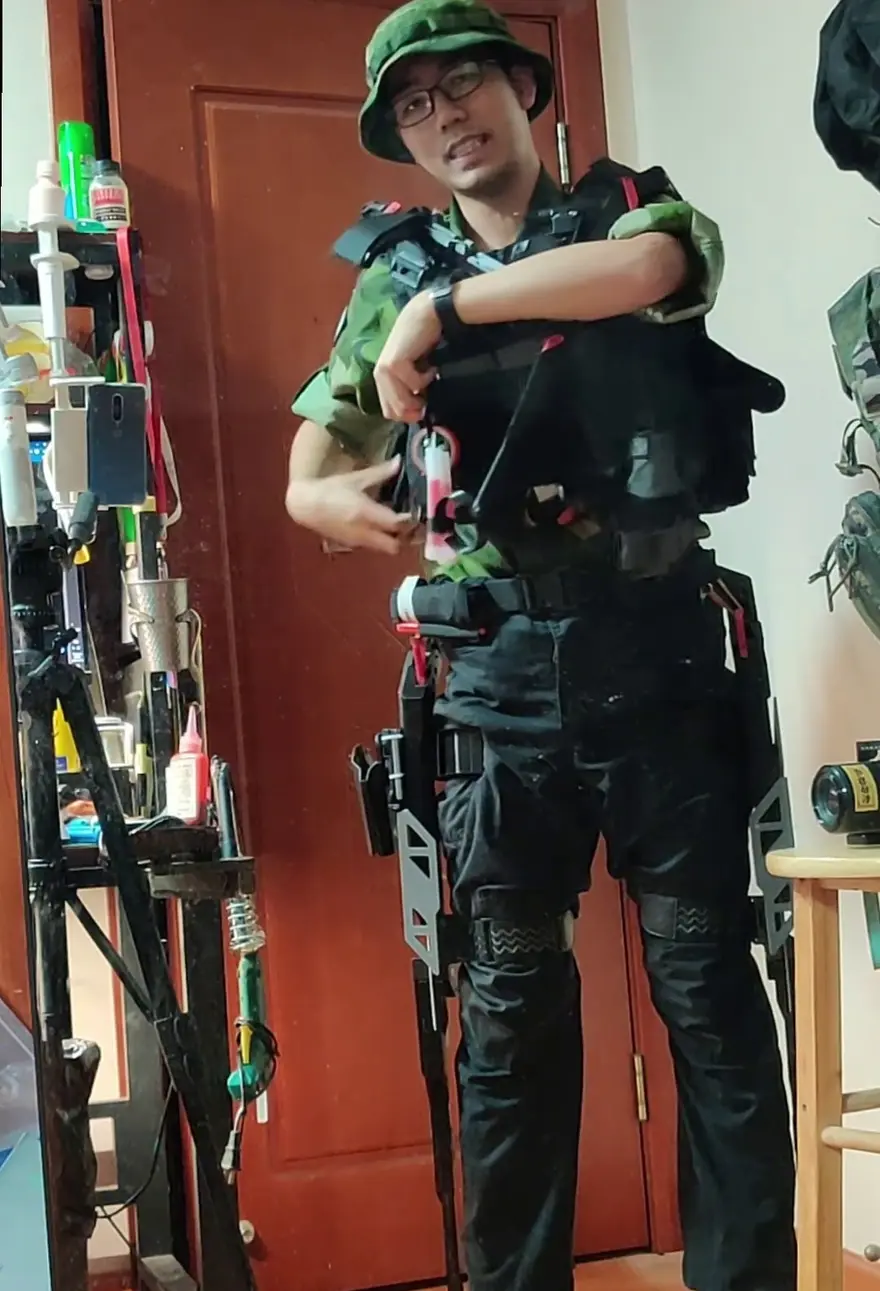
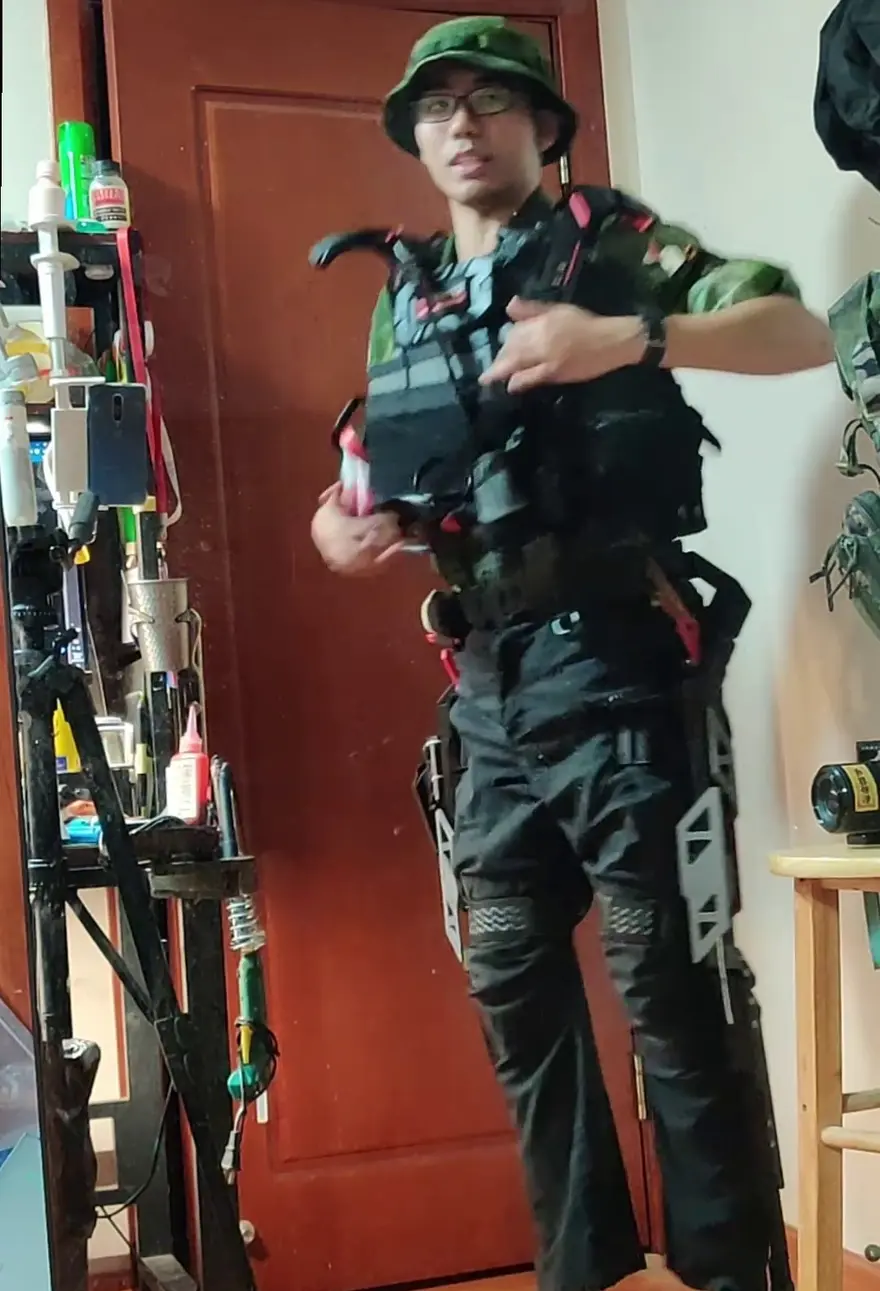
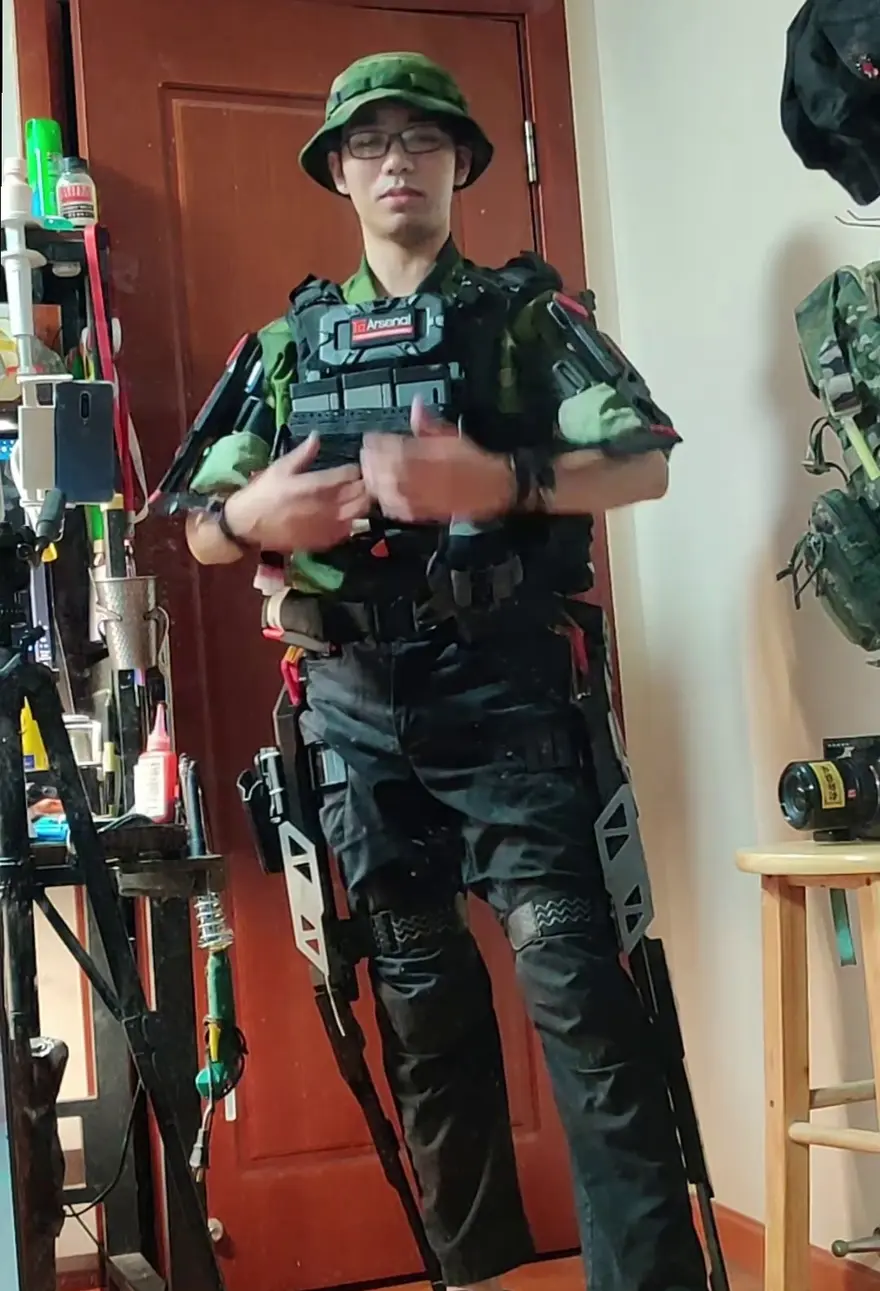
Fitting an exoskeleton to the legs is not difficult. The real challenge is integrating the full set of gear into a single fluid system. In the video, the solution here designs the "upper-limb exoskeleton" to be mounted onto a tactical vest form. The upper-body exoskeleton comes with a built-in connection mechanism, with a quick-release buckle attached at the bottom.
While this exoskeleton is an all-3D-printed prop, it is indeed grounded, and it can definitely bear a portion of your weight.
Step into the lower-limb exoskeleton → Snap on the connectors → Then clasp the upper-body exoskeleton to the waist connector. The full upper and lower exoskeleton structure is connected at the back via a quick-release buckle. This connection distinguishes it from a simple photography vest: it is not resting on the shoulders, but bearing the load.
Activity Performance: Posture Flex, Crossing Legs, One-Arm Push-ups—Go Big, but Wear Your Watch Inside
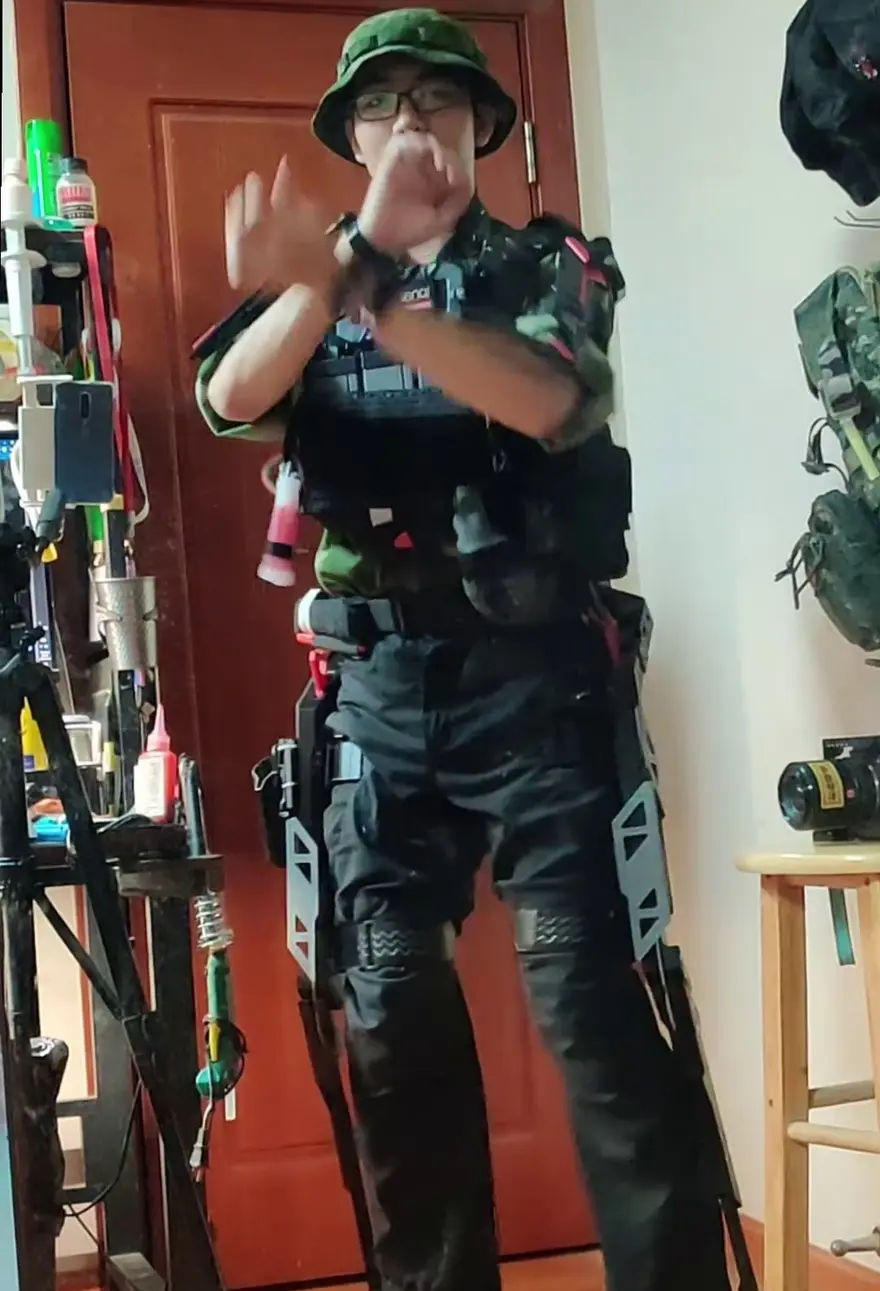
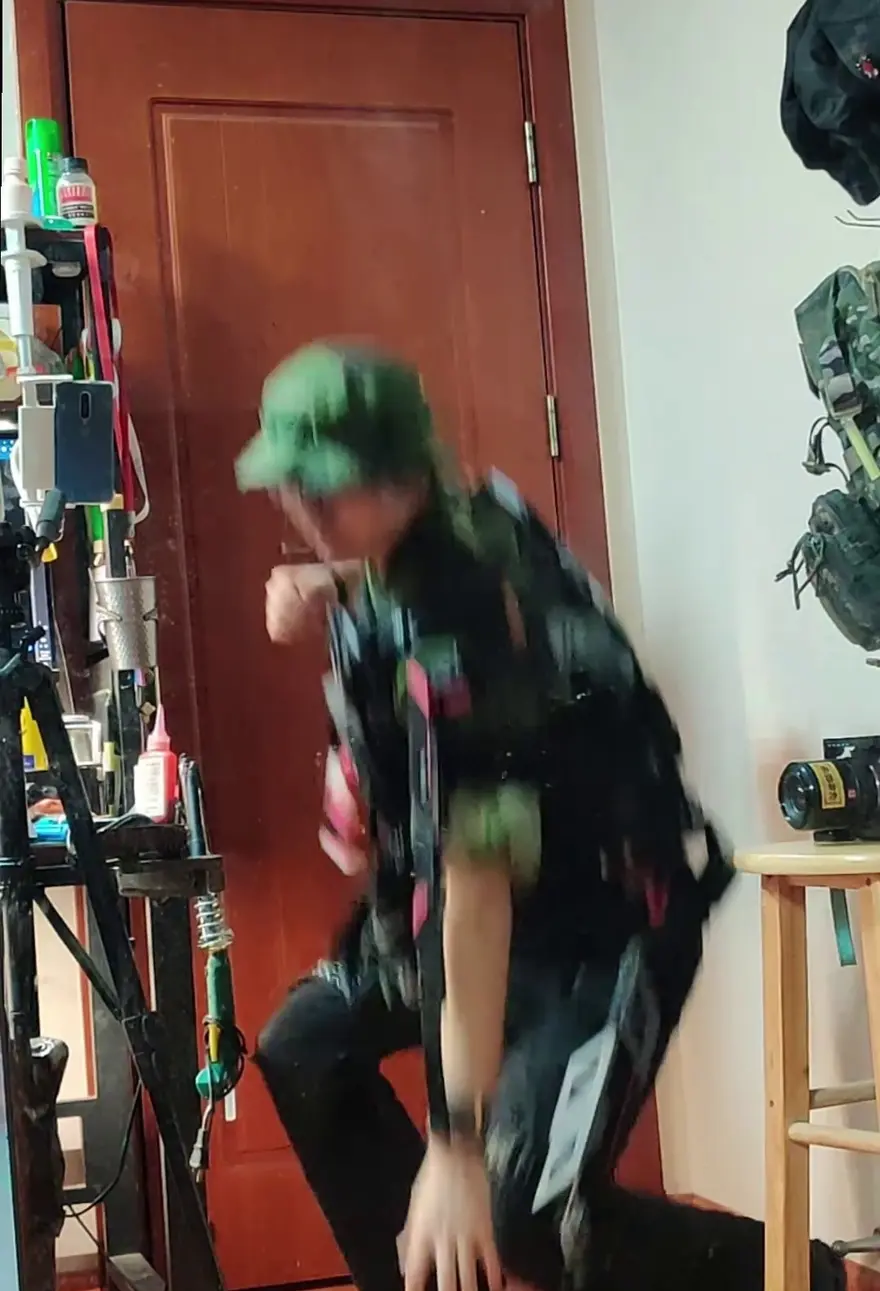
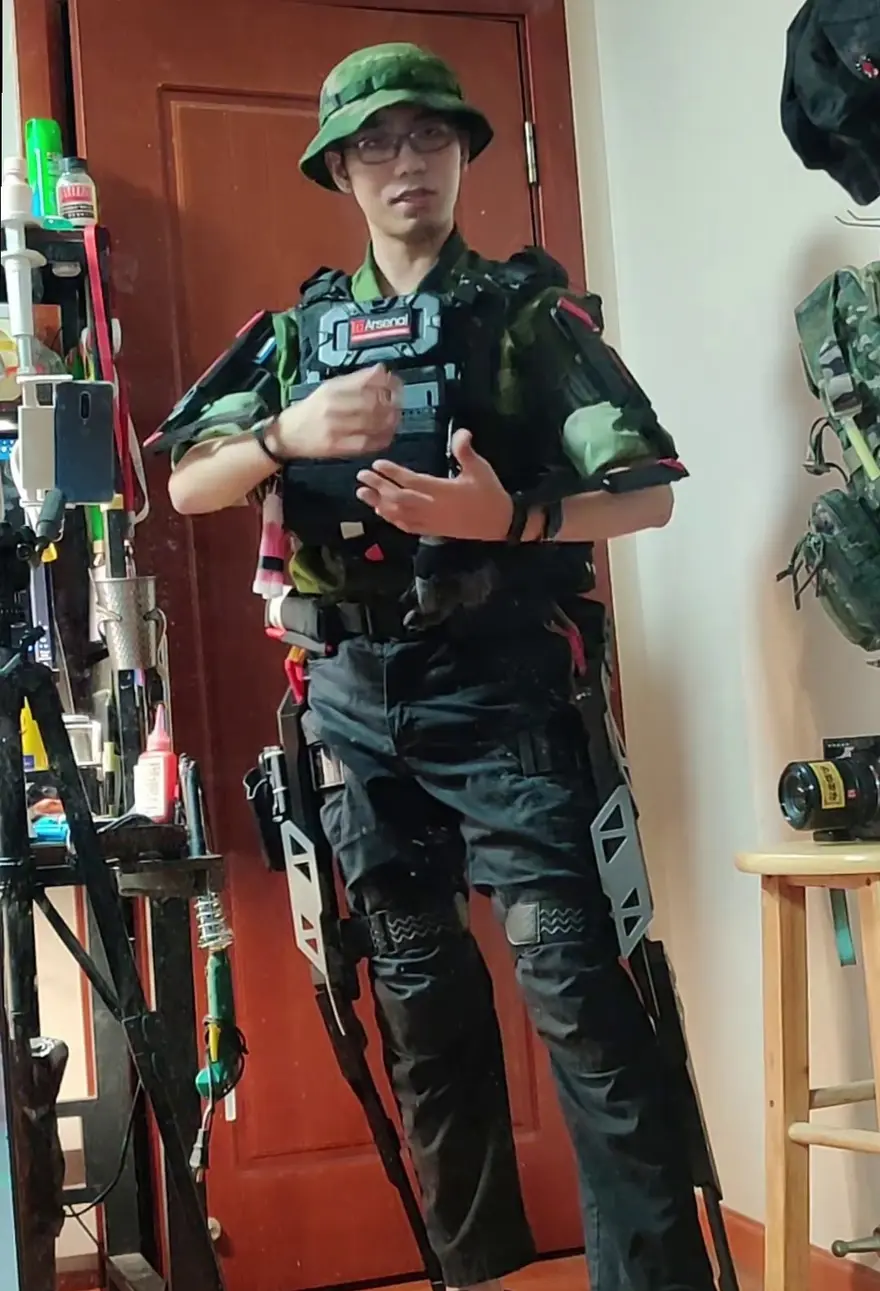
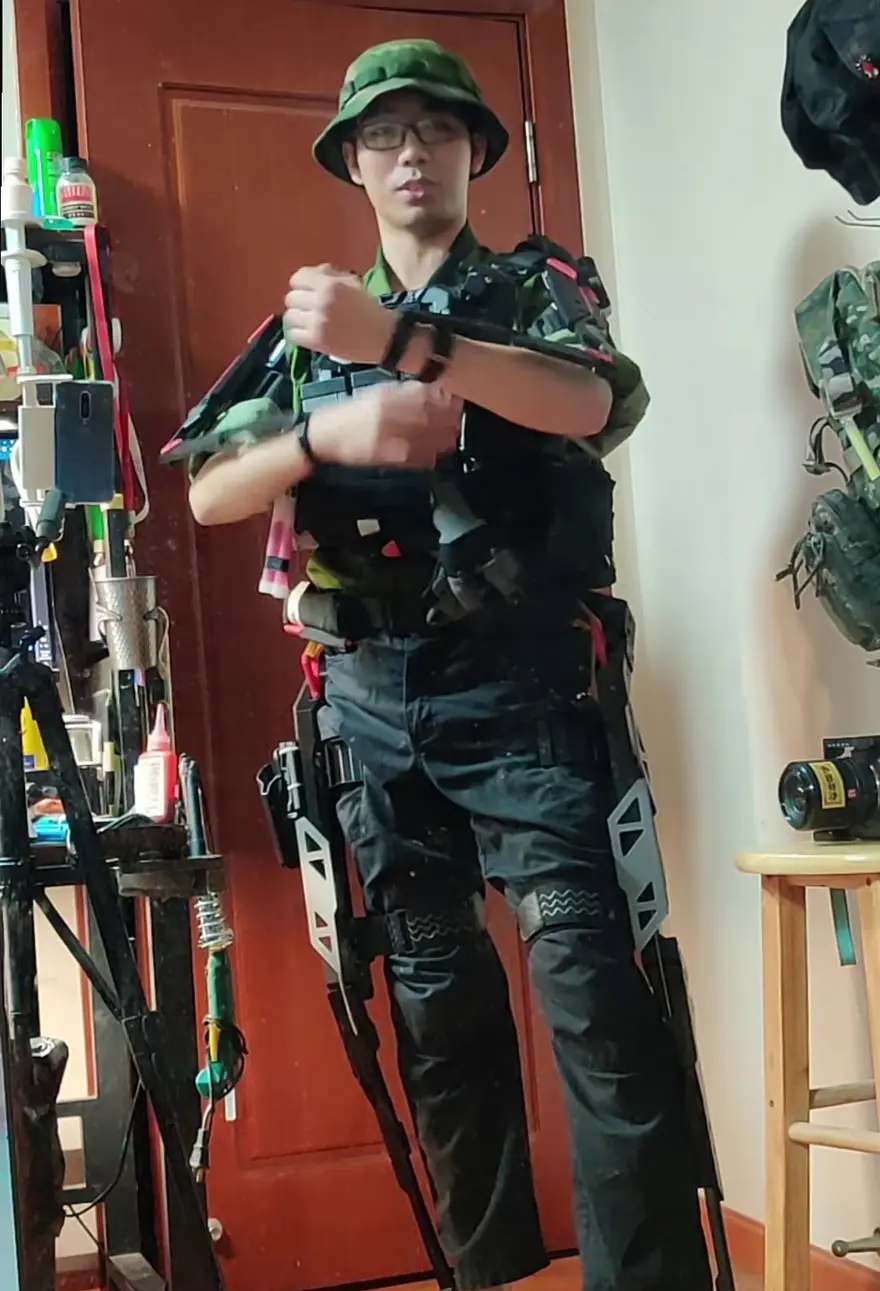
After securing the gear, the creator began testing it with a diverse range of movements: crossing legs, deep squats, and one-arm push-ups, and even threw a ground punch, executing exaggerated posture variations, all without being restricted by the exoskeleton's mechanical structure. The mechanical joints flawlessly tracked the natural movements of the human body, delivering a rigid yet non-constraining structure. The reduction in the sense of redundant lower-limb constriction was evident thanks to the streamlined adjustment straps.
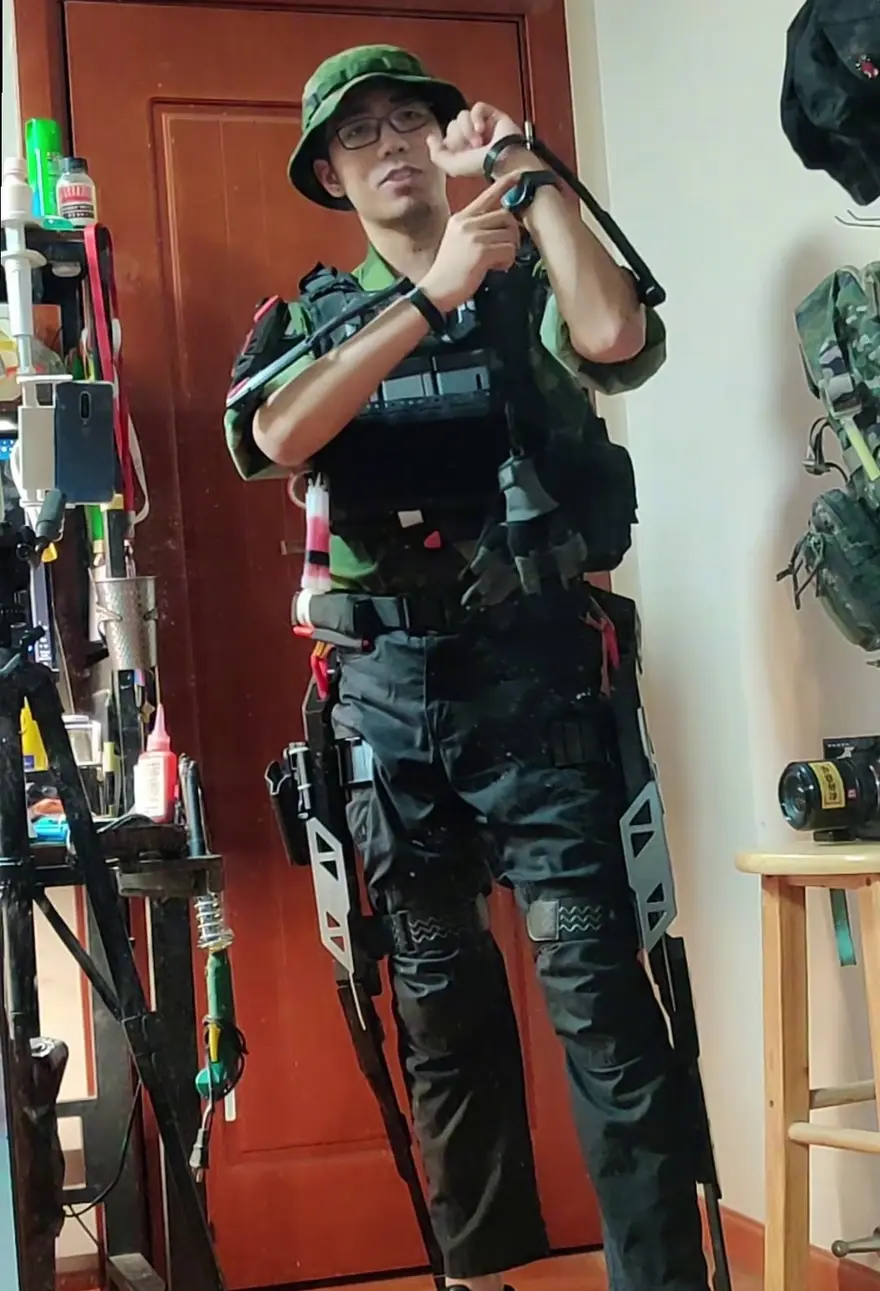
The most practical advice from the entire session addressed a common issue: the smartwatch.
If you wear a smartwatch, make sure to flip it inward rather than leaving it on the outside; otherwise, the exoskeleton will easily shatter it. I'm wearing mine on the inside right now.
During exoskeleton articulation, the rigid frame creates unpredictable compression paths against the skin and exposed accessories. As a user, wearing the watch inward protects the glass from sudden joint impacts; as a product designer, I recognize this is a critical takeaway that deserves to be included in the user guide: The hard edges of the exoskeleton should feature rounded transitions, or incorporate removable cushioned covers.
V. Currently Not "Industrialized" Enough: Spring Noise is Too Loud, Elasticity is Insufficient, and Straps/Ergonomics Need Optimization
This article does not intend to only discuss the pros, because the content creator in the video proactively revealed two engineering issues that are currently being resolved, which deserve serious discussion.
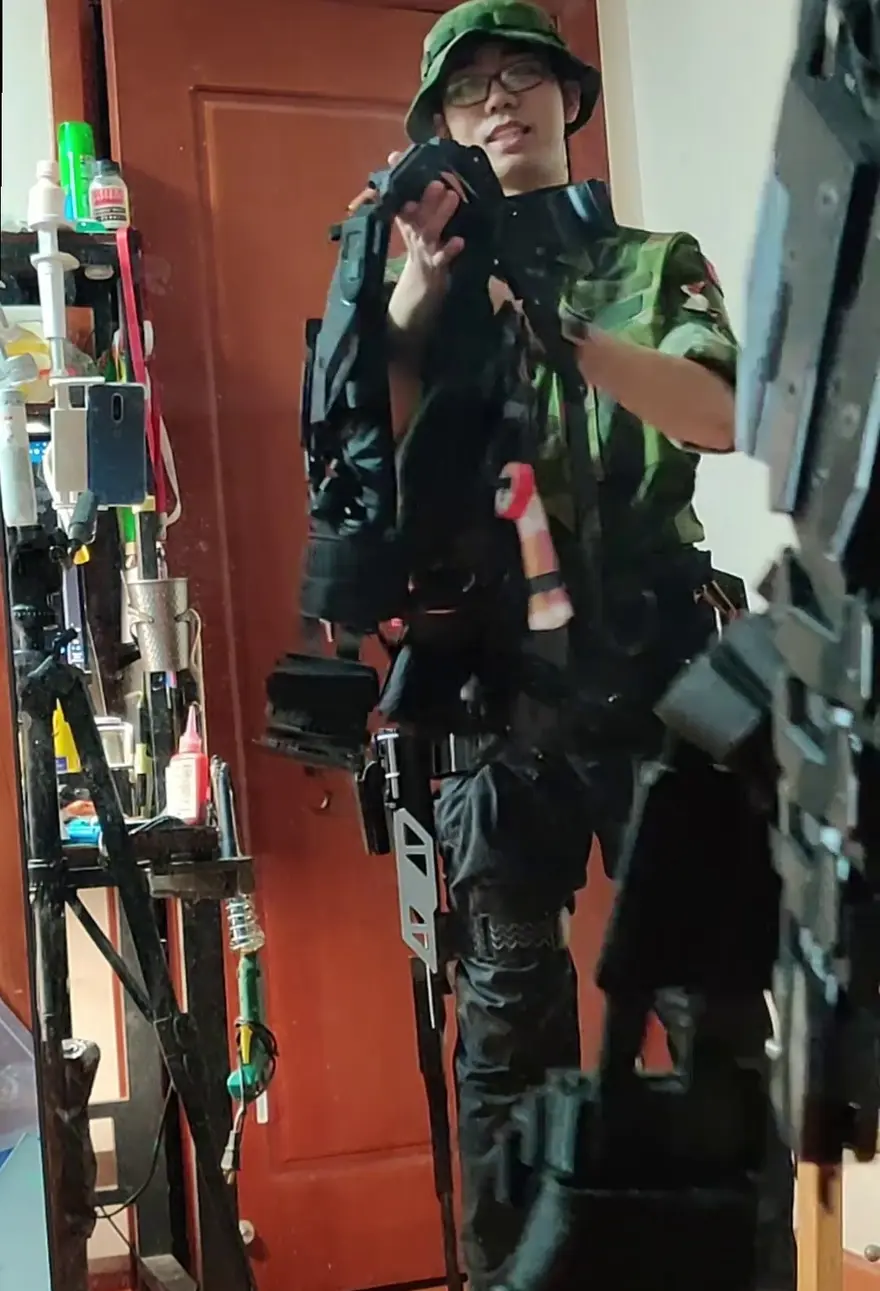
The first is the noise issue. The mechanical structure of this exoskeleton emits high-frequency metallic snapping sounds during motion—the content creator described it as a "clattering" sound. For a tactical exoskeleton, the level of quietness sometimes defines the style. However, for a consumer-grade product, this noise directly impacts the psychological cost of daily use: you wouldn't want to walk around the office in it and receive sideways glances from colleagues.
It is too noisy and not silent at all; this is the spring sound of our upper-body exoskeleton. We have no way to eliminate the sound yet and need some time for component selection. It still has a bit of a lack of elasticity; we need to add more elastic force.
This implies that the smoothness of the structure's elastic system has not yet been tuned to its optimal state. The spring force curve of such systems often requires a trade-off between "sufficient rebound force" and "excess mechanical noise." Component selection and vibration-damping materials remain the focus for structural engineers to tackle next.
The second point is the ergonomic experience of the strap structure. Currently, the foot and leg straps on the lower limbs still use a reverse hook-and-loop (Velcro) structure. The content creator spoke bluntly—
Does it work? Certainly, but I want to make it better. Can we make it a buckle or a magnetic snap? We want it so that after we adjust it once, we don't have to open it up every time. Don't do it like this; just snap it shut and you're done. A one-time adjustment can solve the problem for a long time.
More and more consumer-grade exoskeleton brands, such as Aojian and Halberd, are adopting a "one-time lock, seamless subsequent use" approach for their straps and quick-release structures. If this system is truly going to target tactical users in the future, the "military inertia" demands for the fasteners will be even higher: closeable with gloves, openable while wearing gloves, and securely locked in one step.
6. The Real Highlight is the Tactical Mounting Ecosystem: Armor Plates, Holsters, and More — The exoskeleton Is Becoming a "Platform"
If there was one part of the video that surprised me the most, it wasn't actually the structure of the exoskeleton itself, but rather the tactical mounting system showcased toward the end.
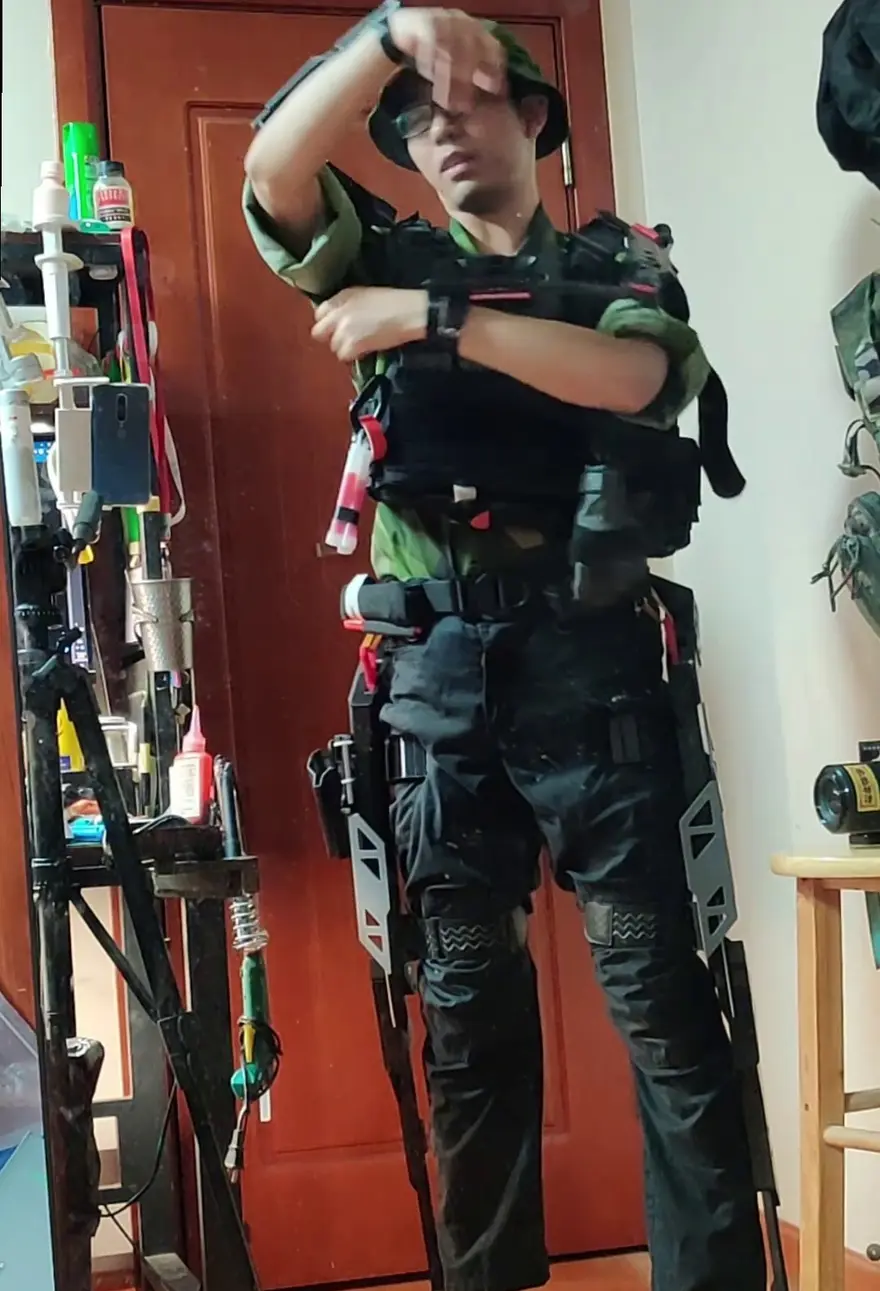
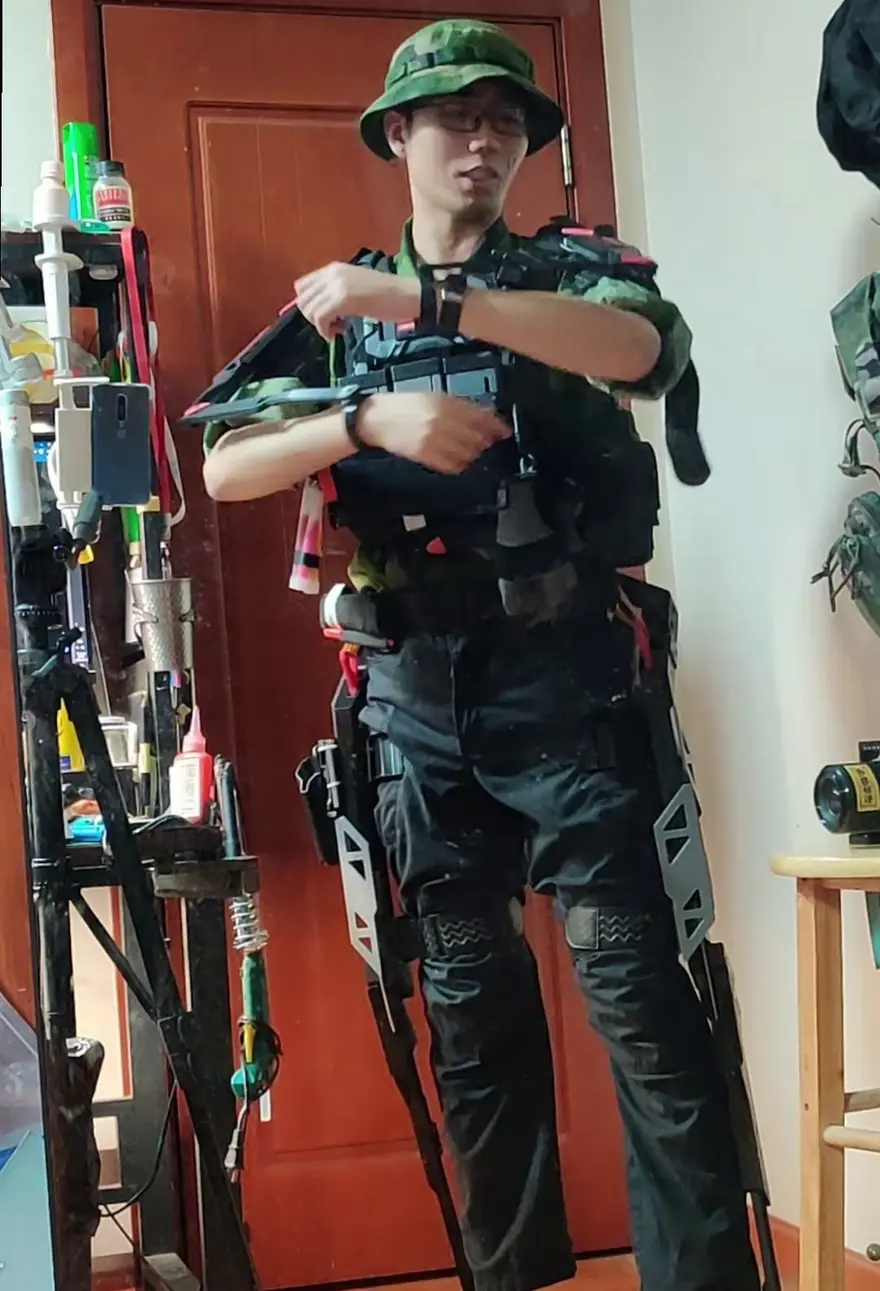
The creator draws a strong conclusion: in the future, this system could evolve into a scalable platform for both protection and max payload by attaching modular gear such as armor plates, shoulder pauldrons, or information panels to the vest.
They are already testing this in highly specific tactical scenarios. For instance, they’ve mounted a simplified holster onto the vest, allowing a firearm to be locked directly into a secured position. Although the current prototype relies on tying two straps together, the design philosophy is clearly to "validate feasibility first, then iterate on the design."
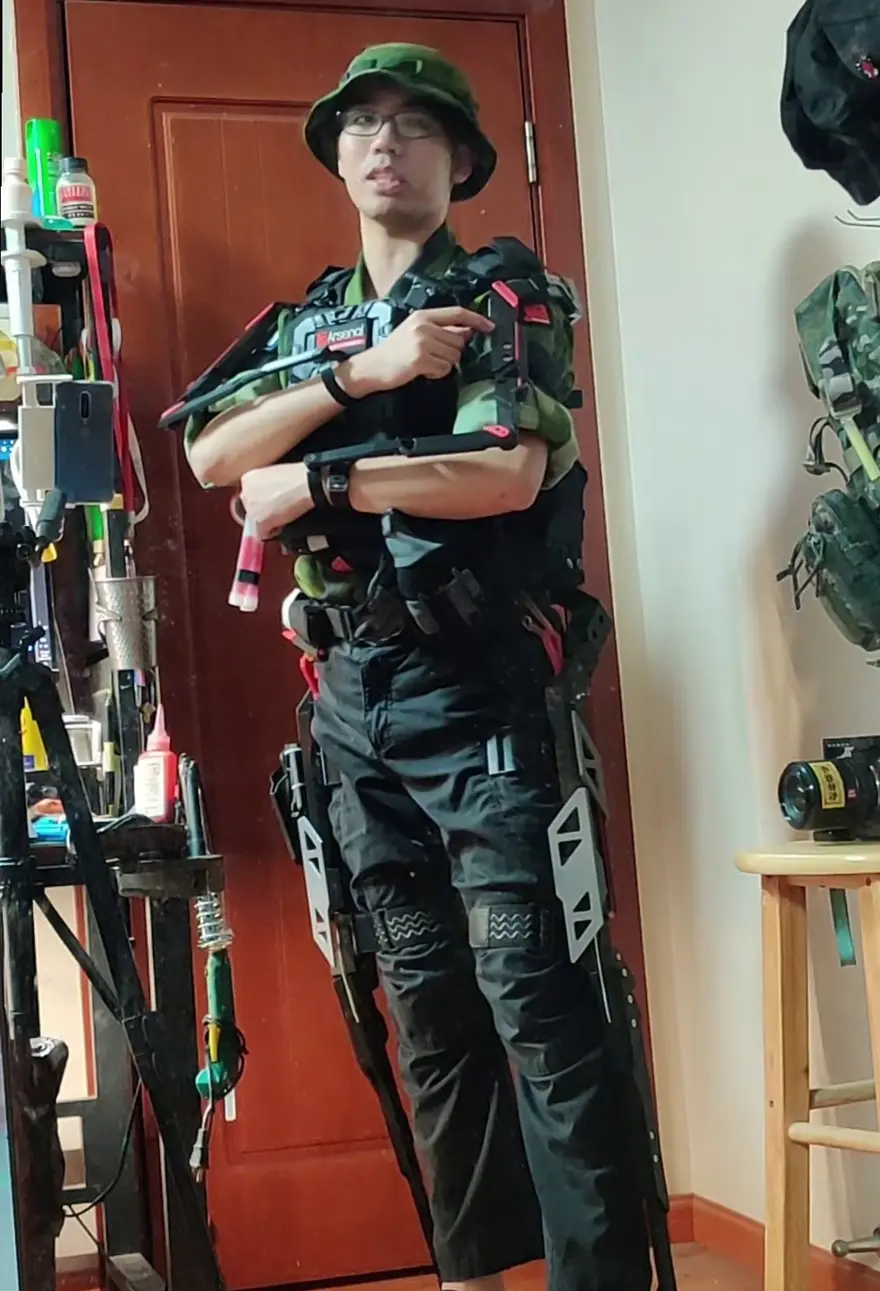
Even more ingenious is how the armor plates are utilized. By pressing down with a reverse-hand motion, the upper-arm exoskeleton serves as rigid support, creating a stable triangular frame between the elbow and the torso. At this point, you can slide an armor plate into this space. While traditional elbow pads merely protect you from impact when kneeling down or taking a hard fall, here, the armor simultaneously acts as a load-bearing bridge that shifts the weight from the arms to the core torso structure. The creator explains this perfectly in the video:
"We’ve integrated things we previously couldn't have imagined without an exoskeleton. But now that I have this exoskeleton, I can practically stack a ton of gear onto it."
VII. Load-Carrying Test: 5kg Payload, Experiencing the 'Weight Transfer' Sensation
The most authentic test came from the payload-carrying segment. After standing inside the exoskeleton wearing a backpack of nearly 4kg and completing a full set of movements, the uploader concluded with this:
"In our previous tests, I carried roughly a 4-5kg pack, and my feet felt loose, unaftigating. The overall experience felt quite solid."
The word "loose" is nuanced here: not implying carelessness, but meaning that the knees and feet are no longer forced to lock rigidly—force is being offloaded onto the exoskeleton's support structure. When we normally carry heavy loads, our bodies instinctively compensate by bending knees, tensing legs, or leaning forward—a default modern posture. A worthy assistive system should free users from this unnatural exertion.
Granted, 4-5kg is no formal benchmark; it serves more as a session-based test. The real challenge lies in safety and durability: for future deployments across mountain trails, Juguang, and even harsh weather, the joint torque, sensor array, and battery system must withstand the stresses of everyday limits.
8. Back to the Essence: An Exoskeleton Is Not a Protective Gear—It’s an “External Payload” That Helps You Carry
There’s another positioning detail that’s easy to overlook: this product must help users stabilize their work workflow.
When a tactical exoskeleton shifts the weight to the lower body, your personal center of gravity moves from being “passively tensed” to being “supported by the system.” It feels more like a suit of wearable armor than a device that merely “helps you lift your legs.”
That’s the core value of consumer-grade exoskeleton devices: it has to be a load-carrying tool that works across use scenarios, not just something for legs that are badly injured.
Of course, the noise level, harness/buckle experience, and battery life mentioned in this video are still being optimized. The creator also honestly shows what isn’t finished yet—which is far more convincing than “bringing a prototype to a red-carpet showcase.” Looking ahead, there are still unresolved issues such as the weight and bending angle around the heavy-load leg structure, mass production of the robotic arm, and the best battery placement that causes the least interference.
But beyond product completeness, this video has already made the more important point crystal clear: what an exoskeleton sells isn’t “making me look more like Iron Man,” but “moving the weight from beneath your legs into your body’s load-bearing structure.”
Top Community Comments
@Indeed las (1 like): Setting a watch, waiting for updates [doge]
This comment may seem casual on the surface, but it actually reflects a very genuine viewer sentiment: "I've arrived, watched half of it, and I'm not satisfied yet—but I won't rush the creator; I'll just note it down." online, setting a watch has become a genuine signal of anticipation and subscription. When viewers say they are "staying put for a while," it is actually the greatest achievement for a creator.
@IndeedNaIndeed (1 like): @WolfieVauk sir this way [doge_jingu]
To translate, this viewer is likely saying, "Take this for your next adventure" or "This makes me want to try it out." The deeper meaning is that the "exoskeleton + tactical vest" aesthetic combo is so visually striking that it immediately triggers the primal urge of those interested in military sandbox games or live-action CS.
@YL_PureNightmare (1 like): [HvorWorld_boom]
This is a short yet highly revealing comment. The "boom" could refer to an explosion effect, or it could be describing the visceral impact of the crisp mechanical sounds during product testing. At the very least, it shows that this viewer's favorite moment in the video was the feedback feel of the exoskeleton during operation.
One-Sentence Summary
This exoskeleton now feels more like a rugged platform built to carry external loads. As the content creator says in the video, it remains "a consumer-grade prototype still undergoing iteration." Nevertheless, it has already delivered a credible prototype of its external force-transfer system, making it a direction worth watching for tactical, defense, and outdoor enthusiasts.
Appendix: Consumer-grade Exoskeleton Glossary (Downloadable if needed)
If you're interested in the engineering details like the "elastic return system,quick-release buckle," and "protective plate load-out" mentioned in this video, here is an incomplete glossary:
- Spring-based tension band / elastic return system
- Reverse hook-and-loop strap
- Quick-release buckle
- Protective plate load-out / armor plate mount
- Loaded as a platform / Platform-based combat vest system