When Doubao Pushed an Exoskeleton to Dad: An In-Depth Hands-On Test of the Yuan Ye Technology Power Knee "Zhi" Assistive Exoskeleton
1. The "Sci-Fi Gear" Pushed to My Parents by an Algorithm
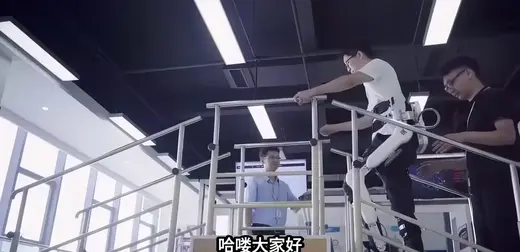
A couple of days ago, my parents suddenly sent me a video, saying it was recommended by Doubao and could make it easier for my dad, who has worn knee cartilage, to go up and down stairs. I clicked it open—good heavens, isn't this the Yuanwo Technology Power Knee smart-power exoskeleton that's been making waves lately?
To be honest, my first reaction was skepticism. This kind of thing, I'd only ever seen in games and sci-fi movies—how much could it really do for an ordinary person wearing it? But on second thought, my parents are getting older, and knee degeneration is an irreversible fact. If it could genuinely make their daily outings and stair-climbing a bit easier, it was well worth looking into seriously. After comparing multiple options, I decided to buy this Power Knee smart-power exoskeleton for my parents, to see whether it's just a gimmick or can truly help them regain the vitality of walking.

A video recommended by Doubao unexpectedly pulled the "consumer-grade exoskeleton" out of sci-fi movies and onto an ordinary family's shopping list.

This actually reflects an interesting trend: exoskeletons are shifting from medical-grade rehabilitation devices down to consumer-grade daily assistive tools. In the past, it was hard to imagine a pair of "machine legs" showing up in your parents' mobile shopping cart, yet today algorithms are already proactively recommending them to silver-haired users.

2. Appearance & Wearability: Magnesium-Aluminum Alloy, On the Leg in One or Two Minutes
First, the appearance and weight. This Power Knee Zhi Dong Li exoskeleton doesn't resemble the bulky mechs you see in movies. The whole unit is built from a magnesium-aluminum alloy, so it feels fairly light in the hand — nowhere near the oppressive "wearing iron armor" sensation you might expect.

Wearing it isn't complicated, either. At first my dad was pretty resistant, saying that with something this high-tech he was worried he wouldn't be able to figure it out. But after fiddling with it on his own for a bit, he actually came up with a mnemonic:
"Align first, secure second, connect third — stick the thigh and shin straps on, and it's on the leg in one or two minutes."

Once he put it on, stood up, and took a couple of trial steps, he cracked a smile right away. He said the breathable fabric felt soft against his leg, with none of that rigid, machine-trapped feeling at all. For an older person who's naturally wary of "high-tech" gear, "easy to put on and doesn't chafe" is the first step toward building trust — and on that front, Power Knee did better than I expected.


3. Independent Left-Right Leg Adjustment: This Is What Truly Sets It Apart From a Brace
What surprised me even more was that it comes with independent left-right leg adjustment.
My dad injured his right knee years ago, and after walking for just a short while his right leg tends to lose strength. The problem with conventional braces is that they only provide passive, symmetrical support — they can't adapt to the different force-output states of each leg. Power Knee, on the other hand, lets you bump up the right leg's assist individually through the mobile app.

After tuning it, I could clearly see his previously shuffling gait become noticeably steadier. He himself exclaimed, "The weakness and the feeling of having no strength to push off — they've both dropped a lot."
This kind of "customized feel" that adapts to the different states of both legs is genuinely far more practical than a conventional brace. Unlike the passive support of traditional symmetrical braces, independent left-right assist is the real technical dividing line that defines an exoskeleton.


From a product-logic standpoint, the value of this is widely underestimated. Lower-limb degeneration in older adults is often asymmetrical — one side declines first while the other compensates, and a symmetrical device can actually worsen that imbalance. The ability to tune parameters leg by leg means this machine is starting to take shape as a "personalized rehabilitation assist" tool, rather than just a mass-produced generic brace.

4. Outdoor Field Test: Zhidongli AI Algorithm, Millisecond-Level Prediction
With the gear in hand, the next step was obviously to take it outside. During the holiday, I took my dad to Xianju Mountain, a place he had been longing to visit. As soon as we got outdoors, Dad couldn't wait to test whether this Zhidongli exoskeleton actually lived up to the hype.

First, let's look at his state without the exoskeleton: when climbing steps, Dad had to grab the railing from time to time, and after walking just a short stretch he'd stop to rub his knees. Watching from behind, even I found it exhausting.

But the contrast after putting it on and powering it up was striking. The Zhidongli system features a proprietary AI algorithm developed by a PhD team, capable of millisecond-level precise gait prediction.
I was originally worried the machine would "fight me for my stride," but it walks even more naturally than I do. Behind this is a real-time closed loop of IMU sensor + torque sensor + proprietary algorithm: sense → predict → deliver force, with virtually imperceptible latency.


This point is actually critical. The hardest part of a consumer-grade assistive exoskeleton isn't "how much force to apply," but "when to apply it." Apply force too early and it feels like being pushed from behind—jarring and unnatural; apply it too late and it can't keep up with your movement rhythm, becoming a burden instead. Millisecond-level prediction means the machine is mimicking "what you're about to do next," rather than mechanically outputting torque at a fixed phase—this is the fundamental difference between it and the rigid logic of early exoskeletons that "assist once per step."

V. Stairs and Slopes: What Does a 45% Effort Reduction Actually Feel Like
When it comes to the truly demanding climbs—slopes and stairs—the built-in powerful servo motor kicks in and delivers active assistance.

Official figures claim an effort reduction of around 45% (this number was mentioned in the video; I did not independently measure it). I can't perceive the exact value, but when I watched my dad reach the halfway point of the hill and excitedly show off to me, I understood that this exoskeleton's assistive effect must be genuinely strong—I was already gasping for breath, while my dad looked utterly unfazed.

"It's rare to see my father, at his age, climb a mountain so effortlessly and calmly to take in the view. Watching the old man leave me behind and stride out in front with that confident silhouette, I swallowed back the words 'just an idiot tax' I had once thrown out."

From an engineering standpoint, "45% effort reduction" is a fairly aggressive figure. It implies that among the three joints—hip, knee, and ankle—at least the knee joint receives significant torque compensation during its flexion-extension phase. For people with worn knee cartilage, this means shifting part of the load that would otherwise press on the joint surface onto the motor and structural components—precisely the core value of an exoskeleton's "load sharing."

6. Reverse Support for Descending Stairs: 60% Knee Load Reduction
Now we reach the part that's hardest on the knees—going downstairs. ZhiDongLi provides an upward reverse support, with the official claim of reducing knee load by around 60% (data cited from the video).


This, in my opinion, is the most "hardcore" aspect of the entire experience. When descending stairs, the instantaneous impact force on the human knee joint can reach 3-4 times body weight—precisely the motion that people with cartilage wear fear most. Power Knee provides "reverse support" during the stair-descent phase, which essentially uses the motor's reverse torque to counteract the impact peak caused by gravitational acceleration—equivalent to installing an "electronic shock absorber" for the knee.

In the past, my dad's knees always gave out when going downhill. Now I see him walking downstairs with incredibly light steps, even having the leisure to stop and snap photos of the scenery with his phone.
Being able to descend stairs "lightly" is often more practically meaningful than saving effort on the way up—because downhill impact damage is cumulative and irreversible. Reducing the load by 60% here may be more directly effective at slowing knee degeneration than any supplement could ever be.

7. Sit-to-Stand Assist + Massage Mode: Tackling the Most Demanding Movements for Seniors
Beyond walking, the movements that actually cost seniors the most effort — and carry the highest risk of injury — are standing up and sitting down. On ordinary outings, every time my dad rose from a chair, I'd rush over to lend a hand.

Now we can simply use the Zhi Dong Li "sit-to-stand assist" feature. When he wants to sit down and rest, two taps on the device at the outer thigh trigger a counter-resistance that lets Dad lower himself steadily and gently into the seat. When he's ready to stand, two more taps engage the device's upward lifting force, and Dad rises to his full height in one smooth, sure motion. The whole process needs no help from me at all.
Sit-to-stand assist is a rare "non-walking scenario" feature in consumer-grade exoskeletons. It extends the use case from "walking" to "daily transfers," which matters even more for seniors living alone or families without children nearby.


Even more thoughtfully, after a tiring hike, when he sits down on a chair, he can switch to massage mode. Watching Dad sit there — breeze on his face, enjoying the kneading relaxation, muttering "money well spent" — this kind of "movement assist + post-activity recovery" closed loop feels far closer to a complete silver-health solution than assist alone ever could.

8. Battery Life and All-Day Experience: 2900mAh / 10 Hours
On the hardware side, Power Knee is equipped with a 2900mAh large battery, capable of delivering roughly 10 hours of runtime (figures cited in the video).

2900mAh, around 10 hours of battery life—out for a full day of stop-and-go walking, I'd say that's more than enough.
This endurance places it in the top tier among consumer-grade exoskeletons. Bear in mind that continuous joint torque output from the motor is a high-drain scenario; holding out for 10 hours means the algorithm takes a remarkably restrained approach to power management on "on-demand power delivery"—not full-power output the entire time, but peak intervention only during the phases where assist is genuinely needed (uphill, climbing stairs, sit-to-stand). This is also why the earlier emphasis on "millisecond-level prediction" matters: accurate prediction is what enables real power savings.


Opinion: The "Watershed Moment" for Consumer-Grade Exoskeletons
After accompanying an elderly family member through this round of use, I'm genuinely convinced. The mystery box recommended by Doubao actually delivered a standout surprise.
Aging may be irreversible, but we can indeed use technology to gradually offset the weight that time imposes.

I'd like to give this Power Knee a clearer positioning: it's not merely a high-tech brace that "shocked me" — it's more like an intelligent companion that actively shares the load and understands an elder's gait. Compared with brands like Chengtian, Kenqing, and Aoshark, which lean toward industrial/medical-grade assist, Yuanke Technology is clearly taking a different path — turning the exoskeleton into a "consumer product" rather than a "medical device." This path is harder, because the bar for consumer products is experience and emotional value, not just a spec sheet.

Of course, as an honest review, a few things must be stated plainly:
- All figures cited in the video — "45% effort saving" and "60% load reduction" — are official data with no independent third-party testing; long-term degradation and real-world performance across different body weights remain a black box;
- Features such as "independent left-right adjustment,sit-to-stand assist," and "massage mode" genuinely exceed the capability boundary of traditional knee braces and represent real product progress;
- For users with severe knee osteoarthritis or those in post-surgery rehabilitation, it still cannot replace the prescription and follow-up of a medical-grade rehabilitation exoskeleton — it's closer to "daily assist" than "medical intervention."

But the direction is right. When exoskeletons start being pushed by algorithms into ordinary households' shopping carts, and when people begin using them to accompany their parents up mountains to enjoy the view, the industry has already crossed the watershed from "lab demo" into "consumer market." From Hypershell and Dnsys focusing on outdoor hiking/trekking assist, to Yuanke Technology's Power Knee focusing on silver-hair walking assist, consumer-grade exoskeletons are showing clear scenario segmentation — and "accompanying parents to walk a few more years" may well be the warmest and most commercially promising one among them.

Top Community Comments
@XiaoluPlayer (2 likes): The whole point of technology is to slow down the years! This lets parents rediscover the joy of walking with a brisk, confident stride.
Interpretation: This comment nails the emotional core of the product—"slowing down the years." For silver-haired users, a consumer-grade exoskeleton sells more than just assistive specs; it sells the psychological compensation of "regaining freedom of movement." That's also why the purchase decision is so often made by their adult children.

@XiaopangpangDuboTianxia (1 like): When we were little, our parents showed us the world. As we grow up, we want to show them more of it too!
Interpretation: A textbook "children buying for parents" motivation. It shows that Power Knee's buyers (the ones paying) and users (the ones wearing it) are two separate groups. The marketing language needs to win over both—making seniors feel "I can put it on, and it's not embarrassing," while making their children feel "it's worth the money, and it shows filial piety."
@LaotouDeFurongwang (1 like): Feels like it's not just for seniors—it suits us "fragile young people" too.
Interpretation: This unexpectedly hits a latent growth market for consumer-grade exoskeletons—"fragile young people." Sedentary lifestyles, sports injuries, and sub-health conditions are driving rising demand for lower-limb assistance among younger demographics. If a brand can stretch the use cases from "elderly assist" to "commuting / trekking assist / standing work," the market ceiling gets dramatically higher.
One-Sentence Summary
YuanYi Technology's Power Knee smart-powered exoskeleton is a compelling example of consumer-grade exoskeletons evolving from "medical devices" to "consumer products"—using millisecond-level AI prediction, independent left-right assist, sit-to-stand assist, and 10-hour battery life, it turns the promise of "helping your parents keep walking for years to come" into a deliverable product. Recommended for: silver-haired users with knee degeneration who still want to stay active outdoors, and adult children willing to pay for their parents' freedom of movement; however, it is not recommended as a medical alternative for severe knee arthritis or post-surgery rehabilitation.