No Motor, No Battery, No AI: Hands-On Test of the RT Fusion Passive Exoskeleton — Springs That Let You "Sit in Mid-Air" and Effortlessly Lift a 30 kg Robot
At a time when consumer-grade exoskeletons are all competing over motors, batteries, and AI motion control, RT Fusion goes the opposite way: a thoroughly passive exoskeleton with no motor, no battery, and no motion control system — relying entirely on springs, elastic materials, and lever structures to redistribute load to where it belongs. In this video, since the creator didn't meet the height and shoe size requirements, a colleague stepped in as the "chosen wearer," going through the full experience of putting it on, walking, sitting suspended in mid-air, and carrying a 30 kg AI robot. This article breaks down that experience and lays out exactly what this "unplugged" exoskeleton can — and can't — do.
First Look: The Exoskeleton That Looks Most Like "Iron Man Gear"—But It's a "Manual Transmission"
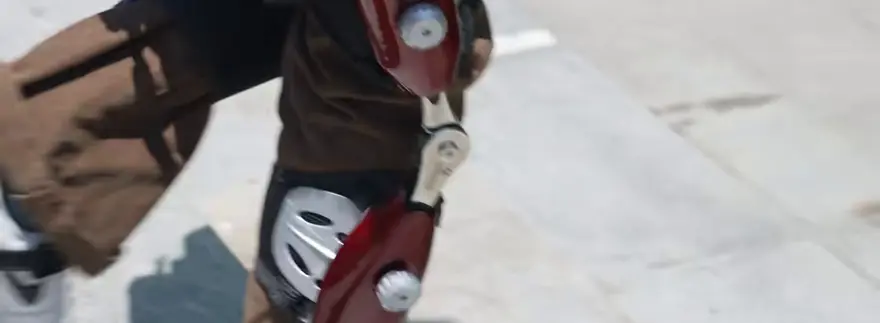
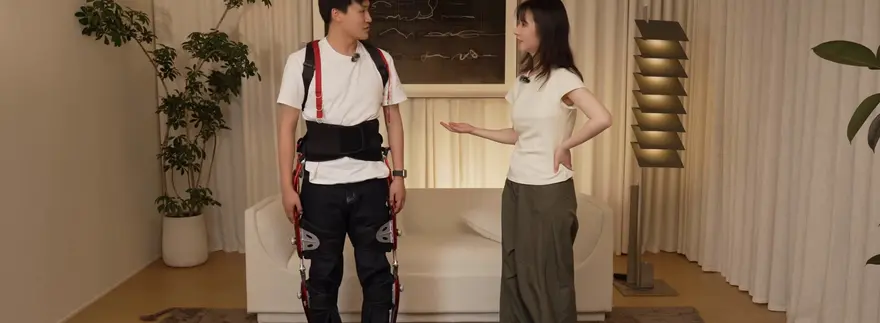
The creator's opening remarks pulled no punches: this is the best-looking, most futuristic exoskeleton he has ever seen. With exposed mechanical linkages and a support frame that hugs the torso, the first thing his colleague said upon handling it was, "This looks just like Iron Man's setup."
But looking cool comes with a threshold—the RT Fusion has hard requirements for the wearer:
Fits heights of 170–185 cm and shoe sizes EU 40–44 (as mentioned in the video)
The creator himself falls outside the fit range, so he had to draft a colleague to play the "conscript" in this review—a test wearer chosen by fate.
Even more interesting was the psychology before putting it on. The colleague's worry wasn't "will it be tiring," but rather "will it walk me around?" and "will it get in the way of my legs?" The creator's reply was arguably the best deadpan joke of the episode: "It won't—look, this thing doesn't even have a battery."
That one-liner actually nails the user mindset around passive exoskeletons: people are afraid powered exoskeletons will "grab the steering wheel," while the RT Fusion doesn't even have the ability to "grab"—it won't walk for you; the effort still has to come from you. Its only job is to put the force you generate exactly where it counts.



The Passive Route: No Motors—All the Engineering Goes Into the Structure
The active exoskeletons we've reviewed before all follow the "motor + sensor + algorithm" route: brushless motors (or servo motors) output joint torque, sensors such as IMUs identify gait phases, and an AI motion-control system decides when to apply force and how much—mainly targeting scenarios like walking assist and hiking / trekking assist.
The RT Fusion takes the exact opposite approach:
It is a passive, purely mechanical exoskeleton with no motor, battery, or AI motion-control system. Structurally, it leverages springs and elastic materials, redistributing load through mechanical principles such as counterweights and levers, while storing and releasing energy (as mentioned in the video)
In plain English: it doesn't generate energy—it only moves it. When you press down, it stores the force; when you rise, it hands that force back to you. When your arms are carrying something heavy, it channels the load into your back and shoulders.
This approach buys three very practical advantages, all of which the video points out:
- It follows your body's movements in real time, so there's no risk of motor output falling out of sync with your motion—the mechanical structure is naturally in step with the human body, eliminating even the sensors needed to detect gait;
- No need to worry about battery life—its "endurance" depends entirely on your legs;
- A purely mechanical structure is hard to break, and even if something does go wrong, replacement parts are easy to swap.

Wearing Process: Five Minutes to "Suit Up," Thirty Seconds to "Take It Off"
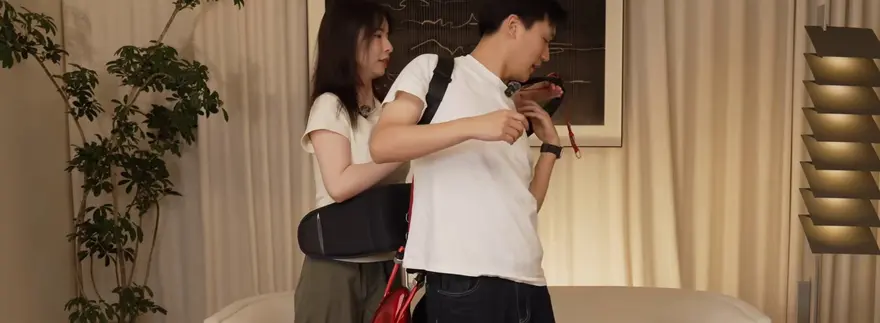
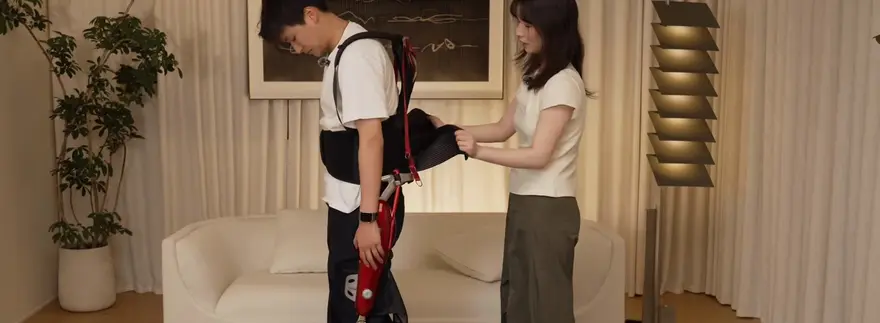
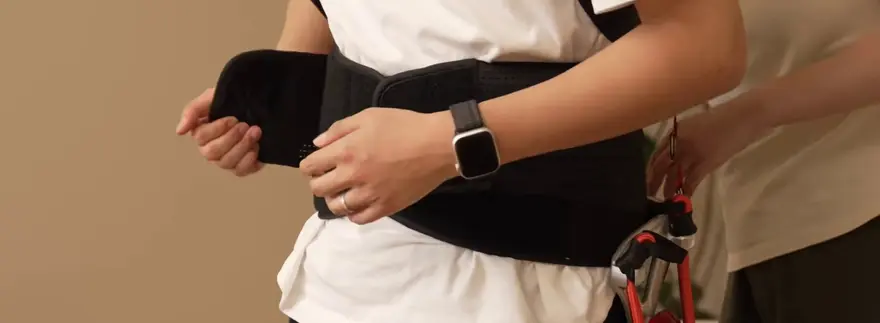
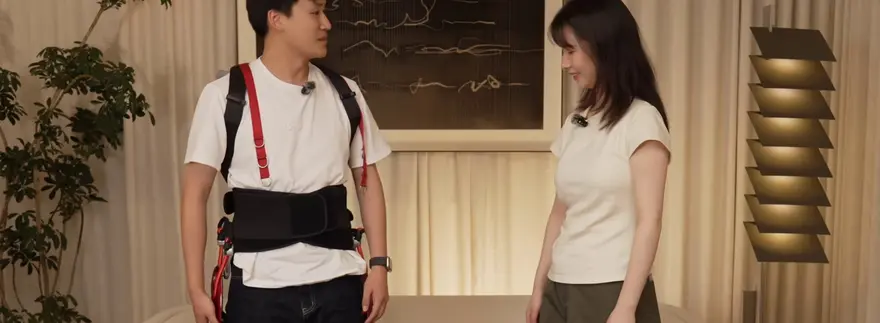
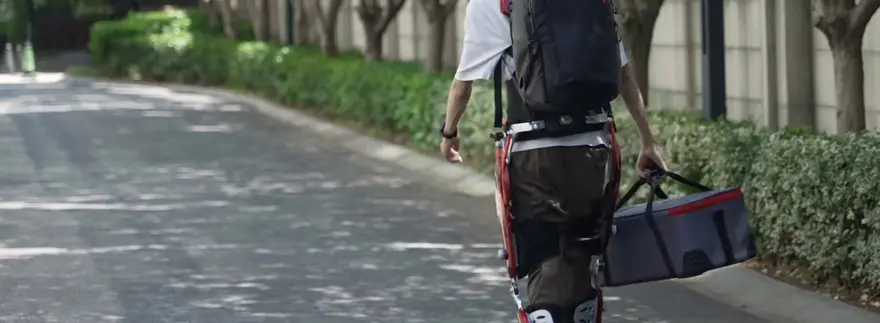
The wearing order goes roughly like this: first put on the dual-shoulder harness, then fasten the waist belt. What actually cinches your waist is a strap similar to a lumbar-support / weightlifting belt—tighten it just until it "holds firm," no need to squeeze until you can barely breathe.
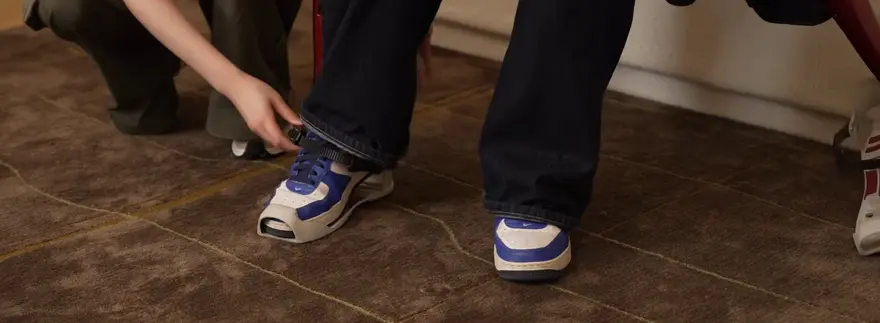
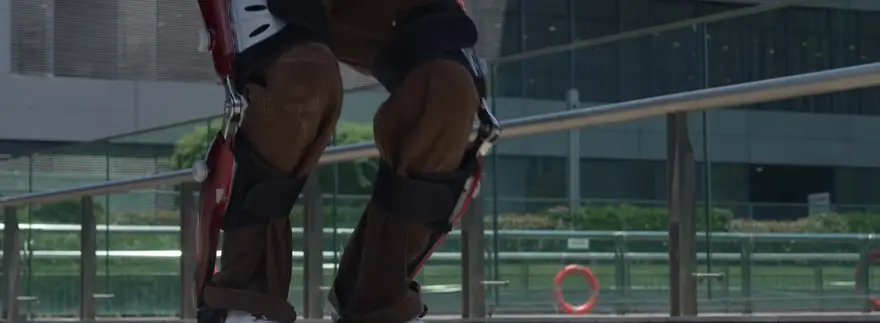
The feet are the key part of this machine. Because the exoskeleton's footplates make direct contact with the ground, and an extra linkage segment runs along the lower leg, there are specific footwear requirements: aside from the sneakers included in the box, any shoes you wear yourself must be flat-soled, thick-soled styles without wide, outward-flared edges.
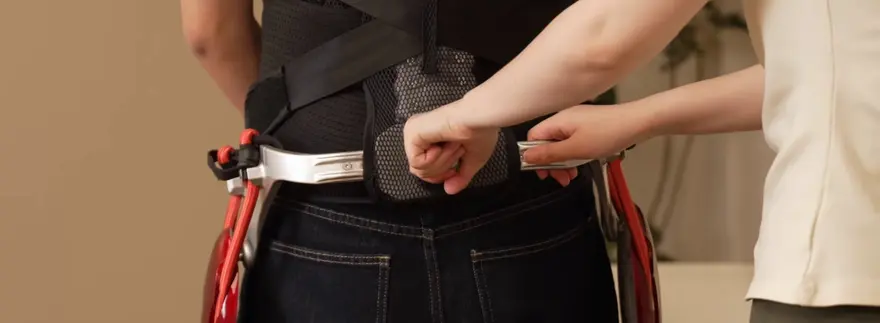
There are also two support plates on the back. The reviewer's description is spot-on: "like a posture corrector, it straightens your back"—the plates follow the natural curve of your spine for support, and the tightness can be adjusted to fit each person's hip width. The leg linkages are length-adjusted via knobs, and every knob on the device uses a press-to-release quick-adjust design, so whether your legs are long or short, you'll find your fit.
Following the tutorial, the first time you put it on takes about 5 minutes; removal took just over thirty seconds in real-world testing; putting it on a second time is much faster (as mentioned in the video)
One small heads-up: the back support plates "straighten" your torso, so bending over and sitting down both become more effortful the first time you wear it—it's best to have someone lend a hand. In the video, the test wearer was at one point literally "stuck" and couldn't get back down.
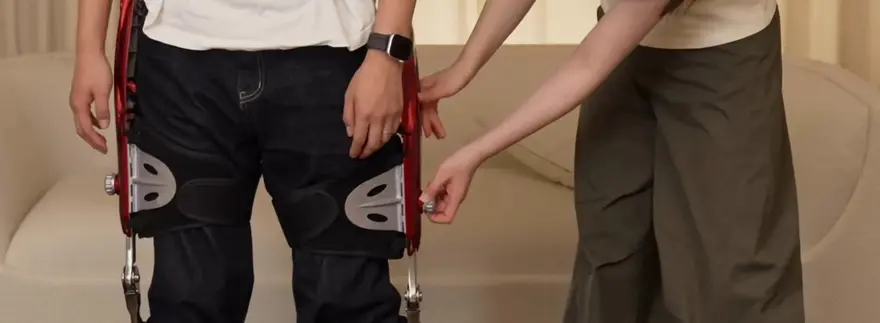
On-Body First Impressions: The Weight Hasn't Disappeared — It's Just Moved Somewhere Else
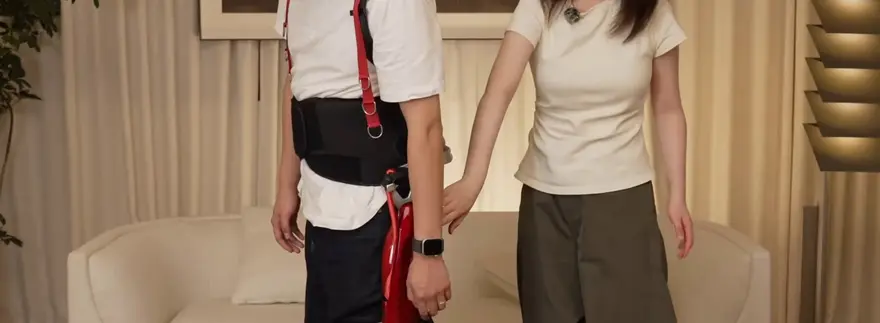
The wearer's first reaction was a classic one: lugging it around by hand, it felt "pretty heavy," yet once it was on, things felt noticeably easier — "the force is all spread out across my back."
The creator filled in the other half of the explanation: because the device is grounded, part of the force is directly supported by the ground. So the sense of load on your back doesn't vanish entirely, "but it feels a lot lighter."
The force isn't just spread across the back — part of it is directly supported by the ground (as mentioned in the video)
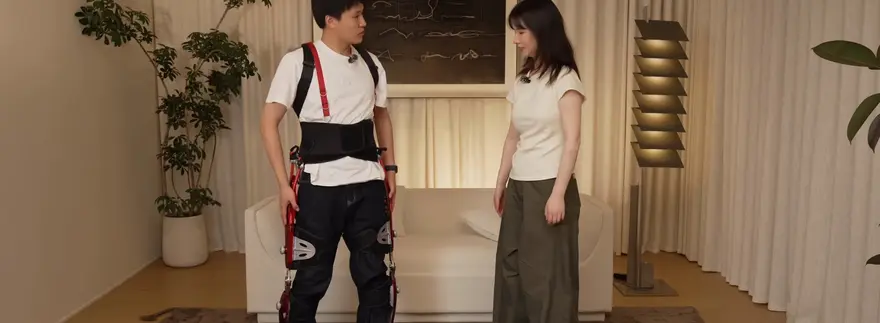
In terms of walking, moving forward and backward posed no real problems, and the gait was essentially left untouched. The main restrictions come down to two movements:
First, extending the leg outward — the two uprights on the outer sides "live right beside your legs," so there's a bit of restriction. That said, as the creator put it, you don't exactly go around throwing side kicks in daily life.
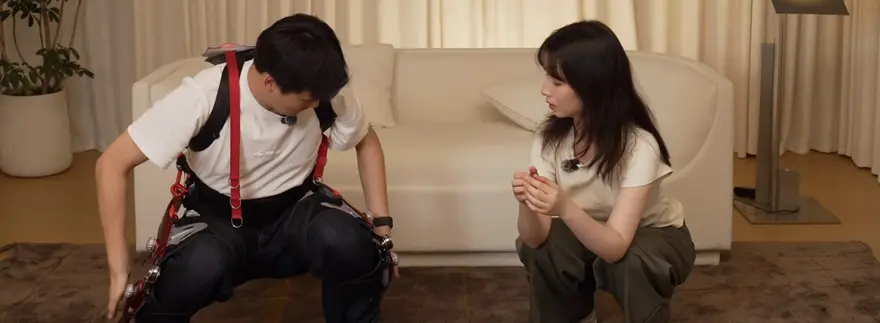
Second, squatting — there's resistance as you lower down, but the moment you stand up, you distinctly feel a surge of assist. The principle is the spring energy storage mentioned earlier: the force gets stored as you squat, and the rebound hands it back to you as you rise.
The wearer's quip hit the nail on the head: "So it's coming out of my own hide, isn't it?" — Exactly. The energy source behind this "assist" is none other than you.

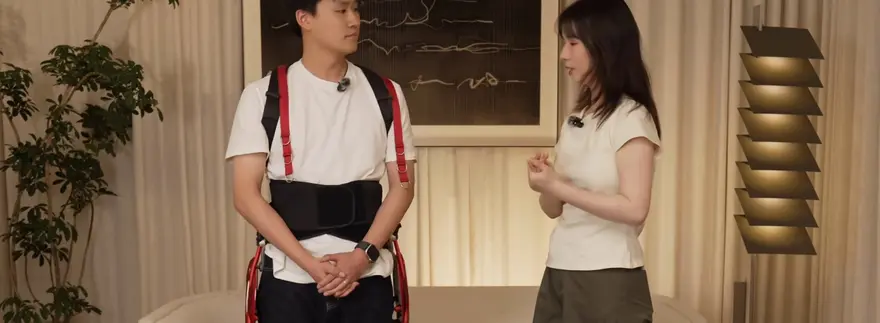

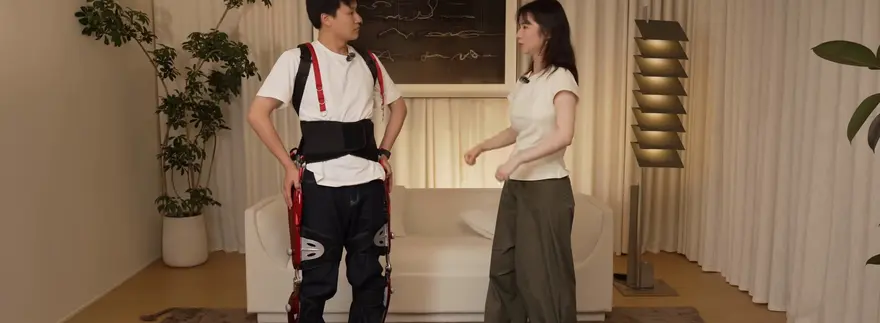
Signature Feature: Hovering Sit — The "Invisible Chair" for Subway Commuters and Queue-Standers
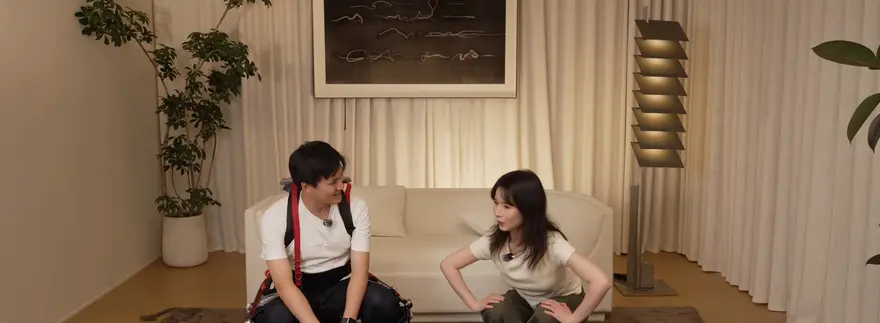
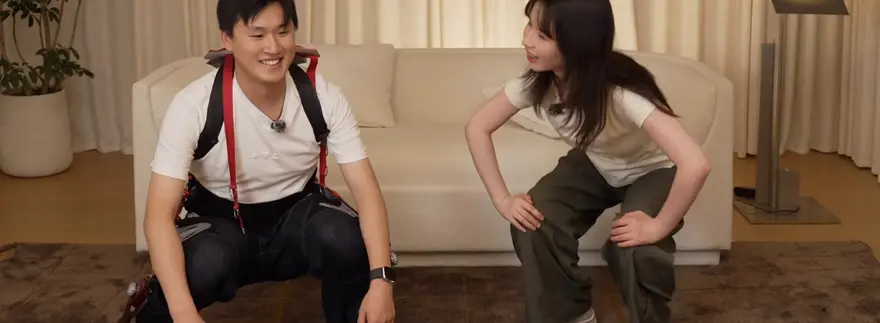
In the creator's view, the biggest value of this exoskeleton is that it lets you "do this movement with zero effort" — holding a half-squat position, as if sitting on an invisible chair.
The wearer's description of the sensation is remarkably specific: it feels as though the underside of your thighs is resting on two "ropes" attached to the frames on either side, with your entire lower body held up — "you don't need to exert the slightest effort with your legs" — and you can hold it for a long stretch: "You could sit here straight through until quitting time."
While hovering in a seated position, the entire lower body is fully supported and the legs barely need to exert any force (as mentioned in the video)
The practical use cases are refreshingly down-to-earth: riding the subway, waiting in long lines — any situation where you're stuck standing for long stretches with nowhere to sit.
But here's the reality check: the creator made it clear that this exoskeleton is not primarily designed to assist with squats or stair climbing — the force it feeds back to you is entirely the force you stored while pressing down. The hovering sit feels effortless because the structure "bears the load" for your legs, not because it conjures energy out of thin air.
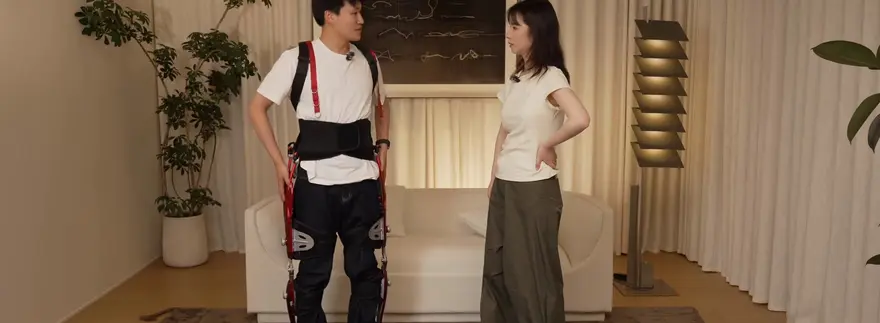
Carrying Test: Lifting a 30+ kg AI Robot Like It's Nothing
"Strapping something this big onto your body just for sitting?" Of course not. Next up: the assistive gloves.
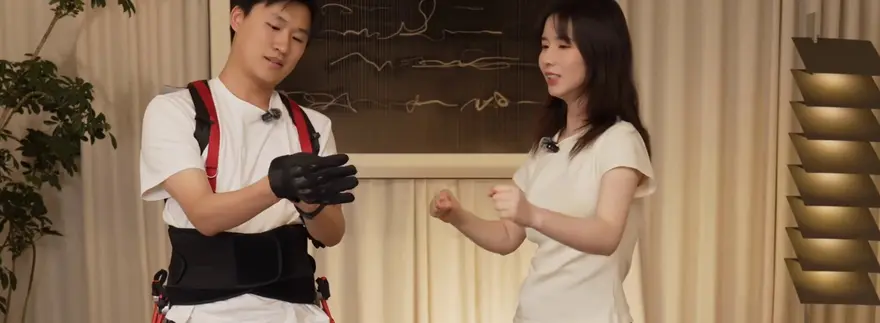
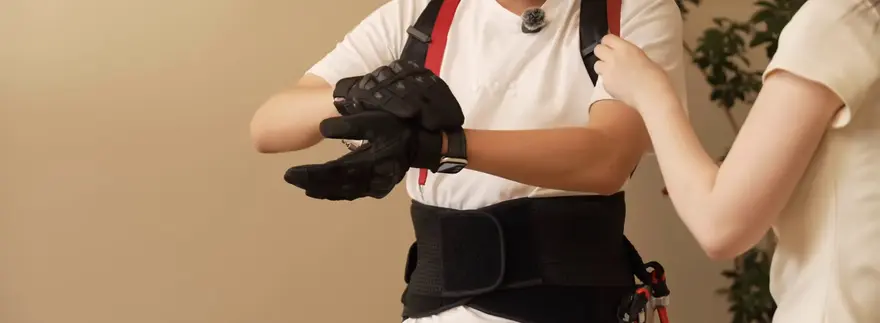
The gloves attach to the exoskeleton straps via snap buckles and offer three adjustable assist levels. The principle runs in the same vein as the rest of the machine: part of the load is distributed to the back and lumbar area, while that full-length "second spine"-like support structure along your back takes on the weight—so your lower back doesn't feel the strain.
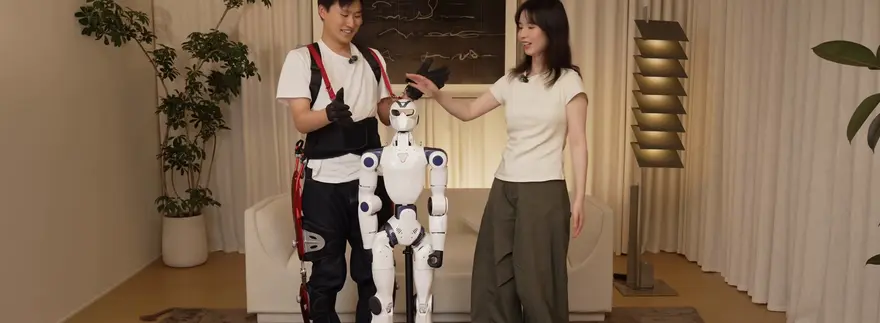
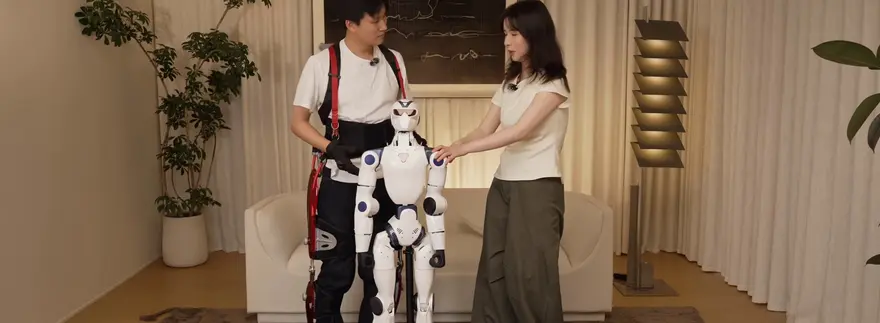
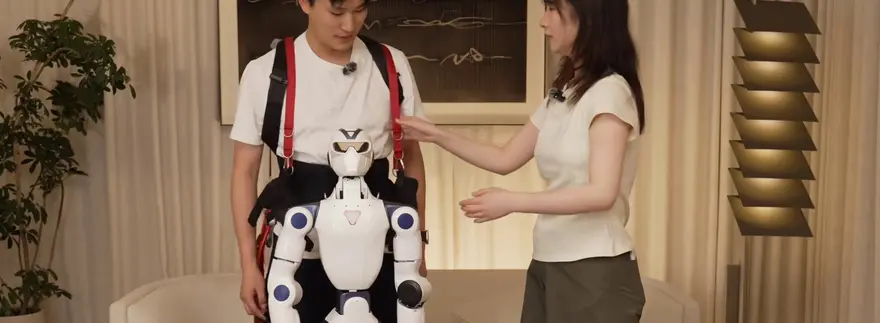
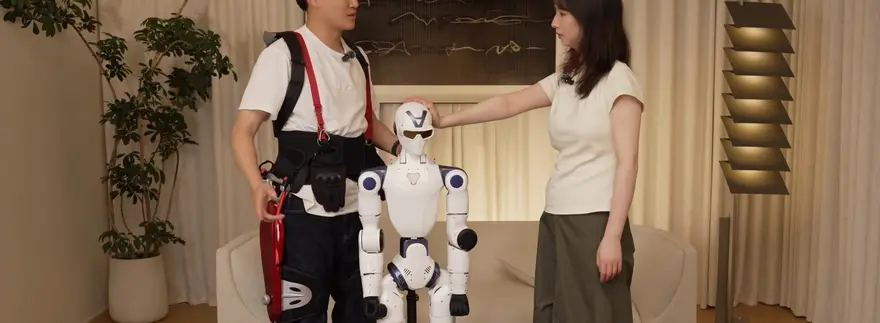
The test prop is an AI robot—don't be fooled by its size, it weighs a good 30+ kg (as mentioned in the video). And when unpowered, its arm and leg joints move freely, going completely limp. As the host jokingly put it, it's "like hauling a corpse"—and the perceived weight is even more than 30 kg.
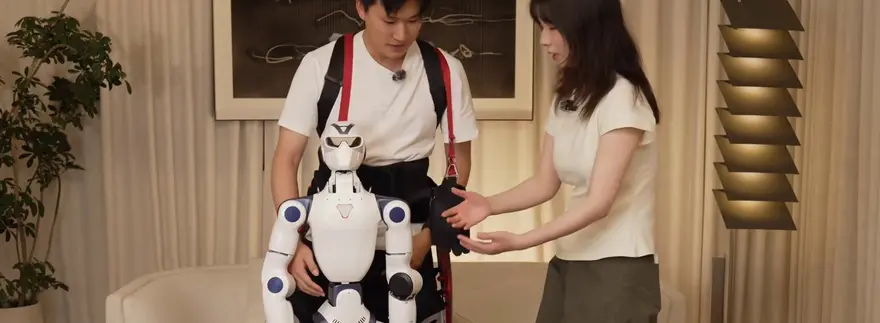
Assistive gloves with three adjustable levels; in the actual test, the 30+ kg AI robot was lifted with ease (as mentioned in the video)
The result: despite being a self-professed "weakling," the wearer lifted the robot effortlessly with the gloves on—even gave it a little swing.
The comparison test is even more convincing: take the gloves off and try again, and reality sets in immediately—he could only bear-hug the robot with both arms, and it kept slipping, making it a real struggle. Here's the difference: with the gloves, you only need to raise the load to a certain height; from there, the structure takes over the rest of the motion, channeling the force backward into your back and shoulders. Without the gloves, your arms have to power through the entire lift on their own.
One side note: the video doesn't list a rated max payload spec—the 30+ kg is simply the weight of this particular test prop, so don't take it as an official figure.
Who Is It Really For: Office Workers May Not Need It, but Camera Operators Should Jump In First
After the hands-on session, the test wearer told it like it is: for a desk worker like him, there's simply no everyday need to lift 30 kg.
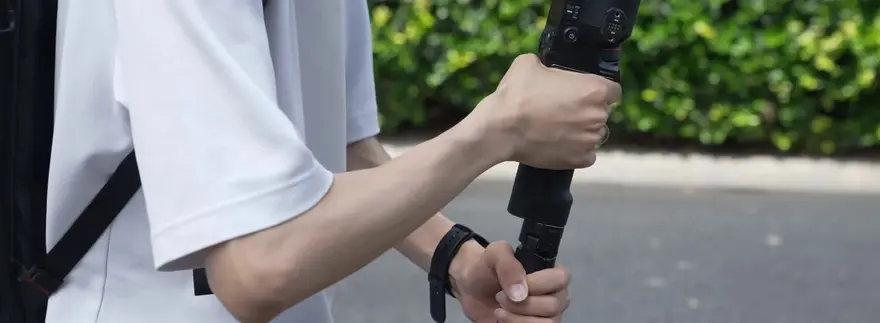
The content creator's answer was more practical: on-location shoots. Camera operators spend entire days holding a stabilizer, plus a camera, plus lenses—that "moderately heavy, held for hours on end" scenario is exactly this exoskeleton's home turf.
In other words, the RT Fusion's target user profile is crystal clear: not "people who want to get stronger," but "people who need to fight gravity for extended periods"—carrying, loading and unloading, set building, filming—it all counts.
Of course, the content creator also singled out one more group: cosplay fans. Being able to strap this mechanical structure and futuristic gear right onto your body is a spot-on match for plenty of sci-fi and game characters. For these users, "looking good" is productivity in itself.
Opinion: Conservation of Energy Is Its Ceiling — and Its Moat
At the end of the video, the creator offers a definition of the passive exoskeleton, and it's the single most memorable line of the entire piece:
No force appears or vanishes out of thin air — energy is conserved. All it does is redistribute the load, so the parts of your body that would normally carry the weight get to take it a little easier.
This one sentence captures both the ceiling and the floor of the RT Fusion.
The ceiling: it doesn't generate energy, so it can never output joint torque the way a powered exoskeleton does to push you uphill, and it offers none of the active safety capabilities like self-balancing or fall protection — at its core, the walking is still entirely your own doing.
The floor (or rather, the moat): precisely because it doesn't generate energy, there's no battery life anxiety and no risk of a motor fighting against your body. The structure is reliable, parts are replaceable, and both cost and maintenance feel closer to "a piece of gear" than "a machine."
One more boundary worth drawing: it is not the same thing as a rehabilitation exoskeleton. Rehabilitation exoskeletons are mostly medical-grade products built for gait training among people with mobility impairments; the RT Fusion is a load-redistribution tool for healthy users — a textbook consumer-grade exoskeleton.
It's not without regrets, though: the height and shoe-size fit is strictly limited, it has requirements on shoe type, first-time donning requires a helper, and the video never mentions the price — all friction points that need smoothing out before it can truly claim to be "consumer-grade."
But the design deserves a word of its own: in an industry where everyone builds exoskeletons that look like medical devices, an exoskeleton you'd happily wear out the door — even to a comic con — is an underrated competitive edge in itself.


Top Community Comments
As of press time, the top-voted comments on this video were still dominated by short, meme-style quips. We've picked out the three most representative ones—along with the user signals behind them.
@JiangJieshi (335 likes): This.
Interpretation: A classic forum-style top-voted one-liner—it says nothing, yet it says everything. What it really reflects is the same emotion as the creator's opening remarks: being struck by the design before anything else. For a consumer-grade exoskeleton, "being willing to take a second look" is itself the first hurdle to clear.
@InnocentFatCat (142 likes): Five kilos of roses.
Interpretation: Viewers are already projecting themselves into real-world use cases—even five kilos of roses counts as a load. Comments like this show that the public's most instinctive mental model of this kind of product is still "help me carry my stuff." The demand for carrying assist is far more universal than walking assist.
@mtb-DasZhaiDa (141 likes): Worth it?
Interpretation: Reads more like a colloquial question about value ("worth the money or not"). The price-versus-practicality question is precisely the controversy no consumer-grade exoskeleton can dodge—the video never mentioned the price, so the comment section effectively put that question on the table first, on everyone's behalf.
One-Sentence Summary
RT Fusion is an "unplugged," consumer-grade passive exoskeleton: it won't push you along as you walk, but it will take the weight you're carrying and move it to where it belongs—seated rest in mid-air and long hours under load (filming, hauling, standing in line) are its home turf, plus a face you could wear straight to a comic con. It's built for professionals who battle gravity all day, and for anyone who simply wants to look cool; if you're expecting powered assist on the climb uphill, turn left at the door and head for the powered camp.
About this article: part of Chinese-Made Exoskeleton Review Archive — an independent, regularly updated English archive of reviews of consumer exoskeletons made in China, edited from publicly available video transcripts. Not an official manufacturer page.
For inquiries and purchasing, contact lonlonago@foxmail.com. More in Reviews · All articles.