Rejecting Human-Machine Confrontation! How Does the Dnsys Wide-Stride Exoskeleton Revolutionize Stroke Rehabilitation Through Bio-Integration?
In the rapidly evolving landscape of wearable robotics, innovation isn’t just about adding horsepower—it’s about creating harmony. The Dnsys Wide-Stride exoskeleton represents a paradigm shift in stroke rehabilitation, moving away from rigid machine-driven correction toward a bio-integrated approach.
"Our goal isn't to overpower the patient," explains the lead engineer. "We aim to create a rehabilitation tool that feels like a natural extension of the human body."
Key Features of the Dnsys Wide-Stride
- Adaptive Gait Coaching: Unlike traditional rigid systems, this exoskeleton utilizes advanced sensors (IMU / pressure sensor) to detect intent and support the user’s natural gait, rather than forcing a mechanical stride.
- Bio-Integration Principle: The system focuses on hip assist and walking assist patterns that complement human biomechanics, reducing the "fight" between the user and the machine.
- Lightweight Construction: Utilizing aerospace-grade materials, the frame combines lightweight properties with durability, ensuring extended runtime without fatigue.
__IMG0__
"The deck has shifted," says Dr. Chen, a researcher in neuro-rehabilitation. "When the device works with the patient's neural pathways instead of against them, we see significantly better engagement and recovery outcomes."
The Dnsys Wide-Stride marks a significant leap in how we view rehabilitation aids. By prioritizing synergy over strength, it sets a new standard for effective, patient-centered therapy.
__IMG1__
Executive Summary and Market Panorama: The Overlooked Tens-of-Billions Rehabilitation Gap
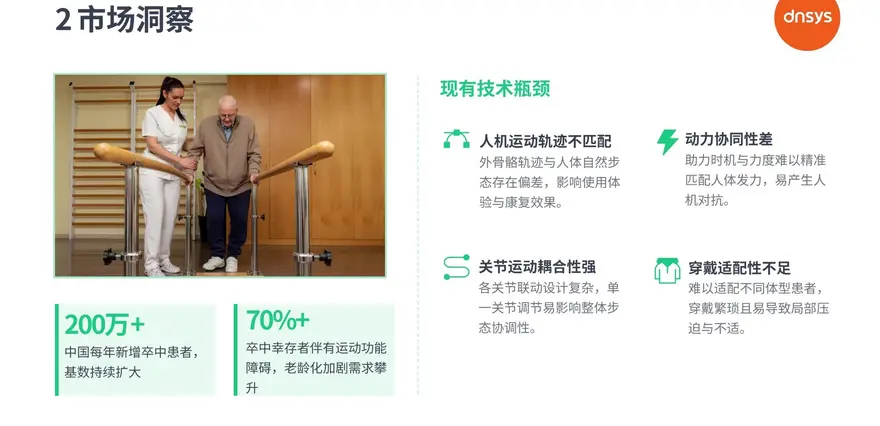
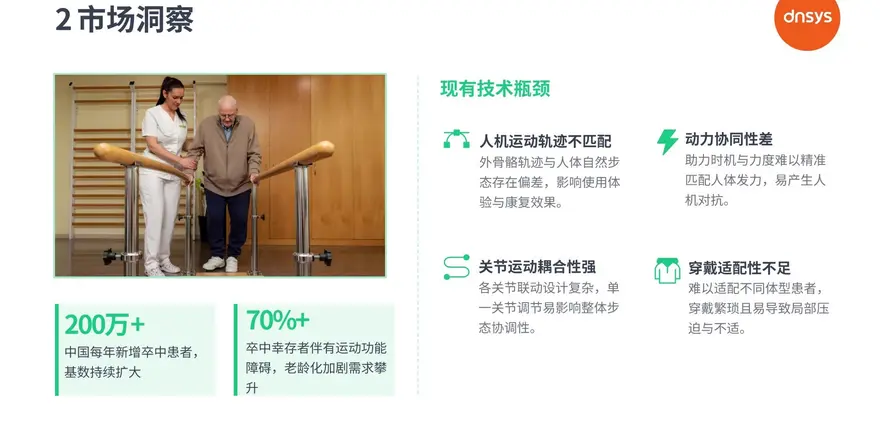
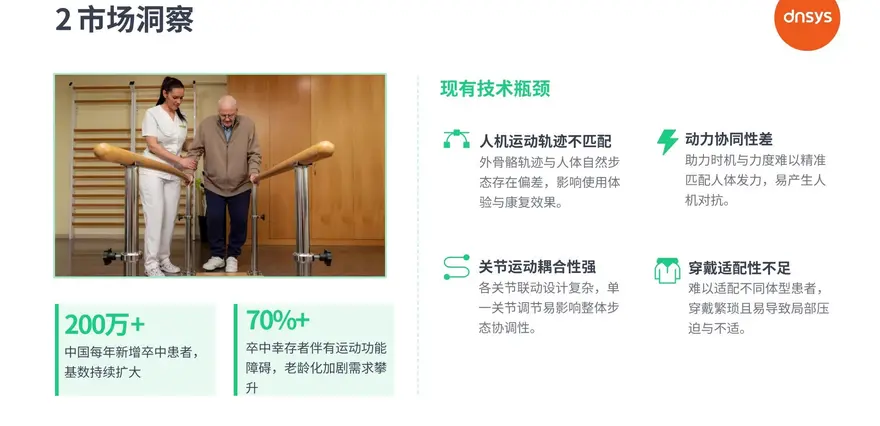
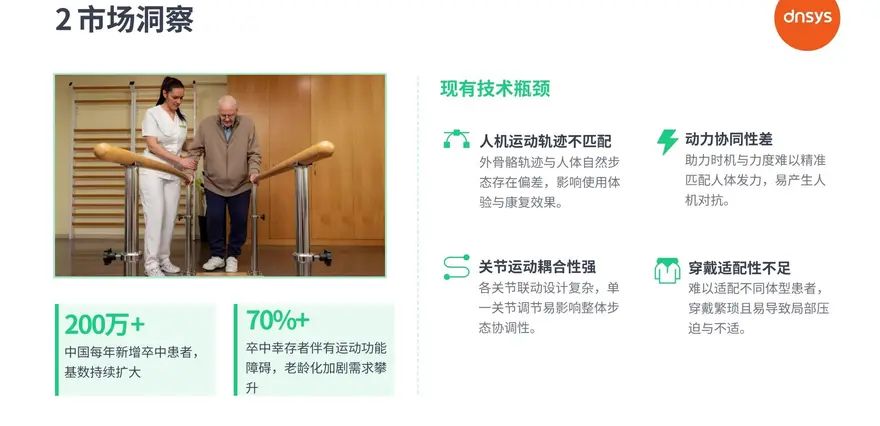
As the trend of population aging intensifies, the domestic market sees over 2 million new stroke patients each year. More than 70% of stroke survivors are left with varying degrees of motor dysfunction. However, there is an acute shortage of professional therapists, and traditional labor-intensive rehabilitation models often suffer from low efficiency and subjective assessments.
Key Insight: With over 2 million new stroke cases annually in the domestic market, over 70% face motor dysfunction, highlighting an acute shortage of professional rehabilitation therapists.
Due to the limited accessibility of traditional rehabilitation services, exoskeleton robots are stepping up to tap into this blue ocean market. It is against this backdrop that Dnsys introduced its flagship product—the Dnsys wide-stride exoskeleton—and proposed a "bio-fusion" solution. !!! !!! !!!
 !!! !!!
 !!! !!!
 !!!
Core Industry Pain Point: "Secondary Injury" from Human-Machine Conflict
In the current rehabilitation exoskeleton track, the biggest industry challenge isn't insufficient power, but human-machine conflict.
Traditional rehabilitation exoskeletons often use rigid mechanical structures. When there's a deviation between the patient's own movement intention and the device's preset driving trajectory, it generates additional interactive forces. This not only leads to jerky movements but, with long-term wear, can also cause muscle compensation, joint wear, and even dangerous secondary injuries. Patients often develop a resistance to using them, which completely contradicts the original intent of rehabilitation.
Dnsys's core mission is to accurately capture the patient's movement intention through multi-dimensional sensors. By fundamentally eliminating human-machine conflict from the core of its algorithms, it lets rehabilitation training return to its safe and natural essence. !!! !!! !!!
 !!! !!!
 !!! !!!
 !!!
Core Technology Decoded: Bio-fusion and Flexible Design
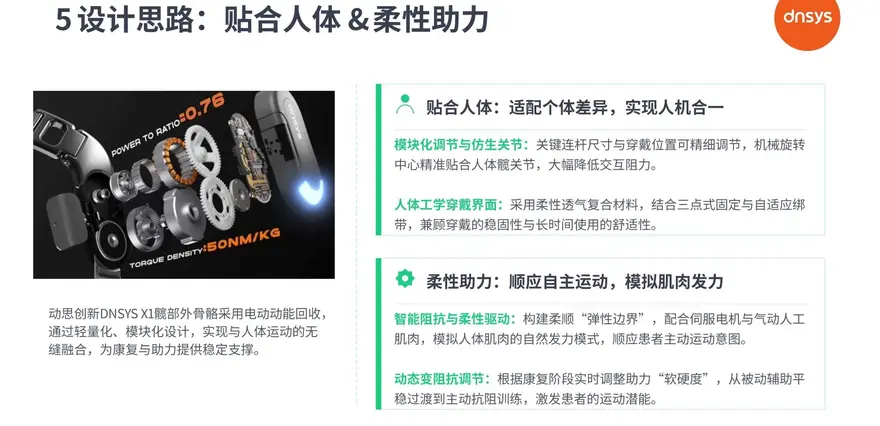
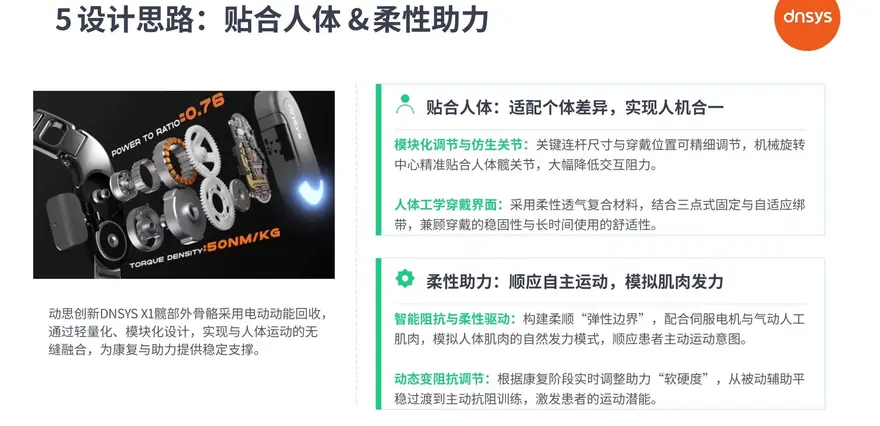
To address the challenge of human–machine interference, Dnsys has developed two core technologies: bio-fusion capabilities and a weakly coupled parallel structure.
First is Bio-fusion Technology. On the hardware side, it adopts a biomimetic structural design that faithfully replicates the physiological structure of human joints, keeping the mechanical motion path highly consistent with natural human motion to eliminate movement interference. On the software side, it leverages intelligent coordination: when sensors (such as IMUs) detect changes in motion, AI algorithms make real-time predictions and drive the device to proactively and intelligently deliver assist, upgrading traditional passive pulling into intuitive active assist that follows the user’s intent.
Second is Weakly Coupled Parallel Technology. Dnsys breaks through the limitations of strong coupling in conventional parallel mechanisms by flexibly connecting the drive units and execution units. While maintaining high rigidity, this approach significantly improves degrees of freedom and adaptability, effectively avoiding the risk of mechanical jamming. It also buffers impact forces at the physical structure level, reducing the risk of injury. Additionally, the device is equipped with a kinetic energy recovery system to further optimize overall performance. !!!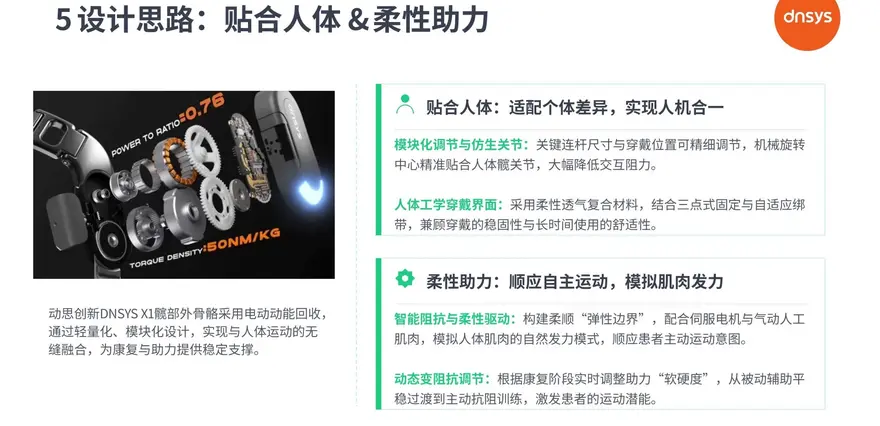 !!! !!!
 !!! !!!
 !!! !!!
 !!!
Wearing Experience and Data Visualization: From "Rigid Traction" to "Adaptive Assistance"
In terms of design philosophy, the Dnsys wide-stride rehabilitation exoskeleton is built around two core concepts: "body-conforming fit" and "flexible assistance." The device features a modular adjustment structure and bionic joints. Both the linkage dimensions and wearing positions can be finely adjusted to ensure precise alignment between the mechanical rotation center and the human hip joint.
Regarding the wearing experience, to enhance patient engagement, the device does not rigidly intervene in the body's autonomous neural regulation of movement. Instead, it guides patients to gradually form a unique and natural active movement pattern that aligns with their neuromuscular memory. This plays a critical role in restoring daily living abilities.
Meanwhile, Dnsys has abandoned traditional unidirectional subjective assessments by integrating multiple types of hardware, integrating a sensor (encoders, torque sensors, and electromechanical sensors) capable of collecting dozens of motion metrics in real time. This data is visualized to assist therapists in making precise, quantitative assessments of the patients' recovery progress. AI algorithms also dynamically adjust training parameters based on real-time data to achieve truly personalized, adaptive training. !!! !!! !!!
 !!! !!!
 !!! !!!
 !!!
A Quantum Leap: Core Advantages Over Traditional Solutions
When we place conventional manual therapy, mainstream exoskeletons, and the Dnsys Kuanbu exoskeleton side by side, the Dnsys device demonstrates generation-spanning superiority across multiple dimensions:
- Treatment Efficiency
- Manual rehabilitation hinges on therapist expertise and offers limited throughput.
- Traditional exoskeletons prescribe rigid trajectories that often trigger muscle compensation.
- Dnsys, with medical-grade precision, follows the body’s natural gait to drive stronger functional and neurological recovery, delivering high accuracy and stability.
- Safety & Adaptability
- Older exoskeletons use strongly coupled, fixed-size frames that create human–machine conflict and localized pressure risks.
- Dnsys adopts a weakly coupled, compliant structure for ironclad safety.
- A modular design allows quick adjustments, ensuring a snug, personalized fit for diverse body types.
- Training Immersion
- Dnsys offers varied training modes plus high-resolution, multi-dimensional data analytics.
- This rich feedback loop eclipses the dull, repetitive nature of legacy rehabilitation programs.
!!! !!! !!!
 !!! !!!
 !!! !!!
 !!!
Section 7/9
The Social Value Outlook: Bringing Professional Rehabilitation to Communities and Homes
As a rehabilitation exoskeleton that combines medical professionalism with a consumer-grade experience, the Dnsys Kuanbu exoskeleton is not confined to hospital settings. Its greater value lies in breaking physical boundaries, extending professional rehabilitation services into communities, eldercare facilities, and even homes.
In the future, the professional clinical data accumulated during the rehabilitation process will also be utilized in sports rehabilitation medicine and neuroscience research, fostering a positive data ecosystem. Given today's economic climate, efficient and intelligent rehabilitation training not only effectively shortens patient hospital stays and reduces medical expenses; more importantly, it helps patients regain the dignity of independent living, significantly alleviating the caregiving burdens on their families.
 .jpg)
 .jpg)
 .jpg)
 .jpg)
 .jpg)
 .jpg)
 .jpg)
 .jpg)
 .jpg)
 .jpg)
Top Community Comments
Rehab therapist “Lao Li”: “Does this use a flexible connection? For patients with calf spasticity or a severely dorsiflexed foot, can the flexible structure still deliver enough joint torque, or will it become too soft?”
Interpretation: This points to a major real-world clinical concern—the tradeoff between flexible safety and rigid support. The video emphasizes multi-dimensional sensors (IMU / pressure sensor) plus AI motion prediction, indicating the system can still provide the required joint torque at the limit rather than being simply “soft.”
Tech reviewer “A-K”: “The kinetic-energy regeneration system sounds cutting-edge, but rehab scenarios don’t involve high-intensity movement. Can regeneration really meaningfully improve battery life / runtime?”
Interpretation: This reflects a geek-style sensitivity to specs. In rehab contexts, kinetic-energy regeneration is more of a bonus or a solution for specific high-load cases, and its effectiveness still needs to be validated by more real-world endurance (in hours) tests.
Geek HQ: “How large is the adjustability range for modular fitting and the bionic joints? Can it cover the huge height gap between 1.5 m and 1.9 m?”
Interpretation: This directly touches on hardware max payload / load capacity and the population-fit boundary. It’s a threshold-level question any consumer-grade product must answer to scale commercially. The video mentions fine-tuned adjustment but does not provide specific ranges.
Tech newbie AI: “Even seniors are using it now—will rehabilitation exoskeletons evolve into a general mobility tool for older adults in the future?”
Interpretation: This touches on the category boundary between rehabilitation exoskeletons and consumer-grade mobility devices, reflecting high public expectations for the industry’s expansion.
Exoskeleton Enthusiast: “Solving human–machine opposition is really appealing! I used to get muscle soreness after wearing one—will this one be different?”
Interpretation: This directly connects to the pain point highlighted in the video. A weakly coupled parallel structure can indeed avoid discomfort caused by earlier strongly coupled designs, which may be this product’s most attractive potential experience upgrade.
Rehab depart “Xiao Luo”: “Not interfering with the nervous system’s self-regulation and relying on AI guidance to form natural movement patterns is great. But for patients who are completely unconscious, can AI algorithms drive passive rehabilitation? We still need to watch the training outcomes for neuroplasticity.”
Interpretation: This focuses on segmented needs across different disease stages, prompting medical professionals to discuss the boundary between passive traction and active control at different phases of recovery.
One-Sentence Summary
The Dnsys Wide-Gait rehabilitation exoskeleton is a lower-limb rehabilitation solution that directly addresses the pain point of "human-machine conflict." By employing biological fusion and weakly coupled structures, it delivers a new approach that balances safety and efficiency, making it worthy of close attention and follow-up from practitioners targeting mass-market segments and home rehabilitation scenarios.
About this article: part of Chinese-Made Exoskeleton Review Archive — an independent, regularly updated English archive of reviews of consumer exoskeletons made in China, edited from publicly available video transcripts. Not an official manufacturer page.
For inquiries and purchasing, contact lonlonago@foxmail.com. More in Rehab & Mobility · All articles.