The Knee's Second Curve: The Dnsys DN6Sys knee assistive exoskeleton crams "knee protection + boost + recovery" into everyday life
I. What Stage Are Consumer-Grade Exoskeletons At? From "Industrial Heavy-Duty" to "Knee-First"
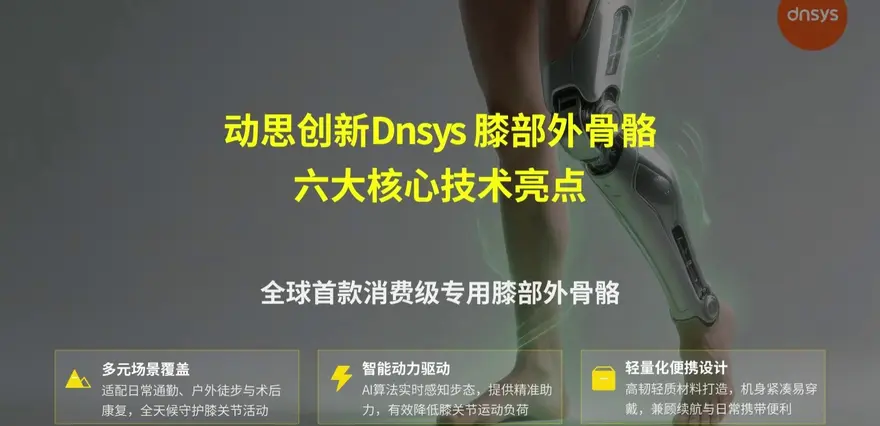
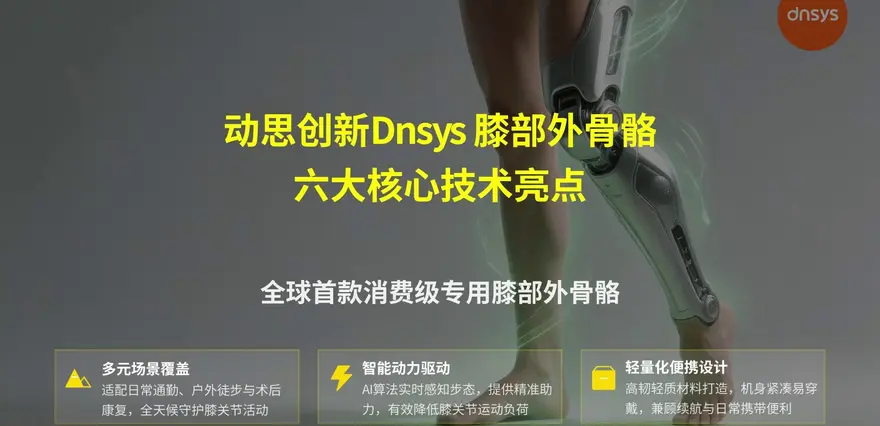
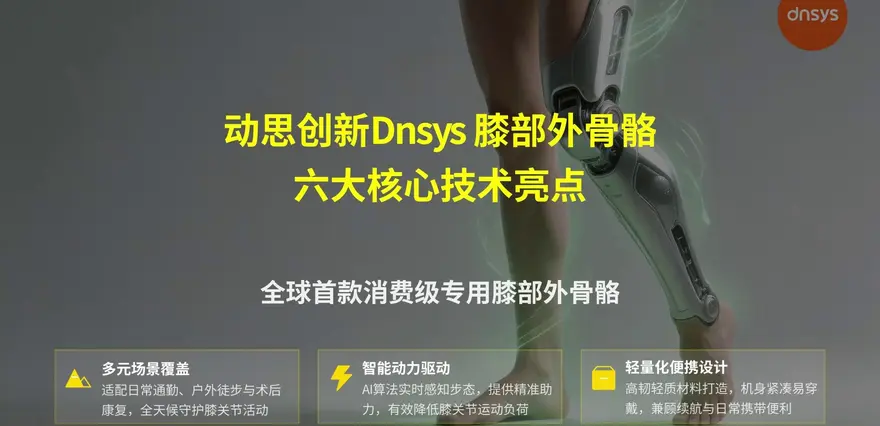
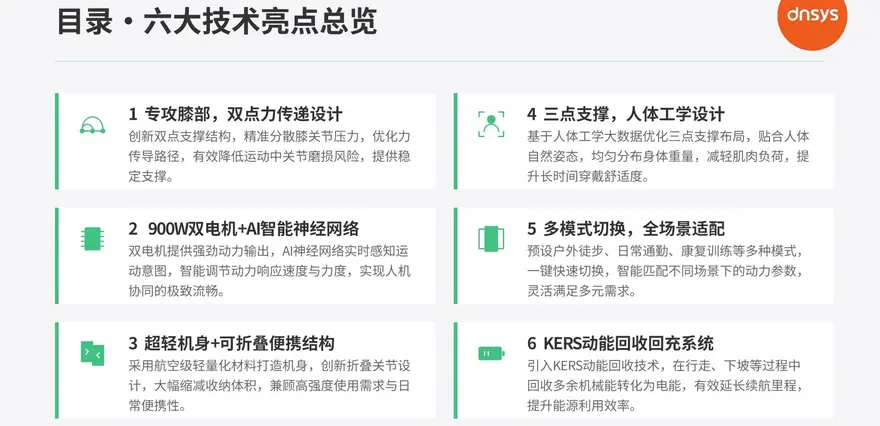
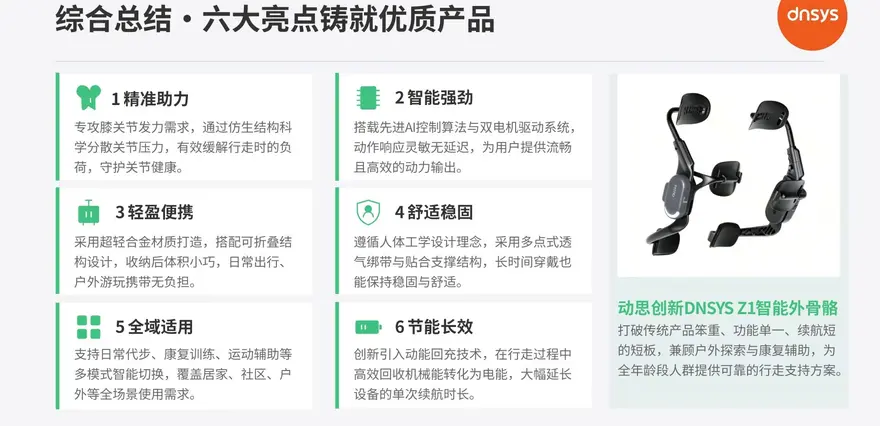
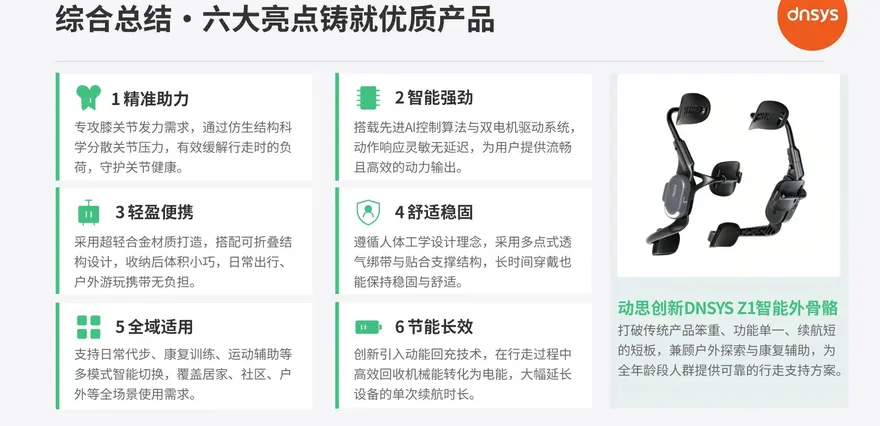
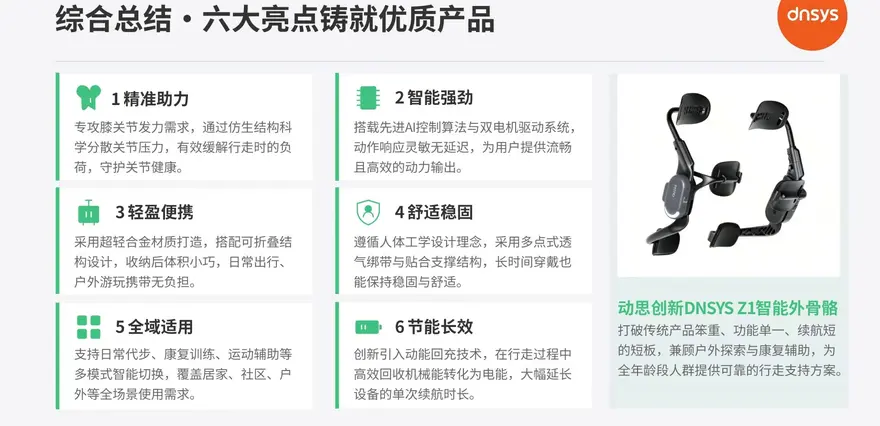
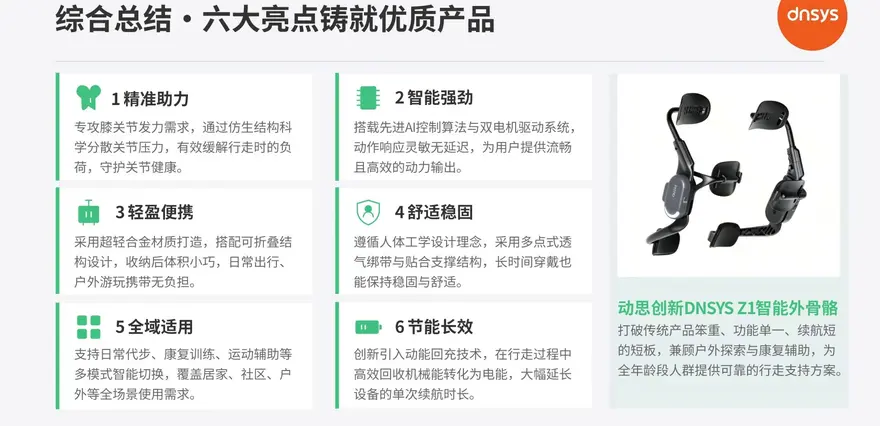
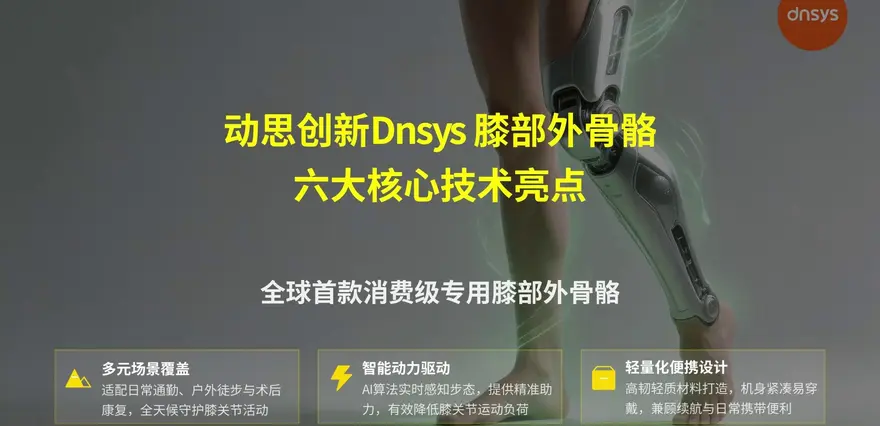
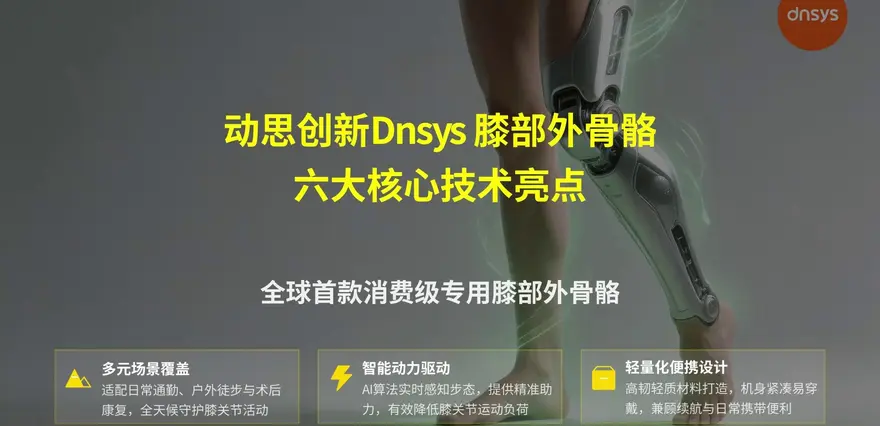
Unlike medical-grade rehabilitation exoskeletons, the goal of a consumer-grade exoskeleton is to truly integrate into high-frequency daily activities such as commuting, hiking, and travel. Over the past few years, we have seen lumbar / back assist devices, hip assist models, and even full lower-limb exoskeletons. However, the knee—a critical yet vulnerable joint—has surprisingly few dedicated products. The Dnsys DN6Sys knee assistive exoskeleton targets precisely this gap: instead of hoisting the entire body, it scientifically redistributes the pressure on the knee joint, trading smaller volume for tangible load reduction.
- Product Form: Knee-specific, independent dual-leg modules, designed to be lightweight and portable.
- Keywords: Assistive exoskeleton, joint load reduction, multi-scenario use.
Mentioned in the video: This is "the world's first dedicated knee exoskeleton truly designed for the consumer market."
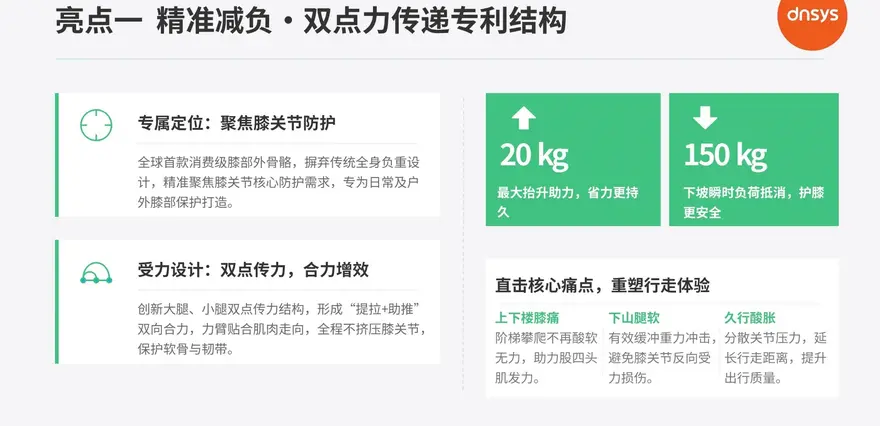
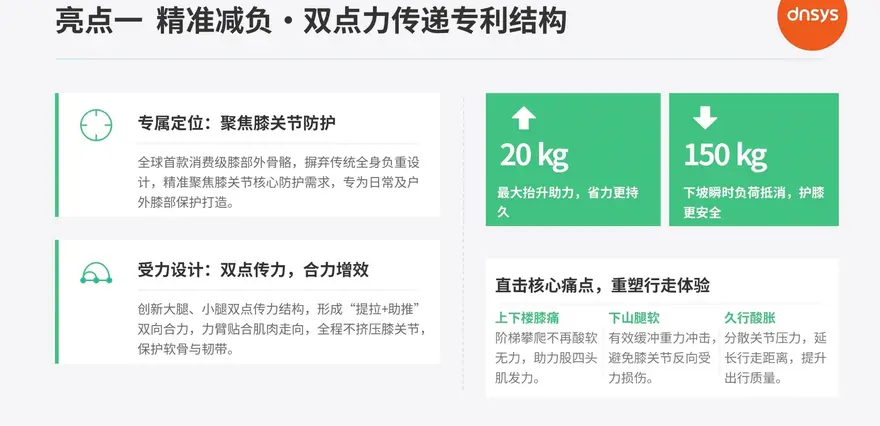
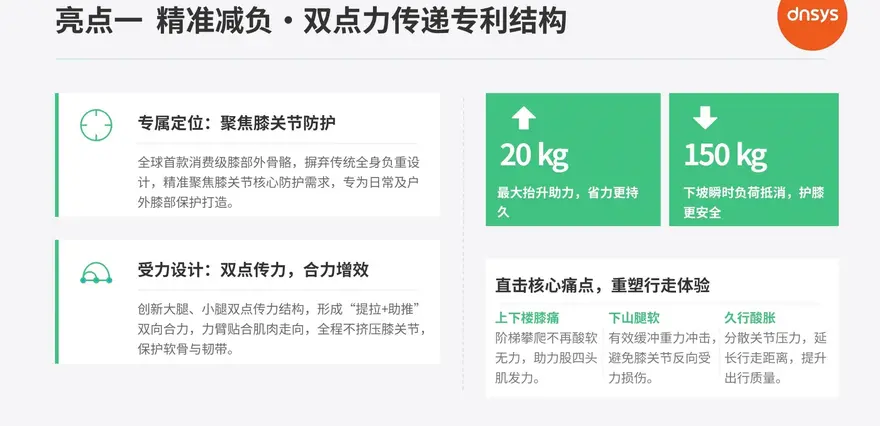
III. Why Focus Solely on the "Knee"? Dual Power Transmission and Force Line Reshaping
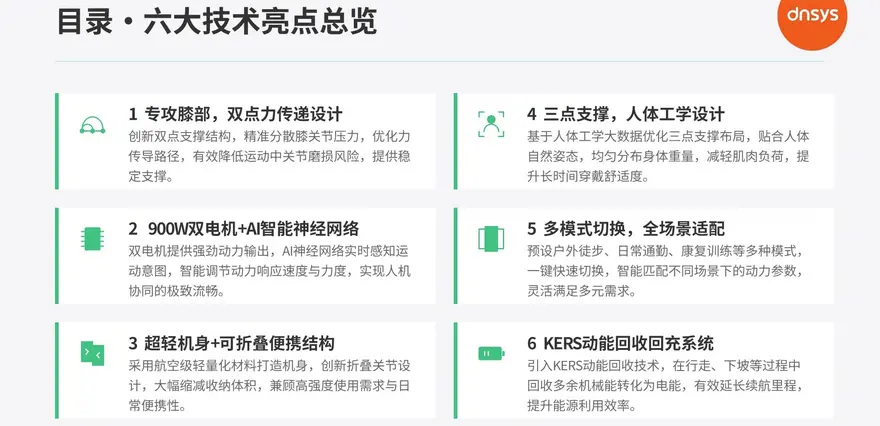
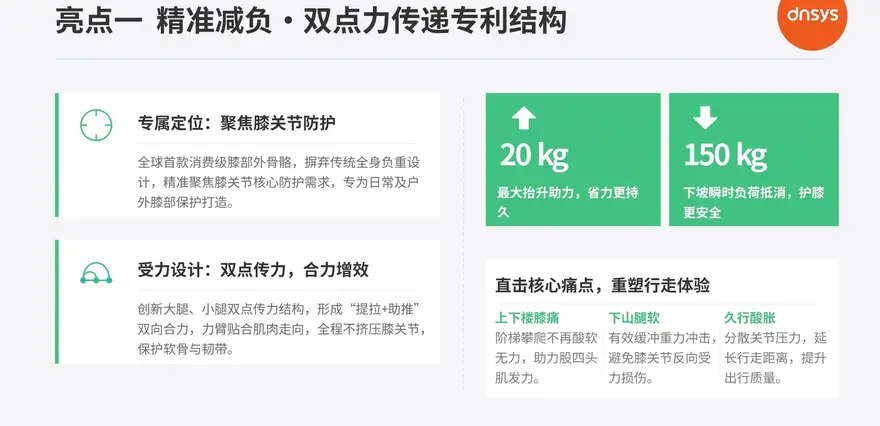
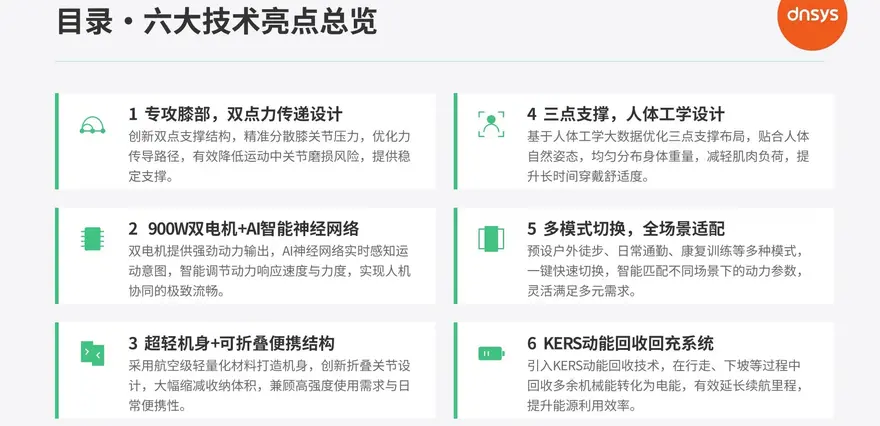
The knee problem is essentially a force line issue: for walking uphill, you need an upward lift; walking downhill requires shock absorption; and climbing stairs demands stability and cushioning. DN6Sys's core philosophy is to bypass the traditional approach of "directly compressing the knee," utilizing two force arms along the thighs and calves to redirect power through the leg muscle chain. This creates a bidirectional combined force of "upward lift + backward push." Consequently, the assistive power does not press directly on the joint itself, but rather establishes an "assist field" around the joint.
As mentioned in the video: maximum lifting assist of approximately 20kg (making walking uphill and climbing stairs significantly easier), and it can offset dynamic loads of up to 150kg when walking downhill (drastically reducing impact).
This "dual power transmission" architecture elevates traditional knee protectors from merely offering "passive support" to providing "active assistive power." The advantages are especially pronounced in scenarios that impose the highest levels of stress on the joint, such as climbing and descending stairs, long-distance walking, and descending mountain trails.
III. The Heart and Brain: 900W Dual Motors and AI Motion Prediction
In terms of power, Dnsys utilizes a dual-motor system with a total nominal output of approximately 900W (mentioned in the video), providing continuous assistance for walking, climbing stairs, and hiking. But the more crucial component is its "brain": by leveraging sensor fusion and motion intent recognition, the system can make assistance decisions with minimal latency, keeping pace with your every step.
Mentioned in the video: The motion prediction lag can reach as low as 0.01 seconds; the system samples human motion data at approximately 100Hz; and leg exertion efficiency can be boosted by up to 50%.
The logic of the actual experience is this: by the time you merely have the thought "I need to exert force," the device has already delivered the assistance. When you slow down or stop, the assistance scales back accordingly. This sense of fluid, zero-latency support is the watershed moment for an exoskeleton, transitioning it from being "able to move" to "reliable enough to use."
4. Lightweight & Portable: Foldable Structure - Is It Really Worth Taking on the Go?
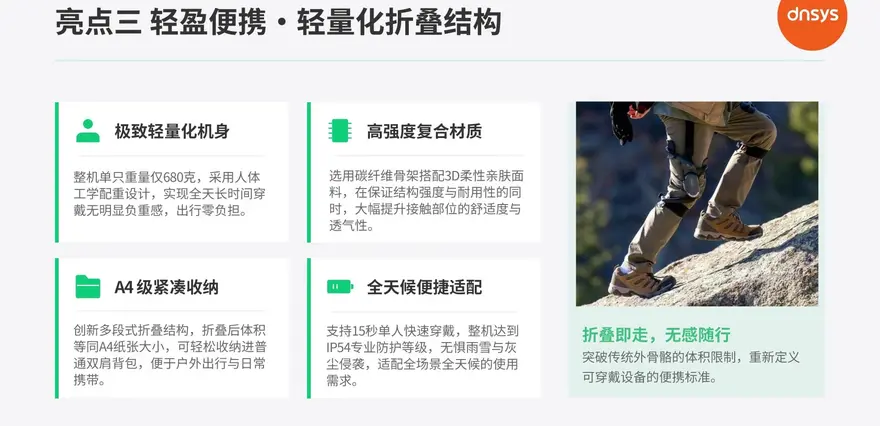
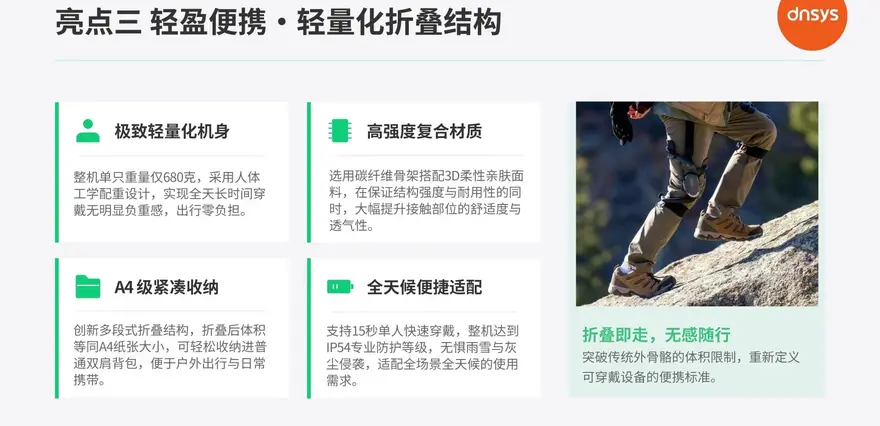
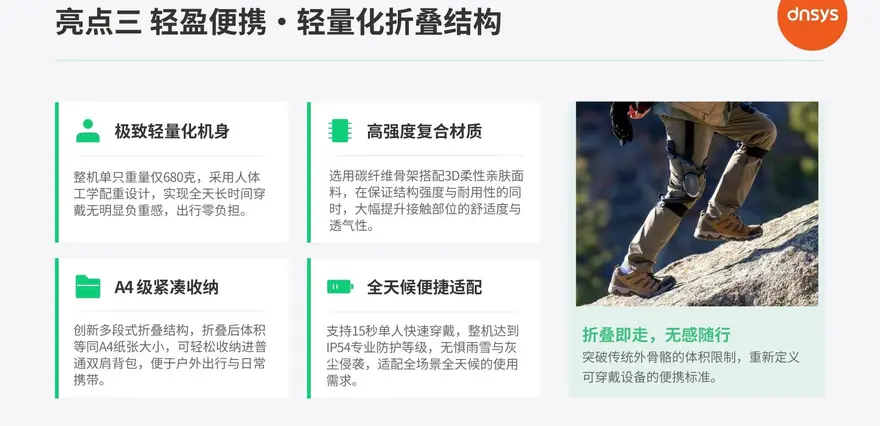
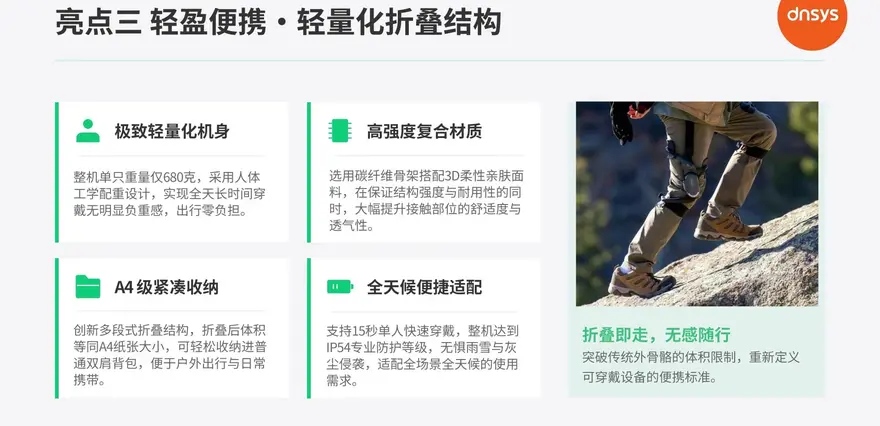
The biggest enemies of an exoskeleton are "weight" and "portability." If a piece of equipment requires you to carry a multitude of bags just to leave the house, it becomes difficult to integrate into daily life. Dnsys's approach involves controlling weight with ultra-light alloys and carbon fiber composite materials, while introducing a foldable structure to ensure the volume "fits into a bag." Judging by the product's positioning, its emphasis on lightweight and portable design aligns perfectly with a daily-use positioning of "carry it anywhere, use it anytime."
Mentioned in the video: Lightweight alloy materials + a foldable design result in a more compact storage volume, making it much more convenient for commuting and travel.
Based on industry experience, the knee assist module is easier to make "portable" compared to a full-body exoskeleton. This explains why "knee-specific" devices have become a viable entry point for the consumer-grade market—they are both functional and easy to carry.
V. Comfort for Extended Wear: Three-Point Support and Ergonomics
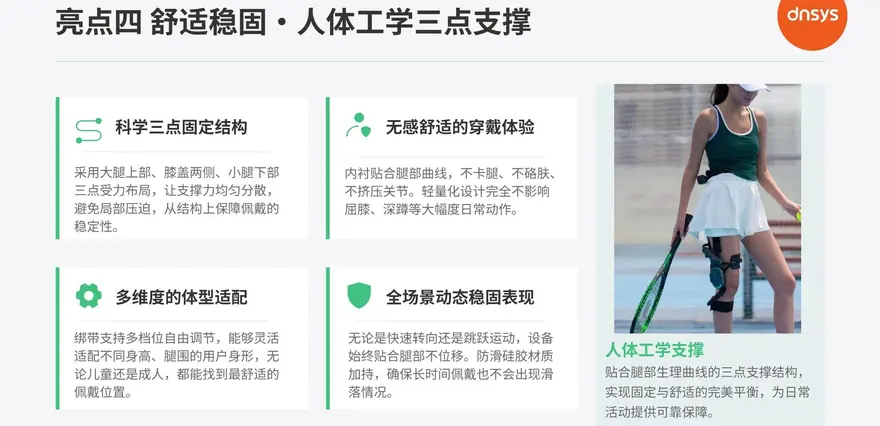
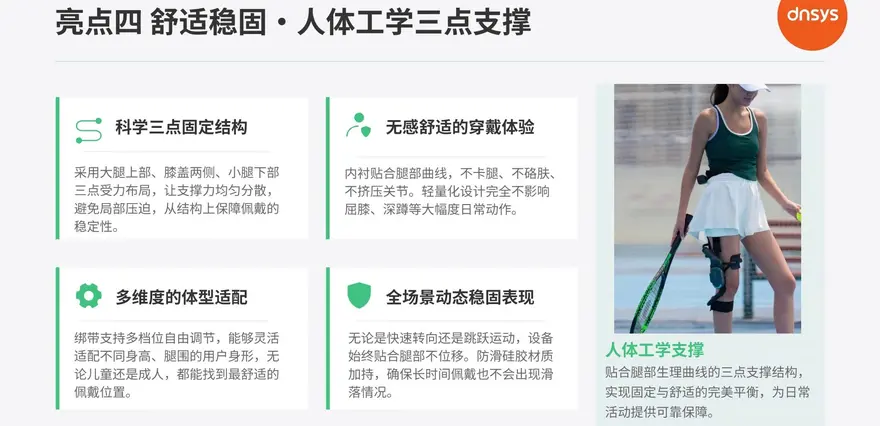
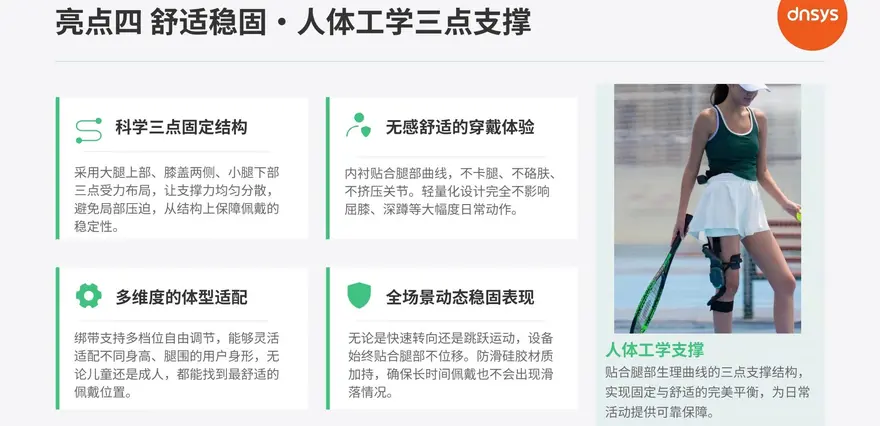
No matter how powerful the hardware is, it is completely useless if the device isn't comfortable to wear. DN6Sys adopts a "three-point support" design and multi-section adjustable straps to securely anchor the assist to the thighs and shins, while avoiding any direct pressure on the front of the knees. Large-area breathable materials and a meticulously tuned fit significantly reduce fatigue and local discomfort during extended wear.
Mentioned in the video: The design follows ergonomic principles, utilizing multi-section breathable straps and a contoured support structure to emphasize both comfort and stability during long periods of wear.
For wearable computing devices of this kind, comfort and assistive performance should be orthogonal yet parallel objectives. Users should not have to choose between "useful" and "comfortable to wear"—this is precisely the product philosophy that consumer-grade devices should embrace.



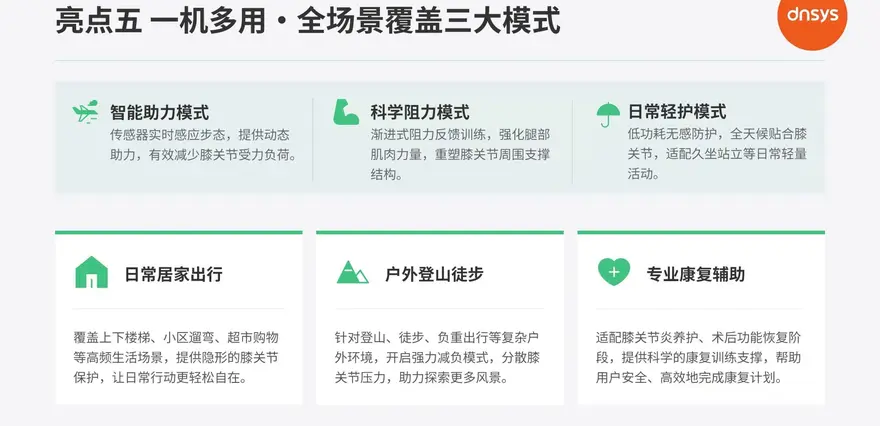
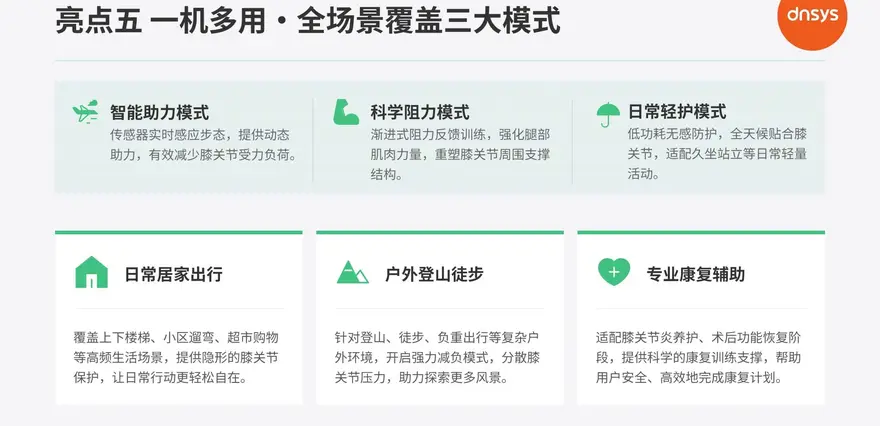
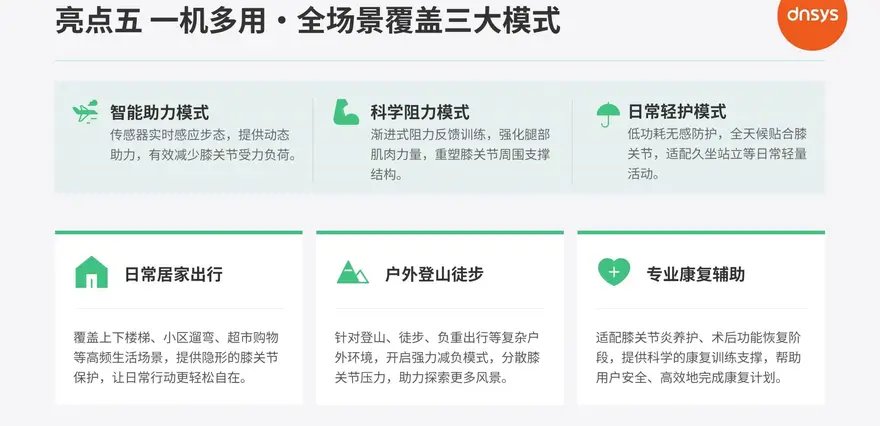
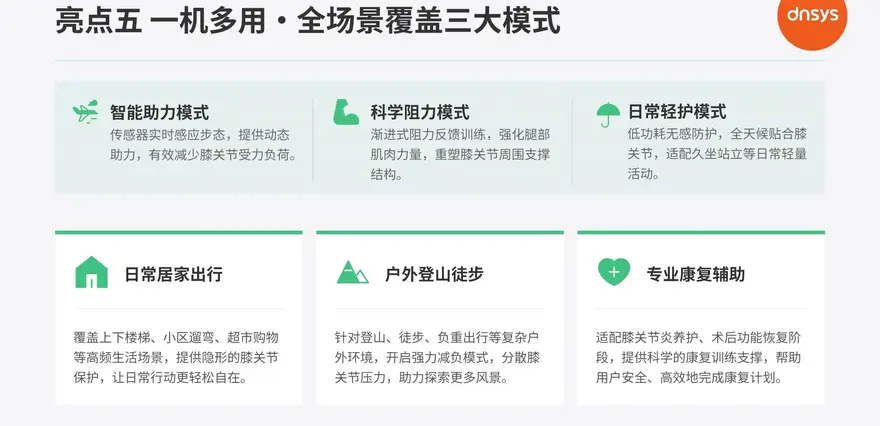
VI. One Device, Multiple Uses: Commuting, Hiking, Business Travel, and Even Post-Surgery Rehabilitation
The scenario coverage of DN6Sys is specific and practical for daily life:
- Commuting: Transit, walking, and shopping. It mitigates knee fatigue caused by prolonged walking without requiring active motor or battery input.
- Outdoors: Hiking and trekking assist. It specifically targets the effort required for "lifting the thigh" during uphill climbs and "cushioning impact" on downhill slopes.
- Rehabilitation: Provides a quantifiable, relatively safe walking assist solution for users recovering from knee surgery.
"The video mentions: It supports multi-mode switching to meet the needs of daily commuting, outdoor trekking assist, and post-surgery rehabilitation."
Important Note: While rehabilitation exoskeletons are typically medical-grade and require use in professional institutions under the guidance of physicians, consumer-grade devices with "rehabilitation assist" capabilities should still adhere to safe recovery pacing and individual differences. Regarding mode boundaries: DN6Sys's "rehabilitation assist" leans toward mild, daily wearable support rather than replacing professional medical rehabilitation equipment.

7. KERS Kinetic-Energy Recovery: Turn Every Step Into Electricity
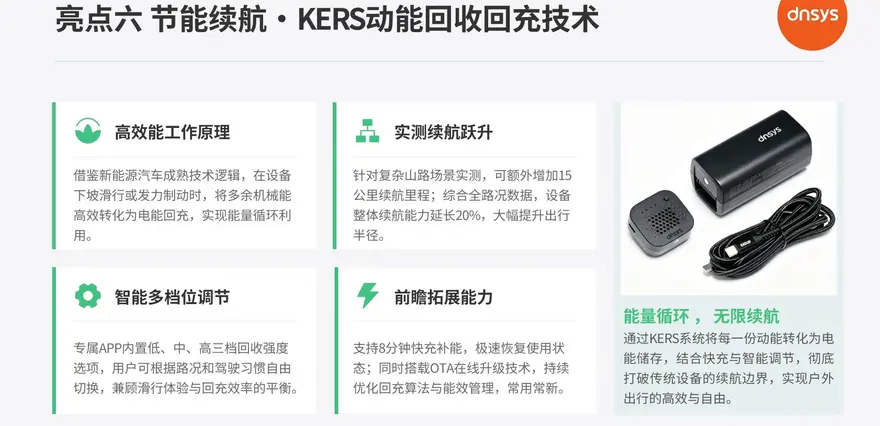
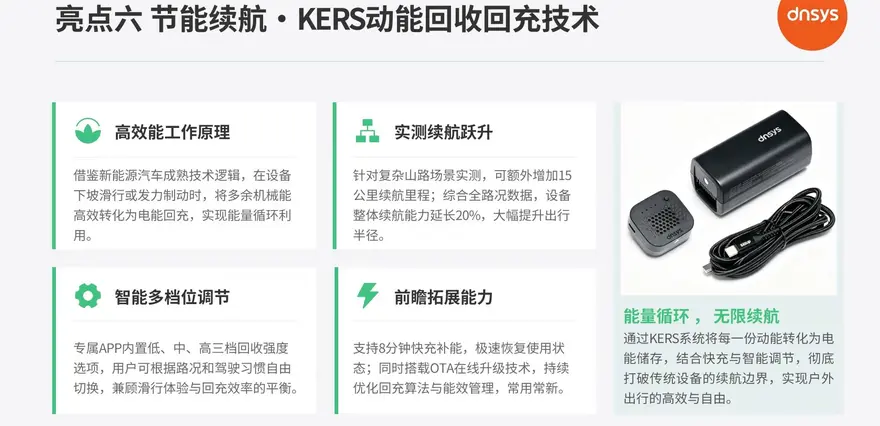
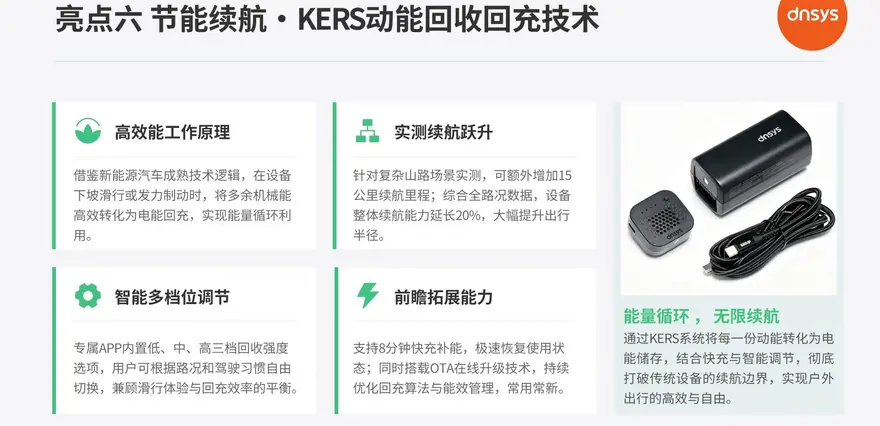
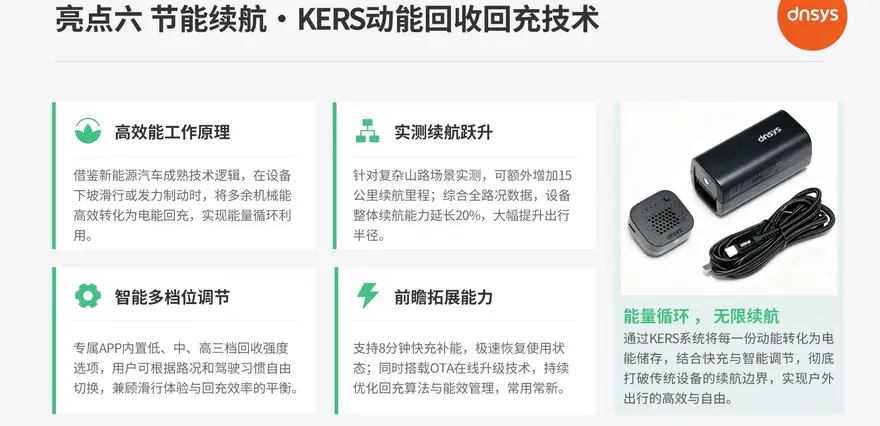
One of the coolest—and most practical—moves is bringing the kinetic-energy recovery concept from new-energy vehicles to exoskeleton technology: when descending, coasting, or braking, part of the mechanical energy is converted into electricity and fed back into the battery, thereby extending battery life. Even better, users can fine-tune the recovery intensity through the app, balancing ride feel with recharging efficiency.
The video notes that KERS recovery can add roughly 15 km of range on complex mountain trails. Combined with full on-road test data, overall battery life is extended by about 20%. It supports 8-minute fast charging and OTA firmware updates.
The product philosophy behind these figures is straightforward: an exoskeleton isn’t just about brute force—it’s about energy management. On steep climbs and descents under heavy load, the more effective the recovery, the farther you dare to roam.
VIII. Hands-On & Field Test: Should You Buy It? How to Use It Best?
If you fall into any of the following groups, the DN6Sys is worth a try:
- You walk a lot on daily commutes and go up and down stairs frequently, leaving your knees prone to soreness and swelling.
- You enjoy hiking/trekking and want to reduce knee joint load while extending your range per battery charge.
- You are in post-knee-surgery recovery and need progressive, gentle walking assist — without being "locked in" by bulky equipment.
In terms of product positioning, the DN6Sys leans toward "a wearable assist and protection device." It won't make you sprint, but it will help you "walk longer and more steadily." Keep this in mind and your expectations will be appropriately grounded. Practical usage tips:
- Start in a low assist level plus low recovery intensity, giving your body and joints some "acclimation time."
- Focus on "lifting" on uphills, "stability" over long distances, and "ease" on downhills — let the device do what it does best.
- Pair with the APP to fine-tune parameters and find your own "gait curve."
Mentioned in the video: leg force efficiency can improve by up to about 50%; the advantage is even more pronounced in high-intensity scenarios such as large strides and rapid uphill/downhill movement.
IX. Compared to Whom? Consumer-grade Positioning within the Industry Landscape
If we compare it with full-body lower-limb exoskeletons, the Dnsys naturally will not match their peak joint torque and max payload; yet, its advantage lies in being specialized for the knee—lightweight, wearable, and suitable for daily use. Compared with conventional knee braces, it provides active walking assist instead of passive support; and, unlike medical-grade rehabilitation exoskeletons, it is more accessible to purchase and easier to adopt.
The video notes: Compared with traditional exoskeletons, Dnsys emphasizes lightweight wearability, a knee-centric focus, and longer battery life.
In other words, knee-specific consumer-grade exoskeleton devices like the Dnsys are defining a category that is much closer to everyday life: not just for a few extreme scenarios, but for the many ordinary moments. This is also a crucial step that the consumer-grade exoskeleton industry must take.
10. Scenario-Based Usage Recommendations: Boundaries for Commuting/Hiking/Travel/Rehabilitation
- Urban Commuting: It is recommended to use a "gentle assist" mode with "low energy recovery" to minimize its presence and maximize long-term comfort. In scenarios like subway rides, walking, or supermarket shopping, the goal is walking for extended periods without fatigue.
- Outdoor Hiking: Use "lift-assist" for uphills and "damping + kinetic energy recovery" for downhills, converting negative impact on the knees into battery power for the remainder of your journey. In real-world mountain trail tests, the significance of "covering an extra 15 kilometers" isn't about showing off technology, but about having enough power to complete the day's route.
- Business/General Travel: Its foldable and lightweight design makes it an item you'll want to bring with you. Long waits at the airport, walking, and visiting exhibitions all become noticeably easier.
- Post-operative Rehabilitation: It is crucial to proceed gradually under the guidance of a doctor or physical therapist, focusing on a "correct gait" and an "appropriate load." The device is an assistive tool, not a replacement for your body's own recovery.
XI. Pre-Purchase Checklist: 5 Things to Consider
- Frequency of Use: The more you walk daily, the greater the benefit. With occasional use, the perceived advantage will be less noticeable.
- Wearing Comfort: Individuals with sensitive skin or those who prefer minimal constriction on their legs should try the device on first.
- Weight & Portability: Despite their lightweight design, you still need to consider the "space in your bag" and the max payload.
- Battery Life & Charging: KERS efficiency varies with your gait, so for extreme journeys, you'll still need to plan for charging.
- APP & Firmware: Tech-savvy users who enjoy customization will appreciate multi-level adjustments and OTA updates, while those unfamiliar with the app can simply use the default mode.
Mentioned in the video: The regenerative intensity is adjustable across multiple levels, with support for fast charging and OTA.
XII. Shortcomings and Improvements: Honesty Drives Progress
- As a knee-focused consumer-grade exoskeleton, its assistive limits become more apparent on extreme terrain (e.g., steep technical climbs); that is not its intended use case.
- For users with complex joint issues or significant pain, consult a medical professional first—do not let assist replace diagnosis.
- The feel of kinetic-recovery varies by user on complex surfaces; test and tune extensively.
- Its high-tech look makes it stand out in formal settings.

Top Community Comments
“As a daily commuter, I’m tempted—but would wearing it on the subway look too over-the-top?”
- Takeaway: Appearance and “social acceptance” are must-answer questions for a consumer-grade exoskeleton. If the footprint and look lean more like “sports gear,” it will be easier to accept in subway and office settings.
“Does 900W mean it drains fast? Can it really last a full day?”
- Takeaway: Users are focused on the balance between power and battery life / runtime. Higher power doesn’t automatically mean higher energy use—the key is energy management and recovery efficiency. Actual endurance (in hours) depends on gait and load.
“Offsetting a 150 kg load on descents? That sounds a bit too good to be true.”
- Takeaway: This reflects curiosity about the “assist + cushioning” principle. At a physical level, it’s about re-routing force lines through the structure and assist curves, rather than literally “creating antigravity.” More detailed real-world testing is expected.
“How much carbon fiber is actually used? Can you share the total weight?”
- Takeaway: Lightweighting is king. Users want clear data on weight and the share of materials (e.g., carbon fiber), so they can judge how burdensome it is to carry.
“Can I use it right after surgery? Or do I need rehabilitation training first?”
- Takeaway: The safety boundary is critical. Even if a consumer device offers rehabilitation-assist modes, users should follow professional rehabilitation plans and progress step by step.
“Can KERS energy recovery really extend runtime by 20%? Is the difference big between uphill and downhill?”
- Takeaway: Battery anxiety is a common pain point. Routes with more downhills yield clearer gains; on flat ground and uphills, performance relies more on battery capacity and algorithmic energy management.
“Will there be a short-leg version? I want something lighter for international travel.”
- Takeaway: Portability and packability are essential. A more “travel-friendly” folding/storable form would further spark purchase intent among heavy-duty travelers.
One-Sentence Summary
The Dnsys DN6Sys is a consumer-grade assistive exoskeleton designed with a dedicated focus on "knee scenarios." By combining dual power transmission with AI prediction, it achieves active joint load reduction. Furthermore, its lightweight, portable design and KERS (Kinetic Energy Recovery System) significantly extend the runtime and operational boundary. This makes it an ideal solution for daily commuters, hiking enthusiasts, and users requiring daily rehabilitation under professional guidance. If you are looking for a "willing to wear every day" joint protection and assistive solution, the DN6Sys is definitely worth a try.
About this article: part of Chinese-Made Exoskeleton Review Archive — an independent, regularly updated English archive of reviews of consumer exoskeletons made in China, edited from publicly available video transcripts. Not an official manufacturer page.
For inquiries and purchasing, contact lonlonago@foxmail.com. More in Rehab & Mobility · All articles.