Real-World Test of a Consumer-Grade Exoskeleton: When an "Add-on Knee" Starts Lifting Your Legs, How Many Steps Are Left on the Mountain Trail for the Elderly?
```markdown
__IMG0__
…continuing from the previous section, this wearable robotic device … ```
First Impressions: Wearing an Exoskeleton Just Like a Pair of Clothes
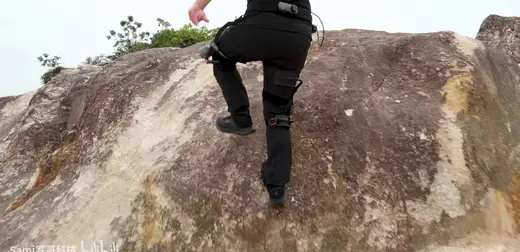
As the video kicks off, the UP host immediately gets into his exoskeleton-wearing mode. Slipping into this gear isn't just a quick, casual step; it demands the fine-tuning precision of an Adjust. The UP host repeatedly tweaks the leg straps, muttering phrases like "a bit too talladjust it a little lower", and "pull it closer to my waist". This perfectly captures the standard fitting procedure for a first-time exoskeleton setup. For any lower-limb exoskeleton, the snug fit of the lumbar assist module and the leg sensors dictates whether the sensor can accurately track the wearer's gait data.


"At first when I put it on, it feels a bit heavy."
This was the UP host's immediate reaction upon getting fully geared up. However, the transition right after is crucial: "The feeling vanished after just a few steps. Even though it didn't sync or assist simultaneously, the weight disappeared entirely." This means the sheer weight of the heavy-duty gear is completely neutralized by a powerful assistive system.

Fit and Comfort: A Protective Feeling Without the "Leg-Cutting" Pain
The physical connection between the exoskeleton and the human determines whether it turns from an assist into a burden. In the video, the creator specifically pointed out a detail:
"These straps don't dig into your legs, they're extremely comfortable, and the fit around the leg is really good."


This part is incredibly compelling. Many similar products from Tanluzhe and Aosha face issues with strap compression, however, this product's strap system does a great job with pressure distribution. Furthermore, the creator also emphasized its fit:
"There’s just the right amount of cushioning."

Levels and Control: Seamless Assist Starting at Three Levels
The video mentions assist levels multiple times: “three levels,” and “there are also level 4 and level 5.” The uploader describes this as “three-level processing.” In practice, it means the assistive exoskeleton algorithm uses a progressive output logic—as the wearer’s motion state changes, the joint torque and assist output adjust accordingly.


“This isn’t one-and-done; there are also level 4 and level 5.”
For consumers, level adjustment means users can choose from light assist to strong boost based on their own physical condition. Starting at level 3 is beginner-friendly, so you don’t have to worry about an overly aggressive driving force suddenly disrupting your gait.

All-Scenario Assist: Stairs, Downhill, and “Keeping Up with Young People”
The most exciting part of the video is how the exoskeleton performs under walking assist and in high-resistance scenarios. When the creator was going down stairs and walking downhill, he said, “It really is a bit too much (too strong).” That suggests the assistive exoskeleton still provides significant assist intervention when moving downward—which could actually raise safety concerns. However, the creator later said it was fine. On flat ground, when walking faster, he said, “Now I can keep up with young people—it feels sharp and brisk.”


The most valuable segment of the experience is about running. After jogging a few steps, the creator marveled:
“I could originally run five kilometers, but now I can run ten. The moment you lift your leg, it just gives you an effortless boost.”
That feeling captures the core value of an assistive exoskeleton—providing leverage-like traction at the instant the user lifts the leg and steps forward, reducing the instantaneous peak force required from the muscles.


Beyond Assistance: The Psychological Mechanism of Overcoming the "Reluctance to Walk"
The insight offered in the second half of the video is quite profound. The creator points out that beyond providing direct assistance, this product delivers another core effect:
"Once some people experience leg discomfort, they develop a sense of reluctance and fear toward walking. With this device on, they simply have to keep moving forward, whether they want to or not."


This is not just simple hardware logic; it represents a "behavioral intervention" approach. Companies like Chengtian and Kengqin follow a similar logic, using highly efficient assistance and fail-safe mechanisms to overcome psychological barriers, build user trust, and encourage continuous use.

Hands-on Summary and Viewer Perspective
The entire video is actually a really excellent qualitative hands-on experience. Although the creator did not provide official specifications, they mentioned some highly crucial data points:
“Ninety percent remaining.” (Mentioned in the video, battery life status display)
“Starting from the third gear, and there are also fourth and fifth gears.” (Mentioned in the video, gear description)


[Author's note: Since this article is based on a speech transcription, the original text did not include specific brand names. However, based on the experience described—such as the "waist belt + leg straps,multi-gear adjustment," and "assisting in lifting the legs"—this is a typical consumer-grade lower-limb exoskeleton with potential for hiking, trekking, and walking assist scenarios.]


Top Community Comments
@Reader: The buying frenzy is on again—come join the rush!
Analysis: This comment is essentially a promotional push, highlighting how consumers are focused on sales and purchasing channels for the hardware.
@User A: Would this be a poor fit for someone with slender legs?
Is this a silly question? Not at all. It underscores user concerns about max payload and suitable height range.
@User B: Could this exoskeleton make people dependent on it?
This is the perennial ethical debate surrounding consumer-grade assistive devices. The tool itself doesn’t create dependency—poor user experiences can.
@User C: Looks great, like donning a battle suit!
Positive feedback on aesthetics matters, especially for users who need a psychological boost.
@User D: Could it work against you when going downstairs?
Safety is the top priority—consumer instincts about risk are often sharper than product logic.
@User E: Is this most suitable for someone with gout-affected knees?
Today’s users really understand their needs; gout-affected knees are a prime target for consumer-grade exoskeletons.
@User F: I’d love to wear this for my daily commute—I think it’ll make me love walking.
Subtle shifts in commuting habits are the ideal outcome for wearable hardware.













One-Sentence Summary
This is not a medical device, but a personal piece of equipment that makes you "more willing to walk." For middle-aged and elderly users with past knee injuries who want to keep pace with the younger generation, this is a technological advancement worth experiencing.
About this article: part of Chinese-Made Exoskeleton Review Archive — an independent, regularly updated English archive of reviews of consumer exoskeletons made in China, edited from publicly available video transcripts. Not an official manufacturer page.
For inquiries and purchasing, contact lonlonago@foxmail.com. More in Rehab & Mobility · All articles.