Say goodbye to “being driven by the machine”: A new algorithm from the University of Waterloo that “reads” your gait in 30 seconds—is this the end of the human-machine struggle in exoskeletons?
The Awkward Reality of Shifting from "Human-Robot Collaboration" to "A Robot Driving the Human"
If you have worn a lower-limb exoskeleton before, you might have experienced a very peculiar sensation: it is indeed exerting force to assist you, but you often feel like you are battling a stubborn, unyielding machine. If you don't step forward, it forcefully shoves you; if you try to take a large stride, it pulls you back tightly.
This isn't human-robot collaboration; this is "a robot driving the human."
This phenomenon, known in robotics control as human-machine inconsistency, is the very vine strangling the path of consumer-grade exoskeletons toward mass adoption.
In the robotics circle, this is referred to as "physical conflict." While traditional exoskeletons can provide assistance, they often grind the wearer down by imposing pre-set mechanical frameworks, as they are simply incapable of perfectly comprehending the spontaneous, adaptive variations of the human walking gait. Today, we are discussing a groundbreaking study that could fundamentally alter our understanding of "wearable robotics."
Translator Note: I have adhered to the original paragraph spacing rules. Also, I have adapted the English terms "wearable robotics" (keep as is) and "consumer-grade exoskeleton" (in order to reflect your target terminology table). The quoted speech section in the blockquote has also been faithfully preserved.
What Is "Human-Machine Misalignment": A Dual Misalignment in Time and Space
This physical conflict—the feeling that the device is "pushing against you"—is known in academia as “Physical Mismatch” or human-machine misalignment. It consists of two layers of contradiction.
The first layer is timing misalignment. The system’s computation and actuation can introduce latency: before your center of mass is fully stabilized, the algorithm may already decide you need forward propulsion and rush to drive you ahead. This creates a sense of being torn between the human and the machine.
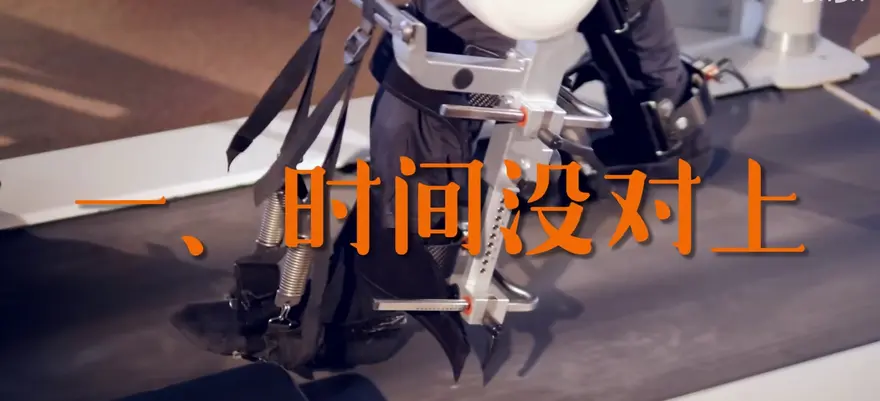
The second layer is spatial misalignment. Human walking patterns (gait) vary widely from person to person, and even the same individual changes stride length across different terrains. However, traditional controllers often prescribe a rigid, fixed trajectory. When you try to take a longer step, the mechanical structure forcibly constrains you to an imposed path, generating strong opposing forces at the joints.

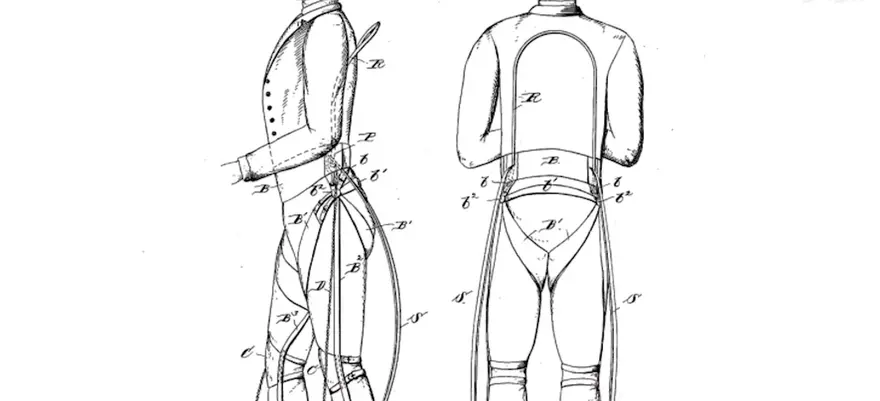
Helping People Exert Force vs. Letting People Kick Back: The Exoskeleton Dilemma
Over the past decade, scientists have largely solved the "time synchronization" issue using various spatiotemporal rhythm algorithms. However, when faced with individual spatial differences, traditional controllers remain as rigid as a fixed measuring scale.
Some might ask: Since fighting against the machine feels so uncomfortable, why not just completely eliminate the counteractive force? Just go with the user's natural momentum, and it will be comfortable.
The answer is: You can't.
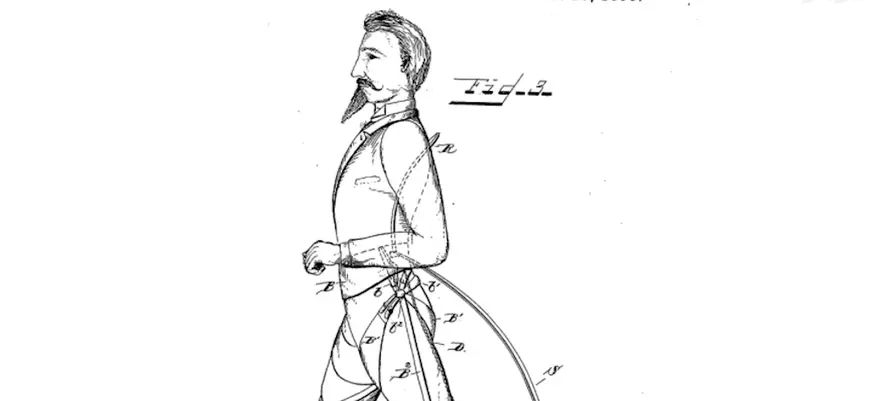
> If we solely aim to eliminate the counteractive force, humans will become lazy and completely abandon their own muscle strength. This is an outcome that rehabilitation medicine absolutely never wants to see.
For a rehabilitation exoskeleton, the ultimate goal is certainly not to turn users into complete "slackers" who do absolutely nothing. Instead, it is to provide "just enough" assistance precisely when needed, while maximizing the active engagement of both the human brain and muscles. This presents a massive challenge for algorithm design: How can it perfectly align with your gait while maintaining the optimal level of assistance?
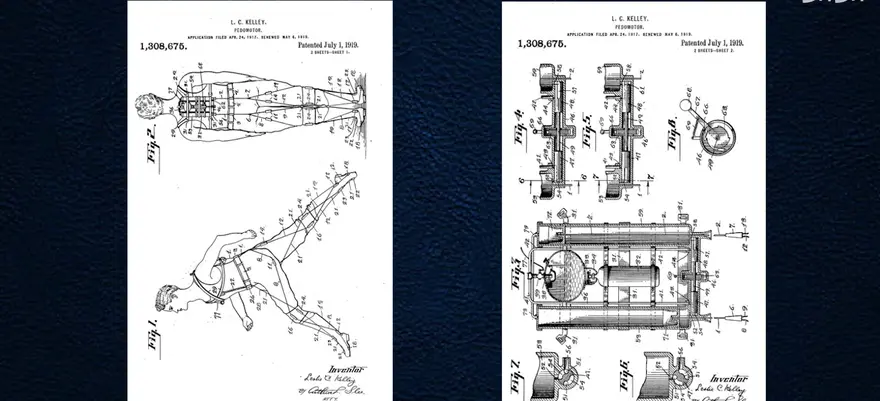
The Sordid History of Legacy Approaches: Rigid, Fixed Trajectories
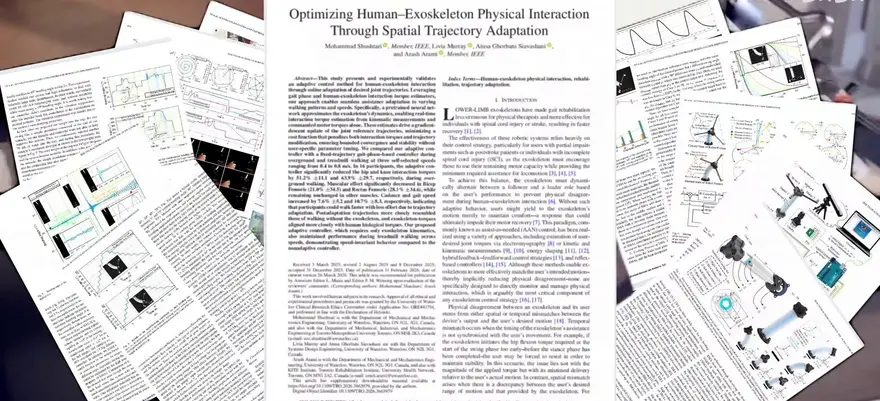
A research team from the University of Waterloo in Canada and other institutions unveiled an exceptionally elegant solution in the flagship robotics journal IEEE TRO (Transactions on Robotics).
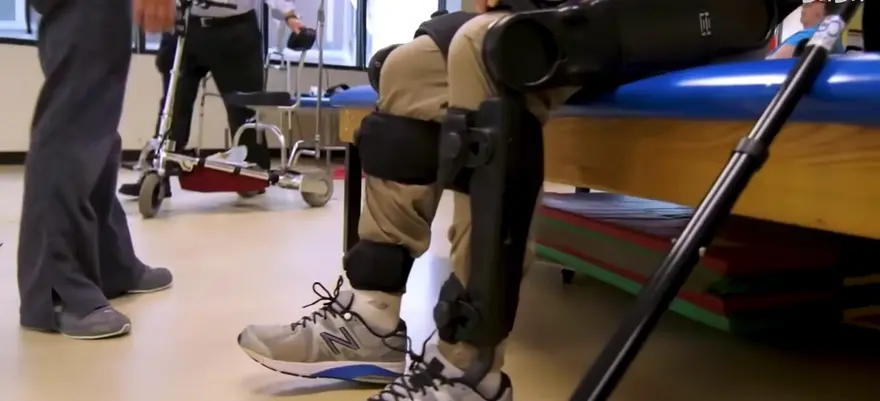
To validate the concept, the researchers skipped armchair theorizing and instead deployed a top-tier hardware verification platform—the Indigo Explorer lower-limb exoskeleton platform.

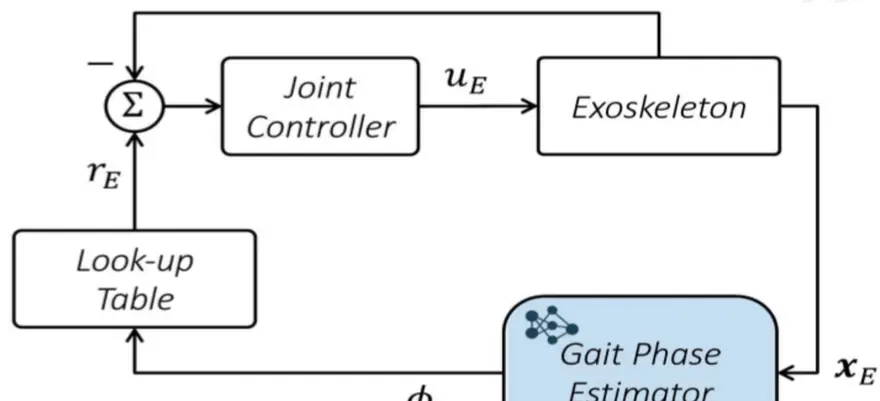
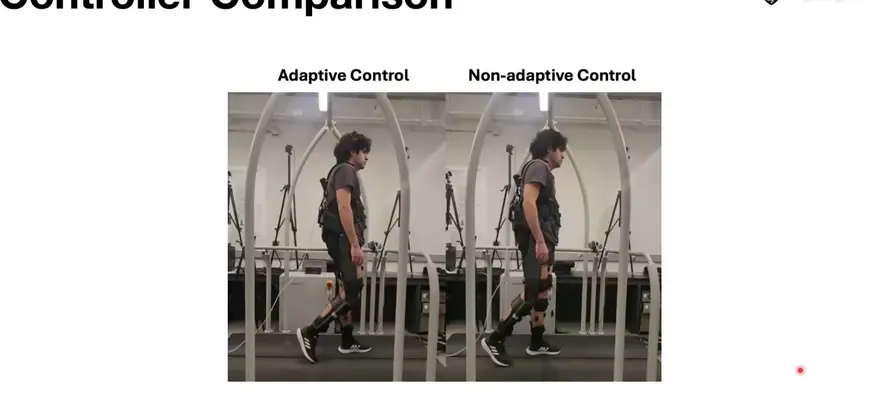
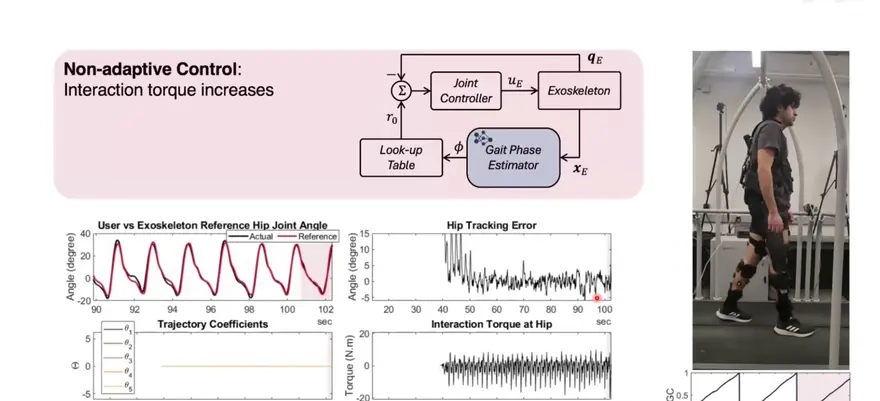
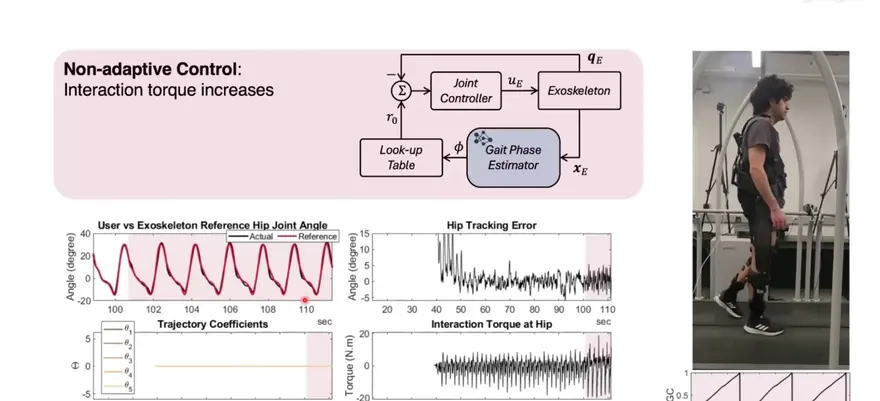
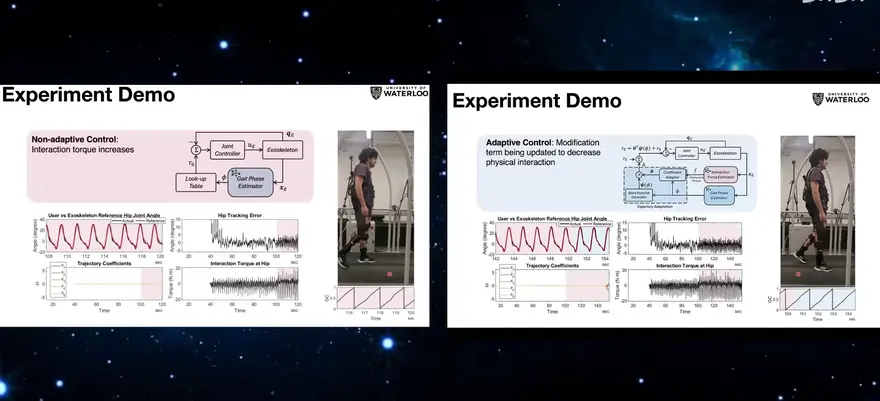
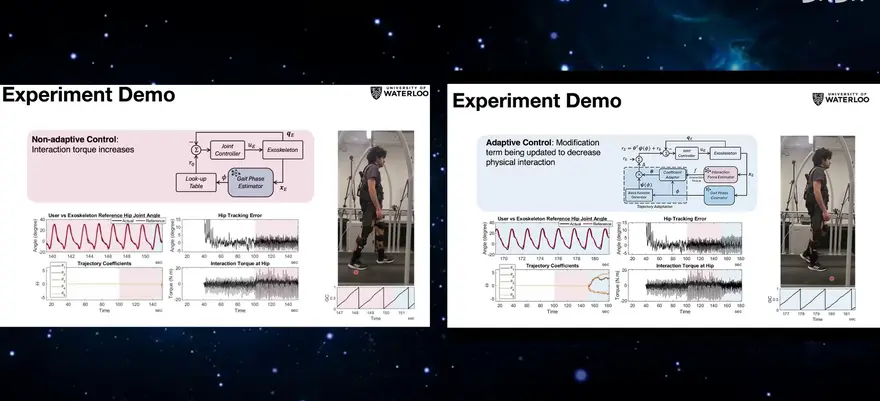
Let’s see how rigid legacy No-Adaptive controllers are: In the conventional mode, the system first employs a pre-trained neural network to estimate your walking gait phase (i.e., determining which stage of the stride you’re in, such as heel strike or toe-off).

Once the current gait phase is identified, the system rigidly outputs a pre-set trajectory curve. Regardless of which shoes you’re wearing today or whether your legs feel strong or fatigued, it forces you to follow that template. This is precisely why traditional exoskeletons often feel like they’re fighting against you.
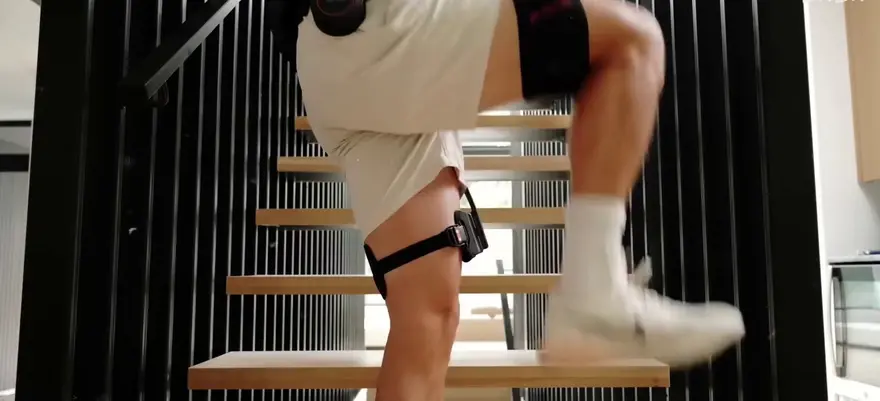
Black tech arrives: zero-contact reading of human-machine interaction force
The research team's genuine black tech hides in a brand-new Adaptive controller.
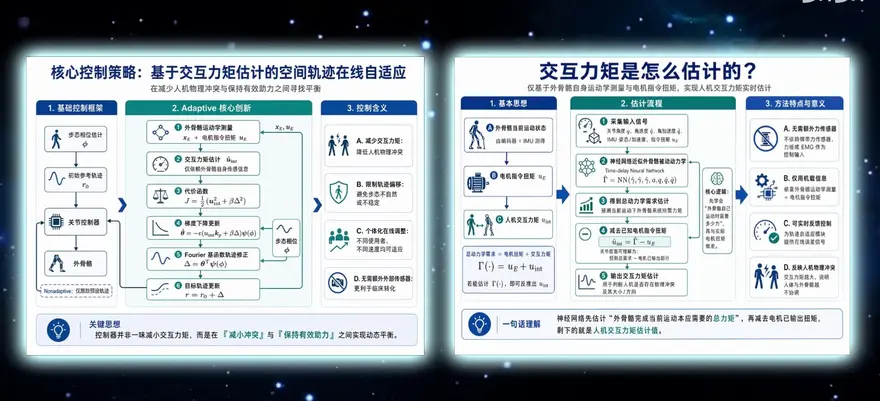
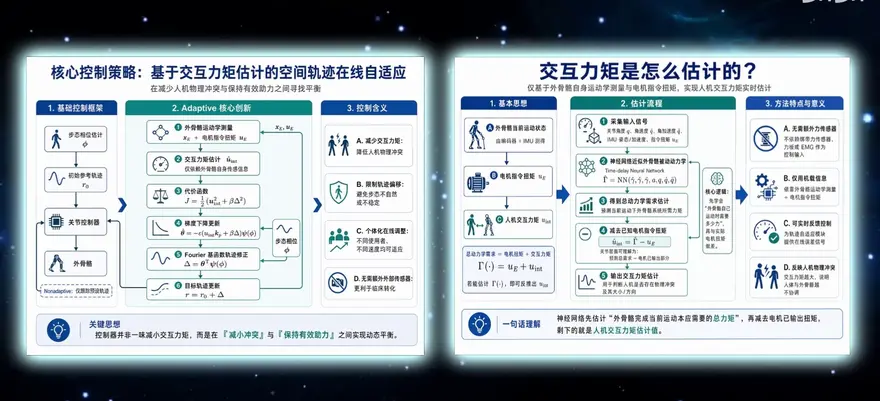
The most brilliant part of this approach: **it does not make you stick any complicated force sens
The Romance of Mathematics: Multi-Objective Balance in Optimization Equations
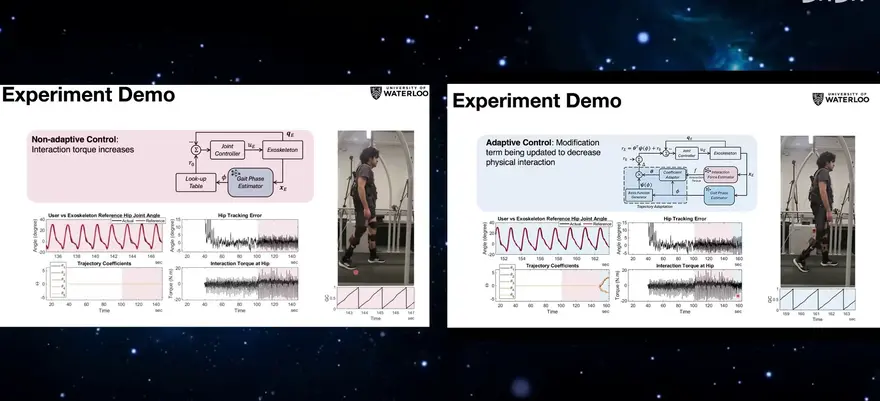
The paper decomposes the exoskeleton’s desired motion trajectory into an ingenious parameter combination: initial trajectory + correction term.
This correction term is expressed as a complex-frequency function and updated in real time via the Gradient Descent algorithm. Here, the algorithm’s “neural circuitry” is essentially solving an exquisite balancing act, with two mutually opposed optimization objectives:

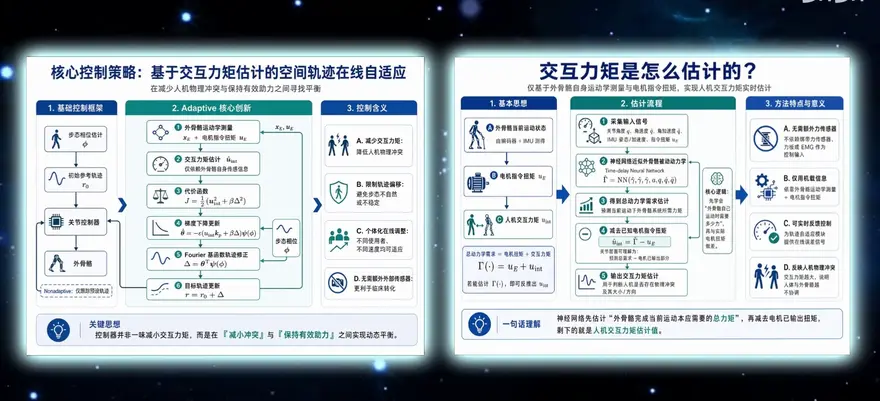
On one hand, it strives to reduce the human-machine interaction joint torque. When it senses that the user’s leg is resisting, it steers the exoskeleton to follow the user’s force, minimizing “head-butting” friction. On the other hand, it penalizes any trajectory that drifts too far from the initial template. If the system caters blindly to zero opposition and simply follows every erratic move, it could produce unnatural or even unstable, bizarre gait patterns, potentially leading to falls.
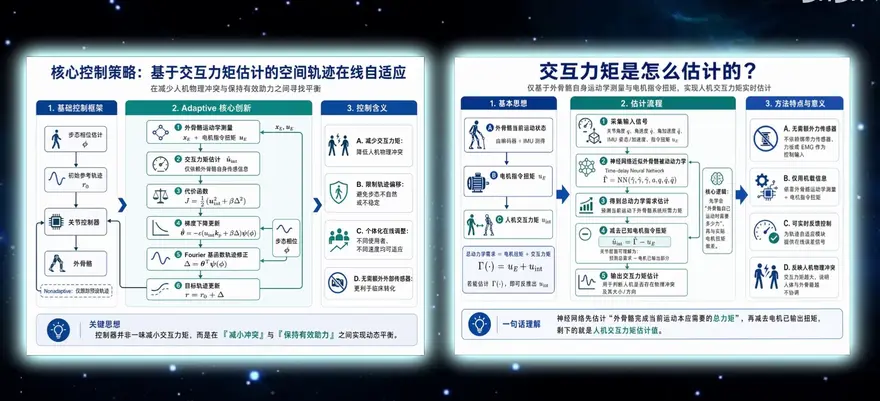
> This boundary awareness is critical. The ultimate goal of a rehabilitation exoskeleton is to deliver just enough assistance when needed while preserving the active participation of human muscles as much as possible—not to let the user lie back completely.
Most impressively, this algorithm requires no pre-training specific to individual users and no tedious manual tuning. Within just 30 seconds, it can generate a personalized, adaptive motion trajectory tailored specifically for you.
Real Results Matter: Fluid Human-Machine Synergy
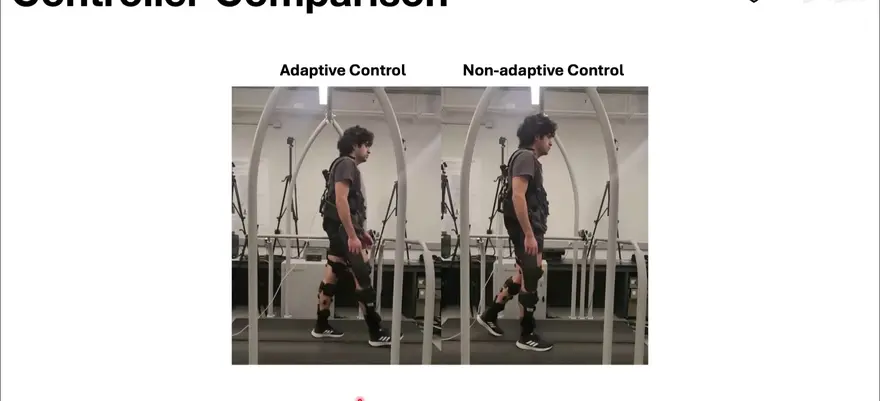
When it comes to theory vs. reality, the clinical data is paramount. The research team recruited 16 volunteers to conduct rigorous testing on flat ground and treadmills. They tested at three different speeds: ultra-slow, slow, and medium, pitting the adaptive controller against the traditional controller.
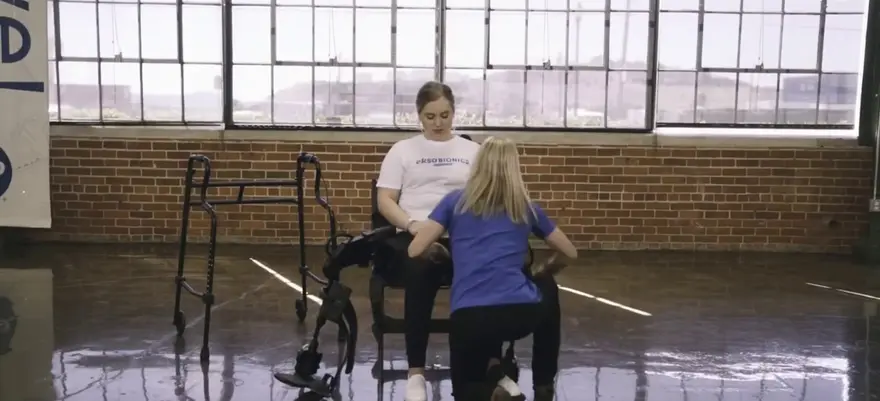
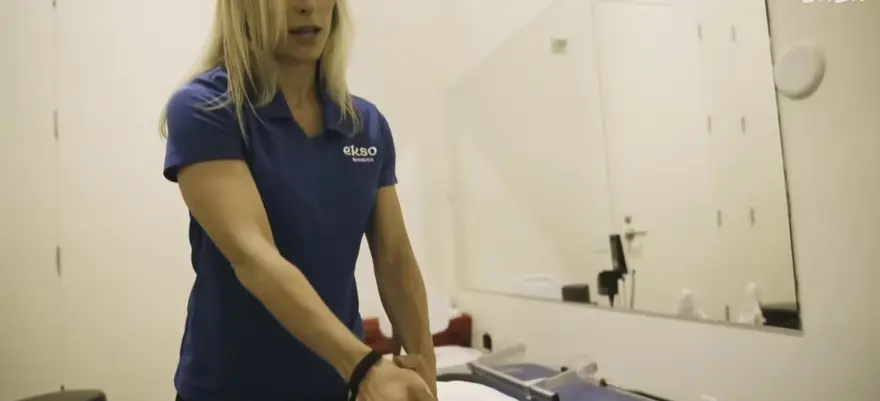
The experimental results not only passed rigorous statistical tests but also delivered significant impact regarding the physical sensation data:
- During level walking, compared to the traditional fixed-track controller, the adaptive controller reduced human-machine resistance at the hip joint by 51.2% and at the knee joint by 63.9%.
- The stuttering and the tearing sensation of being forcefully pulled by the machine completely disappeared, replaced by a fluid assist.
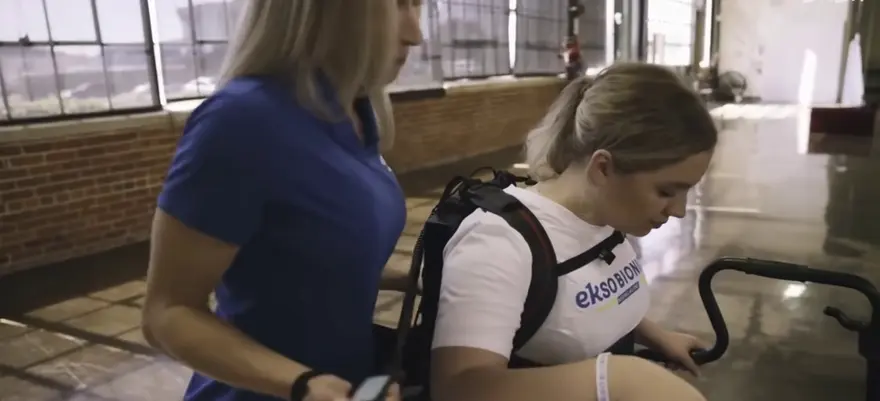
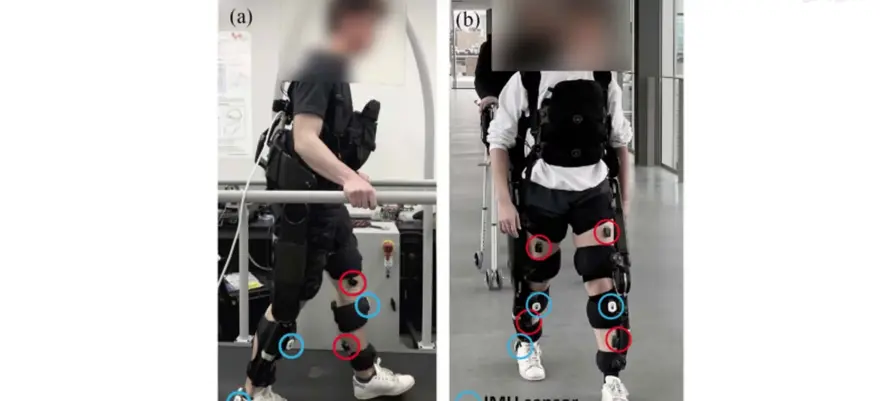
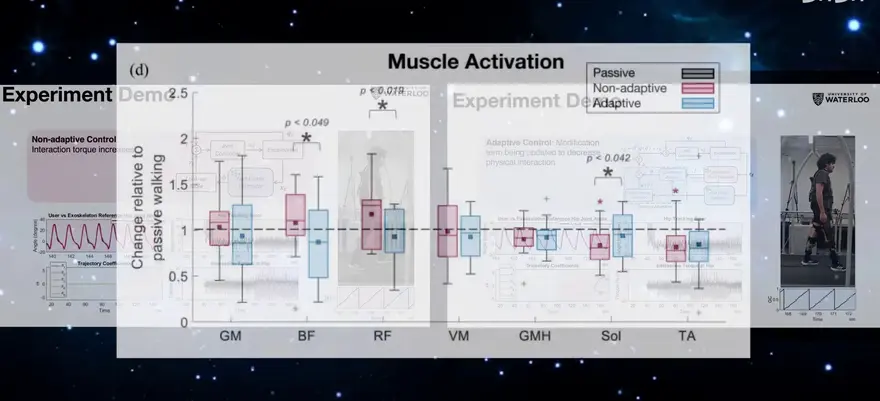
> By collecting Electromyography (EMG) signals, it was found that the Muscular Effort of the Rectus femoris on the anterior thigh and the Biceps femoris on the posterior thigh was significantly reduced by 28.1% and 21.0%, respectively. This indicates a substantial increase in force generation efficiency.
Even more impressive quantitative metrics emerged: while volunteers felt less fatigue, their gait stability improved by 7.6% and their overall walking speed increased by 10.7%. This means it wasn't just more comfortable, but the walking capability was actually enhanced.
The Grand Industry Blueprint: From Rehabilitation Robots to Consumer-grade Exoskeletons
Although this impressive study has so far been validated only on healthy subjects, it unveils enormous imagination space for the entire industry: blazing-fast self-adaptation and zero-parameter personalization.
Let’s take a look at cutting-edge pioneers in the industry (Note: examples are based on the hardware platforms mentioned in the video and the current industry landscape):
- Indigo Explorer lower-limb exoskeleton platform: As a top-tier research validation platform, it offers precise kinematic measurements and powerful joint torque control, while its closed-loop control system provides an exceptional proving ground for state-of-the-art control algorithms.
- AoJing, Keqing, Tanluzhe (TOREAD) and other domestic brands: These companies are actively introducing carbon fiber lightweight structures and brushless motors into the consumer-grade market. A significant bottleneck they have encountered in the past was the inability to resolve, at low cost, the individual differences caused by varying height and weight.
- Emerging players such as Hypershell and Yuntai Technology (Yuntai): They are bringing micro-actuators and advanced adaptive algorithms into more everyday scenarios.
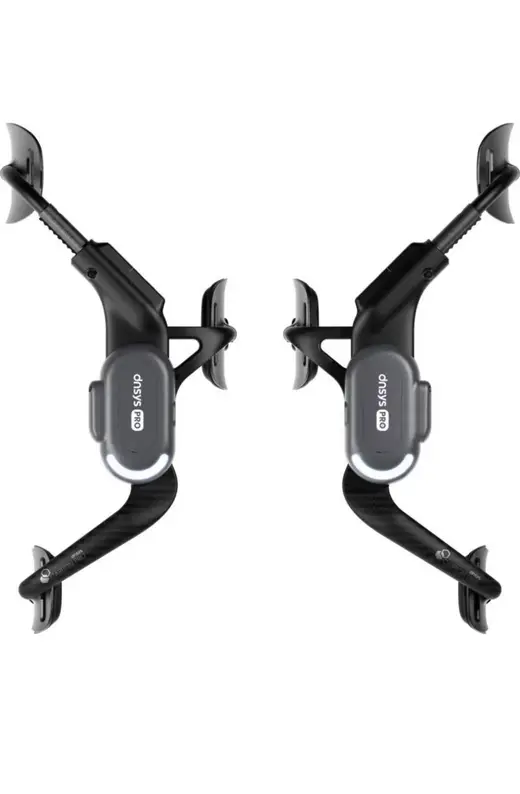
- Exoskeleton R&D enterprises like Dnsys: Their deep work in next-generation control systems is opening fresh commercial possibilities for consumer-grade assistive devices.
> In the future, rehabilitation robots will no longer be cold, strict trainers forcefully correcting you, but rather gentle dance partners that can read your physical condition within 30 seconds.
This research demonstrates that, through clever algorithmic design, we do not need to force wearers to adapt to the machine; instead, the machine genuinely accommodates the human biological gait. By quietly empowering you while respecting individuality and preserving autonomous muscle exercise, this may be the right path for wearable robotics to enter everyday life.

Top Community Comments
> @Reader (5 likes): Dudes who have never worn an exoskeleton won't understand; it's like a cheat macro for your mouse! [doge]
> @-xing_han_can_lan- (4 likes): Feels like pretty traditional tech anyway.
> @Reader (2 likes): Love you guys, so professional and entertaining.
> @Reader (3 likes): If this algorithm is adapted for hiking / trekking assist, reducing knee pressure, it's going to be a total game-changer!
> @Reader (1 like): With housing prices this crazy, who is a normal person going to buy this thing to wear?
One-Sentence Summary
This University of Waterloo TRO study leverages an elegantly adaptive algorithm and dual-objective optimization to tackle the long-standing human–machine tug-of-war in the exoskeleton field. By delivering a 30-second, zero-perturbation, code-customized gait, the research sets an exemplary benchmark for how future smart wearable devices—spanning medical rehabilitation and consumer hiking exoskeletons—can truly become person-aware and step into a new era of human-centric design.
About this article: part of Chinese-Made Exoskeleton Review Archive — an independent, regularly updated English archive of reviews of consumer exoskeletons made in China, edited from publicly available video transcripts. Not an official manufacturer page.
For inquiries and purchasing, contact lonlonago@foxmail.com. More in Tech & Design · All articles.