The exoskeleton sector's third boom: unpacking the supply-chain opportunities behind the consumer-grade exoskeleton breakout
Exoskeleton, not robot: the heated debate over augmenting humans vs. replacing humans
Today, we want to talk about a track that’s booming for the third time—the exoskeleton robot field. Why is it so special? In the tech world, this is a rare area that has been “hot three times”: it took off in 2014, was hyped again in 2016, and went viral once more in 2021. Each time it was hot for only three days and then cooled off completely. But this time, things might really be different.
Before analyzing the industry, we have to debunk a concept that’s most frequently confused: it’s called a robot, but it’s not really a robot.
The essence of a humanoid robot (embodied AI) is to give AI a body so it can replace humans at work. The logic of exoskeleton, however, is exactly the opposite: it “puts” machinery on you to enhance your capabilities.
“One replaces humans, and the other augments humans—these are two completely different paths. Humanoid robots need to solve general intelligence, which is nowhere in sight for five to ten years. But exoskeletons don’t need that. When you wear one, your mind is still yours.”
This difference in logic directly determines the pace of commercialization. Humanoid robots face the technical barrier of general intelligence, whereas exoskeletons are much more pragmatic—they don’t require AI to have self-awareness; they only need to perceive your intentions precisely and assist with exertion.



Four Engines Ignite Simultaneously: Why Is This Time Truly Different?
If this third boom is still just hype, then how do we explain everything happening right now? The answer is simple: four engines are igniting simultaneously for the first time.
Engine One: Technological "Dimensional Reduction Strike". In the past, exoskeletons often weighed ten to twenty kilograms, making wearing them even more exhausting than carrying the load itself. With the maturation of domestic carbon fiber production, the situation has drastically changed. Taking the Haier W3 as an example, the overall weight has been forcefully brought down from over 20 kilograms to just 1.75 kilograms. This is backed by the domestic substitution of harmonic reducers and brushless motors, directly slashing the cost of core components by over 60%.
The video mentions: "Bringing the whole machine down from over 20 kilograms to 1.75 kilograms—this is the current hardware level of the Haier W3."
Engine Two: Policy Backing. This is the first time that exoskeletons have an "official price tag." Beijing took the lead by including the training of lower-limb walking assist exoskeleton robots in medical insurance, priced at 222 yuan per session, followed soon after by Jiangsu and Guangdong. This not only benefits patients but also marks the official establishment of a payment reference standard for the entire industry in the medical field.
Engine Three: Consumer Market Explosion. During the 2025 Spring Festival, a video went viral showing the Zhongtianmen section of Mount Tai: a middle-aged man wearing an exoskeleton was climbing the Eighteen Bends as easily as walking on flat ground. Shortly after, ChengTian Tech's consumer-grade product went on sale at a price of 2,599 yuan, selling out within 15 seconds.
Engine Four: Capital Giants Enter the Arena. In May 2026, Ant Group and Meituan Dragon Pearl jointly led an investment in Keji Technology. This is the first time internet giants have entered the exoskeleton hardware track as lead investors. Ant Group targets the health data behind 320 million elderly people, while Meituan sees the industrial applications behind the 300 million delivery riders and users.
How Big Is the Market? Understanding the Underlying Logic of "Three Orders of Magnitude"
When it comes to exoskeletons, the data provided by different institutions often causes a headache. Take the global market size for 2025 as an example: Markets and Markets projects it at 560 million USD, while another institution estimates 12.16 billion USD. The valuation differs by nearly 20 times. It is not that one calculation is wrong, but rather that the definitions are not standardized: the narrow scope only accounts for finished machines, whereas the broad scope includes rehabilitation aids, industrial equipment, and core components.
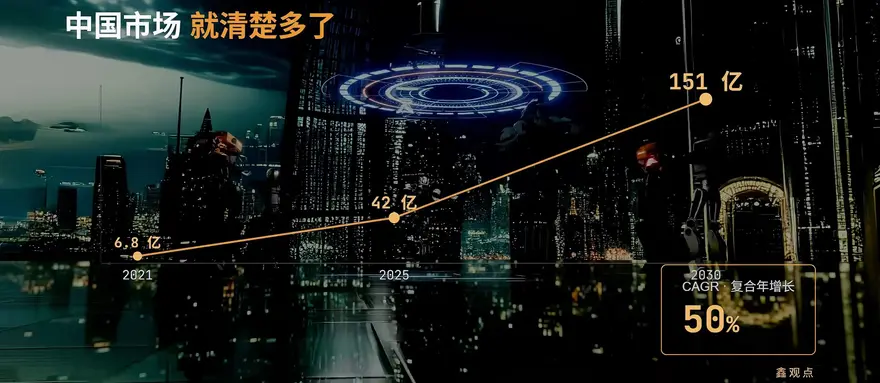
However, in China, the data trend is relatively much clearer. The Chinese exoskeleton market grew from 680 million RMB in 2021 to 4.2 billion RMB in 2025. It is expected to break through 15.1 billion RMB by 2030, with an annualized compound growth rate of approximately 50%.
"What is more memorable than the annualized growth rate is this instantaneous data: from January to April 2026, the online retail sales of smart walking assist exoskeletons surged by 785%. You heard that right, not 78%, but 785%. This is the real moment of the industry transitioning from 0 to 1."



Dissecting the Industry Chain: Upstream with ~58% Gross Margin Is the Real “Picks-and-Shovels” Player
The exoskeleton industry is not shaped like a single “smile curve”; instead, it comprises three high-barrier tracks. To read the race clearly, you have to start by breaking down the supply chain.
- Upstream core components (gross margin ~58%): This is the most stable layer. No matter which downstream scenario wins—medical, industrial, or consumer—the market will still need reducers, brushless motors, IMUs (inertial measurement units), and carbon fiber structural parts. Typical representatives include several leading suppliers of reducers, brushless motors, IMUs, and carbon fiber structural components.
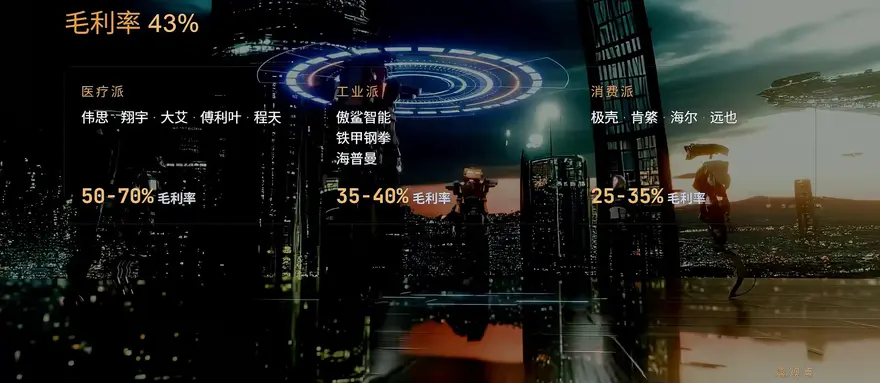
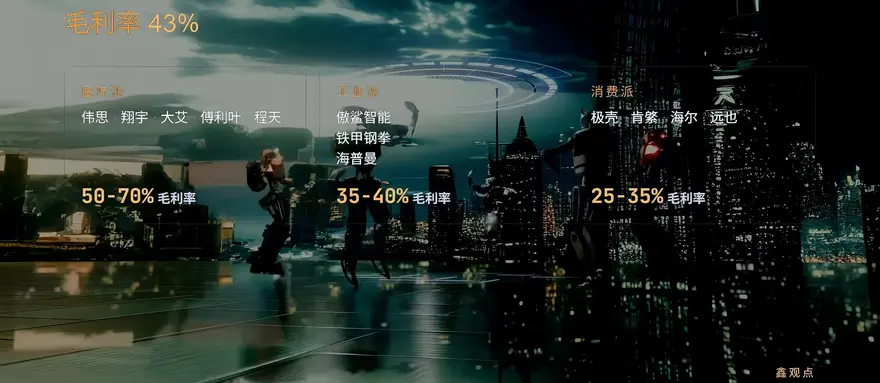
- Midstream system integration andcomplete unit manufacturing: There are three camps. The medical-focused camp (including Chengtian), with gross margins around 50%–70%; the industrial-focused camp (including Aoshark and Haier), driven by strong demand; and the consumer-focused camp (including Kenqing and Yuanye), with gross margins around 25%–35% and a focus on cost-performance.
The video notes: “Upstream players make money regardless of which downstream scenario wins. That’s the real ‘picks-and-shovels’ business. In the long run, if shipments reach tens of millions of units, the incremental demand would be roughly 3.2 billion for motors, 12 billion for reducers, and 4 billion for IMUs—bringing the upstream growth opportunity close to 20 billion.”



Distinct pay logic across four scenarios: healthcare leans on insurance, industrial hinges on payback
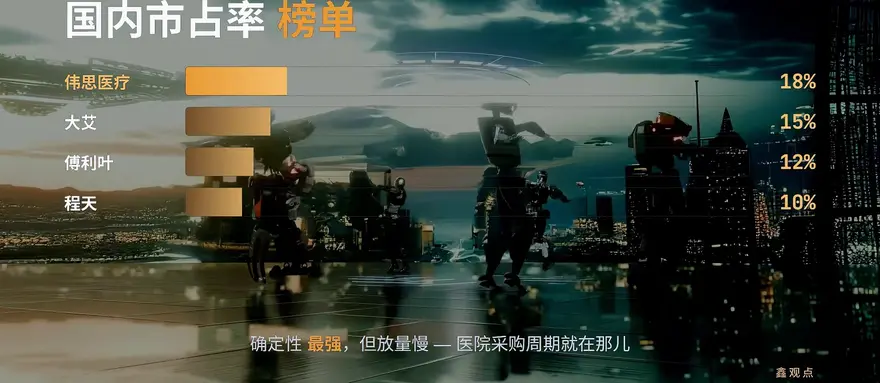
Medical rehabilitation: the anchor for cash flow. This track has the clearest certainty, but ramps more slowly. In China, the population needing rehabilitation care is about 35 million, and annual new stroke cases exceed 2.5 million. Domestic medical-grade rehabilitation exoskeletons are priced at RMB 200,000–500,000 per unit. Earlier, Beijing added training to medical insurance coverage (RMB 222 per session). In the competitive landscape, Dnsys leads with an 18% share, followed closely by Daai, Fourier Intelligence, and ChengTian.


Industrial assist: the fastest-scaling scenario. Industrial use doesn’t need to wait for a technology inflection point—it’s purely a math problem. Across global manufacturing and logistics, 34% of workplace injuries are musculoskeletal. Data shows that exoskeletons can reduce risk by 55%, while also improving efficiency and easing staffing pressure.
Quoted in the video: “The average payback period for exoskeletons in industrial settings is 14 months—right at the psychological threshold for industrial equipment purchases.”
At present, Aosai Intelligence is the absolute leader (89% market share), with a customer roster that includes JD Logistics, BYD, Boeing, and Walmart.
The Exploding Consumer-Grade Track: The Real Pain Points Behind Doubled Customer Traffic and a 60% Return Rate
This is the track with the highest ceiling, yet also the highest risk. The user pool is incredibly enticing: there are 320 million people aged over 60 and 400 million outdoor hiking and mountaineering users in China. Combining these yields a total of 700 million people—100 times the size of the medical rehabilitation population.
Price wars have also begun: the Keji X series is priced at 6,999 to 13,999 RMB, the Chengtianyixing at 2,599 RMB (selling out instantly upon launch), and the Kenqingpai series at 8,280 RMB. Even the Taishan mountain scenic area has launched a rental service, offering three hours of use for 80 RMB.
However, massive hidden risks lurk beneath this prosperity.
Mentioned in the video: "Currently, the online return rate for consumer-grade exoskeletons is as high as 60%. Why? Because consumers have different heights, different body postures, different wearing habits."



Big Players Aren’t Joining the Fray to Sell Hardware: They’re Zeroing In on the ‘Human-Body Data Gateway’
A 60% return rate has laid bare a core pain point for consumer-grade exoskeletons: difficult device fitting. The experience of imagining mind-blowing performance before purchase but encountering a device that simply does not fit afterwards means an exoskeleton cannot rely solely on hardware sales to generate revenue.
So what will tomorrow’s business model look like? The answer is straightforward: whoever turns an exoskeleton into a data gateway wins.
That is why Ant Group and Meituan are investing heavily. Single-unit hardware profits are not on their radar.
- Ant Group is after the gait data and chronic-disease management models of 320 million elderly people.
- Meituan craves the physical-exertion data and delivery-capacity scheduling insights from 300 million couriers.
When an exoskeleton is no longer a mere external muscle booster but a full-blown human-body sensor network, every leg lift, every burst of power, and every recorded joint torque will rewire the service models of these tech giants.




Timeline Forecast: In 2026 Focus on the Industry, in 2027 Focus on Data, in 2028 Focus on the Competitive Landscape
When we lay out the timeline, the logic becomes very clear:
- In 2026, look for an industry breakout: Four engines are igniting—expansion of medical insurance coverage, consumer hit products proving successful, and full-scale entries of major players across the board.
- In 2027, look for data validation: We need to focus on real return rates, repeat purchase rates, and gross margins. Whoever can survive the data “stress test” will emerge as the true leader.
- In 2028, look for a reshaping of the landscape: Industry standards will be established, valuations will be revised, and a major reshuffling will take place.
“In the exoskeleton race, the ceiling may not be as high as in new energy vehicles, but the demographic base is substantial, payment scenarios are clear, and industrial signals are observable. It is a prime industrial track with long-term growth potential from Wuhan, solid fundamentals, and a well-defined rhythm.”





Top Community Comments



One-Sentence Summary
“The exoskeleton isn't a robot, but a technological singularity that 'enhances humanity.' By 2026, the consumer-grade exoskeleton has evolved from a geek toy into a mainstream consumer product. The real game in the next decade will be identifying which company turns the exoskeleton into 'the master data gateway for the human body'—that will be the defining battle for capital.”

About this article: part of Chinese-Made Exoskeleton Review Archive — an independent, regularly updated English archive of reviews of consumer exoskeletons made in China, edited from publicly available video transcripts. Not an official manufacturer page.
For inquiries and purchasing, contact lonlonago@foxmail.com. More in Industry · All articles.