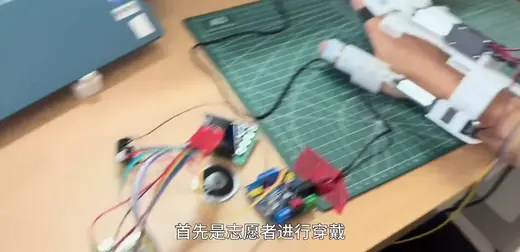
Superpowers in Just One Wear: Why exoskeleton robots are poised for an explosion before humanoid robots?
Wearable Smart Equipment: ‘exoskeleton’ at the Tipping Point of Explosive Growth
When it comes to the exoskeleton, your first thought might be heavy-duty mecha armor. But in today's tech world, it has long evolved into a smart device you can "wear" directly. After years of progression, the consumer-grade exoskeleton leverages precision mechanical structures and sensing technology, combined with AI algorithms, to subtly enhance human strength, protect the body, and even help mobility-impaired individuals stand and walk again.
Compared to general-purpose humanoid robots—which many believe are still far off—the exoskeleton is poised to become the next trillion-dollar market to experience explosive growth first.
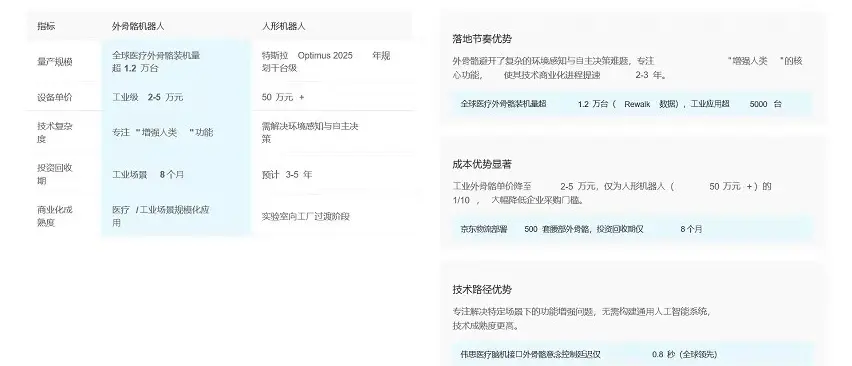
The global exoskeleton market size surpassed $1.2 billion in 2023, and the industry is standing right at the tipping point of explosive growth.
Why can it achieve large-scale commercialization earlier? We have to look at its underlying technical composition. The International Federation of Robotics (IFR) has long categorized it alongside industrial robots and service robots as one of the three core branches of smart equipment.




A Full Leap in the Tech Foundation: From Mechanical Assist to "Intelligent Enhancement"
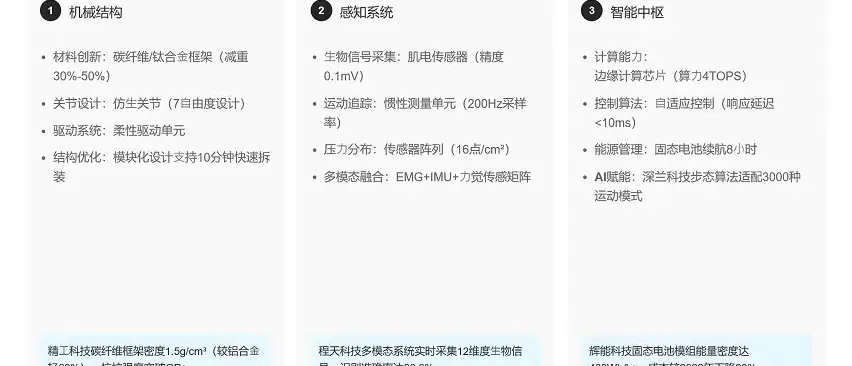
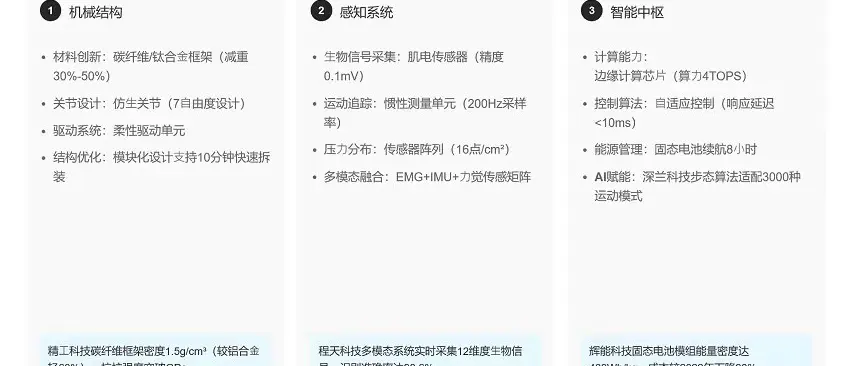
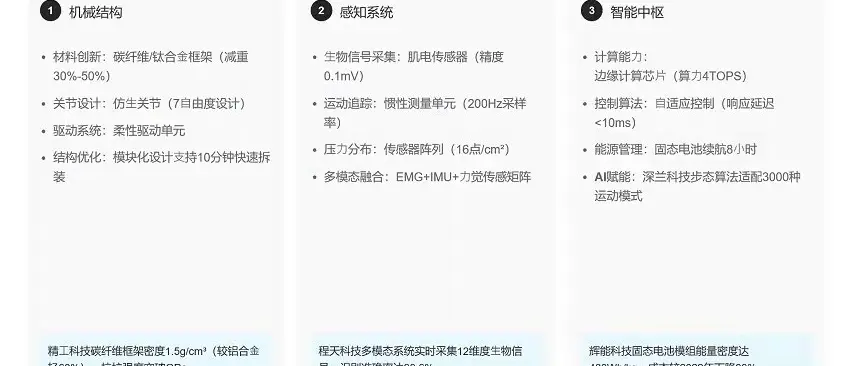
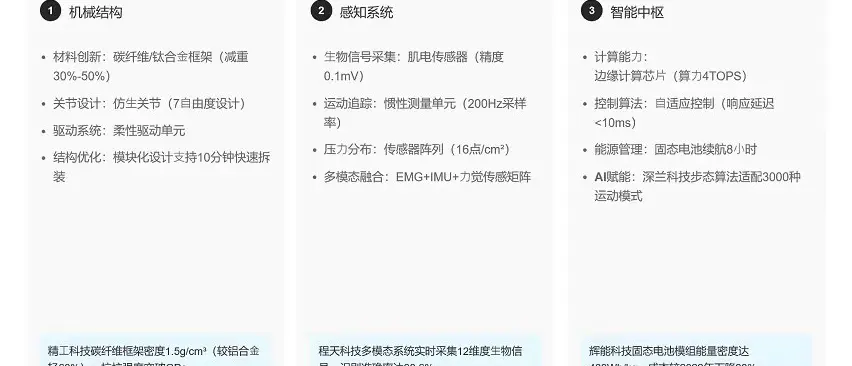
A modern exoskeleton is primarily composed of three core subsystems. First is the mechanical structure that acts as the skeleton, which nowadays generally employs carbon fiber or titanium alloy frameworks—achieving a substantial 30%-50% reduction in weight compared to conventional materials. Second is the sensing system, where tiny EMG sensors, inertial measurement units (IMU), and pressure sensors capture the faintest human motion signals in real time. Finally, the smart control hub acts as the "brain," equipped with an edge AI processor and adaptive algorithms to control the device and execute instantaneous responses.
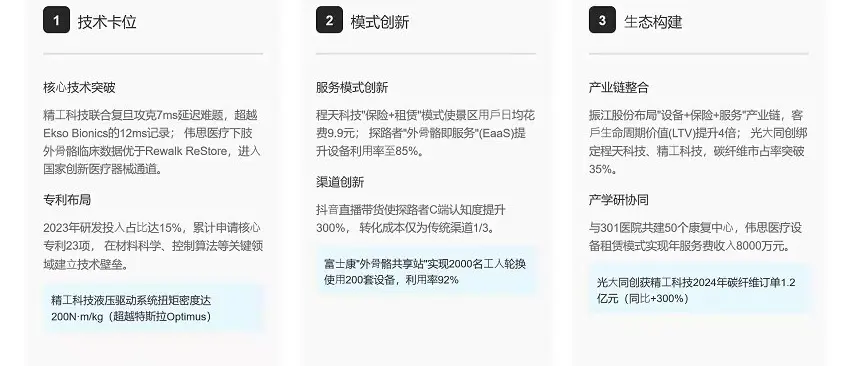
Camera-based lag typically takes tens of milliseconds, whereas a truly superior exoskeleton can complete intent recognition within 10 milliseconds—even faster than a human blink.
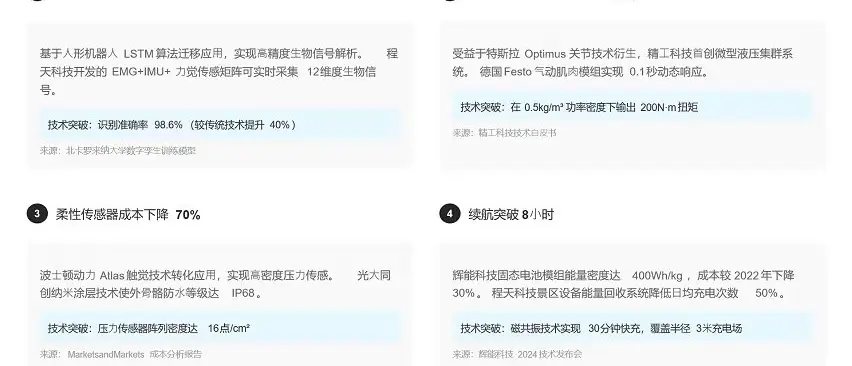
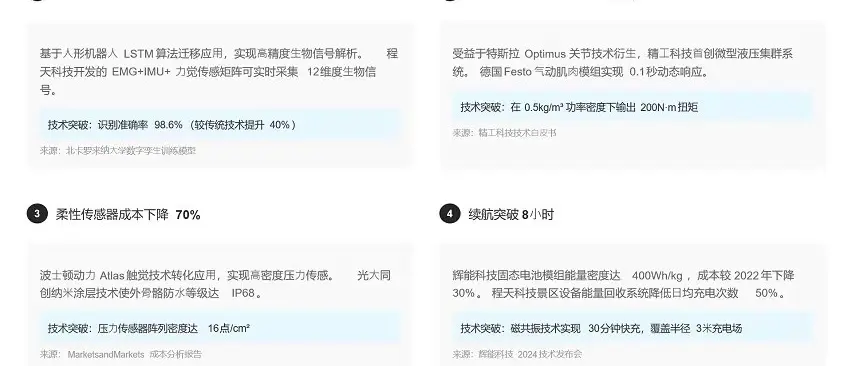
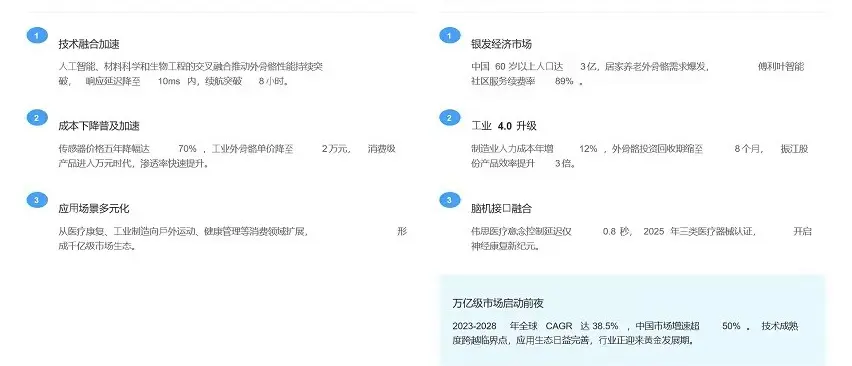
2024 marks a critical inflection point in exoskeleton evolution, breaking through several key technological thresholds: intent recognition accuracy across the industry has generally surpassed 95%, the power density of actuator systems has reached 300 watts per kilogram (W/kg), the cost of flexible sensors has plunged by 70%, and battery endurance (in hours) has finally crossed the 8-hour milestone.
It is particularly worth noting that the underlying technical framework shared by exoskeletons and general-purpose humanoid robots is completely interconnected.
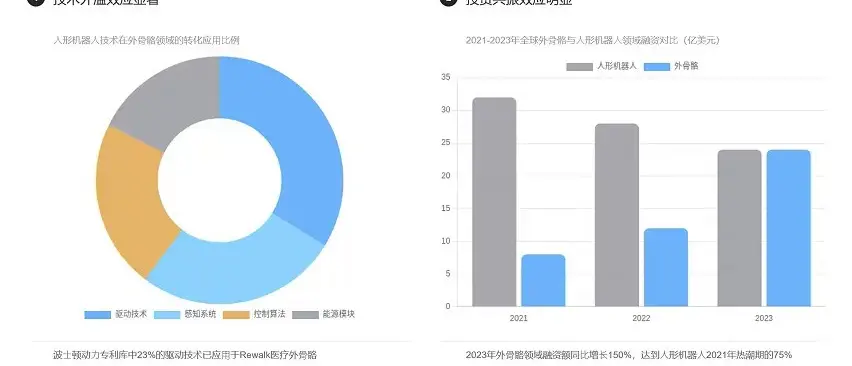
Boston Dynamics has successfully migrated 23% of its core actuation technologies to medical-grade exoskeletons. The current explosive growth in humanoid robots is aggressively, in turn, empowering the exoskeleton industry.
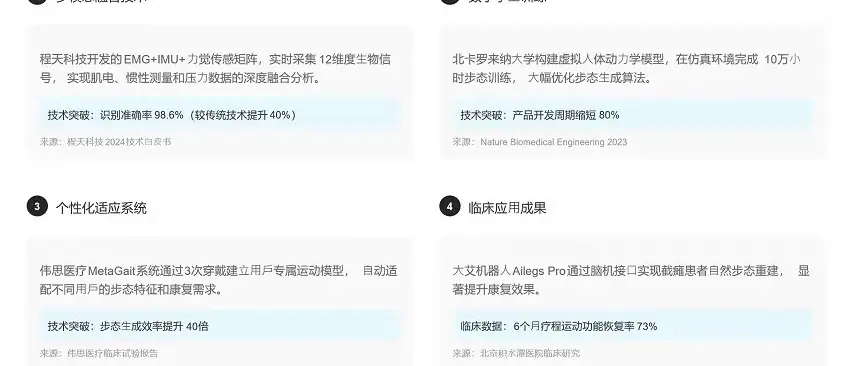
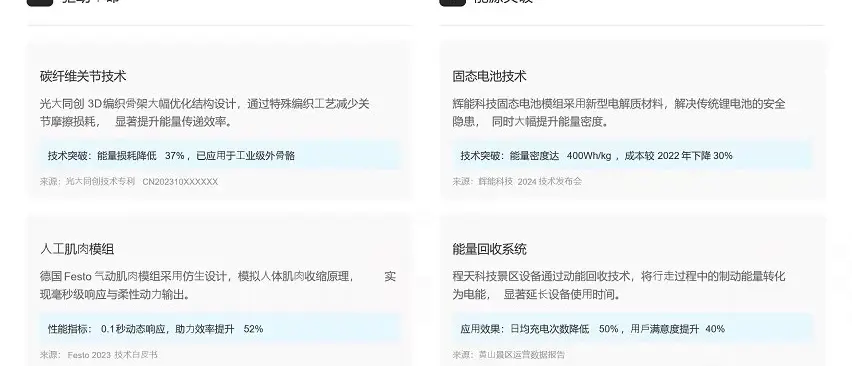
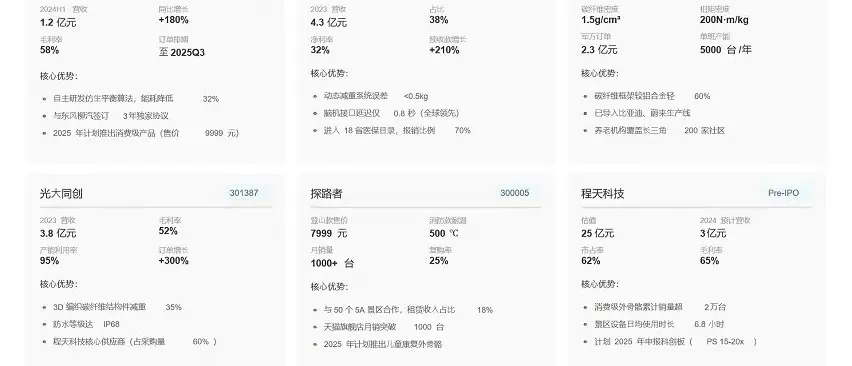
For instance, the UGO exoskeleton developed by ChengTian features a multimodal fusion sensing system capable of simultaneously capturing 12 dimensions of biosignals, achieving a recognition accuracy rate of 98.6%. Moreover, employing digital twin technology, the University of North Carolina (UNC) has completed 100,000 hours of gait training in virtual environments, accelerating the product development cycle by an astounding 80%. On the actuation front, Festo'spneumaticartificial muscle modules BioRobot, paired with the HART smart bionic hand, compresses response time to just 0.1 seconds; solid-state battery energy density has broken through 400 Wh/kg with a 30% cost reduction compared to 2022, while carbon fiber joints can further reduce energy loss by 37%.







Medical Rehabilitation: The Most Mature "Cash Cow" Scenario
Among all application scenarios, medical rehabilitation is currently the most technologically mature and most lucrative field. It represents a completely different track from the targeting young people. By utilizing a consumer-grade exoskeleton, paraplegic patients can not only stand and walk again to rebuild their gait, but their recovery results are also backed by hard data.
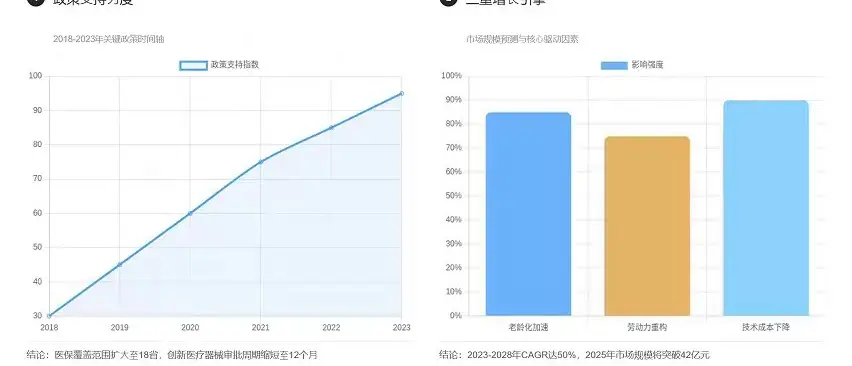
The 6-month recovery rate for medical rehab exoskeletons has reached 73%. They have been included in medical insurance in 18 provinces, with a single device generating up to 300,000 in annual service revenue.
Taking the product of medical-grade exoskeleton company Big E Robotics as an example, this standing device for paraplegics allows patients to rebuild their gait within 6 months. The rehabilitation system by Fourier Intelligence covers 2,800 communities globally. Despite a minor grammatical slip in the video's voiceover stating nearly 7 services per day, it nonetheless reflects its exceptionally high daily turnover rate and an impressive renewal rate of up to 89%. More importantly, 18 provinces domestically have already included exoskeletons in medical insurance.


Mass Production: Industrial Exoskeletons: The Ultimate B-End ‘Power-Ups’
Turning our attention to the industrial sector, exoskeletons are rolling out rapidly across the assembly lines of major factories. No longer the bulky, outdated machines of the past, they have become physical power-ups for their workforce.
After JD.com's Asia No. 1 Warehouse introduced lumbar exoskeletons, sorting efficiency increased by 66% and labor costs dropped by 28%.
At JD Logistics' Asia No. 1 Warehouse, workers wearing lumbar assist exoskeletons to lift 50kg loads boosted installation efficiency by a whole three times. Feedback from these industrial settings is highly direct: enhanced protection and efficiency have caused turnover rates to plummet. Furthermore, to lower the purchase barrier for businesses, a new business model known as the "exoskeleton sharing station" has emerged.
200 units are available for rotation among 2,000 workers, achieving a device utilization rate as high as 92%.
Moving Towards the Masses: A First Look at the Consumer and Outdoor Markets
If medical and industrial applications form the foundation, then the consumer outdoor sector represents the future of the exoskeleton. Although its development began relatively late, it has already generated impressive data regarding everyday usability.
The emergence of consumer-grade outdoor products can reduce oxygen consumption by 27% during hiking and trekking, while achieving a 38% user repeat purchase rate.
In outdoor hiking scenarios, early-generation assistive exoskeletons have significantly reduced the pressure on the lungs. In the fitness domain, wearing an exoskeleton for exercise can decrease sports injury rates by 52%. Furthermore, a firefighting exoskeleton nicknamed "Iron Man" boasts a response speed of just 0.3 seconds and costs only half the price of similar competing products from abroad. As these advantages become apparent, various products are poised to launch their assault on the mass consumer market.
A Crushing Blow: Why Exoskeletons Are Beating Humanoid Robots to Market?
Many of you might ask: With both falling under the umbrella of embodied AI, what is the competition between exoskeletons and humanoid robots? The most obvious advantage lies in speed to market and mass production costs.
Currently, the cumulative installed base of medical exoskeletons globally has reached 12,000 units, whereas the mass production plans for humanoid robots in 2025 amount to only a few thousand units at best. In terms of price, the unit price of an industrial exoskeleton is 20,000 RMB, merely 4% of that of a humanoid robot.
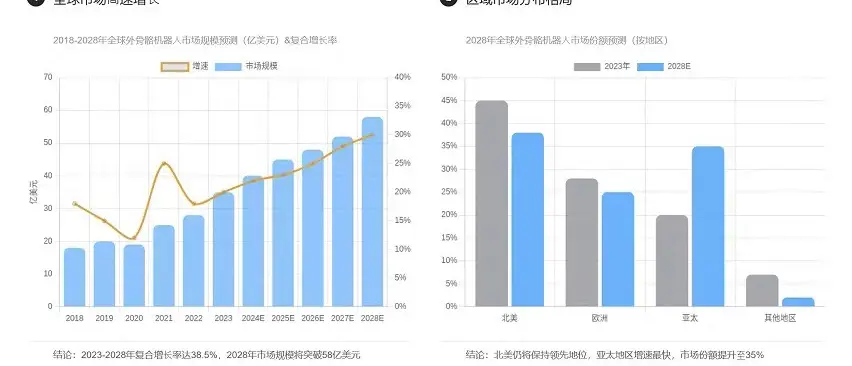
The manufacturing cost of humanoid robots often runs into the millions; even the top-tier products available today remain essentially expensive "models" confined to laboratories. The exoskeleton industry, by contrast, is a business with healthy cash flow and a mature supply chain. According to institutional forecasts, the global market size will reach 3.7–5.8 billion USD by 2028, potentially breaking 14.6 billion USD by 2030.
The Compound Annual Growth Rate (CAGR) of the Chinese market is even more startling. Domestic market size is projected to reach 4.2 billion RMB by 2025, with a CAGR as high as 50% between 2023 and 2028.
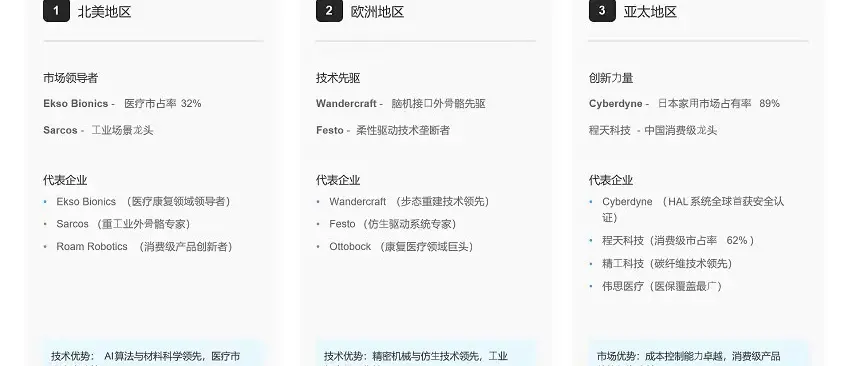
Medical scenarios are expected to account for over 60% of the market share, maintaining an annual growth rate of over 38%. In the competitive landscape, North America has "Ergo," Europe has "Wonder," and Japan has "Hexagon,"** while Chinese manufacturers possess absolute dominance in supply chain costs.
Domestic Breakthroughs and Investment Landscape: The Next Trillion-Dollar Opportunity
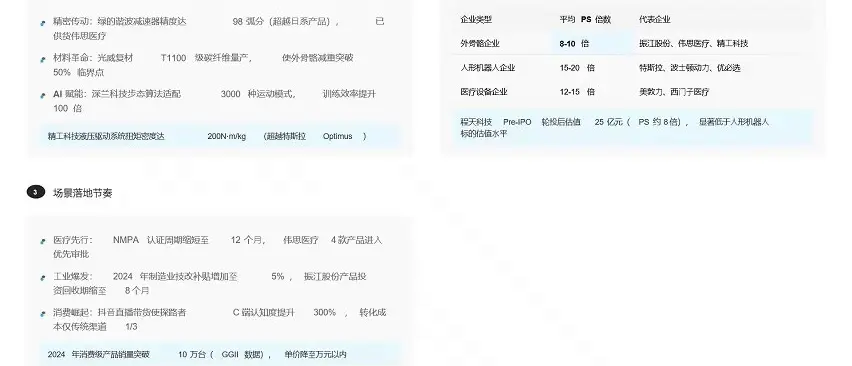
Chinese enterprises have long mapped out the path to success in the exoskeleton industry. Technologically, although Jinggong Technology's hydraulic drive system sounds like the fictional martial art "Qinggong" (light skills), it achieves an astounding power density of 200 Nm/kg. Meanwhile, Chengtian Technology has taken the lead in market share for the consumer-grade exoskeleton sector and plans to go public on the STAR Market by 2025 (noted as "Science and Innovation Board" in a video fluke).
In terms of business models, new strategies are emerging. Through an "insurance + rental" model, tourists at scenic spots can rent devices for just 9.9 RMB per day. Simultaneously, the supply chain is rapidly closing the loop. Zhenjiang Shares has built a complete chain of equipment + insurance + services, boosting user Lifetime Value by four times.
From an investment perspective, three core supply chains deserve attention: Leaderdrive in the transmission sector, whose harmonic reducers have surpassed Japanese counterparts in precision; Guangwei Composites in the materials sector; and DeepBlue Technology in the AI-enabled sector. Specifically regarding enterprises, Zhenjiang Shares reported revenue of 120 million RMB from its exoskeleton business in the first half of this year, a year-on-year increase of 180%. Weisi Medical (originally "Weisi Medical") has four products entering the national priority approval channel.
Overall, the exoskeleton robot industry is currently in a dual-driven period of technological breakthroughs and scenario implementation. The three major scenarios of medical, industrial, and consumer applications are poised for gradual explosion. With continuous cost reductions and policy support, a trillion-level market scale is likely to emerge between 2025 and 2030, becoming the next big opportunity in the field of intelligent equipment.
Top Community Comments
@EM4-Longshot: The cover right now: I didn’t have dirty thoughts [doge]
Interpretation: This comment reflects the “stereotype” some newcomers hold about the appearance of exoskeletons. Cover visuals often come with a strong sci-fi mech vibe, easily triggering playful imaginations about a “wearable brute-force intervention device.”
**@Reader: What is a humanized robot?
Interpretation: This highlights how little concrete perception the public still has of exoskeletons. The first task for industry practitioners remains lowering market-education costs so that users understand these are “suits for humans,” not “replacements for humans.”
“Can you bring the price down? I can’t afford it.”
Interpretation: The core pain point in the consumer-grade field. Even though the video mentions “9.9 per day,” if the outright purchase price tops ten thousand yuan, that jump will still scare off most ordinary users in non-essential scenarios.
“Can grown-ups’ wearable devices be lighter? Carrying two or three kilograms up the stairs isn’t great.”
Interpretation: Points out the weight-versus-assist trade-off faced by consumer-grade exoskeletons. The fatigue felt after long-term wearing is the ‘last-mile’ issue that today’s consumer-grade wearable devices must solve.
“Every time I see the words ‘consumer-grade,’ I picture a huge iron frame costing tens of thousands.”
Interpretation: Users confuse the concept of “consumer-grade” with “industrial-grade/medical-grade.” What consumer-grade exoskeleton users value most is actually an everyday-friendly appearance and convenience, rather than a mere stacking of parameters.
“Fitness exoskeletons can cut injury rates by 52%? Gym owners should get a batch.”
Interpretation: A remarkably sharp commercial insight. Coaches using exoskeletons to help clients protect their knees may become the new standard in the fitness industry.
One-Sentence Summary
This is not a distant cyberpunk dream, but a technology revolution that has already quietly shipped in medical, industrial, and even hiking scenarios. If you're an investor watching the tech supply chain, or a geek curious about how robots are reshaping human physical strength, this deep dive into the exoskeleton reveals the underlying logic behind the next trillion-dollar wave in smart gear.
About this article: part of Chinese-Made Exoskeleton Review Archive — an independent, regularly updated English archive of reviews of consumer exoskeletons made in China, edited from publicly available video transcripts. Not an official manufacturer page.
For inquiries and purchasing, contact lonlonago@foxmail.com. More in Exoskeleton · All articles.