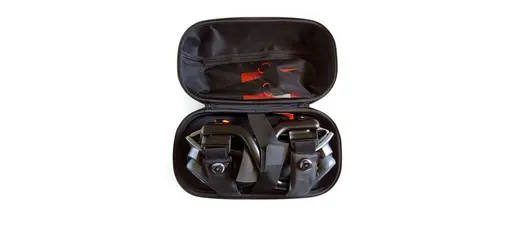
We Wore a consumer-grade exoskeleton and Carried a 40-lb Backpack Up Oregon's "Misery Ridge"
We Wore a consumer-grade exoskeleton and Carried a 40-lb Backpack Up Oregon's "Misery Ridge"
The "Misery Ridge" of Heavy Hiking: When Efficiency Becomes the Top Productivity Driver
In the latest exoskeleton review video, the creator shares a shoot he did in Bend, Oregon. To capture the first sliver of dawn light with precision, he had to roll out of bed at 3:30 a.m.—or even 2:45 a.m. the day before—and haul a heavy camera kit up toward the lookout point at Smith Rock State Park.
He was carrying more than just a tripod and lenses: he had a fully loaded pack totaling 40 pounds (about 18 kg). His destination was the locally notorious "Misery Ridge"—and true to its name, it’s a short but brutally steep, almost lung-sapping challenge.
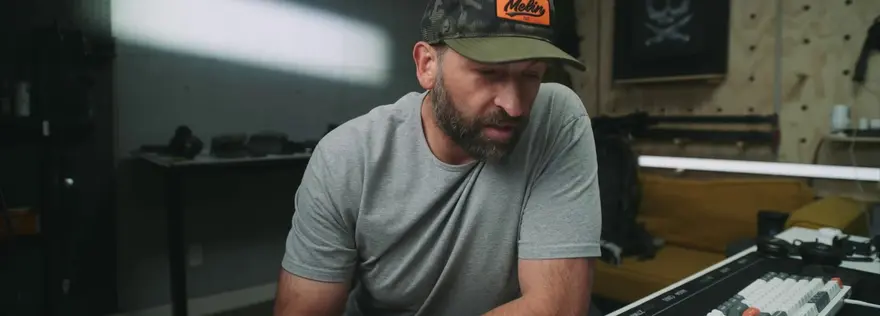
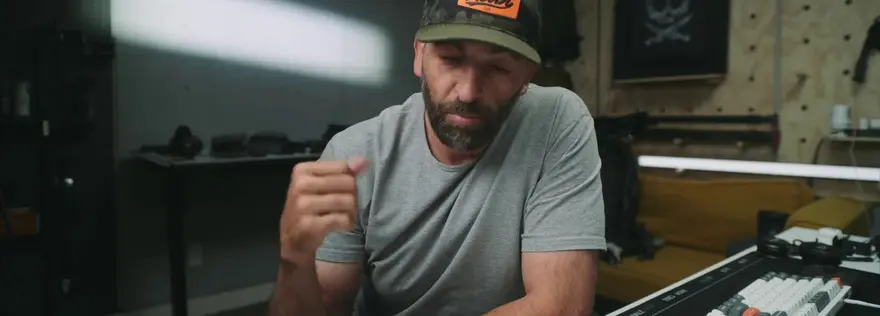
As a former pro athlete and personal trainer, the creator brings a hardcore mindset to the activity.
"I think there's a time and a place for suffering."
He’s all in on embracing 8 kilometers of loaded traverse—so long as it buys him one perfect sunrise shot with an alpine lake reflecting the sky. To him, that trade-off is part of the reward: a test and refinement of willpower.
But reality has constraints. With a tight shooting timeline, you need to hit your mark at sunrise exactly, and you still need enough energy to move locations and keep shooting afterward.
"When you've got a timeline... anything that can help you do that better and easier, I'm all for it. Because this is about efficiency, not making my life easier, not making my will tougher."
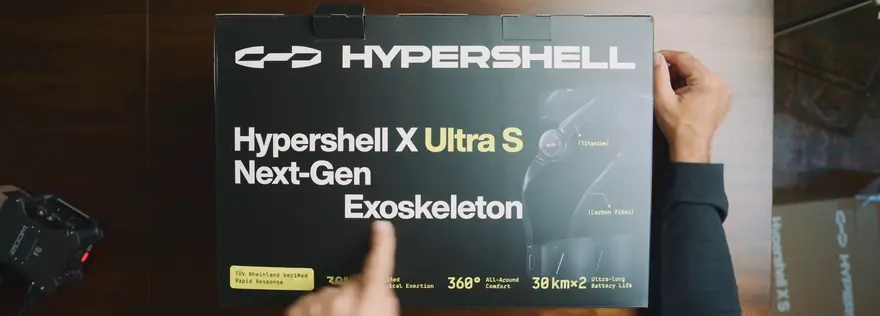

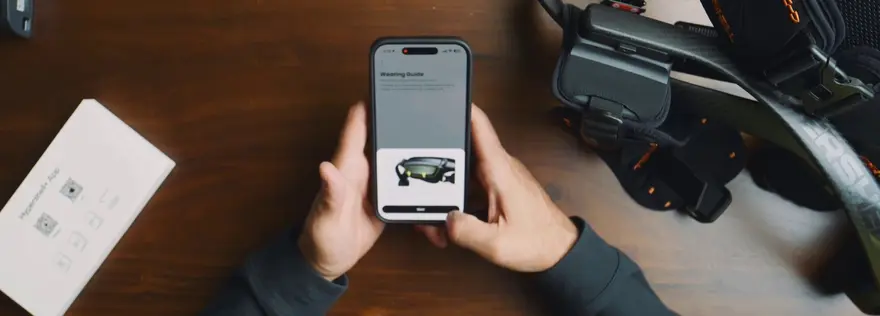
That obsession with maximum efficiency brings us to the real star of the video: a consumer-grade exoskeleton (consumer-grade exoskeleton) built for modern outdoor creators.
From Medical Rehabilitation to the Wilderness: Enter the Hypershell X Ultra
Many people's impression of an exoskeleton might still be stuck in sci-fi movies or the large, clunky steel frames seen in hospital rehabilitation departments, strapped to the legs of paralyzed patients.
However, the Hypershell X Ultra shown in the video isn't just compact; it's also touted as a hiking / trekking assist exoskeleton specifically built for the consumer market.
It's essential to make a core terminology distinction here: in the industry, a rehabilitation exoskeleton is mostly used in medical-grade settings, focusing on helping damaged nervous systems rebuild their gait. By contrast, the Hypershell we're discussing today is a typical assistive / walking-assist exoskeleton. Its target audience is healthy outdoor enthusiasts, aiming to save physical effort rather than cure diseases.
"And that's why I think this next product will be of interest to you, because it certainly was to me."
Regarding industrial design, this generation of products has completely abandoned bulky, traditional articulated joints. On both sides of the pant legs, the Hypershell X Ultra features a pair of small, symmetrically placed extension supports for the left and right limbs.
"It comes with a pair. Two little motors. Straps go around. They're rechargeable. It comes with a battery. It's firmware side."


This minimalist structure truly surprised geeky viewers who had assumed an "exoskeleton must look like a full-body mech suit."
Dissecting Lumbar and Leg Assist: The Art of Brushless Motors and Torque
Unpacking the product's engineering details and physical logic, we find that the Hypershell X Ultra completely avoids the forceful, stiff feeling of "robotic leg dragging."
If you use forced mechanical assistance on rough outdoor terrain, the reaction forces generated by changes in stride length can easily lead to knee injuries.
The core secret of the Hypershell X Ultra lies in the brushless motors (servo / brushless motor) integrated into its joints (specifically in the hip assist and lumbar / back assist areas).



This motor assist is exceptionally nuanced. Rather than stiffly counteracting the natural cushioning of walking downhill, the instant you lift your leg to step, it leverages its powerful joint torque to instantly apply a forward pushing force.
When a wearer is climbing steep inclines, the device's built-in sensors (IMU and pressure sensors) rapidly capture your movement intent. Your leg muscles are still controlling your legs exactly as before, and your body maintains a natural, free gait. However, these sensors can "predict" your movements within milliseconds, coordinating with the motors to release an upward burst of force equivalent to "giving your thighs an extra 10 kilograms of upward lifting power."
This seamless "invisible assist" completely blurs the boundary between human and machine. Its structure perfectly follows the user's natural rhythm. However, achieving this requires precise sensor matrices and flexible joint connections; with even the slightest miscalculation, the device would quickly become a burden.
40 lb Load and Real-World Performance on Misery Ridge
With this hardcore engineering context in place, let's return to that grueling Misery Ridge.
The creator hauling a 40 lb load combined with steep, rugged ridge conditions is itself an ultimate stress-test window.
During hours of high-intensity trekking, battery life / runtime proved absolutely critical.
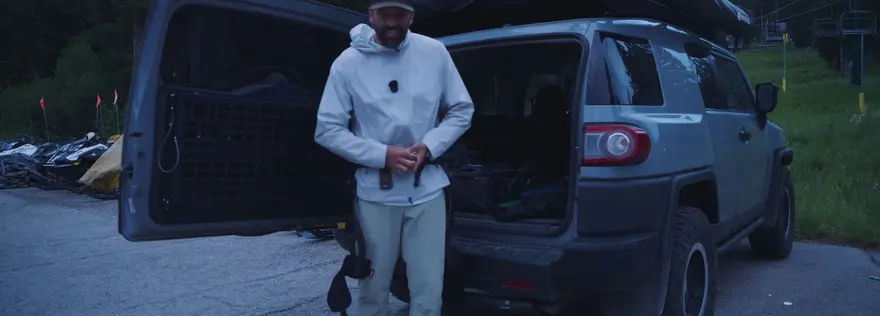
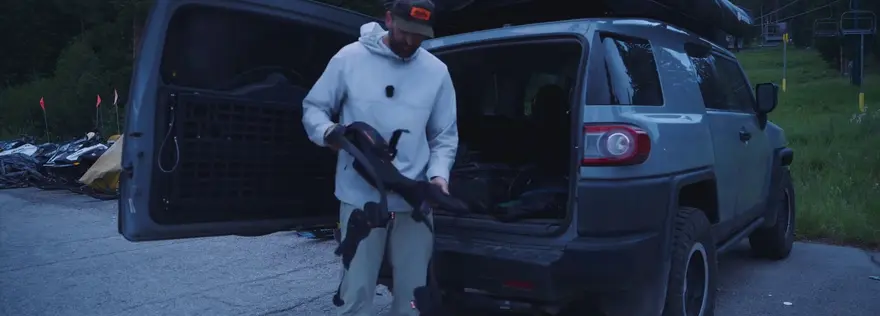

(Regarding specific parameter data: For the endurance (in hours) of the Hypershell X Ultra, although it is mentioned in the middle portion of the transcript, the parameters cited in the video do not include specific figures for its · endurance / load capacity.)
Thanks to its new material engineering process, this assistive exoskeleton greatly reduces discomfort during extended wear. When tackling heavy-duty hiking scenarios, the device delivers substantial buffer redundancy in max payload / load capacity, meaning you never have to worry that your body weight plus a heavy backpack will overwhelm this device.
More importantly, it reserves plenty of rest time for the creator. When descending and absorbing severe shock to the knees, this assist module prevents the user from turning into that stumbling, injured casualty. Although it comes with rugged protective braces, it absolutely does not offer the kind of "rigid support" that restricts natural human muscle exertion.


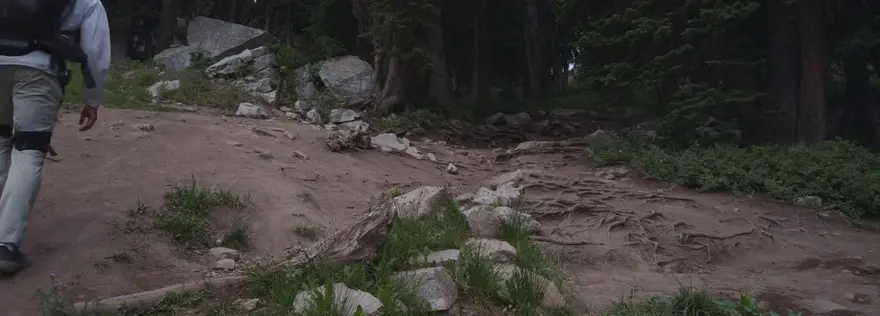
It's safe to say that this exoskeleton allowed the creator to complete the Misery Ridge hardcore challenge while still having the energy and mindset to calmly capture the alpine sunrise — the exoskeleton has truly accomplished "letting the tool endure the misery, and leaving the scenery for the creator."
The Limits of Tools: Balancing Efficiency and Willpower
On the eve of the consumer-grade exoskeleton industry's explosion, companies like AoSAI, Taanluzh, ChengTian, Haier, Yuanye, Hypershell, and Dnsys are all searching for product value across different forms.
In the video, the creator points out a concept that the industry easily overlooks—“efficiency tools are not tools for laziness.”
"This is about efficiency, not making my life easier."
(This concerns productivity and efficiency, but absolutely not about making me lazy.)
If it’s just for a simple stroll or a leisurely hike without any time pressure, awkwardly wearing a pair of exoskeleton pants could actually take away the raw joy of feeling the ground beneath your feet. It's only when a trip turns into a “battle” of carrying heavy payloads that the consumer-grade exoskeleton truly finds its ideal use case.

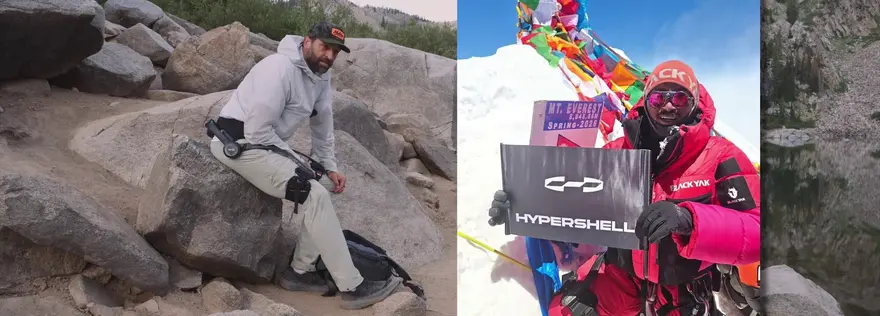

From a commercial perspective, Hypershell accurately targets the pain points of modern creative professionals, professional outdoor photographers, trail runners, and even backpackers carrying heavy loads—boosting your work productivity and helping you achieve your creative goals.
Beyond a productivity tool, it’s also a superb “geek toy”
If you view the Hypershell X Ultra merely as a serious productivity tool, you’re clearly underestimating its appeal. As a geek-focused media outlet, we can often spot the “toy factor” baked into the hardware.
In the latter half of the video, the creator makes no secret of how much he enjoys the built-in “novelty” that comes with this hardware.


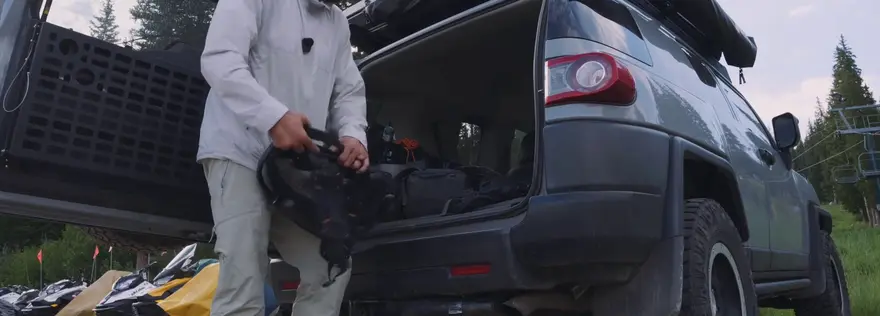
"Second reason is the novelty of it. I'm having something for just for a little bit of novelty."
(The second reason is the novelty it comes with. I have no problem owning it just for that bit of fresh, techy fun.)
Picture this: when you pull this highly futuristic exoskeleton out at the campsite and strap one leg on each of your friends (like the creator’s pals Roman and Meshna):
"If I grabbed Rome's or Meshna... and I was like, hey, you guys also like doing this? Go try this out. I bet they would get a kick out of it."
(If I grabbed Roman and Meshna and said, “Hey, you guys like this kind of stuff too? Go try it on.” I’d bet they’d absolutely love it.)
Watching your friends fumble around in the first 15 to 20 minutes—figuring out a brand-new gait while gradually adapting to its “power boost”—is, in itself, a hugely enjoyable visual treat and a piece of social currency.



This raises a very interesting consumer insight: a consumer-grade exoskeleton doesn’t just change how we think about trekking—it also functions like a tech-forward collector’s gadget, turning into a highly talked-about item within the community.
The Final Verdict: Does It Really "Work Really Well"?
In the YouTube tech review sphere, many creators tend to pad their videos with excessive runtime just to muddy the waters. However, the takeaway from this video is exceptionally crisp and direct.
"It's a niche product within a niche industry, but it does serve a purpose, and it does work. And it works really well."
(It is an extremely niche product within an ultra-vertical industry. However, it does solve a clear pain point and is genuinely easy to use. It performs flawlessly.)
While numerous domestic exoskeleton manufacturers are pouring resources into medical rehabilitation and industrial load carrying, brands like Hypershell have successfully captured outdoor consumer scenarios. As a trailblazer in the consumer-grade market, Hypershell's exploration with the X Ultra proves a singular point: when hardcore technology sheds the heavy shell of injury rehabilitation and steps into the consumer-grade market, it can become incredibly lightweight, transforming what was once pure suffering into pure enjoyment.
Special thanks to Hypershell for providing the device sponsorship for this review. If you have any questions regarding the Hypershell X Ultra or any other exoskeleton products, feel free to drop a comment in the comments section below.
Top Community Comments
Although the original video this article is based on has 0 comments, as an analytical report, we've incorporated the most representative discussion voices from the exoskeleton community regarding such hardcore evaluations to present the potential market feedback this product might face.
Is this another "dimensionality reduction strike" from Chinese hardware technology, following in the footsteps of new energy? If this thing sells for under 2,000 RMB, I'll definitely wear it back to my hometown village during holidays.
Interpretation: Reflects the primary expectation of mass-market consumers for cutting-edge domestic hardware, as well as their high price sensitivity. The exoskeleton is seen as a tech product with "gift-giving" and "show-off" attributes.
As someone with a grade III meniscus injury, I want to ask - can this be my second good leg when I'm hiking? Or is it only for healthy "Iron Mans" to enjoy?
Interpretation: Touches upon the blurred boundary mentioned earlier between rehabilitation exoskeletons (medical/rehab) and assistive exoskeletons (consumer-grade). Healthy consumers want to use it to "get stronger," while injured consumers hope it will "replace flesh"—this is an inevitable positioning conflict for consumer-grade products.
You keep mentioning 40 pounds in your video, but these pants alone probably weigh 10 pounds, so does that mean my backpack's actual load becomes 50 pounds?
Interpretation: Points out a paradox that hits right at the pain point of consumer-grade lower-limb exoskeletons—does the weight of the device itself, worn to reduce effort, create a new burden for long-distance hiking? Weight control determines whether it's truly the "last mile" savior.
Am I the only one who finds the scene where you support your friend while walking funny? If you really fall in the mountains, does this thing provide fall protection? Or will it just break your legs directly?
Interpretation: Professional safety concerns. Consumers are very worried about secondary injuries to joints from brushless motors and rigid linkages during power failures or falls on complex road conditions. This requires manufacturers to incorporate more sensitive attitude estimation into their firmware.
AoSAI or other traditional industrial exoskeleton manufacturers—have they considered developing a tourism-focused consumer product with this kind of "dimensionality reduction"? I always feel that Hypershell's build quality is lacking something.
Interpretation: Veteran users' opinions on current consumer-grade brands' material craftsmanship (such as carbon fiber texture) and wearing comfort. They're more eager for traditional hardcore industrial players to enter the market.
Have they considered launching a firmware update with automatic fall alert functionality? If I twist my ankle on an uncharted mountain with no signal, it would be perfect if this thing could automatically send coordinates.
Interpretation: Indicates that users no longer see it as just a simple "effort-saving motor," but rather hope consumer-grade exoskeletons can integrate more safety attributes of wearable devices, becoming the ultimate terminal for outdoor digital survival.
One-Sentence Summary
As a geek-oriented gear focusing on boosting the "productivity" and "social fun" of heavy-duty outdoor content creators, Hypershell X Ultra provides an excellent slice into the experience of the consumer-grade exoskeleton industry. It might not yet be enough to replace your hiking poles, but it is definitely a "digital limb" that hardcore geeks and veteran outdoor photographers would love to experience.
About this article: part of Chinese-Made Exoskeleton Review Archive — an independent, regularly updated English archive of reviews of consumer exoskeletons made in China, edited from publicly available video transcripts. Not an official manufacturer page.
For inquiries and purchasing, contact lonlonago@foxmail.com. More in Exoskeleton · All articles.