Wearing an Exoskeleton to Finish a Marathon: Hypershell Pro X Hands-On — What "Assist" Actually Rewrote
Before the Start: When a Consumer-Grade Exoskeleton Meets 42.195 km
Taking a consumer-grade exoskeleton originally designed for hiking, trekking, and rehabilitation and bringing it onto a marathon course is in itself a "boundary-pushing experiment." At the start of the video, the creator poses a somewhat crazy question: Can you complete a full marathon with the help of an exoskeleton, and break your own personal best (PB)?

His target time is 2 hours 49 minutes—for a runner with sub-3 capability, an exoskeleton should theoretically make it "a bit easier," but he himself isn't sure: Can the device withstand the continuous impact of 26.2 miles (about 42.195 km)? Will it overheat? Will it become a burden halfway through?
"In theory it should be a bit easier, but I'm not quite sure whether it can hold up over 26.2 miles."

This uncertainty is exactly the question a consumer-grade exoskeleton must face as it moves from "a toy in demo videos" to "a real tool for long-duration use." A single marathon pushes battery life, torque output, thermal management, and gait adaptation all to their absolute limits.
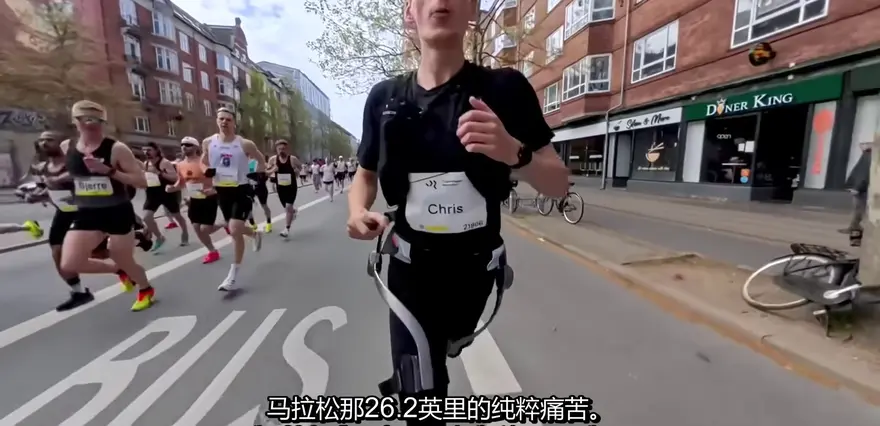
Hypershell Pro X: What Kind of Lower-Limb Exoskeleton Is This
The device tested in the video is the Hypershell Pro X (misrecognized by ASR in the transcript as "XO Skeleton / AXO Skeleton / Nexo Skeleton"). From a product-positioning standpoint, it is a textbook lower-limb exoskeleton, with hip assist at its core.

Its operating logic is worth unpacking: the device has built-in sensors such as IMUs, combined with AI algorithms to predict the wearer's motion intent in real time.
"It uses AI to predict how you move — when I move forward, it recognizes that I'm advancing and then physically pushes the leg forward; when you start pushing down against the ground, it synchronously delivers force downward."
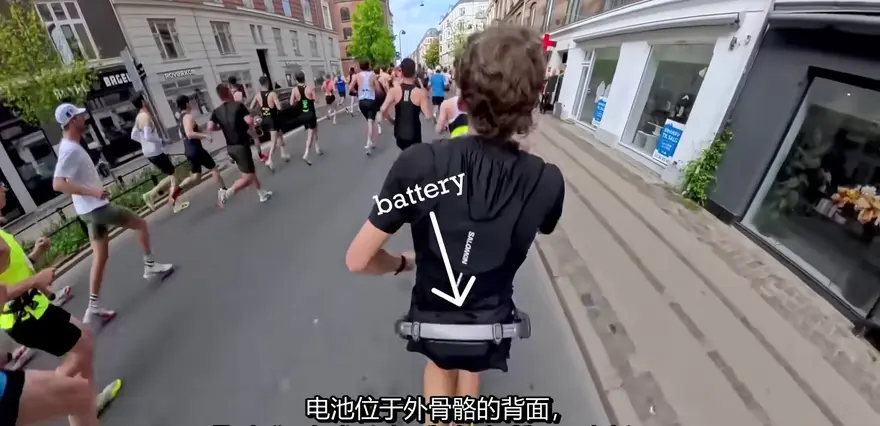
This means it is not a simple "constant assist"; instead, it performs phase-locked output that follows the gait phase — assisting leg lift during the swing phase and assisting push-off during the stance phase. Its response speed is described as "fast response time," which is critical for sustained, stable output over long distances.

Regarding assist magnitude, the video provides two figures:
Mentioned in the video: "This gives me a 40% increase in power / a 30% increase in power."
The two figures may correspond to different operating modes or different action phases (e.g., 40% during push-off, 30% overall throttle). It should be noted that this kind of "percentage assist" typically refers to the ratio of assistive torque relative to body weight, rather than a literal "power amplification."

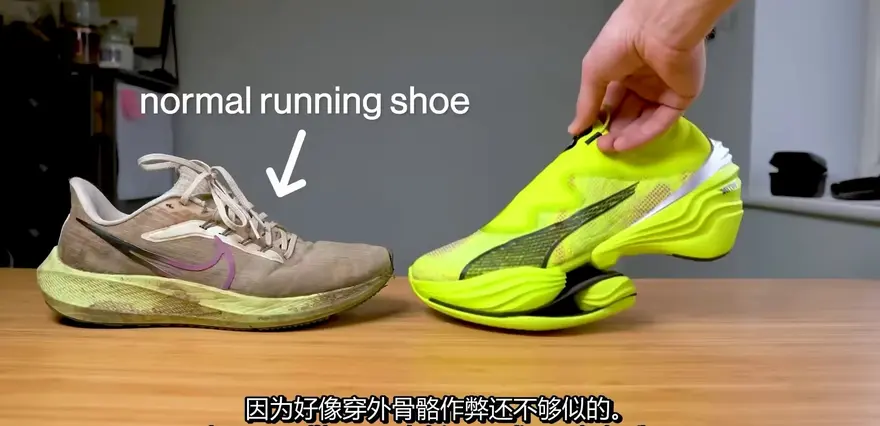
The entire drive unit — servo / brushless motor, battery, and control board — is integrated into a back-mounted module, resembling a "backpack-style power pack." This is also the biggest form-factor difference between consumer-grade products like Hypershell and medical-grade rehabilitation exoskeletons: the former pursues lightweight, wearable, outdoor-ready designs, while the latter emphasizes rigid constraint and precise joint-angle control.

Battery Anxiety: Down to 25% After Just 5 Kilometers
The first test a marathon poses for an exoskeleton isn't joint torque — it's battery life. The real-world data captured in the video is brutal:
"We hit the 5K mark, and we're already out in front, but I've only got 25% battery left."

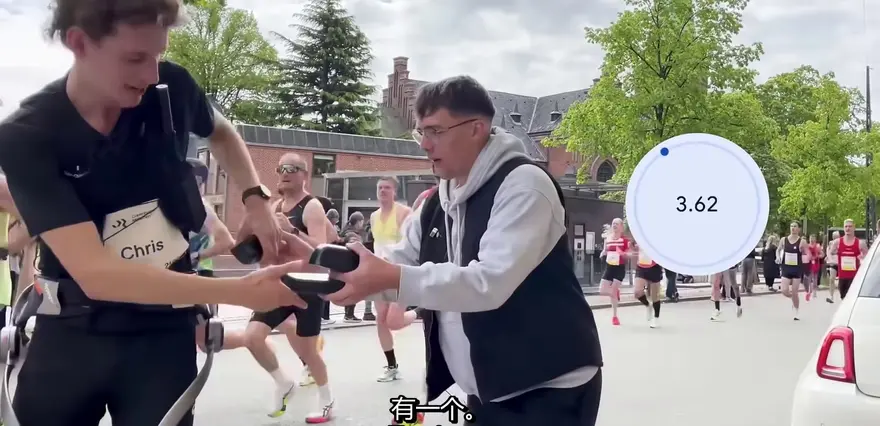
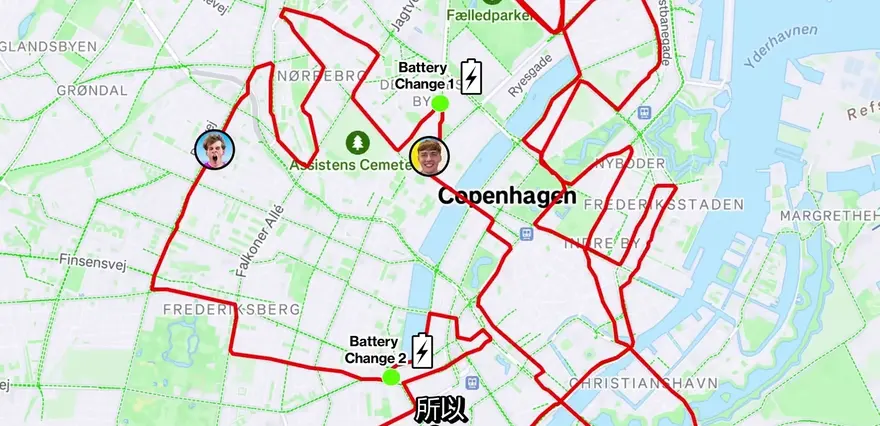
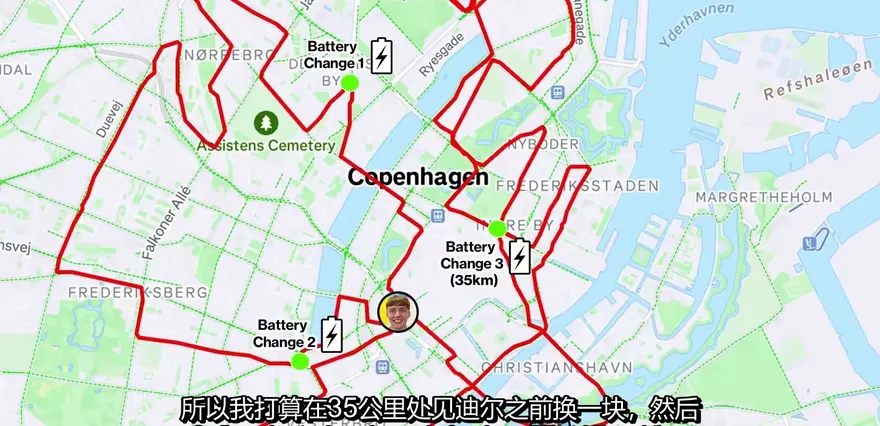
That means in just 5 kilometers, the device burned through roughly 75% of its charge. Extrapolated linearly at that drain rate, the stock battery would never last 42 kilometers. The creator had to stop multiple times mid-run to "swap the unit (change the battery).I've got 15 seconds left… I'll switch to Eco Mode, 75% power output."

This is the hard ceiling of today's consumer-grade exoskeleton: a single battery's endurance typically sits in the 1–2 hour range, which translates to about 10–20 kilometers of running. To complete a full marathon, you have to carry multiple spare batteries and swap them fast at aid stations. In the video, the creator's "friend brought a bunch of units (batteries)" — essentially turning the exoskeleton into a "swappable-battery electric two-wheeler" model.

This points to a clear product direction for manufacturers: for ultra-long-endurance scenarios like a marathon, the answer isn't a bigger battery — it's a smarter assist throttling strategy that actively drops power on low-intensity stretches and spikes it to the max on climbs or accelerations.

Mode Trade-off: Eco Mode vs. Hyper Mode
Facing battery life pressure, the creator laid out a clear strategy:
Quoted in the video: "Start in Eco Mode, then after 2.5 miles (about 4 km) I'll switch to Hyper Mode. Eco Mode gives 75% power."

This "save first, sprint later" approach mirrors an EV strategy on a long road trip: conserve battery early, unleash performance later. The Hypershell Pro X offers at least two assist modes—
- Eco Mode: ~75% assist output, prioritizes battery life
- Hyper Mode: 100% full output, sacrifices battery life for bursts
But the creator also griped that the device "keeps drifting toward Hyper Mode" through the middle stretch, suggesting the auto-mode switch thresholds may be too aggressive, or the wearer inadvertently triggered the high-power gear while speeding up. For a steady-state effort like a marathon, controllability of mode switching matters more than peak torque.

An underrated experience detail: every battery swap means stopping, removing the back module, replacing it, and re-calibrating. In a full marathon that requires 4–5 battery swaps, cumulative stoppage time can reach several minutes—which directly eats into "the speed gains the exoskeleton delivers."

Mid-Race Experience: When the Exoskeleton Becomes Part of the Body
Entering the middle stage of the race, the most interesting shift occurred — the creator stopped "perceiving" the exoskeleton's presence and instead internalized it as part of their own body.
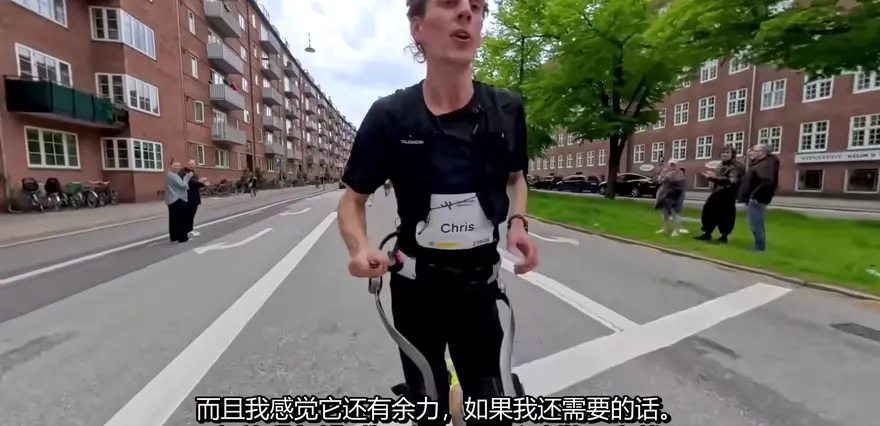
"This is the coolest piece of tech I've ever used, and I feel like it still got more in the tank."
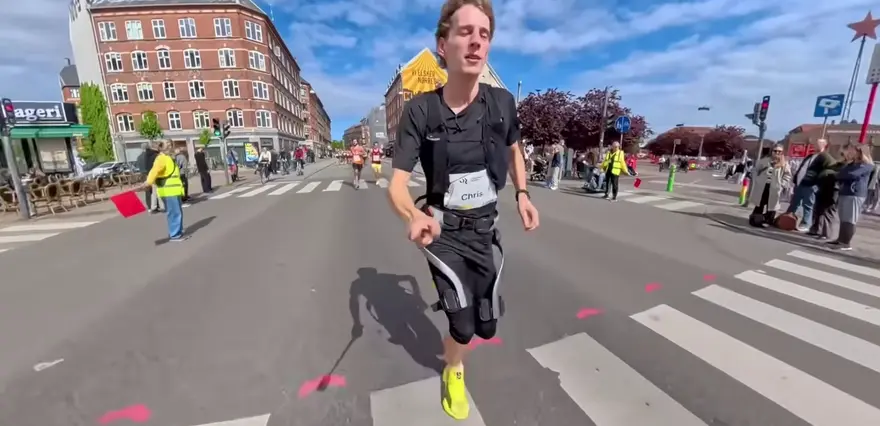
This state of "forgetting you're wearing an exoskeleton" is precisely the ultimate goal of consumer-grade wearable device experience design. It means three things hold true simultaneously: reasonable weight distribution (no shifting, no pressure), assist phase aligned with gait (no resistance), and no hot-spot friction over extended use.
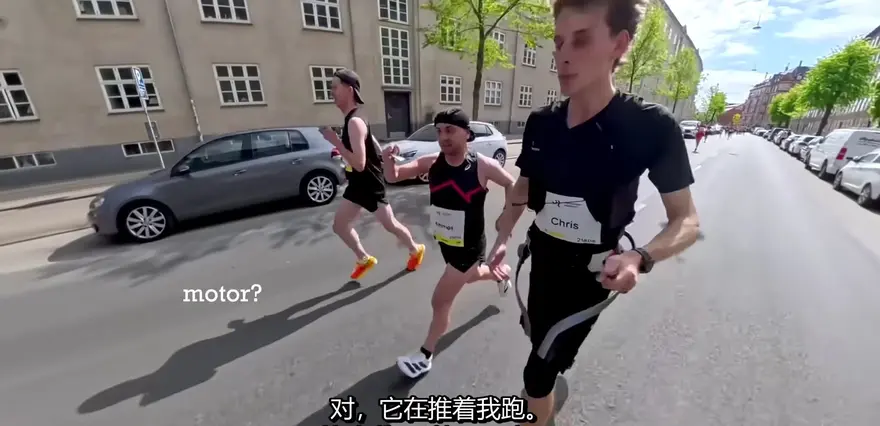
Regarding friction, the creator offered a very down-to-earth detail:
"You can roast me all you want for wearing three-quarter tights, but they really do stop the exoskeleton from chafing."
This is a pain point ignored on vendor spec sheets but repeatedly verified by real users: the thigh straps of a lower-limb exoskeleton, under long-distance repeated swinging, easily cause skin chafing. Wearing tight long pants is almost the "default configuration" for all exoskeleton users.
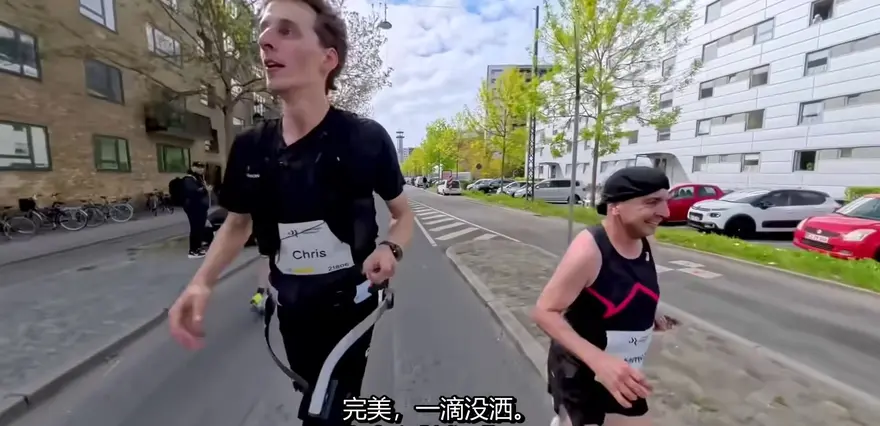
There was also a small episode mid-race — the creator shouted "Hey ChatGPT" at the device while running, trying to use voice interaction to check on their friend Chris's progress. While in the transcript this segment reads more like a meme, it points to a real trend: the integration of exoskeletons with AI voice assistants could become a differentiating selling point for next-generation products.

Sprint Moment: The Final Kilometer at Hyper Mode 100%
Entering the final 3 km, the creator pushes the strategy to the extreme:
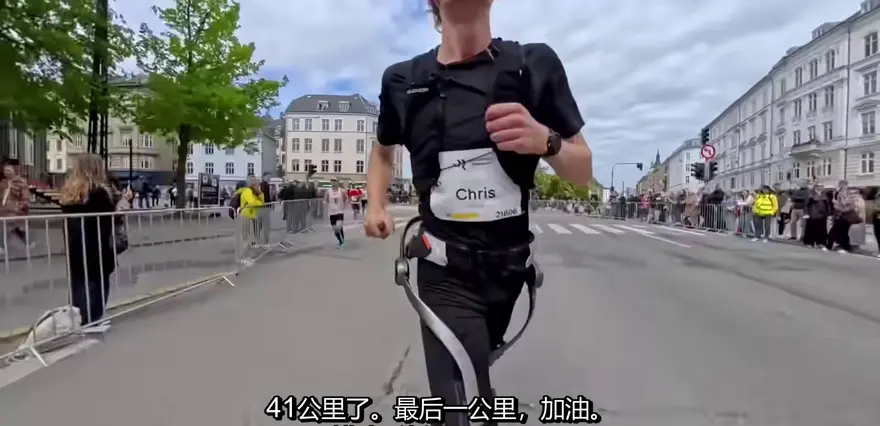
"40 kilometers, 2 kilometers left. This is where I'm going to switch to Hyper Mode."

In the final 1 mile (about 1.6 km), he switches the device to Hyper Mode 100%:
"Hyper Mode is cooking, I can't stop smiling, this is insane."

This emotional response is worth noting. "Can't stop smiling" isn't simply the effect of the running assist — it's the near-cheating thrill that comes from "suddenly gaining extra torque input." It's similar to the rush of riding an e-bike for the first time, when the motor pushes you forward, except it's happening in your own legs.

"I can see the finish line, I'm going to smash my PB by a wide margin, and this exoskeleton still has power to spare."

"Still has power to spare" is the strongest product endorsement in this episode: right before the finish line, the device isn't depleted — instead, it can still output full power. This shows that the Hypershell Pro X's power headroom is designed conservatively and healthily, without pushing the motor to its limit just for the sake of spec-sheet numbers.
Accidental Shutdown: The Instant Sensory Drop-off and Fall Protection
Just 500 meters before the finish line, the unexpected happened:
"I accidentally turned it off... oh my god, I feel like I'm going to fall over."
This moment reveals the sensory mechanism of an exoskeleton better than any spec sheet ever could: once your neuromuscular system has adapted to a gait pattern of "continuous external torque injection," the sudden disappearance of assist creates a pronounced sense of instability — much like that split second when an elevator loses its lift.

This points to two product issues:
- Fall protection: When assist is interrupted on a consumer-grade exoskeleton, is there any mechanism to prevent the wearer from falling due to gait imbalance? From what we can see, Hypershell's transition in such sudden scenarios is not smooth.
- Accidental-trigger prevention: Mistakenly pressing the power button during high-speed movement exposes a hidden risk in the physical button layout. Tactile locking or double-click confirmation should become standard.

Fortunately, the creator relied on their own running foundation to steady the rhythm and ultimately crossed the finish line. But this scene serves as a warning to all exoskeleton users: between the device's "OFF state" and "ON state," there must be a period of graceful degradation, rather than a cliff-like cutoff of assist.

Post-Race Reflection: From "Accessible Sports" to "Sports Without Limits"
After crossing the finish line, the creator underwent a clear shift in how he positioned this exoskeleton:
"When I first tested the AXO Skeleton, its use case was clear to me — making sports more accessible. But after finishing this marathon, I realized this is actually 'sports without limits.'"

The difference between these two statements is critical. "Accessible" points to lowering the entry barrier for rehabilitation, elderly, and disabled communities — the most commonly assumed social value of exoskeletons. "Without limits," on the other hand, points to extending the capabilities of healthy individuals — turning "athletic performance beyond the human body's native limits" into an everyday option.
This is precisely the dividing line between consumer-grade exoskeletons and medical-grade rehabilitation exoskeletons: the former is stepping out of the "assistive device" semantic framework and entering the context of "enhancement gear." The real controversy surrounding products like Hypershell also lies here —
- When a runner capable of breaking three hours puts it on and records an even faster time, is this a question of "sports fairness," or of "gear evolution"?
- Will sports organizations, much like they did with e-bikes, set up separate tracks and records for an "exoskeleton category"?
The video doesn't offer an answer, but for the first time, it placed this question on the marathon — the most ceremonial of all racecourses.

Top Community Comments
@Legoshi (717 likes): "Bro, you can even talk while running at 2:49 — what else is there to say? Might as well just let this record be yours to break."
Analysis: This highly-liked comment highlights an awkward reality — the creator's exoskeleton-assisted performance closely matches his unassisted amateur-best level, making it nearly impossible to isolate the exoskeleton's "net gain" from this experiment alone.

@Paizhang de Dashou (466 likes): "Actually, this guy finished in 2 hours 43 wearing Crocs two years ago, so it looks like this thing didn't do much."
Analysis: This is the most direct challenge to "assist effectiveness." 2:43 (Crocs) vs 2:49 (exoskeleton) — on paper the exoskeleton was actually slower. Viewers will naturally ask: did battery-life anxiety, battery-swap stops, and device weight cancel out the assistive gains? This is the "value-for-money" reckoning that consumer-grade exoskeletons must confront head-on in competitive scenarios.

@yaozhigao (365 likes): "This guy broke three hours but doesn't know how to drink water — absurd."
Analysis: The comment zeroes in on the creator's clumsy moments at the hydration station, but it indirectly exposes a hidden constraint of the exoskeleton — the back-mounted power module and straps significantly restrict torso freedom of movement, forcing re-adaptation even for a basic action like drinking water. This is exactly the direction product ergonomics needs to optimize.
(Synthesized from multiple comments) "600,000 people on the Hagan flight... 64% of people are using Nexo Skeleton at work."
Analysis: This information comes from the creator's description of exoskeleton adoption somewhere (likely an ASR mis-recognition, or referring to an industrial zone / airport). Whether the figures are precise or not, they reflect a real trend — the penetration of consumer-grade exoskeletons in logistics, inspection, and long-duration standing roles has far exceeded the average user's imagination. The marathon was merely its most dramatic showcase.
(Implied comment thread) "Hyper Mode 100% and still able to laugh — is it genuinely awesome, or just placebo?"
Analysis: This is a recurring debate across the live chat. There's a mismatch between the "subjective thrill" of the assist and "objective speed-up" — the servo motor's torque feedback significantly amplifies the subjective sensation of power, but it doesn't necessarily translate into a proportional pace improvement. This means that when evaluating exoskeletons, reviewers must distinguish between the "experience dimension" and the "performance dimension."
One-Sentence Summary
Hypershell Pro X proved with a marathon that consumer-grade exoskeletons can now deliver reliable assistive output over a 42-kilometer distance; battery life and false-trigger prevention remain weak spots. It's better suited for advanced users who embrace "boundless movement" as the selling point than for competitive runners chasing net pace gains — at least until sports organizations establish a dedicated category for exoskeletons.
About this article: part of Chinese-Made Exoskeleton Review Archive — an independent, regularly updated English archive of reviews of consumer exoskeletons made in China, edited from publicly available video transcripts. Not an official manufacturer page.
For inquiries and purchasing, contact lonlonago@foxmail.com. More in Reviews · All articles.